

EXECUTIVE SUMMARY
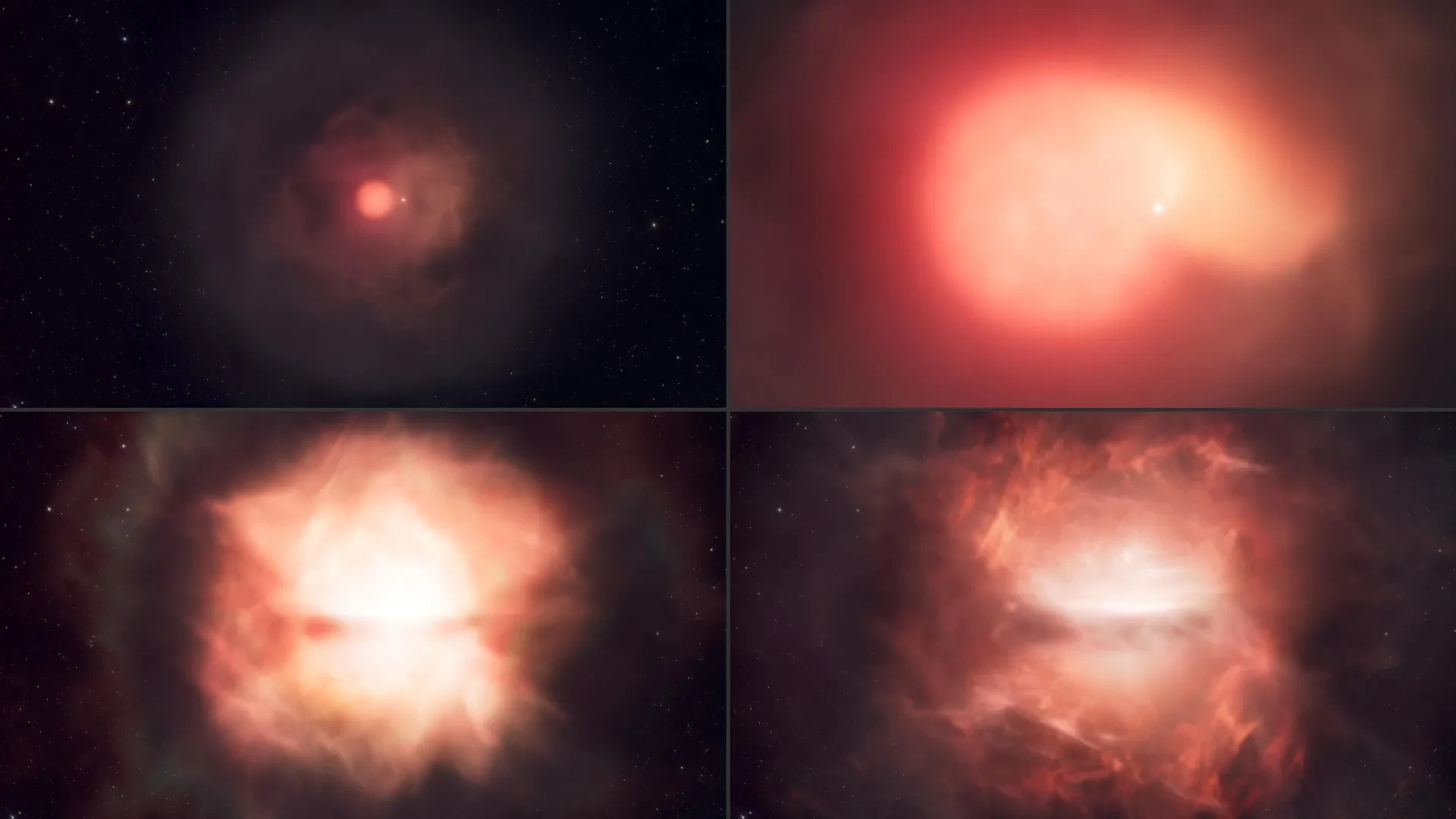
In a landmark achievement for observational astrophysics, an international team of researchers has documented an extraordinary stellar collision within our neighboring Andromeda galaxy, marking the first time scientists have caught a stellar merger of this magnitude unfolding in near real-time. The rare cataclysm, officially designated AT 2025abao and affectionately nicknamed "Bao" by its discoverers, unfolded when a smaller companion star spiraled inward and was ultimately swallowed by a gargantuan supergiant.
Rather than instantly obliterating the binary system, the dramatic encounter culminated in a violent explosion—likened by researchers to a bomb detonating deep within a living star—that left behind a single, potentially "rejuvenated" stellar body. Enabled by a multi-observatory campaign spanning ground-based facilities and cutting-edge space telescopes, this discovery provides unprecedented insight into a fundamental yet elusive chapter of stellar evolution known as common envelope phase dynamics.
Crucially, observations from NASA’s James Webb Space Telescope (JWST) captured the system just 47 days after its eruption peaked in late 2025. This lightning-fast follow-up offered an unhindered, high-resolution look at the immediate aftermath of a stellar unification process that upends long-held theoretical assumptions regarding the speed and mechanics of binary interactions. The findings not only illuminate the lifecycle of massive stars in distant galaxies but also establish a critical baseline for interpreting similar transient events in the era of wide-field cosmic surveys.
1. Executive Overview: A Cosmic Collision in Andromeda
The universe is characterized by ceaseless motion, yet true cataclysms on a stellar scale typically play out over millions or billions of years, rendering them virtually imperceptible to human observation. However, the outer rim of the Andromeda galaxy (Messier 31), located approximately 2.5 million light-years from Earth, recently offered a rare exception to this celestial rule.
For millennia, two distinct stars existed in a stable binary relationship, locked in a gravitational dance that preserved their individual identities. That prolonged equilibrium shattered when the smaller of the two stars began grazing the vast, tenuous outer atmosphere of its companion. What followed was a rapid, highly volatile spiral toward the center of the primary star, terminating in an explosive merger that forged a singular, hybrid object.
The discovery of AT 2025abao represents a watershed moment for modern astronomy. By capturing the system before, during, and immediately after its dramatic outburst, researchers have acquired an empirical Rosetta Stone for understanding how binary star systems evolve, interact, and occasionally destroy one another. The event bridges theoretical models of stellar physics with hard observational data, offering a rare glimpse into the chaotic mechanisms that shape the stellar population of our local galactic neighborhood.
2. Detailed Chronology: From Archival Whispers to the 2025 Eruption
The unravelling of the Bao system was not a matter of pure serendipity, but rather the result of meticulous, long-term monitoring by a global network of automated sky surveys and space observatories. Piecing together the life and death of the binary required astronomers to travel backward through years of archival data before confronting the sudden, violent climax of 2025.
The Warning Signs: Archival Clues and Slow Brightening
Long before the system erupted into public view, subtle anomalies in its baseline emissions signaled that a profound transition was underway. The first definitive clue emerged in February 2023, when researchers analyzing archival data from NASA’s retired NEOWISE (Near-Earth Object Wide-Field Infrared Survey Explorer) mission noticed unusual behavioral shifts in an otherwise unremarkable star. While historical records indicated that the object had maintained a steady, predictable luminosity prior to 2018, subsequent measurements revealed a creeping intensification.
This gradual brightening was the physical manifestation of orbital decay. As the smaller companion star began skimming the outer envelope of the primary supergiant, it generated friction, disturbing the surrounding gas and stripping away the giant’s outer layers. This liberated gas flowed out into the surrounding space, forming a dense cocoon of dust that absorbed visible light and re-emitted it as infrared radiation.
By September 2024, observations secured by the Wide-field Infrared Transient Explorer (WINTER) confirmed that the system was steadily ramping up its activity. The star was growing increasingly luminous while continuing to expel vast quantities of dust into the interstellar medium.
The Turning Point: SPHEREx and the Onset of the Outburst
The transformation accelerated dramatically by mid-2025. In July of that year, NASA’s SPHEREx (Spectro-Photometer for the History of the Universe, Epoch of Reionization and Ices Explorer) mission fortuitously captured Bao during a routine all-sky survey. The data revealed a striking photometric shift: the object was rapidly fading in visible light wavelengths while simultaneously brightening intensely in the infrared spectrum. This unique spectral signature served as an unmistakable siren call, indicating that a major structural transformation was actively unfolding.
The climax arrived on October 17, 2025. The Zwicky Transient Facility (ZTF), designed to systematically scan the night sky for rapidly changing phenomena, detected a sharp, sudden surge in brightness accompanied by a dramatic spike in temperature. The system had officially erupted.
The Immediate Aftermath and JWST’s Historic Intervention
Recognizing the monumental significance of the transient event, astronomers quickly mobilized a multi-wavelength follow-up campaign. In November 2025, observations from NASA’s now-retired Neil Gehrels Swift Observatory and NOIRLab’s Gemini North telescope in Hawaii provided crucial spectral and photometric data on the escalating outburst.
The crown jewel of the observational campaign, however, was secured on December 24, 2025. Utilizing an urgently approved Director’s Discretionary Time program, NASA’s James Webb Space Telescope trained its highly sensitive mid-infrared instruments on AT 2025abao. This intervention captured the system merely 47 days after its eruption had peaked—the earliest ever follow-up observation of a stellar merger of this type. JWST’s data stream provided an unprecendented window into the physical state of the gas, dust, and core remnants immediately following the unification event.
3. Supporting Context & Metrics: Anatomy of "Big Bao" and "Little Bao"
To properly contextualize the mechanics of the collision, the research team developed highly refined computer simulations, calibrating their numerical models against the empirical data gathered by JWST and ground-based facilities. These models laid bare the staggering physical dimensions and mass ratios of the two merging components.
The Primary Star: "Big Bao"
The larger of the two stars was an absolute cosmic behemoth. Prior to the merger, the supergiant possessed an estimated mass roughly seven times that of our Sun ($7 M_odot$). Its physical dimensions were equally extreme: its radius extended to approximately 350 times that of the Sun, and it blazed with a luminosity 18,000 times greater than solar output. These staggering proportions earned the primary star its informal moniker, "Big Bao."
JWST’s mid-infrared capabilities were instrumental in characterizing Big Bao. Because infrared light pierces through dense veils of circumstellar dust, the telescope was able to analyze material that the supergiant had expelled over centuries, providing a detailed history of the star’s mass-loss rates and atmospheric composition prior to its demise.
The Companion Star: "Little Bao"
For the first time in the study of such systems, astronomers were able to calculate the precise mass of the smaller, doomed companion. Nicknamed "Little Bao," this secondary star was somewhat less massive and dimmer than our Sun, possessing an estimated mass of approximately 0.7 solar masses ($0.7 M_odot$).
Despite its modest size, Little Bao acted as a gravitational wrecking ball once it breached the supergiant’s outer atmosphere. As it plunged into the dense gas layers, resistance rapidly drained its orbital energy. Rather than maintaining a stable orbit or managing to escape the system’s gravitational well—an outcome initially deemed possible by preliminary simulations—Little Bao was dragged inexorably inward toward the supergiant’s core.
The final merger released a staggering amount of thermal and kinetic energy, driving the explosive outburst observed by the Zwicky Transient Facility and documented in detail by the James Webb Space Telescope.
4. Official Statements: Perspectives from the Research Frontline
The findings, published in the prestigious journal Nature, have elicited profound excitement across the astronomical community, offering empirical validation for long-standing theoretical models regarding common envelope evolution.
Viraj Karambelkar, a NASA Hubble Fellow at Columbia University and first author of the groundbreaking study, emphasized the sheer difficulty of capturing such fleeting cosmic phenomena in real-time.
"Stellar mergers are very, very difficult to observe in real time because they are hard to predict," Karambelkar explained. "However, we noticed something unusual was going on in 2023 and continued to monitor the system to see what it would do. Then, in 2025, it erupted! Webb observed Bao only 47 days after the stars’ eruption peaked, the earliest ever follow-up of an event like this. The telescope’s data helped us characterize what the system looked like before, during, and immediately after the merger, which is absolutely mind-blowing."
The speed with which the merger progressed also caught the research team off guard, challenging existing paradigms regarding the timescale of common envelope dynamics. Nadia Blagorodnova, an associate professor at the University of Barcelona and co-author of the study, noted the unexpected velocity of the outburst:
"We thought an outburst from such an extended star would take years," said Blagorodnova. "One day, its brightness started rising and within a week, it peaked!"
This rapid evolution contrasts sharply with previous observations of binary mergers involving smaller stars, which typically require thousands of orbits to transition from initial atmospheric contact to a unified state. In the case of Bao, the final unification phase was completed in a mere seven additional orbits—roughly seven years.
Detailing the prelude to the eruption, co-author Kishalay De, an assistant professor at Columbia University, pointed out how the secondary star systematically dismantled the primary’s defenses:
"When a companion star begins to interact with the outer surface of the primary star, it produces a subtle effect—a slow brightening, which we clearly saw in Bao’s data," De noted. "As the companion continues its orbit, it keeps peeling off the primary star’s outer layers, and that gas flows away into the surrounding space."
Reflecting on the violent internal mechanics of the final collision, De offered a vivid physical analogy:
"It was almost like a bomb exploding inside a living star."
Meanwhile, Karel Temmink, a Ph.D. student at Radboud University in Nijmegen, Netherlands, who led the computer simulations, underscored the sheer dominance of the primary star within the binary architecture:
"It was an absolute beast of a star, completely outshining its companion in the data," Temmink remarked.
5. Future Outlook: Implications for Astrophysics and the Roman Space Telescope
Beyond unraveling the biography of AT 2025abao, the successful study of this Andromeda merger holds profound implications for our broader understanding of stellar evolution and the lifecycle of binary systems throughout the cosmos.
Decoding Common Envelope Evolution
The interaction observed in the Bao system represents a textbook case of common envelope evolution, a critical yet poorly understood phase in binary star astronomy. This phase occurs when two orbiting stars become enveloped within a shared outer layer of gas, typically triggered when an aging star expands and engulfs its smaller companion.
As the companion plows through the gaseous envelope, frictional drag saps its orbital energy, causing it to spiral inward. While Bao’s story ended in a complete merger, such encounters do not always culminate in unification. In many instances, both stars manage to survive the ordeal, shedding massive amounts of material while emerging from the common envelope locked in significantly tighter orbits.
These surviving binary systems serve as the vital progenitors for some of the universe’s most extreme and exotic astrophysical phenomena. Depending on their initial masses and separation distances, they can evolve into tightly bound neutron star binaries, generate cataclysmic supernovae, act as powerful sources of gravitational waves rippling across space-time, or spin up into rapidly rotating millisecond pulsars. Consequently, deciphering the mechanics of common envelope evolution is essential for tracing the cosmic origins of these high-energy phenomena.
A New Era of Transient Astronomy
The discovery of AT 2025abao arrives at a uniquely auspicious moment for observational astronomy. As current facilities continue to refine their survey capabilities, the astronomical community is bracing for an unprecedented influx of similar discoveries.
Chief among these upcoming assets is NASA’s Nancy Grace Roman Space Telescope. Engineered to survey wide swaths of the cosmos with unprecedented sensitivity, the Roman Space Telescope is slated to conduct extensive public surveys, including the ambitious Galactic Bulge Time-Domain Survey. By repeatedly monitoring dense stellar fields over extended periods, Roman will excel at identifying transient events—objects whose brightness, color, or structural appearance changes dynamically over time.
This technological leap promises to transition stellar mergers from rare, serendipitous curiosities to systematically cataloged events. With automated surveys flagging anomalous candidates and advanced observatories like the James Webb Space Telescope providing rapid-response, high-resolution follow-ups, researchers will soon possess the statistical sample size required to map out the true frequency, diversity, and long-term consequences of stellar engulfment.
As astronomers continue to monitor Bao to determine how its newly merged interior settles and evolves, AT 2025abao stands as a monument to modern multi-wavelength astronomy—a vivid reminder that even in the quiet expanses between galaxies, nature is continually reinventing its most luminous inhabitants.
