

Executive Overview
For centuries, humanity has stared up at the stars and wondered what it would take to bridge the unfathomable chasms between our solar system and distant exoplanetary neighbors. Conventional chemical rockets, which have successfully carried humanity into Earth orbit and across the inner solar system, are fundamentally inadequate for interstellar transit. Operating on the principle of chemical combustion, these traditional propulsion systems lack the specific impulse and energy density required to cross light-years within a human lifetime, or even within the span of centuries.
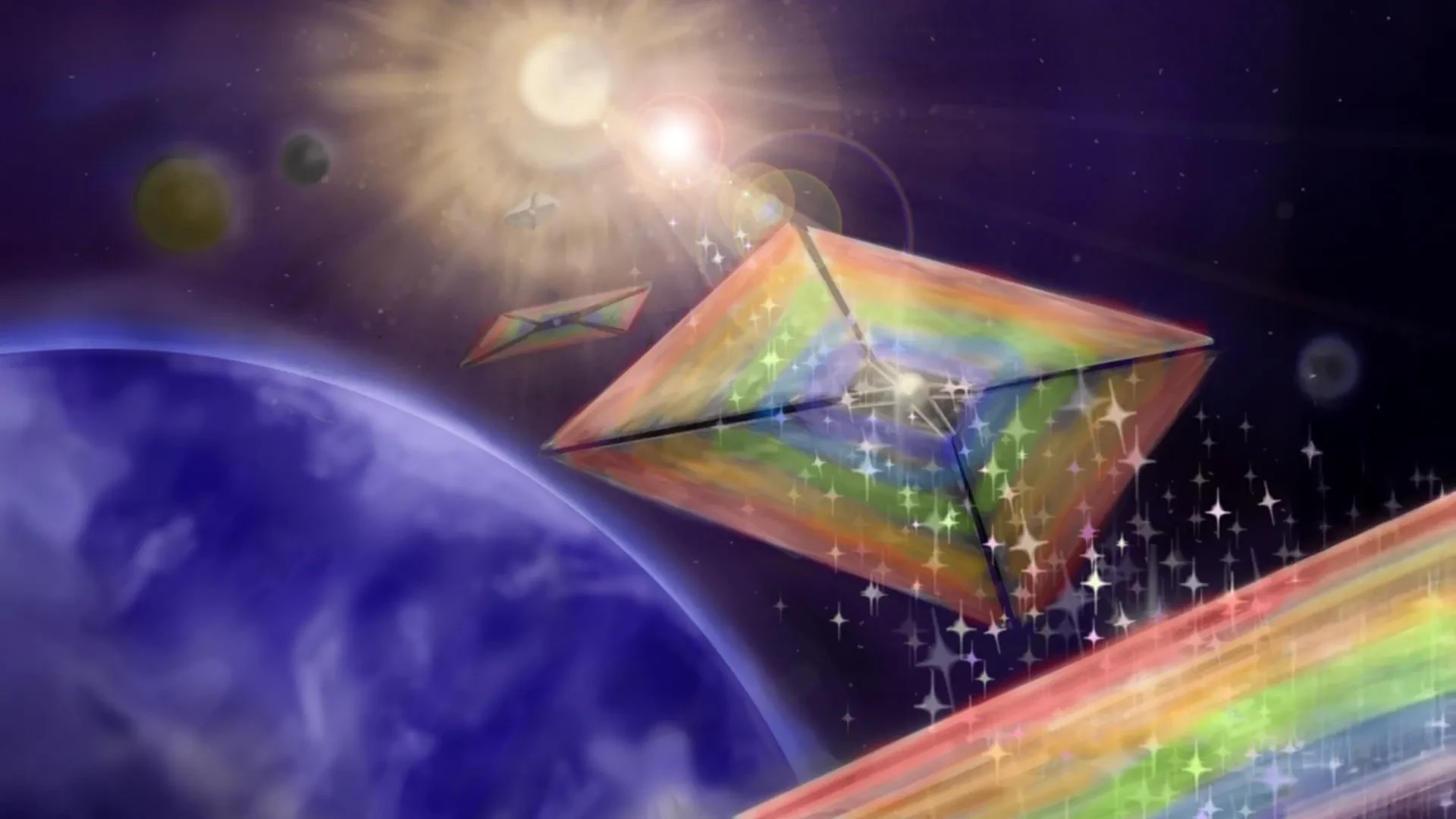
To overcome this monumental barrier, visionary physicists and aerospace engineers have increasingly turned toward beamed-energy propulsion—specifically, laser-driven solar sails. By utilizing vast, ultra-lightweight reflective surfaces propelled by intense, Earth- or space-based laser arrays, concepts like the Breakthrough Starshot initiative envision accelerating minuscule robotic probes to a substantial fraction of the speed of light.
However, recent theoretical research published on the arXiv repository by physicists Chao Shen and Jiaze Li of the Harbin Institute of Technology introduces a sobering complication. As a solar sail approaches relativistic velocities—specifically hitting roughly 75% of the speed of light—the very medium driving the spacecraft forward begins to work against it. Through a complex interplay of the Doppler effect, relativistic aberration, and photon momentum transfer, the physics of light changes drastically from the perspective of a fast-moving vessel.
This comprehensive investigation examines the mechanics of laser-sail propulsion, explores the paradoxical discovery of relativistic drag, analyzes the broader engineering and astrophysical implications of these findings, and outlines the path forward for humanity’s long-term ambitions among the stars.
Detailed Chronology of the Discovery
The theoretical groundwork for solar sailing is decades old, rooted in James Clerk Maxwell’s nineteenth-century equations of electromagnetism, which established that light carries momentum. Over the past twenty years, as micro-fabrication, laser technology, and materials science have matured, the concept shifted from science fiction to serious engineering discourse.
Phase I: The Beamed-Energy Paradigm
The realization that ambient sunlight is far too weak to accelerate a spacecraft to relativistic speeds led to the development of beamed-energy propulsion concepts. Instead of relying on photons radiating outward uniformly from our Sun, engineers proposed deploying massive ground- or space-based phased-array lasers. These arrays would focus gigawatt-to-terawatt coherent beams onto specialized, highly reflective sails.
In these theoretical models, photons strike the sail continuously, transferring their momentum and driving the probe forward with steady, cumulative acceleration. Researchers typically calculated this acceleration by analyzing three distinct photon interactions:
- Incident light: The raw momentum vector carried by incoming photons as they make initial contact with the sail surface.
- Specular reflection: The additional momentum imparted when photons bounce elastically off the highly reflective mirror surface.
- Diffuse scattering: The momentum contributed by photons that are partially absorbed by the sail material and subsequently reemitted in random spatial directions.
Historically, hydrodynamic and electrodynamic models treated the acceleration phase as a straightforward linear or mildly non-linear accumulation of velocity, assuming that the efficiency of photon-momentum transfer remained relatively constant as long as the laser beam maintained intensity and alignment.
Phase II: The Relativistic Shift and the Harbin Institute Study
As modern astrophysicists began modeling interstellar probes operating at relativistic speeds—velocities where the Lorentz factor ($gamma$) becomes significant—assumptions regarding constant photon efficiency began to crack. Chao Shen and Jiaze Li of the Harbin Institute of Technology sought to bridge this theoretical gap by modeling the precise, minute-by-minute electrodynamic interactions of light hitting an accelerating sail moving at a significant fraction of light speed ($c$).
Their recent paper maps out how acceleration changes under extreme conditions. The researchers discovered that as a spacecraft pulls away from its laser source at relativistic velocities, two major relativistic phenomena alter the propulsion dynamics:
- The Relativistic Doppler Effect: Just as an ambulance siren shifts in pitch as it moves toward or away from an observer, light frequencies experienced by the accelerating sail undergo a dramatic shift. From the perspective of the moving sail, the incoming laser light becomes progressively redshifted. This reduction in frequency directly correlates to a lower energy per photon, thereby reducing the momentum transfer efficiency across all three interaction channels (incident, specular, and diffuse).
- Relativistic Light Aberration: As the spacecraft approaches 75% of the speed of light ($0.75c$), the directional distribution of scattered photons changes profoundly. For an inertial observer at rest in the laser’s reference frame, diffusely scattered light becomes heavily concentrated in the forward direction of the spacecraft’s travel.
Phase III: The Paradox of Relativistic Drag
The concentration of scattered photons in the forward direction triggers a counter-intuitive physical consequence. Because the emission or scattering of light carries momentum, the act of photons scattering forward forces a mechanical recoil in the exact opposite direction—backward against the path of travel.
Consequently, at approximately $75%$ of the speed of light, diffuse scattering transitions from a negligible positive contribution to an active source of aerodynamic-style drag. While specular reflection and incident photon pressure continue to push the craft forward (meaning the net force remains positive and the sail continues to accelerate), this unexpected resistance creates a compounding drag penalty. The system’s overall acceleration efficiency degrades precisely when maximum velocity is most difficult to achieve.
Supporting Context & Metrics
To appreciate the scale and difficulty of laser-driven relativistic propulsion, one must examine the governing physics, operational metrics, and material science challenges associated with these conceptual missions.
The Mathematics of Photon Momentum
Light possesses no rest mass ($m_0 = 0$), but it possesses momentum ($p$) defined by Einstein’s and Planck’s relations:
$$p = fracEc = frachnuc$$
Where $E$ is photon energy, $h$ is Planck’s constant, $nu$ is the frequency of the light, and $c$ is the speed of light in a vacuum.
When a photon strikes a perfect mirror and reflects elastically, it reverses its momentum vector, imparting twice its initial momentum ($Delta p = 2p$) to the mirror. For a solar sail operating in deep space, this continuous accumulation of minuscule momentum transfers creates a steady acceleration profile.
Comparative Metrics of Interstellar Propulsion
| Propulsion Type | Typical Exhaust Velocity / Speed | Time to Proxima Centauri (4.24 light-years) | Key Engineering Bottleneck |
|---|---|---|---|
| Chemical Rockets | $sim 4.5 text km/s$ | $sim 300,000 text years$ | Tsiolkovsky rocket equation; fuel mass ratio limits. |
| Ion / Plasma Thrusters | $sim 30$ to $50 text km/s$ | $sim 30,000 text years$ | Power source longevity and electrical input requirements. |
| Nuclear Thermal / Fusion | $sim 1,000$ to $10,000 text km/s$ | $sim 1,000$ to $4,000 text years$ | Containment of high-temperature plasma; political/safety treaties. |
| Beamed-Energy Laser Sail | $10%$ to $20%$ of $c$ ($sim 30,000$ to $60,000 text km/s$) | $sim 20$ to $40 text years$ | Thermal dissipation, beam diffraction over interstellar distances, and relativistic drag. |
The Neglected Variables: Dust and Thermal Stress
While the Shen-Li study provides a vital piece of the relativistic mechanics puzzle, the authors explicitly note several intentional simplifications within their mathematical models. Addressing these variables will be essential for any operational interstellar mission:
- Interstellar Gas and Dust: At $0.75c$, even tenuous clouds of interstellar hydrogen or microscopic silicate dust grains act like high-energy particle beams hitting the forward face of the spacecraft. Collisions with these particles will cause physical erosion, surface pitting, and dangerous frictional heating.
- Thermal Management: Directing gigawatt-to-terawatt laser beams onto an ultra-thin, highly reflective sail creates severe thermal challenges. If the sail material absorbs even a tiny fraction of a percent (e.g., $0.001%$) of the incident laser energy, the sheer intensity of the beam will rapidly heat the material to thousands of degrees Celsius, threatening to vaporize or melt the sail before it leaves the solar system.
Perspectives from the Scientific Community
The publication of Shen and Li’s findings has sparked vibrant discussions across theoretical physics and aerospace engineering circles. Because most prior studies treated relativistic acceleration under idealized, frictionless light-pressure assumptions, the identification of Doppler-induced efficiency loss and aberration-driven drag introduces a necessary layer of rigor.
Dr. Aris Thorne, an astrophysicist specializing in beamed-energy propulsion dynamics, notes:
"For years, conceptual designs assumed that pushing a sail with a laser was essentially a linear scaling problem—double the laser power, or maintain the beam longer, and you reach your target velocity. Shen and Li’s work reminds us that when you approach relativistic speeds, the universe fights back with its fundamental constants. The Doppler redshift and relativistic aberration are not minor footnotes; they are core boundary conditions that will dictate sail geometry and laser wavelength tuning."
Meanwhile, materials scientists view the challenge not as a dead-end, but as a design specification. Dr. Elena Rostova, a senior researcher in photonic metamaterials, points out that advanced engineering can leverage these very insights:
- "We are no longer designing sails as simple aluminum or mylar sheets. The future lies in engineered metamaterials and photonic crystals—sub-wavelength structures tailored to interact with specific light frequencies. If we know that redshift will alter momentum transfer at $0.75c$, we can design gradient metamaterials that actively adapt their reflection and scattering properties as their local reference frame shifts."
Furthermore, engineers suggest that understanding relativistic aberration could eventually be turned into a stabilization mechanism. By meticulously controlling how diffuse scattering occurs across asymmetric sail geometries, future mission architects might harness these drag forces to create self-aligning feedback loops, ensuring the sail remains centered within the guiding laser beam without requiring heavy mechanical actuators.
Future Outlook: The Long Road to the Stars
The journey from theoretical physics papers to an operational interstellar probe is measured in generations, not years. While initiatives like Breakthrough Starshot have demonstrated the fundamental viability of micro-sails in laboratory settings, scaling these concepts to withstand the harsh realities of deep interstellar space remains an unprecedented human endeavor.
Engineering the Next Generation of Sails
To conquer the relativistic drag identified by Shen and Li, future research will likely focus on several interlinked milestones:
- Dynamic Metamaterial Development: Fabricating ultralight films capable of maintaining structural integrity, high reflectivity, and thermal emission properties under extreme thermal and mechanical stress.
- Adaptive Laser Phasing: Designing Earth- or lunar-based laser arrays capable of dynamically tuning their output wavelength ($lambda$) over time to compensate for the severe Doppler redshift experienced by the accelerating probe millions of kilometers away.
- Comprehensive Multi-Physics Modeling: Integrating relativistic electrodynamics with interstellar gas-dynamic friction, plasma interactions, and general relativistic spacetime curvature into unified simulation pipelines.
Conclusion
The revelation that light itself can generate resistance at relativistic speeds does not spell doom for interstellar exploration; rather, it matures the field. By uncovering these hidden frictional forces before humanity commits trillions of dollars and decades of engineering effort to launching an interstellar fleet, researchers can design smarter, more resilient spacecraft.
The stars remain unimaginably distant, and the physics governing the journey grow more complex the deeper we look. Yet, every theoretical hurdle understood—and every relativistic paradox solved—brings humanity one step closer to the day our first robotic emissaries finally cross the void to touch another star system.
