

Executive Overview
KABUL, Afghanistan — In the pre-dawn hours of a quiet Sunday, the fragile fabric of trust between rural Afghan communities and the international military coalition was violently torn apart. In two remote villages nestled within the Panjwai district of Kandahar province—a region historically recognized as the birthplace and a primary stronghold of the Taliban—a rogue U.S. service member allegedly embarked on a calculated predawn rampage.
Moving silently through sleeping homes, the gunman executed 16 Afghan civilians, including nine children and three women. Entire families were extinguished in their beds, leaving behind a scarred landscape of grief, profound shock, and escalating political tension.
While military authorities and coalition commanders have repeatedly insisted that the massacre was the isolated act of a single, deranged soldier acting alone, local survivors and community leaders remain deeply skeptical. The tragedy has triggered intense outrage across Afghanistan, placing immense pressure on the diplomatic and security frameworks binding Kabul and Washington. As investigators comb through bloodstained rooms and grieving families bury their dead, the incident threatens to permanently alter the trajectory of the NATO-led military mission and the bilateral relations between the two nations.
Detailed Chronology
The Pre-Dawn Horror in Panjwai
The sequence of events began unfolding in the dim hours before sunrise on Sunday in the Panjwai district. According to preliminary military findings and eyewitness accounts gathered by investigators, a U.S. Army staff sergeant stationed at a nearby forward operating base walked away from his post. Armed and equipped, he entered residential compounds in two adjacent villages where families were fast asleep.
Survivors recount a scene of absolute terror. Rather than a chaotic firefight or a military engagement gone wrong, the incursions were methodical.
"One guy came in and pulled a boy from his sleep and he shot him in this doorway," a devastated mother recalled, sitting amidst the wreckage of her home. "Then they came back inside the room and put a gun in the mouth of one child and stomped on another child."
The brutality of the assault left little room for survival. By the time the rampage concluded, 16 bodies lay scattered across the targeted compounds. Among the dead were toddlers as young as two years old, their small bodies later loaded into the backs of pickup trucks alongside adult victims. One local minister reported that a single extended family lost 11 members during the predawn onslaught.
The Aftermath and Mourning
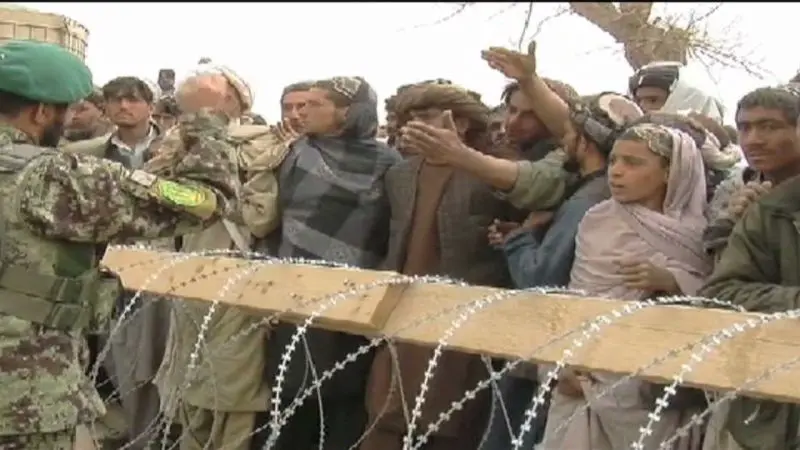
As the sun rose over Kandahar, the immediate vicinity of the killings transformed into a landscape of mourning and disbelief. Young and old men sat against trees and walls, their heads in their hands, weeping openly. Pickup trucks transporting the dead served as grim hearses, carrying bloodstained toddlers and char-marked remains of victims who had been partially burned in the fires ignited during the chaos.
Investigators from the International Security Assistance Force (ISAF) arrived soon after, collecting shell casings, photographing blood-spattered walls, and cataloging the devastation. Yet, technical forensic work offered little solace to communities consumed by an overwhelming sense of betrayal. Families spent the remainder of the day rushing to bury their dead according to local traditions, their grief rapidly morphing into volatile anger directed squarely at the foreign military presence.
Supporting Context & Metrics
A "Safe" Return Shattered by Violence
The psychological devastation of the Panjwai massacre is compounded by the specific history of the region. Known widely as a notorious hotbed of insurgency and the ideological birthplace of the Taliban, the western Kandahar district has long endured the brunt of the Afghan conflict.
However, many of the families residing in the targeted villages had only recently returned to their homes. Residents stated they had fled the area months prior due to heavy fighting, but were explicitly encouraged to come back by U.S. military personnel stationed at the local base.
"This base told us to come back to our villages… we will not bother you. This is your land, and this is your own village," one grieving mother recounted, her voice shaking with rage. "This is what they told us. But these dogs came and grabbed us."
She and other villagers swore they had not seen a single Taliban fighter in the area for five months prior to the attack, underscoring the bitter irony that they felt safer from insurgents than they did from the very forces deployed to protect them.
Profile of the Accused Soldier
As the investigation deepened, new details regarding the background of the accused soldier began to emerge from the Pentagon.
Defense Department officials identified the suspect as a U.S. Army staff sergeant—a seasoned infantry sniper who had been rigorously trained to neutralize targets at distances up to 800 meters. Prior to his deployment to Afghanistan, the soldier had completed three separate combat tours in Iraq.
Crucially, investigative disclosures revealed that the soldier had suffered a traumatic brain injury (TBI) during a 2010 vehicle accident in Iraq. Following medical treatment and subsequent evaluation, he was cleared by military medical boards to return to active duty. The deployment to Kandahar province marked his first tour of duty in the Afghan theater.
The disclosure of his medical history—specifically the untreated or lingering impacts of a traumatic brain injury combined with elite sniper training—has intensified scrutiny on military mental health screening protocols, deployment waiver processes, and the cumulative strain placed on combat veterans.
Official Statements & Diplomatic Friction
Condemnations and Accountability
The massacre drew immediate and unequivocal condemnation from the highest levels of international leadership. U.S. President Barack Obama and senior defense officials released statements expressing profound sorrow, shock, and condolences to the families of the victims. U.S. commanders on the ground moved quickly to reassure both the Afghan public and the international community that a thorough, transparent investigation was underway.
Despite these high-level expressions of remorse, local Afghan leaders argued that words were entirely insufficient. The chasm between official diplomatic sorrow and the raw reality on the ground widened as anger mounted over jurisdiction and accountability.
The Battle Over Jurisprudence: U.S. vs. Afghan Courts
In the wake of the killings, Afghan lawmakers and tribal elders immediately demanded that the accused soldier face a public trial on Afghan soil, under Afghan law. The demand struck at the heart of national sovereignty and the ongoing debate over legal protections for foreign troops operating within the country.
However, the Pentagon swiftly shut down any prospect of local prosecution. Pentagon spokesman George Little clarified the legal standing of the suspect during a press briefing:
"The soldier was never in the custody of Afghan forces and will not face punishment under the Afghan justice system," Little stated unequivocally. "The U.S. military has strong means to address wrongdoing. There is an agreement in place with the government of Afghanistan, so that the investigation—and when appropriate, prosecution—will be done through U.S. military channels."
This stance created severe friction. Village tribal leaders and regional representatives argued that it was fundamentally incomprehensible how a trained professional soldier could act completely alone, and equally unacceptable that the perpetrators of crimes committed on Afghan territory would be shielded from local justice.
Future Outlook & Strategic Implications
Impact on the NATO Military Mission
The Panjwai massacre occurred at a highly sensitive juncture for the International Security Assistance Force (ISAF) and its overarching strategy in Afghanistan. As coalition forces transition security responsibilities to the Afghan National Security Forces (ANSF) with an eye toward a broader withdrawal, incidents of this magnitude threaten to unravel years of painstaking counterinsurgency efforts.
Military analysts warn that the psychological fallout from the killings could permanently poison civilian-military relations. While the Taliban quickly vowed swift and violent revenge for the deaths, widespread anti-American protests initially remained contained as communities focused on burying their dead. Nonetheless, the long-term risk of accelerated insider attacks ("green-on-blue" incidents) and diminished local intelligence-sharing has skyrocketed.
The Road Ahead
The path forward for both Washington and Kabul is fraught with peril. For the United States military, the incident demands an urgent, introspective re-evaluation of force readiness, psychological screening, and the moral hazards of prolonged combat exposure. For the Afghan government, balancing public fury with the strategic necessity of continued international partnership has become an acute political crisis.
Ultimately, the tragedy in Panjwai transcends the actions of a single rogue infantryman. It stands as a devastating reminder of the human cost of war—where the lines between combatant and civilian blur, and where rebuilding trust requires far more than institutional apologies and military tribunals.