

Executive Overview
In the grand tradition of agricultural journalism and unhinged culinary taxonomy, the global community of apple enthusiasts—affectionately dubbed the "Apple Snack Gang"—has returned for a second installment of rigorous, sensory-driven fruit evaluation. Following a wildly unpredictable initial batch, pomological field researchers have set their sights on a fresh collection of esoteric, historic, and downright aggressive specimens.
This report provides an exhaustive investigation into seven distinct apple and crabapple varieties procured during the peak of the autumn harvest. Moving far beyond the commercial monoculture of the standard grocery store aisle—where uniformity supersedes flavor—this evaluation dives deep into the wild genetics, historical anomalies, and structural integrity of heirloom and specialty fruit.

From dense, nutmeg-heavy oddities to gym-honed ironclad cultivars tasting inexplicably of nostalgic chewing gum, the findings confirm that the world of apples is infinitely weirder, more poetic, and more chaotic than mainstream agriculture suggests. Utilizing a strict numerical scoring metric, this review catalogs the triumphs, the tragedies, and the structural dental hazards associated with modern and historic pomology.
Detailed Chronology of the Tasting Trials
The evaluation process spanned multiple days, accounting for the variable post-harvest maturation of living organic matter. Each specimen was subjected to rigorous visual inspection, tactile assessment, and immediate gustatory analysis. Below is the chronological breakdown of the cultivars evaluated during this latest phase of the inquiry.

1. Kickapoo Spice
- Score: 6.9 / 10
- Visual/Tactile Assessment: Described structurally as a "dense boy" and a "weird friend," this cultivar boasts a compact, heavy-handed physical presence.
- Flavor Profile: Exhibiting a remarkably high spice component, the Kickapoo Spice leans heavily into nutmeg territory, supported by secondary notes of cinnamon and clove. Surprisingly devoid of traditional juiciness, the fruit leaves an unusual aftertaste reminiscent of freshly cut grass.
- Pomological Analysis: The presence of grassy notes suggests that the fruit’s storage lifecycle was non-optimal. Apples, as agricultural erraticism dictates, exist on a knife-edge: certain cultivars improve steadily off the tree, while others begin an immediate, irreversible descent into culinary obsolescence the moment they are severed from their branches. Despite its eccentricities, it remains a compelling and meritorious snack.
2. St Edmunds Pippin
- Score: 8.3 / 10
- Visual/Tactile Assessment: As the premier "proper" apple of the season, the St Edmunds Pippin presents with a distinctly rough skin texture, likened colloquially to "licking a shark backward." However, this superficial deterrence gives way to an intensely satisfying, explosive structural pop upon the initial bite.
- Flavor Profile: Exceptionally crunchy, juicy, and sharp-breaking. The flavor is bright and herbal, carrying unmistakable aromatic vibes of fennel pollen while maintaining a harmonious, deeply satisfying sweet-tart balance.
- Pomological Analysis: A masterclass in how a slightly unconventional, funky heirloom fruit can deliver elite-tier culinary satisfaction. It stands as one of the standout performers of the testing cycle.
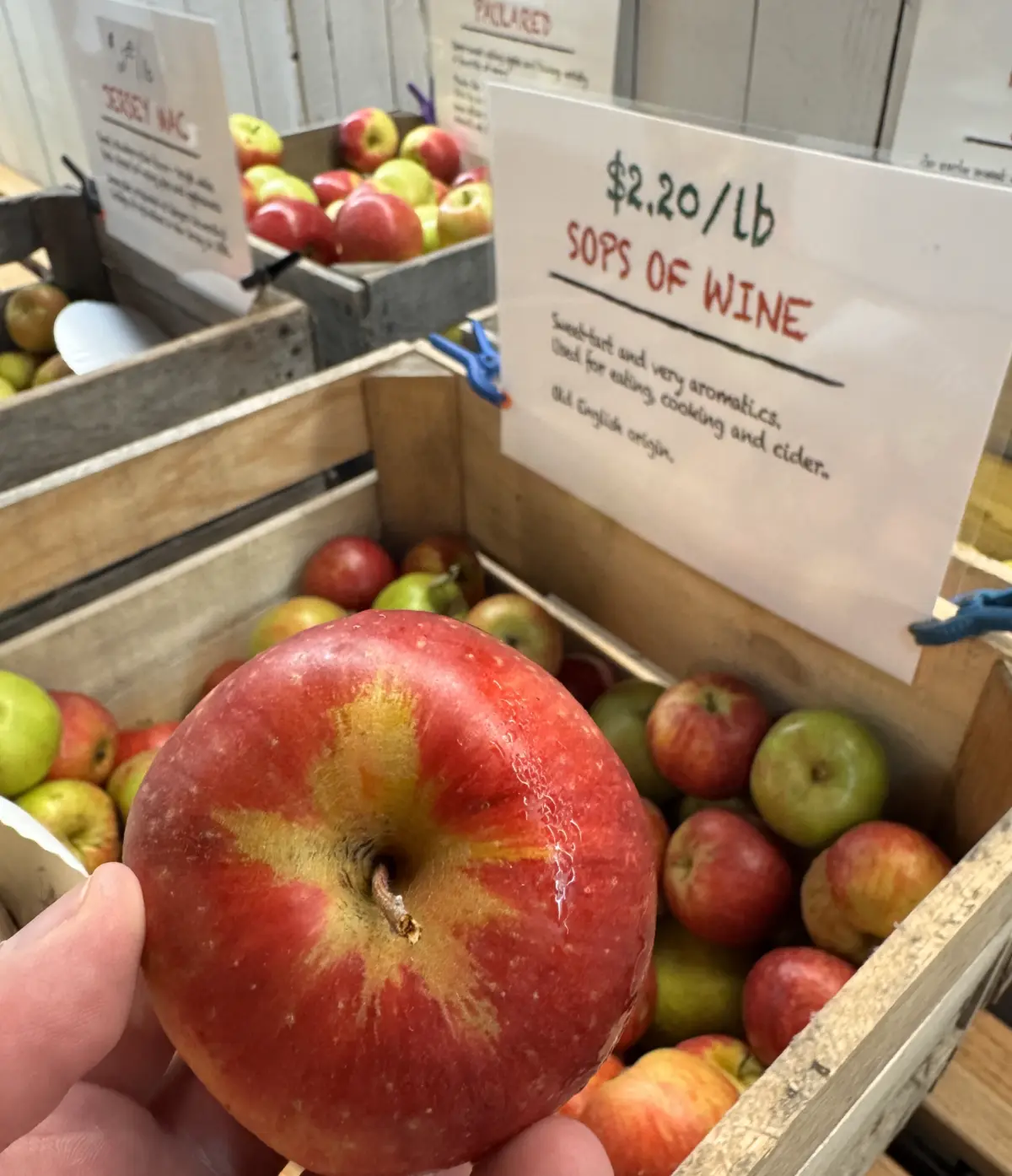
3. Sops of Wine
- Score: 3.5 / 10
- Visual/Tactile Assessment: Visually conventional, though marred by a post-harvest timeline that pushed its structural integrity past the brink.
- Flavor Profile: The fruit offered pleasant, funky aromatic notes blending sub-acid sweetness (more sweet than tart) with delicate whispers of vanilla and spice.
- Pomological Analysis: Despite decent foundational flavors, the texture was catastrophically compromised—mealy, gritty, and structurally disappointing. Furthermore, pomological confusion abounds regarding the moniker; while classic texts describe true Sops of Wine as possessing red-fleshed or red-streaked interiors, this specimen displayed standard white flesh. This fuels the ongoing debate over whether "Sops of Wine" represents a single distinct genetic lineage or functions as an umbrella term for a disparate collection of ancient, nebulous apple types.
4. Fenceline Surprise
- Score: 1.0 / 10
- Visual/Tactile Assessment: Promising visual presentation accompanied by a sophisticated name that begs to be pronounced with a faux-French cadence rather than a standard rural inflection.
- Flavor Profile: A fleeting, microscopic whisper of pear juice misted across the pulp, which evaporates almost instantly upon contact with the palate.
- Pomological Analysis: The ultimate disappointment of the batch. Despite signage designating it as a "firm apple," the specimen yielded a bland, mushy interior texture comparable to chewing on beach sand. Whether suffering from an inherently grumpy genetic batch or accelerated post-harvest decay, it offered virtually no redemption save for its linguistic panache.
5. Americus Crab
- Score: 2.5 / 10
- Visual/Tactile Assessment: Possesses an evocative nomenclature straight out of a Victorian steampunk adventure novel, conjuring images of rogue inventors and eccentric maritime superheroes.
- Flavor Profile: True to its crabapple classification, it is intensely complex: savory, tart, heavily tannic, and structurally impenetrable.
- Pomological Analysis: Decidedly unsuited for casual, out-of-hand consumption by the unprepared consumer. However, it earns merit points for adventurous eaters who appreciate aggressively wild, untamed botanical profiles.
6. Campfield (False?)
- Score: 4.1 / 10
- Visual/Tactile Assessment: Labeled cryptically with the qualifier "(false)," suggesting a deceptive, duplicitous botanical nature. Structurally, it offered a rubbery resistance akin to chewing on a callused thumb.
- Flavor Profile: Cloyingly sweet yet overwhelmingly bogged down by massive structural tannins, creating the uncanny sensation that the fruit was consuming the consumer just as rapidly as the consumer was consuming the fruit.
- Pomological Analysis: Historical records indicate that Campfield is fundamentally a cider apple—meaning its true potential is locked behind the transformative alchemy of fermentation rather than direct human mastication.
7. Graham
- Score: 8.0 / 10
- Visual/Tactile Assessment: Unusually dense and armored. This cultivar presented physical resilience so absolute that it threatened the physiological stability of the taster’s temporomandibular joint (TMJ). It shattered upon impact like a calving glacier.
- Flavor Profile: Once the structural fortress was successfully breached, the taster was greeted by an astonishing, unreserved flavor profile matching classic Juicy Fruit chewing gum.
- Pomological Analysis: A triumph of unexpected flavor delivery, tempered only by the extreme structural fortitude required to breach the fruit’s exterior defenses.
Supporting Context & Metrics
To ensure transparency and scientific rigor, the evaluation relies on a standardized, multi-variable grading framework. Apples are judged not merely on sugar content, but across four distinct pillars:
- Structural Integrity (Crunch & Density): Measures the acoustic and physical resistance of the flesh. Renders penalties for mealiness and rewards sharp, clean fractures.
- Aromatic Complexity: Evaluates the presence of secondary and tertiary flavor notes (e.g., fennel pollen, nutmeg, vanilla, or artificial confectionary profiles).
- Juiciness-to-Tannin Ratio: Assesses the balance between hydration and mouth-drying astringency.
- Historical & Linguistic Resonance: Allocates subjective bonus weight based on the sheer entertainment value of the cultivar’s name and historical provenance.
| Cultivar | Structural Integrity | Flavor Complexity | Historical/Linguistic Weight | Final Score |
|---|---|---|---|---|
| St Edmunds Pippin | High (Crisp) | High (Fennel/Herbal) | Moderate | 8.3 / 10 |
| Graham | Extreme (Armor-clad) | High (Juicy Fruit) | Low | 8.0 / 10 |
| Kickapoo Spice | Moderate (Dense) | High (Nutmeg/Clove) | High | 6.9 / 10 |
| Campfield (False?) | Tough (Cider-type) | Moderate (Tannic) | High | 4.1 / 10 |
| Sops of Wine | Poor (Mealy) | Moderate (Vanilla) | Moderate | 3.5 / 10 |
| Americus Crab | Tough (Crabapple) | Wild (Savory/Tart) | High | 2.5 / 10 |
| Fenceline Surprise | Failed (Mushy) | Negligible (Pear-whisper) | Moderate | 1.0 / 10 |
Official Statements and Historical Excursions
The investigation into the Campfield apple yielded a remarkable historical artifact concerning its namesake lineage. Archival records trace the fruit’s origins back to Matthew Canfield (historically spelled Campfield), an anti-royalist Puritan who migrated from England during the Great Puritan Migration prior to 1637.

As a founding father of New Haven Colony, Norwalk, Connecticut, and Newark, New Jersey—regions renowned for producing exceptional hard cider—Canfield’s legacy is deeply intertwined with American pomology. Historical town records from New Haven and Newark outline rigorous local ordinances requiring freeholders to cultivate multi-acre fruit orchards. Canfield’s own civic duties famously included evaluating fence lines, assessing agricultural damages caused by wandering swine, and procuring "three barrels of good cider made of winter fruit."
The survival of the Campfield apple lineage underscores the profound intersection between early colonial infrastructure and the evolution of American cider culture.

Future Outlook
As the autumn harvest shifts geographically, pomological field researchers are expanding their operational footprint. Expeditions slated for the upcoming week will target the historic orchards and agricultural hubs of New York, New England, and Canada.
Given the rich biodiversity and cooler climatic conditions of these northern regions, the upcoming trials promise an influx of unprecedented heirloom cultivars. The Apple Snack Gang remains committed to its core mission: consuming, evaluating, and documenting every anomalous, historic, and delightfully chaotic apple encountered in the wild.

Field updates, appearance schedules, and public apple-donation drop-off points remain active via official tracking portals. The pursuit of the ultimate pomological specimen continues unabated.