

Executive Overview
As voters across the United States head to the polls on November 3, 2026, the nation stands at a critical political crossroads. This midterm election cycle—vicious, highly polarized, and defined by a deep public exhaustion with the policies of Donald Trump’s second presidential administration—is serving as a high-stakes referendum on the trajectory of American governance.
A confluence of compounding economic and geopolitical pressures has soured the electorate on the ruling Republican majority. Surging inflation, declining consumer confidence, and skyrocketing fuel prices—supercharged by the administration’s controversial war of choice in Iran—have severely eroded the economic optimism that once buoyed the MAGA base. Simultaneously, the aggressive legislative and executive actions pursued by the White House have alienated independent voters and fractured segments of the conservative coalition.
Against this turbulent backdrop, Democrats are projecting sweeping victories, anticipating a "blue wave" that could yield significant gains in the House of Representatives and potentially flip control of the Senate. However, as political analysts and strategists emphasize, midterm elections are notoriously volatile. Beneath the surface of national polling trends lie intense factional power struggles within the Democratic Party, multi-million-dollar war chests deployed by ultra-wealthy donors like Elon Musk, eleventh-hour primary dramas, and tectonic shifts in deep-South demographics that could produce historic electoral surprises.
Detailed Chronology and Electoral Dynamics
The path to the November 2026 midterms has been characterized by shifting momentum, bitter primaries, and desperate legislative maneuvers by both major parties.
The Spring and Summer Legislative Battlegrounds
As the year began, the Republican-led Congress sought to consolidate power by implementing aggressive redistricting strategies across pivotal states such as Texas and Florida. Designed to neutralize projected Democratic gains and protect conservative incumbents—particularly in districts where Trump had made notable inroads among Black and Latino voters in 2024—these maps were treated as the GOP’s firewall.
However, as the months pressed on, external economic shocks altered the political landscape. The fallout from the military intervention in Iran sent energy prices soaring, dragging down consumer sentiment. Polling data throughout late summer and early fall indicated that the fragile multi-racial coalition that returned Trump to the White House was steadily fracturing. In response, Democratic-controlled state legislatures in powerhouses like California and Virginia moved quickly to implement counter-gerrymandering strategies, setting up a brutal national map war.
The Closing Weeks and Michigan’s High-Drama Primary Fallout
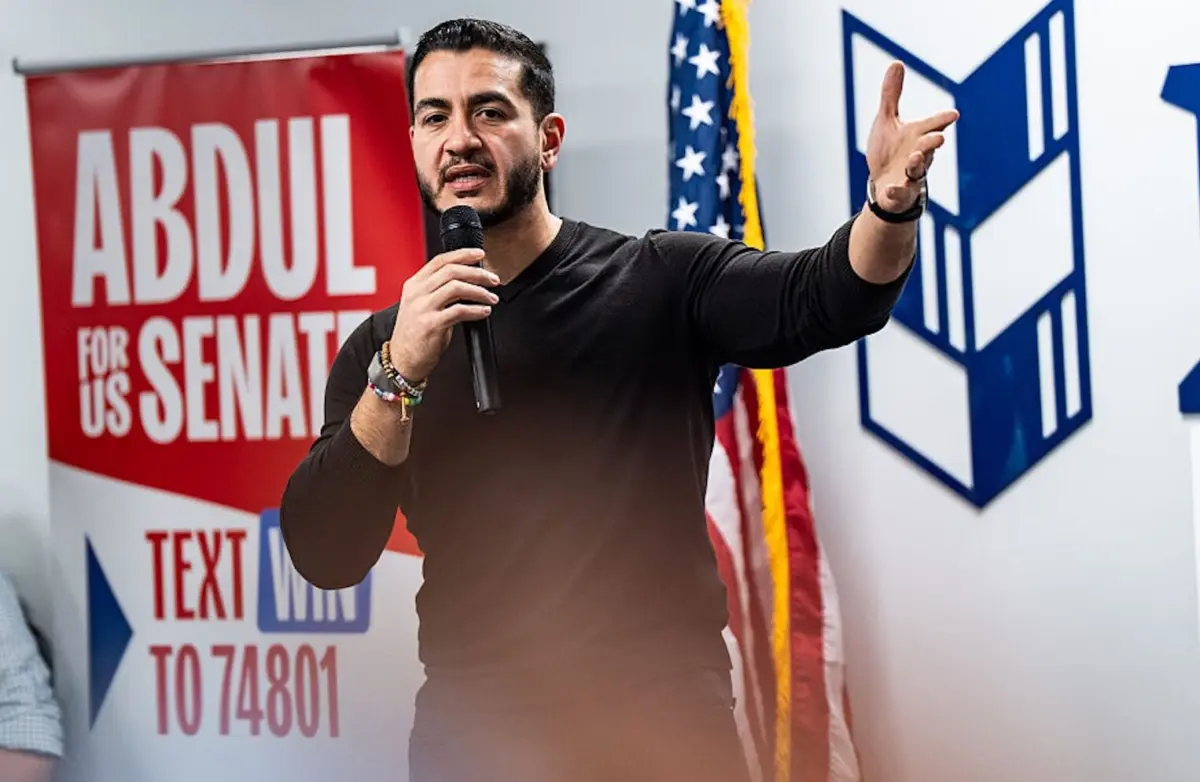
By October, attention had crystallized around marquee Senate and House races that would determine the balance of power. In Michigan, Democratic Senate candidate Dr. Abdul El-Sayed embarked on the "Knock Out The Vote Tour," cementing his status as a progressive powerhouse in the state.
However, the race was abruptly upended in its closing days by stunning intra-party drama. U.S. Representative Haley Stevens, who had narrowly lost the bruising Democratic Senate primary to El-Sayed by a razor-thin margin of just 1% (roughly 14,893 votes), executed a shocking political heel-turn. After repeatedly pledging support to El-Sayed behind closed doors, Stevens appeared at a Sunday church service alongside her Republican opponent, former Congressman Mike Rogers, and formally endorsed him in a video message. The betrayal triggered immediate fallout, resulting in Stevens being formally expelled from the Michigan Democratic Party.
While state Republicans privately lamented that the endorsement had come too late to fundamentally alter the trajectory of the race—especially given a pre-scandal New York Times/Siena poll showing El-Sayed with an 11-point lead—the nonpartisan Cook Political Report had already shifted the race rating to "Leans Democratic," viewing the progressive candidate’s underlying momentum as resilient.
Election Day: Early Indicators
As polling stations open across the country, election-watchers are focusing heavily on early bellwether districts. Key among them is Kentucky’s 6th Congressional District, where Democrat Zach Dembo faces Republican Ralph Alvarado. Long held by the GOP since 2012 despite a brief scare in 2018, the district represents an early-evening litmus test. Polls closing at 6:00 PM EST in Kentucky will offer the first tangible evidence of whether grassroots enthusiasm translates into an expansive national blue wave.
Supporting Context & Metrics
The Scale of the "Blue Wave"
Projections for Democratic gains vary, but most models suggest the party is poised to capture upwards of 25 seats in the House, putting the chamber within their grasp, alongside a viable path to a Senate majority.
Beyond traditional swing states like Maine, Iowa, Kansas, and Alaska, the expansion of the electoral map has brought historically safe Republican territory into play. In Texas, state lawmaker James Talarico has galvanized progressive and independent voters, running a competitive campaign that has deeply unnerved the state’s GOP establishment.
Money in Politics: The Musk Factor
The 2026 cycle has shattered historical spending records, largely driven by the world’s first trillionaire, Elon Musk. According to The New York Times, Musk poured an unprecedented $474 million into the midterms this cycle, distributing funds across a complex network of super PACs, outside groups, and dark-money vehicles.
A significant portion of this war chest—including $168 million directed to the Senate Leadership Fund—was deployed to rescue vulnerable conservative candidates, most notably Ken Paxton, the embattled GOP Senate nominee in Texas locked in a dead heat with Talarico.
Beyond the immediate electoral math, Musk’s massive financial footprint carries profound personal and political risks. Should Democrats secure a congressional majority, Musk faces the near-certainty of aggressive legislative investigations. Inquiries are widely expected to focus on his corporate interventions in international conflicts—such as his reported actions regarding Russia’s war against Ukraine—and his high-profile leadership tenure within the Department of Government Efficiency (DOGE) during the opening months of Trump’s second term.
Ideological Tensions: Progressives vs. The Establishment
The magnitude of the election night results will directly arbitrate an ongoing ideological civil war within the Democratic Party. The establishment wing has long advocated for a moderate, center-left approach, arguing that only candidates who tack toward the middle can win national elections.
Conversely, progressive factions argue that bold, populist policy platforms are essential for energizing the base. A decisive blue wave—featuring wins by prominent progressives like El-Sayed in Michigan or William Lawrence, co-founder of the Sunrise Movement who is challenging incumbent GOP Rep. Tom Barrett in Michigan’s 7th Congressional District—would provide immense momentum to the progressive wing ahead of the 2028 presidential cycle.
Anticipating this tension, progressive organizations have already begun pushing back against expected establishment narratives. A leaked memo from the Progressive Change Campaign Committee obtained by Politico warns:
"Expect to hear narrow victories cited as evidence of weak electability. But a candidate’s first winning margin is not their electoral ceiling."
Official Statements and Campaign Reactions
As returns begin to trickle in, campaign headquarters and party leadership have released statements reflecting the high-stakes atmosphere.
- Democratic National Committee Spokesperson:
"The American people have grown utterly exhausted by the chaos, division, and economic devastation of the Trump administration’s second term. Voters are rejecting the MAGA agenda at the ballot box because they want leadership focused on lowering costs, protecting fundamental rights, and restoring competence to Washington."
- National Republican Congressional Committee (NRCC) Representative:
"Despite a challenging national economic headwinds manufactured by failed Democratic policies, our candidates have fought tooth and nail to defend economic freedom and secure our communities. We remain confident that voters will reject radical progressive policies that seek to federalize our economy and dismantle our judicial system."
- Progressive Change Campaign Committee (Excerpt from internal memo):
"Progressive candidates have proven they can build multi-coalition winning campaigns in tough environments. We reject the false premise that moderation is the sole path to victory; enthusiasm and bold economic populism are driving this cycle’s energy."
Future Outlook: The Deep-South Wildcards and Post-Election Realities
While a standard blue wave remains the consensus projection, political analysts caution that the 2026 midterms could still deliver historic surprises in unexpected geographical pockets, echoing the dramatic multi-seat shifts seen in Georgia in 2020 or New York in 2022.
Chief among these dark-horse battlegrounds are deep-South states long considered impregnable for Democrats: South Carolina, Mississippi, and Louisiana.
- South Carolina: Following the death of longtime Senator Lindsey Graham, Governor-appointed GOP incumbent Darline Graham has struggled on the campaign trail, drawing sharp criticism for lackluster debate performances. Democratic challenger Annie Andrews has capitalized on these vulnerabilities, running a disciplined campaign that has steadily narrowed the polling gap in a state ripe for an upset.
- Mississippi: Longtime incumbent GOP Senator Cindy Hyde-Smith is facing a surprisingly fierce challenge from Democrat Scott Colom. Buoyed by high voter mobilization among the state’s substantial Black electorate—energized in the wake of the Supreme Court’s decisions weakening the Voting Rights Act—and compounded by a series of unforced campaign gaffes from the incumbent, Mississippi has emerged as a genuine battleground.
- Louisiana: In a state where roughly one-third of the population is African American, early-voting surges among Black residents have fundamentally altered the electorate. Recent polling shows a statistical dead heat between Republican Julia Letlow and Democratic challenger Jamie Davis, a Black candidate running a competitive statewide platform.
What Lies Ahead
Should even one or two of these southern longshots materialize into Democratic victories, it will signal that the anticipated blue wave has transformed into a political tsunami.
Regardless of the final seat tallies, the morning after the election will usher in a radically altered political reality. For the White House, a newly empowered or majority-controlled opposition in Congress will mean an immediate wall of subpoenas, oversight hearings, and gridlock. For the Democratic Party, navigating the internal chasm between its ascendant progressive wing and its cautious establishment will dictate the opening salvos of the 2028 presidential race. As the ballots are counted tonight, the nation waits to see what unexpected chapters history will write next.
