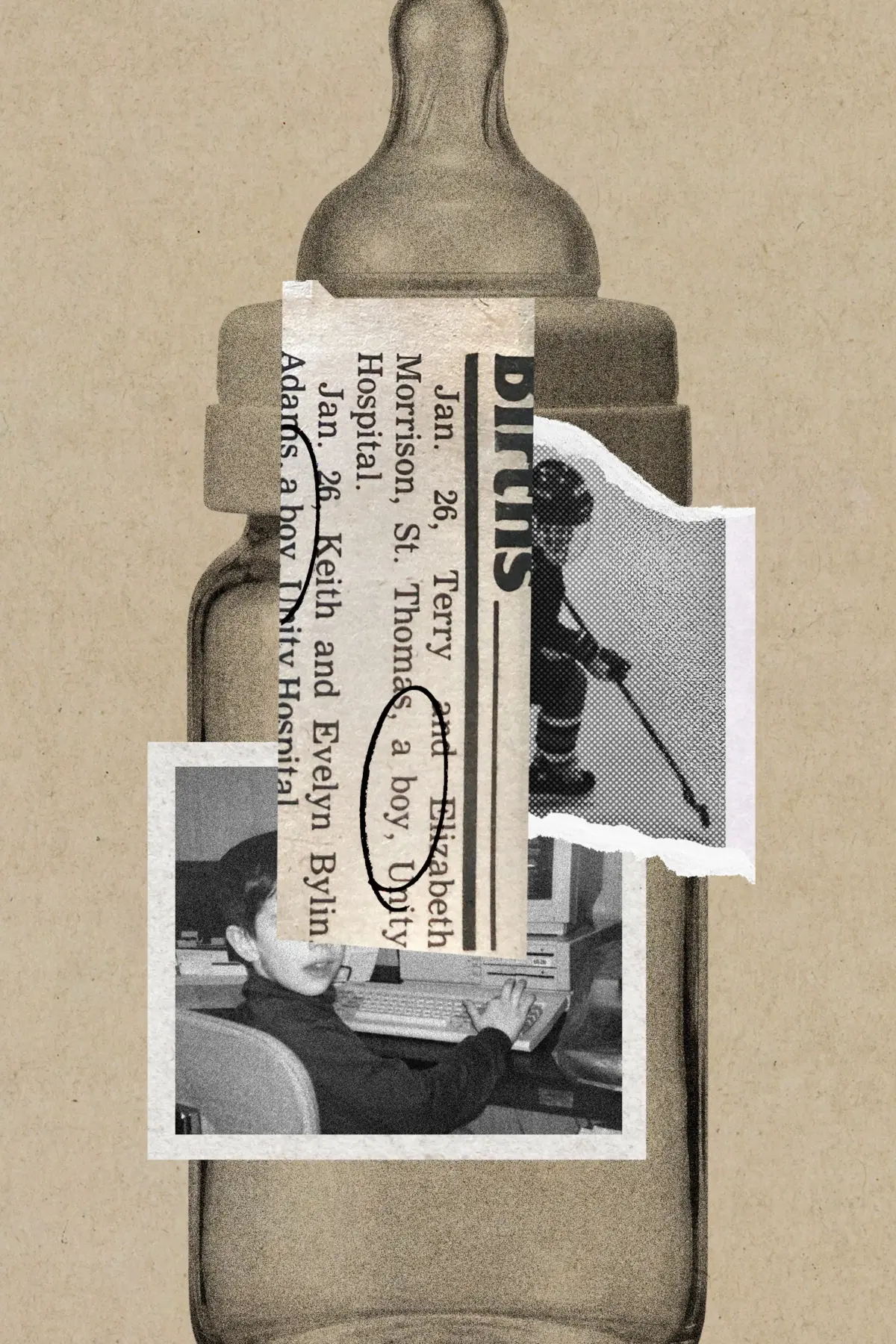
On a subzero January day in 1988, two families welcomed baby boys into the world at Unity Medical Center in Grafton, North Dakota. Liz O’Toole and Terry Morrison brought home a healthy son named Jeremy, while Evelyn Newton and Keith Bylin welcomed a boy they named Kyle. For nearly four decades, both boys grew up in starkly different environments—one on a multi-generational family farm, the other in a modest single-wide trailer. They navigated divergent paths, developed contrasting interests, and lived lives defined by subtle, nagging feelings of not quite fitting in.
In 2024, routine direct-to-consumer DNA testing shattered these illusions. The results revealed an unthinkable reality: Jeremy and Kyle had been swapped in the hospital nursery shortly after birth, each wearing an identification bracelet meant for the other. They had quietly lived out the lives designed for strangers. Now, bound by an extraordinary medical oversight and an ongoing legal battle against the hospital, both families are grappling with the shattering echoes of a mistake made nearly forty years ago.
Detailed Chronology: The Winter of 1988 and the Unraveling
Births in the Frozen Plains
The story begins on January 26, 1988. In Grafton, North Dakota, a biting wind whipped across the frozen plains as Liz O’Toole arrived at Unity Medical Center. Following a complicated labor that required a Cesarean section, O’Toole and her partner, Terry Morrison, welcomed their firstborn. Nurses inked the baby’s feet, pressed them onto a birth certificate bearing the name Jeremy, and handed the infant over.
Hours later, Evelyn Newton arrived at the same rural facility to deliver her second child with Keith Bylin. After an arduous delivery, Newton also received a swaddled infant, officially named Kyle Jerome Bylin.
Both families returned home to contrasting futures. Jeremy grew up in a single-wide trailer, raised by a mother who later worked in community rehabilitation and flood-relief efforts. Kyle was taken to the Bylin family farm in Adams, North Dakota—a community of roughly 121 people where his family’s agricultural roots stretched back four generations.
The Divergent Paths of Two Strangers
Though raised just an hour apart, the boys cultivated vastly different personalities and trajectories:
Kyle Bylin gravitated toward technology, rock music, and introspection. While his father and brother, Darren, worked on cars and livestock, Kyle retreated indoors, writing lyrics and dreaming of a life outside of farming. He eventually became a research librarian and technology journalist, living across multiple states.
Jeremy Morrison flourished outdoors. He spent his youth building forts, catching frogs, and working on cars. Inheriting a blue-collar work ethic, he eventually built a career as a quality-control inspector in the wind-energy sector.
Despite loving families, both boys harbored a quiet alienation. Jeremy frequently joked with his mother that he must have been adopted because he looked and acted nothing like his relatives. Kyle experienced a similar sense of detachment, though it was partially masked by the unique background of his mother, Evelyn, who had been adopted by an American soldier in post-World War II Germany.
The 2017 Catalyst and the 2024 Revelation
The truth began to surface in December 2017, when Kyle received an Ancestry.com kit as a Christmas gift. He mailed his sample and largely forgot about it.
Years later, in August 2023, a Minnesota woman named Martha Hotchkiss messaged Kyle after he appeared on her platform dashboard as a genetic match. Hotchkiss was searching for a long-lost aunt. The digital investigation paused and resumed until January 2024, when Kyle—studying for a master’s degree in library science in Michigan—urged his mother, Evelyn, and brother, Darren, to submit DNA samples for health tracking.
The results sent shockwaves through the family: Darren and Evelyn matched, but Kyle did not.
Realizing the geographic significance, Kyle messaged Hotchkiss to ask if her family had connections to Grafton, North Dakota, in 1988. Hotchkiss immediately realized the connection: her sister, Liz O’Toole, had given birth at Unity Medical Center on that exact day.
"That’s when the bottom fell out of everything," Hotchkiss recalled. Subsequent conversations confirmed the impossible: the infants had been swapped in the nursery.
Supporting Context & Metrics: The Scale of Accidental Mix-Ups
While hospital baby switches are culturally depicted as exceedingly rare, experts suggest that institutional errors happen far more frequently than public statistics indicate.
According to psychologist Dr. Nancy Segal, co-author of Accidental Brothers: The Story of Twins Exchanged at Birth and the Power of Nature and Nurture, public perception is skewed because only detected cases come to light. Citing historical health studies, researchers estimate that thousands of newborn mix-ups occur globally, though the vast majority are caught before families leave the facility.
However, rural hospitals operating in the late 1980s faced distinct systemic vulnerabilities:
Record Keeping: Paper-based identification charts, handwritten wristbands, and manual nursery logs left significant room for human error.
Staffing Limitations: Smaller medical facilities frequently operated with skeletal overnight shifts and limited nursing oversight in maternity wards.
The Passage of Time: As medical institutions undergo structural changes, archival records from decades prior are routinely purged or lost, severely limiting retrospective investigations.
For the Bylin and Morrison families, the statistical rarity materialized as a deeply personal disruption, fracturing generational lineages and forcing both men to reconstruct their identities in adulthood.
Official Statements and Legal Action
Faced with permanent alterations to their family trees, the families pursued formal legal accountability. In July, attorneys filed a comprehensive civil lawsuit against Unity Medical Center in North Dakota state court.
Allegations in the Lawsuit
The legal filing asserts multiple counts against the hospital, including:
Medical malpractice and institutional negligence
Intentional and negligent infliction of emotional distress
Deceit and failure of duty of care
The plaintiffs are seeking substantial financial damages for past and future pain, emotional anguish, and non-pecuniary losses resulting from the lifelong separation from their biological relatives.
The Hospital’s Defense
Unity Medical Center formally responded to the litigation by denying any institutional negligence or liability. In an official statement, the hospital acknowledged the profound emotional toll of the discovery while emphasizing the impossibility of verifying historical events:
"We are currently working to better understand a highly unusual situation involving two men who apparently were separated from their biological parents at some point during their lives… We recognize the profound impact this discovery has had on them and their families. Unfortunately, because of the passage of nearly four decades, the medical and staffing records that might have provided additional clarity no longer exist, and no members of the delivery team from that time are still employed by the hospital. While we deeply sympathize with the men and their families, we have found no evidence to support claims that Unity Medical Center or its staff were responsible for what occurred."
Emerging Historical Claims
Following media coverage of the lawsuit, additional local residents stepped forward with unverified historical accounts detailing close calls at the same facility. Two women independently reported near-miss baby mix-ups at Unity Medical Center—one in December 1971 and another in June 1975—where nurses briefly handed them infants belonging to other mothers before correcting the error. Hospital legal representatives have declined to comment on these historical disclosures.
Future Outlook: Rebuilding Connections
More than a year after the DNA revelation, the families continue to navigate an unprecedented dynamic. Face-to-face meetings have bridged generational gaps: Kyle has built a rapport with his biological mother, Liz O’Toole, and his biological father, Terry Morrison. Similarly, Jeremy has forged relationships with Evelyn Newton and Keith Bylin, discovering striking behavioral and physical mannerisms shared with his biological brothers.
Yet, the psychological aftermath remains complex. Darren Bylin, who grew up alongside Kyle, expressed the profound ripple effects of the discovery in a statement to the press:
"This is a mess that has affected many people in a confusing, sad, depressing way. The butterfly effect is endless… No wonder Kyle and I have always been on such different paths in life. I was never able to look through his eyes and understand much. I sometimes wonder how the farm would look positively with a brother involved."
As for Kyle and Jeremy, the two men whose lives were covertly exchanged in a North Dakota hospital in 1988, their relationship remains uniquely defined. They are not traditional brothers, nor are they legally or socially integrated as siblings. Instead, they remain permanently intertwined by a shared trauma—their pasts irrevocably swapped, and their futures forever bound by the ghost of a nursery mix-up.