

Executive Overview
In the realm of digital product development, few challenges are as universally frustrating—and deceptively complex—as the simple act of naming things. Whether a developer is attempting to label an obscure CSS class, a designer is defining a hierarchy of design tokens, or a product manager is debating the title of a newly released feature, nomenclature sits at the absolute core of software design. The language we choose does not merely decorate our work; it actively shapes the way we think, builds the mental models of our users, and dictates the efficiency of cross-functional team communication.
Poor nomenclature leads to an insidious form of organizational friction: a phenomenon where designers, developers, product managers, and end-users speak in entirely different dialects. A designer might label a component based on its visual presentation (e.g., BlueRoundedRectangle), a developer might rely on programmatic shorthand (e.g., Btn_pri_02), a product manager might evaluate it through business metrics, and an end-user might seek it out based on the intuitive job it performs. When these perspectives collide, cognitive load increases, development slows down, and feature adoption

plummets due to discoverability barriers.
Fortunately, the design and engineering communities have increasingly rallied around this challenge, producing a wealth of open-source taxonomies, repositories, and strategic frameworks. This guide synthesizes these resources to help modern digital teams establish a scalable, unified language. From classifying interface components and color palettes to architecting multi-brand design tokens and naming features that resonate with real human behavior, we explore the essential toolkits required to conquer the chaos of nomenclature.

Detailed Chronology and Evolution of Naming Frameworks
The historical trajectory of digital naming conventions mirrors the maturation of the web itself. In the early days of front-end development, naming was largely an ad hoc affair. Developers relied on idiosyncratic tags, inline styling, and localized naming conventions that made scalability nearly impossible. As websites evolved into complex, enterprise-grade applications, the lack of standardization triggered a crisis of maintainability.
The Rise of Systematic Taxonomies
- The BEM Revolution (Block, Element, Modifier): Introduced to bring predictability to CSS, BEM forced developers to think structurally about their codebases. While it solved specificity wars, it also highlighted how rigid our nomenclature could become.
- The Design System Boom: As companies like Salesforce, Atlassian, and Intuit scaled their digital properties, design systems emerged as the single source of truth. Suddenly, the vocabulary used in Figma needed to match the codebase 1:1. This era gave birth to "design tokens"—abstracted values for colors, spacing, and typography that decoupled visual styling from hard-coded values.
- Multi-Brand and Cross-Platform Complexity: Today, enterprises manage multi-brand, multi-themed ecosystems (such as Vodafone or Intuit’s family of products) where a single token must adapt seamlessly across web, iOS, Android, and varying brand identities. Naming went from being a localized naming task to an enterprise architecture discipline.
Throughout this evolution, the industry has transitioned from asking “What sounds good?” to “What is scalable, semantic, and universally understood?” Today’s naming strategies rely heavily on taxonomical mapping, where tokens and components are classified by their intent, behavior, and role rather than their visual attributes.

Supporting Context, Resources, and Practical Metrics
To solve the perennial problem of naming, practitioners have built robust external resources that offer inspiration, structural guidance, and validation. Below is a comprehensive breakdown of the essential tools and methodologies available to modern product teams.
1. Breaking Out of Creative Blocks: General Naming Resources
When struggling to name HTML classes, CSS properties, or internal JavaScript functions, looking beyond traditional technical terminology is often necessary.

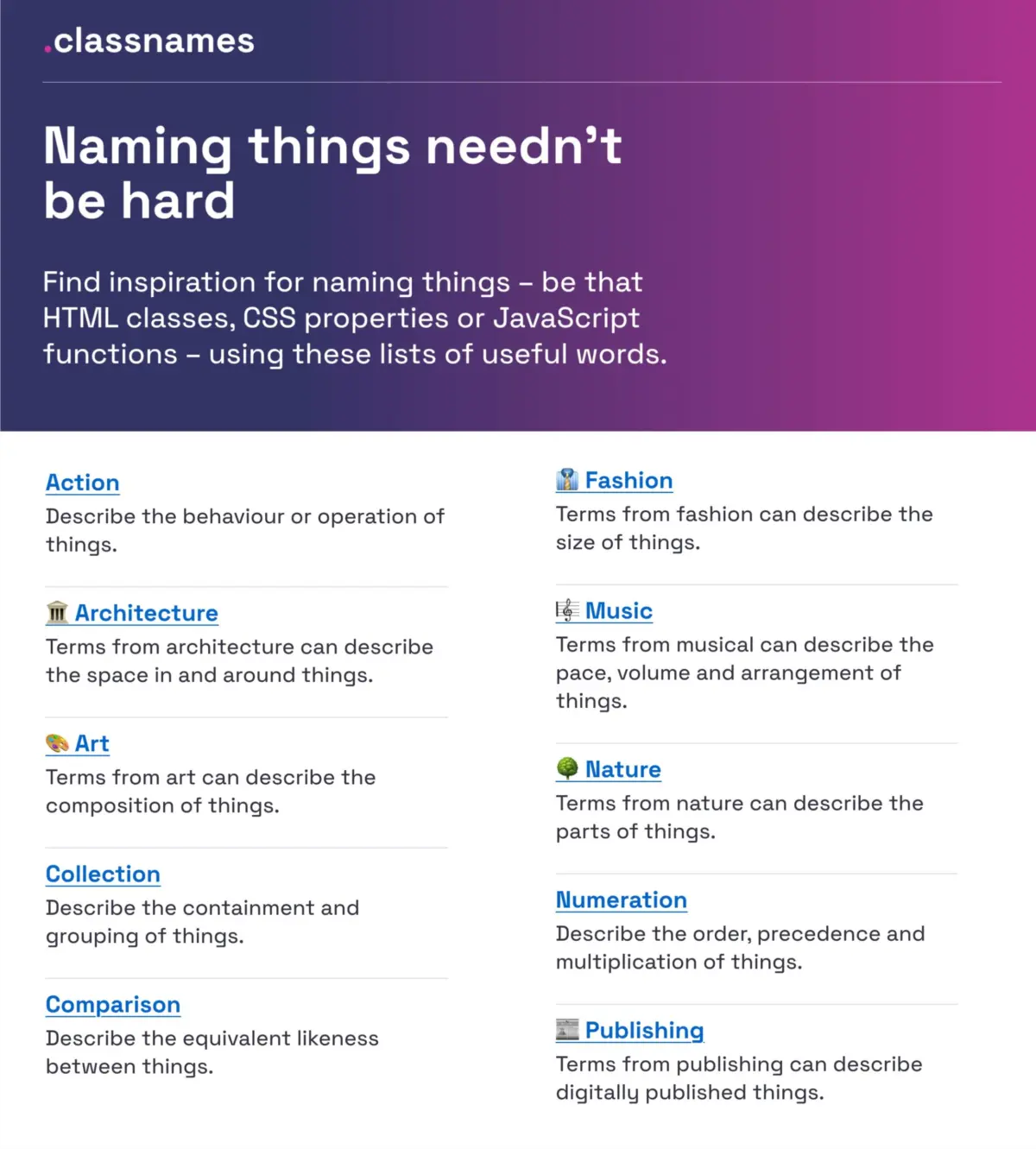
- Classnames: Maintained by Paul Robert Lloyd, Classnames is an exceptional resource packed with thematically grouped lists of words designed to get developers thinking outside the box. It offers terms describing behavior, likeness, order, and grouping, alongside poetic and thematic collections drawn from nature, art, theater, music, architecture, fashion, and publishing.
2. Standardizing Color Palettes
Colors are notoriously difficult to name objectively. Hex codes (#FF5733) are machine-readable but humanly opaque, while colloquial names (like "coral" or "burnt orange") are subjective.
- Color Names Repository: David Aerne maintains a massive repository featuring over 30,355 unique color names sourced from various references and thousands of user contributions. Accompanied by interactive color pickers and name-search utilities like Color Parrot, this repository serves as an invaluable reference for design systems teams establishing canonical color tokens.
3. Layer and Component Best Practices in Design Tools
In collaborative design environments like Figma, messy layer panels are productivity killers.

- Design Guidelines for Naming: Javier Cuello has formalized a set of best practices for naming layers, groups, and components consistently and scalably. An effective name, according to Cuello, possesses a logical structure, remains concise and meaningful, is universally understood across the team, and avoids reliance on fleeting visual properties (e.g., using PrimaryButton instead of BlueRoundedBox).
4. Enterprise-Grade Design Token Taxonomies
Scaling design tokens across a massive portfolio of products presents monumental organizational challenges.
- Intuit’s Token System: The parent company behind Mailchimp, QuickBooks, TurboTax, and Mint faced the daunting task of building a flexible token taxonomy that could serve widely disparate brand themes while maintaining a shared foundation. Nate Baldwin documented this transformation, detailing how Intuit overcame legacy technical debt to build a system centered around clear semantic mapping.
- Vodafone UK Variables Taxonomy Map: A stellar example of modern token architecture, Vodafone’s open-source Figma community file maps out the anatomy and categorization of design tokens. It establishes a four-tiered hierarchy—spanning from brand primitives to semantics and page-level variables—building upon Nathan Curtis’s foundational work on token naming.
- Design Token Naming Guide + Builder: Romina Kavcic’s interactive tool (
namedesigntokens.guide) and accompanying Design Token Names Inventory spreadsheet provide teams with a bird’s-eye view of their design tokens, allowing for seamless filtering, scalability, and adherence to structural roles and states.
5. UI Component Benchmarking
Reinventing the wheel—or worse, inventing a novel name for a standard UI pattern—creates unnecessary friction for users.
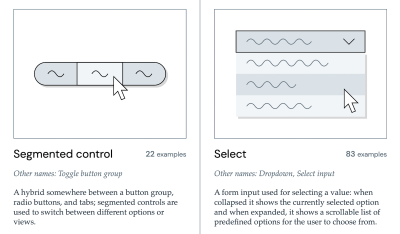
- The Component Gallery: Created by Iain Bean, this exhaustive directory collects interface components from real-world design systems. It indexes over 50 UI components (ranging from accordions to visually hidden elements) and lists alternative names each component goes by in the wild.
- Name That UI: A complementary visual dictionary designed to help practitioners quickly identify and correctly title common interface patterns.
Official Statements and Industry Insights
Industry leaders continually emphasize that nomenclature is not merely an aesthetic choice, but a fundamental driver of software quality and user experience.
Reflecting on the psychological impact of feature naming, UX strategist Erin Gannon notes in her foundational guide, What Do We Call This Thing?:

"Feature adoption needs time—first the feature must be discovered, then understood, then tried, learned, and eventually built into existing workflows. Good names are driven by user needs and problems. They should signal the value or outcome of a feature (the job-to-be-done), and—most importantly—tap into the user’s own language. Ask people to explain a feature in their own words, and then use the words they use."
Furthermore, design systems authorities frequently stress that semantic clarity outlives visual trends. When organizations name components after what they are rather than what they look like (e.g., naming a text style Heading-Large rather than Bold-Red-32px), they future-proof their products against inevitable redesigns and rebranding initiatives.

Future Outlook: The Next Frontier of Semantic Architecture
As the digital landscape marches toward hyper-personalized interfaces, artificial intelligence integration, and automated design-to-code pipelines, the importance of pristine nomenclature will only escalate.
Looking forward, we can anticipate several key shifts in how teams approach naming:

- AI-Assisted Taxonomy Generation: As Large Language Models (LLMs) become deeply integrated into design and development workflows, automated tools will increasingly scan codebases and design files to flag naming inconsistencies, suggest semantic tokens, and automatically reconcile discrepancies between designer and developer dialects.
- Automated Design Token Synchronization: The manual friction of translating Figma variable names into CSS custom properties or Swift tokens will vanish, replaced by automated synchronization pipelines governed by strict, machine-readable taxonomy maps.
- User-Centric Dynamic Lexicons: Future interfaces may dynamically adapt their internal terminology based on user telemetry—surfacing labels that align most closely with an individual user’s mental model and linguistic preferences.
Wrapping Up
Ultimately, the right name is the one that is universally understood, embraced, and actively utilized by both the multidisciplinary product team and the end-user. Countless hours are squandered every year simply because cross-functional teams speak in isolated dialects—the designer’s dialect, the developer’s dialect, the product manager’s dialect, and the user’s dialect.
By auditing your organization’s nomenclature, adopting proven community taxonomies (such as those found in The Component Gallery, Classnames, and enterprise token guides), and anchoring feature names in the user’s own language, you can systematically dismantle organizational friction. Pay close attention to naming conflicts, maintain an active backlog of technical debt related to terminology, and treat your lexicon with the same rigorous engineering standards you apply to your code. After all, clear communication begins with a shared vocabulary.
