

August 16, 2026
By Global Defense Desk
Executive Overview
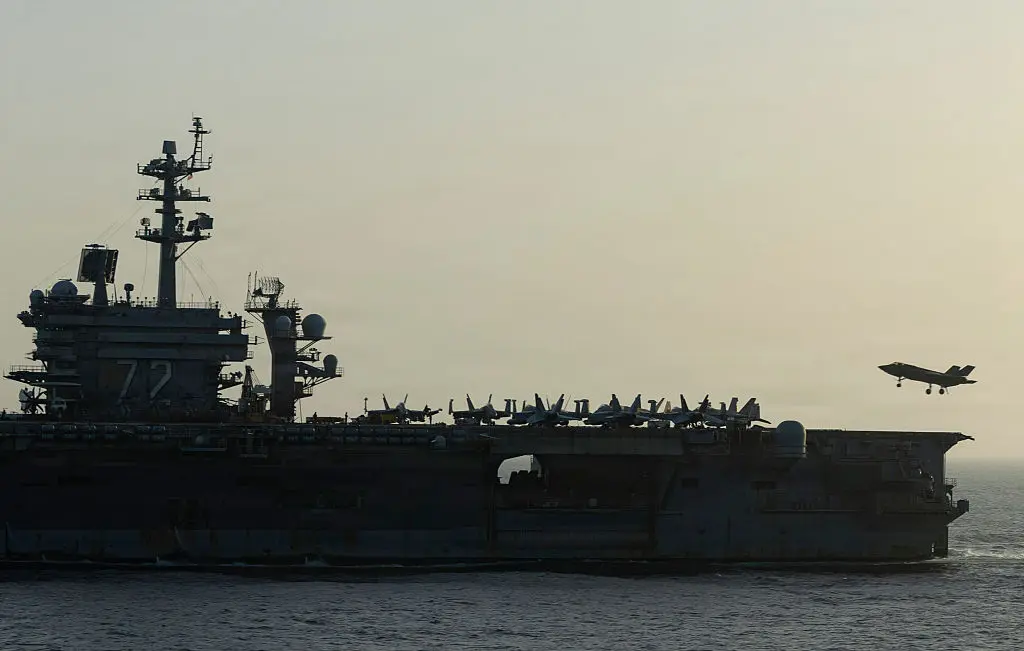
The nearly nine-month deployment of the nuclear-powered aircraft carrier USS Abraham Lincoln (CVN-72) has ignited a fierce national debate regarding military readiness, the welfare of service members, and the strategic strain placed on the U.S. Navy. Operating continuously in the Middle East in support of ongoing military operations against Iran, the ship has spent more than 260 days away from its home port of San Diego, California—including a grueling stretch of over 200 consecutive days without a single port call.
Amid severe reports of deteriorating living conditions, food shortages, compromised drinking water, and mounting psychological distress among the roughly 5,000 sailors and Marines aboard, top military leadership has descended upon the vessel to assess the situation. Admiral Brad Cooper, commander of U.S. Central Command (CENTCOM), boarded the carrier on Saturday during a 10-day regional tour, spending hours evaluating conditions and speaking directly with the exhausted crew.
Yet, even as relief approaches, the crisis has exposed a stark disconnect between the lived experiences of deployed service members and the public statements of civilian leadership. While military families and lawmakers sound the alarm over suicide risks and a perceived lack of institutional care, top Trump administration officials have dismissed the gravity of the situation. The controversy has not only underscored the human toll of protracted naval deployments but has also forced a high-stakes strategic gamble in the Western Pacific as the U.S. military rushes to rotate its dwindling carrier assets.
Detailed Chronology: From Departure to Crisis
To understand how the USS Abraham Lincoln became the epicenter of a political and humanitarian firestorm, it is necessary to examine the timeline of its relentless deployment.
- November 2025: The USS Abraham Lincoln and its associated strike group depart Naval Base Coronado in San Diego, embarking on what was initially framed as a standard Indo-Pacific and Middle East rotational deployment.
- Early 2026: As geopolitical tensions flare and operations tied to the conflict with Iran intensify, the Lincoln’s mission profile shifts dramatically. The ship is ordered to maintain a continuous, unyielding presence in the U.S. Central Command area of responsibility.
- Spring 2026: The carrier crosses the threshold of 150 days at sea without entering a port. Routine maintenance cycles are deferred, and logistical supply chains begin to experience significant friction due to the sheer duration of the mission.
- Summer 2026: The deployment surpasses the 200-day mark without a port call. Reports begin leaking ashore via distressed family members detailing systemic failures in shipboard infrastructure, including broken sanitation facilities, erratic laundry availability, and diminishing provisions.
- August 11–14, 2026: Reports emerge across defense and mainstream media outlets that multiple sailors have attempted to go overboard amidst acute mental health crises. Public outcry escalates sharply, drawing immediate defensive reactions from the White House and Pentagon leadership.
- August 16, 2026: CENTCOM Commander Adm. Brad Cooper boards the Lincoln to conduct an on-site evaluation. Simultaneously, the Navy initiates preparations to relieve the battered crew by dispatching the USS George Washington from the Western Pacific to the Middle East.
Supporting Context & Metrics: Conditions Aboard the Lincoln
The logistical and psychological realities of modern carrier aviation are punishing under normal circumstances, but the Lincoln’s current deployment has pushed the threshold of human endurance.
Infrastructure and Supply Chain Failures
Families of crew members have painted a grim picture of daily life inside the 1,092-foot floating city. With approximately 5,000 personnel relying on the ship’s systems, the breakdown of vital infrastructure has compounded operational stress:
- Water and Food: Reports indicate intermittent rationing or quality issues concerning potable water, alongside diminishing stocks of fresh food items, forcing crews to rely heavily on shelf-stable rations for extended periods.
- Sanitation: Widespread failures in shipboard plumbing—including broken showers and backed-up waste systems—have severely compromised basic hygiene standards for hundreds of sailors sharing tight berthing compartments.
- Isolation: The absence of port visits for more than 200 consecutive days has meant zero psychological decompression for the crew, denying sailors the fundamental reset that regular liberty stops provide.
The Mental Health Toll
The physical deprivation has been mirrored by psychological collapse. Multiple verified reports of sailors attempting to jump overboard highlight an acute mental health emergency. While the U.S. Navy has formally acknowledged dealing with individual mental health cases on the ship, it has pushed back against characterizations of a systemic or runaway crisis.
Nevertheless, military mental health advocates argue that extended deployments exponentially increase rates of anxiety, depression, and operational fatigue. Without adequate downtime, access to mental health professionals is often overwhelmed by the sheer volume of sailors in distress.
Official Statements and the Political Clash
The plight of the Lincoln has transformed from an internal military logistical issue into a high-profile political battleground, drawing sharp divisions between military families, veteran lawmakers, and civilian defense officials.
The Civilian Leadership Response
The Trump administration has largely rejected claims that the carrier’s conditions are unmanageable or that the deployment length is excessive.
Defense Secretary Pete Hegseth publicly stated that media reports detailing the conditions aboard the Lincoln have been heavily exaggerated or misrepresented. Doubling down on Friday, President Donald Trump went a step further, telling reporters that the carrier’s record-setting stretch at sea was "not nearly long enough," emphasizing the strategic necessity of maintaining an unyielding posture in the Middle East.
Pushback from Families and Lawmakers
These remarks triggered immediate fury from military advocacy groups and families of the deployed crew, who denounced the dismissive tone of the administration.
Elected officials soon entered the fray. On Sunday, Senator Ruben Gallego (D-Ariz.), a Marine Corps veteran, laid direct blame on the administration, characterizing the situation aboard the Lincoln as evidence of a "true lack of leadership" and a failure to prioritize the basic welfare of the rank-and-file.
Offering a measured institutional perspective, retired Admiral Mike Mullen, former chairman of the Joint Chiefs of Staff, appeared on ABC’s This Week. Mullen noted that while the damage to morale had been severe, crew spirits had finally begun to rebound upon receiving concrete news that relief and a return home were imminent.
Future Outlook: Strategic Costs and Operational Dilemmas
While the eventual return of the USS Abraham Lincoln to the United States will bring long-overdue relief to its exhausted crew, the maneuver highlights a deeper, systemic vulnerability within the U.S. Navy’s force structure: the over-extension of global carrier strike groups.
To relieve the Lincoln, the Pentagon has ordered the USS George Washington—the Navy’s only forward-deployed aircraft carrier, normally stationed in Japan—to depart the Western Pacific and steam toward the Middle East. This strategic pivot creates a critical vacuum, temporarily leaving the Western Pacific entirely devoid of a U.S. aircraft carrier presence at a time when Chinese military activity and assertiveness in the region are actively accelerating.
As military analysts dissect the fallout from the Lincoln deployment, fundamental questions remain regarding the sustainability of modern naval strategy. Without an expansion of the fleet or a recalibration of global commitments, the U.S. military risks trading the long-term well-being of its most valuable asset—its sailors—for short-term tactical presence. The Navy has yet to announce an official homecoming date for the Lincoln, but when the ship finally docks, the conversations sparked by its grueling voyage will likely resonate across the Pentagon for years to come.