In the fast-paced world of search engine optimization, visibility is everything. Gone are the days when digital marketers could rely on manual spreadsheets updated sporadically or accept weekly data batch updates as the industry standard. Today’s competitive digital landscape demands real-time, highly granular insights into search engine results pages (SERPs). Whether you are monitoring thousands of keywords for a global enterprise or tracking local map-pack rankings for a regional client, investing in specialized SERP tracking software has transitioned from a nice-to-have luxury to an absolute necessity.
The modern SERP is dynamic, volatile, and increasingly cluttered with rich features—ranging from AI Overviews and featured snippets to video carousels and People Also Ask (PAA) boxes. Without sophisticated tracking tools, digital marketers are essentially operating in the dark, unable to prove the return on investment (ROI) of their SEO campaigns or pivot quickly when search algorithms shift.
This comprehensive review examines the current state of search engine tracking software, breaks down the nine essential features every modern SEO professional must look for, and provides an in-depth analysis of the seven best SERP tracking tools available in 2025. By evaluating both dedicated standalone platforms and robust all-in-one SEO suites, this guide will equip you with the knowledge needed to select the ideal solution for your specific business requirements.
Detailed Chronology and Evolution of SERP Tracking
The evolution of rank tracking mirrors the maturation of the search engine optimization industry itself. In the early days of SEO, webmasters tracked progress using basic, locally installed desktop scrapers that checked a handful of exact-match keywords once a week. These rudimentary tools were notoriously prone to IP bans, CAPTCHAs, and data inaccuracies caused by personalized search histories.
As Google and other search engines evolved into hyper-personalized, context-aware platforms driven by machine learning, traditional rank tracking became obsolete. The introduction of local search intent, device-specific formatting (desktop versus mobile), and an explosion of SERP features fundamentally changed how users interact with search results.
The Shift to Cloud-Based, On-Demand Infrastructure
By the mid-2010s, the industry witnessed a massive migration toward cloud-based SERP tracking architectures. Platforms began leveraging distributed proxy networks to scrape search engines globally, capturing localized data down to the zip-code level. This technological leap eliminated the limitations of desktop software, allowing for automated, 24-hour batch updates.
The Rise of Real-Time Data and AI Integration
Entering 2025, the baseline expectations for rank tracking have shifted once again. Today’s market demands not just daily updates, but on-demand data refreshes accessible at the click of a button. Furthermore, the integration of artificial intelligence—exemplified by features like Google’s AI Overviews—has forced tracking software providers to adapt. Modern platforms no longer just track numerical positions; they monitor a staggering array of SERP features, quantify Share of Voice, and map ranking shifts directly to downstream traffic, conversions, and revenue.
Supporting Context and Metrics: Why Invest in SERP Tracking Software?
Securing executive buy-in or proving agency value requires concrete data. One of the leading indicators used to validate SEO efforts and justify ongoing budgetary investments is the ability to accurately track positioning movements across diverse search engines, geographical locations, and device types.
Investing in a robust SERP tracking solution unlocks several core capabilities:
Granular Progress Validation: Show stakeholders precisely how optimization efforts translate into upward momentum on the SERP.
Competitor Threat Detection: Identify when rivals are encroaching on your core keyword territory, allowing for proactive defensive strategies.
SERP Feature Capitalization: Discover which keywords trigger lucrative features (like Position #0 or AI Overviews) and implement targeted content updates to steal them.
Bottom-Line Correlation: Link ranking movements directly to organic traffic acquisition, conversion rates, and revenue generation by integrating with analytics platforms.
The 9 Essential Features to Look for in SERP Tracking Software
When evaluating software options, not all rank trackers are created equal. To ensure your investment pays off, look for these nine critical features:
1. Access Accurate On-Demand Ranking Updates
SERP positions fluctuate rapidly throughout the day. Waiting 24 hours—or several days—for a scheduled batch update is no longer acceptable. Leading platforms like AccuRanker provide automated daily updates while also offering on-demand data refreshes at the click of a button, ensuring you always have access to real-time metrics.
2. Monitor Performance Across SERP Features
Ranking in the traditional top ten is only half the battle. To truly dominate a niche, you must target SERP features such as AI Overviews, featured snippets, knowledge cards, and video carousels. Top-tier trackers allow you to monitor 50+ different SERP features in a single view, highlighting precisely where opportunities lie.
3. Track SERP Movement Across All Major Search Engines
While Google commands the lion’s share of global search traffic, comprehensive SEO campaigns—especially those targeting international markets like China or Russia—require multi-engine tracking. Look for platforms that support Google, Bing, Baidu, Yandex, and YouTube.
4. Granular Tracking (By Location and Device)
Local SEO campaigns require hyper-local data. Software like Semrush enables users to track keyword rankings down to the country, state, city, or even zip-code level, while simultaneously separating desktop performance from mobile rankings.
5. Map SERP Movements to Traffic and Revenue/Conversions
Tracking rankings in a vacuum is insufficient. Advanced platforms integrate seamlessly with Google Analytics or Adobe Analytics, combining keyword positions and Share of Voice metrics with bounce rates, load times, and conversion data to paint a complete picture of your bottom line.
6. View Historical Rank Performance
Point-in-time metrics tell a limited story. A superior SERP tracker provides deep historical data, enabling analysts to review long-term performance trends and benchmark them against competitors over months or years.
7. Run Competitor Comparisons
Market share is a zero-sum game. The best software distributes keywords into position buckets (e.g., positions 1-3, 4-10, 11-50) to track your visibility distribution relative to your top competitors over time.
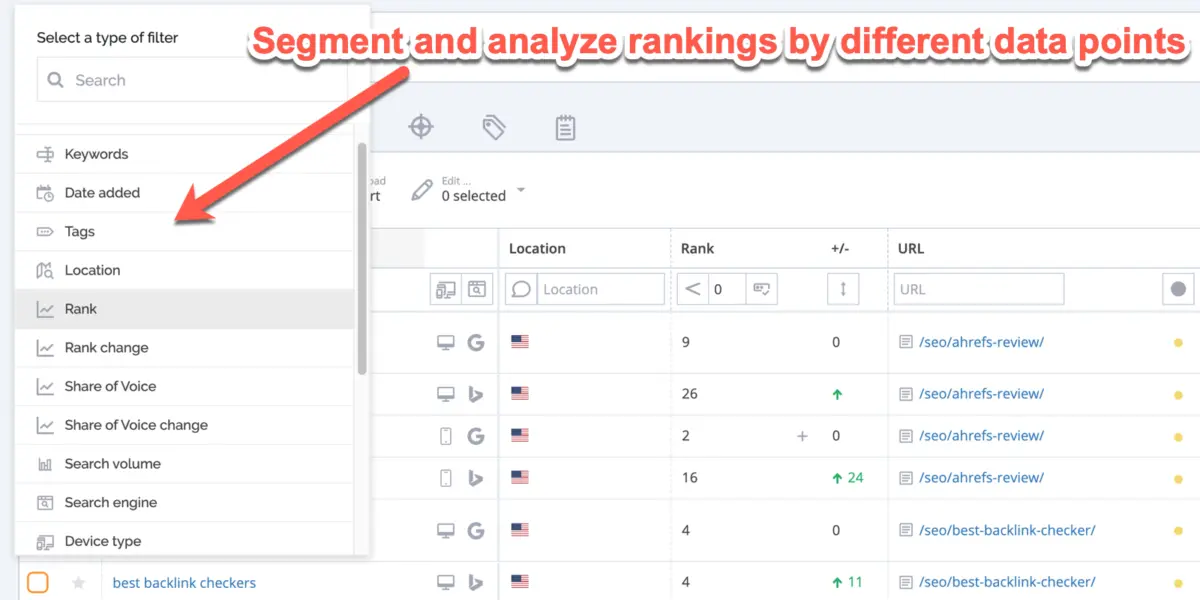
8. Tag and Segment Rankings Data
Keywords vary wildly in intent, topic, and funnel stage. Robust tagging and segmentation functionalities allow you to analyze performance by content category, user journey stage, or device type.
9. Generate White-Label Reports
For agencies and consultants, client reporting is a major touchpoint. Native white-label reporting features—alongside robust integrations with tools like Google Looker Studio (formerly Data Studio) and Databox—make it effortless to deliver clear, branded progress reports.
The 7 Best SERP Tracking Tools to Consider in 2025
The market features countless rank-tracking solutions. To simplify your decision-making process, we have curated a shortlist divided into dedicated standalone trackers and comprehensive all-in-one SEO platforms.
1. AccuRanker (Best Dedicated Standalone Tracker)
Overview: Trusted by over 32,000 companies—including enterprise giants like HubSpot, IKEA, and Kinsta—AccuRanker is widely regarded as the lightning-fast, highly accurate premier standalone SERP tracker on the market.
Key Features: On-demand ranking refreshes, deep Share of Voice analytics, comprehensive SERP feature tracking, and elite Google Analytics integrations.
Pricing: Plans scale based on tracked keyword volume, starting at $116/month for up to 1,000 keywords.
2. Semrush Position Tracker and SERP Gap Analyzer (Best All-in-One Solution)
Overview: Serving over 10 million users from brands like Samsung and Vodafone, Semrush offers an exceptional Position Tracking Tool embedded within its massive digital marketing suite. Its accuracy rivals dedicated trackers while providing holistic SEO capabilities.
Bonus Feature: The SERP Gap Analyzer (available via the Semrush App Center) scans search results to find under-optimized content, integrating directly with Google Search Console to deliver actionable optimization recommendations.
Pricing: Comprehensive platform subscriptions start at $139.95/month.
Overview: Used by more than 60,000 customers, ProRankTracker is a highly scalable, budget-friendly standalone solution tailored for agencies, enterprises, and video marketers needing multi-device, multi-language tracking.
Pricing: Subscription tiers begin at an accessible $39/month.
4. Advanced Web Ranking – AWR (Best for Enterprise & Custom Reporting)
Overview: A veteran standalone tool utilized by brands like Microsoft, AWR excels at high-volume, enterprise-grade SERP tracking across diverse geographic locations and highly customized white-label reporting environments.
Pricing: Plans begin at $99/month.
5. SERPWatcher by Mangools (Best for Simplicity and Usability)
Overview: Part of the Mangools SEO ecosystem and trusted by brands like Airbnb and adidas, SERPWatcher introduces the proprietary Performance Index, which calculates organic traffic potential based on current rankings and search volume.
Pricing: Bundled platform plans start at $29.90/month.
6. SE Ranking (Best Feature-Rich Mid-Market Suite)
Overview: SE Ranking simulates real user behavior within precise geographical targets to guarantee 100% accurate rank data across all major search engines and devices.
Pricing: Entry-level plans start at $52/month based on daily updates for 500 keywords.
7. Nightwatch (Best for Hyper-Local and Global Scale)
Overview: Trusted by Shopify and Coinbase, Nightwatch tracks search engine rankings across an astonishing 107,296 distinct global locations with pinpoint precision.
Pricing: A 14-day free trial is available, with paid tiers starting at $32/month for up to 250 keywords.
Official Statements and Industry Insights
Industry leaders continually emphasize the necessity of integrating rank data with broader business intelligence.
"It’s by far the best keyword ranking tracker in the market and has a ton of great reporting functions. If you want visibility on large volumes of keywords housed within a nice dashboard—this is for you."
— Matthew Howells-Barby, Co-Founder, TrafficThinkTank
Furthermore, modern reporting demands fluid data visualization. As Ian Howells, Co-Founder of Traffic Think Tank, notes regarding dashboard integrations:
"The thing that really got me using them heavily in the last month or two is their Google Data Studio connector. Combining the tag feature, as well as the Share of Voice metric… has been a big help in making these reports immediately digestible."
Future Outlook
As we look deeper into 2025 and beyond, the SERP tracking landscape will continue to be reshaped by artificial intelligence and shifting consumer search behaviors. Traditional blue links are rapidly sharing screen real estate with zero-click AI summaries, conversational search interfaces, and hyper-personalized local results.
Consequently, the future of rank tracking lies in contextual visibility. Future-proof tools will no longer measure success strictly by static numerical positions (e.g., ranking #3 versus #4). Instead, they will measure holistic digital footprint dominance—evaluating how brands capture attention across AI-generated answers, video carousels, and localized packs simultaneously.
Marketers who invest in agile, feature-rich SERP tracking software today will be uniquely positioned to decode these algorithmic shifts, protect their organic market share, and consistently tie search visibility directly to enterprise growth.


![7 Best SERP Tracking Tools for 2022 [In-Depth Review]](https://www.robbierichards.com/wp-content/uploads/2020/05/Best-SERP-Trackers.jpg)
![7 Best SERP Tracking Tools for 2022 [In-Depth Review]](https://www.robbierichards.com/wp-content/uploads/2020/04/image16-2.png)
![7 Best SERP Tracking Tools for 2022 [In-Depth Review]](https://www.robbierichards.com/wp-content/uploads/2020/04/image2-3.png)
![7 Best SERP Tracking Tools for 2022 [In-Depth Review]](https://www.robbierichards.com/wp-content/uploads/2020/04/image6-2.png)
![7 Best SERP Tracking Tools for 2022 [In-Depth Review]](https://www.robbierichards.com/wp-content/uploads/2020/04/image15.jpg)
![7 Best SERP Tracking Tools for 2022 [In-Depth Review]](https://www.robbierichards.com/wp-content/uploads/2020/04/image12-1.png)
![7 Best SERP Tracking Tools for 2022 [In-Depth Review]](https://www.robbierichards.com/wp-content/uploads/2020/04/image13-2.png)
![7 Best SERP Tracking Tools for 2022 [In-Depth Review]](https://www.robbierichards.com/wp-content/uploads/2020/04/image3.jpg)
![7 Best SERP Tracking Tools for 2022 [In-Depth Review]](https://www.robbierichards.com/wp-content/uploads/2018/08/rj-employee_Robbie-color-new.png)
![7 Best SERP Tracking Tools for 2022 [In-Depth Review]](https://www.robbierichards.com/wp-content/uploads/2020/05/Databox-SEO-dashboard-1.jpg)
![7 Best SERP Tracking Tools for 2022 [In-Depth Review]](https://www.robbierichards.com/wp-content/uploads/2020/04/image4-2.png)
![7 Best SERP Tracking Tools for 2022 [In-Depth Review]](https://www.robbierichards.com/wp-content/uploads/2020/04/image5.jpg)
![7 Best SERP Tracking Tools for 2022 [In-Depth Review]](https://www.robbierichards.com/wp-content/uploads/2020/05/AccuRanker-Google-Data-Studio-integration.jpg)