In the modern digital ecosystem, relying on static, manually updated spreadsheets to track search engine optimization (SEO) performance is an obsolete strategy. As search engine results pages (SERPs) evolve with real-time algorithm shifts, localized map packs, and dynamic AI-driven features like Google’s AI Overviews, digital marketers face an increasingly complex data landscape. Tracking a massive volume of keywords across multiple devices, international locations, and search engines demands sophisticated automation.
Enter professional Search Engine Results Page (SERP) tracking software. These platforms replace outdated manual logging with continuous, high-fidelity monitoring. They give businesses, agencies, and enterprise brands the ability to measure exact ranking movements, audit visibility gaps, and tie organic positions directly to bottom-line metrics such as traffic, conversions, and revenue.
This comprehensive guide examines why investing in advanced SERP tracking software is essential for proving SEO ROI in 2025. We will evaluate the nine critical features required in modern rank-tracking tools, review the seven best software options on the market—splitting them into dedicated standalone solutions and comprehensive all-in-one SEO platforms—and help you determine which tool aligns best with your strategic objectives.
Detailed Chronology: The Evolution of Rank Tracking
To understand why modern SERP tracking tools operate the way they do, it is helpful to look at how the technology has evolved over the past two decades:
The Manual Era (Pre-2010): SEO practitioners manually typed keywords into search engines, counted physical positions on the screen, and pasted URLs into desktop software or rigid Excel spreadsheets. Data was sporadic, prone to human error, and completely disconnected from user behavior analytics.
The Rise of Automated Desktop Trackers (2010–2015): Desktop-based applications emerged, allowing users to schedule local scrapes using proxy lists. While this eliminated some manual labor, these tools were resource-heavy, frequently blocked by search engine CAPTCHAs, and limited by local hardware limitations.
The Cloud-Based SaaS Revolution (2015–2020): Cloud infrastructure enabled SaaS companies to build scalable, cloud-hosted tracking engines. Tools introduced daily automated updates, historical charting, and early integrations with web analytics platforms like Google Analytics.
The Multi-Feature, AI-Driven Ecosystem (2020–Present): Today, SERP trackers must account for volatile SERP layouts, including local packs, video carousels, People Also Ask (PAA) boxes, and generative AI search results. Modern platforms offer on-demand data refreshes, hyper-local zip-code tracking, API connections to data visualization dashboards (such as Google Looker Studio), and automated gap analyses powered by machine learning.
Supporting Context & Metrics: Why Invest in SERP Tracking Software?
Proving the value of SEO to stakeholders has historically been difficult due to the lag time between optimization efforts and ranking improvements. Modern SERP tracking software bridges this gap by offering granular validation of your organic search investments.
When evaluated across key performance indicators (KPIs), the right software empowers digital marketing teams to:
Validate SEO Spend: Accurately correlate ranking improvements with increased organic traffic and revenue generation.
Mitigate Algorithm Volatility: Quickly identify sudden drops caused by core updates and isolate affected URL clusters or keyword tags.
Capitalize on SERP Features: Monitor fluctuations in "Position #0" elements, featured snippets, and AI-driven answer boxes to steal visibility from competitors.
Scale International and Local Campaigns: Track localized intent down to the city, state, or postal code level while managing multi-language international campaigns simultaneously.
9 Essential Features to Look for in SERP Tracking Software
Before committing capital to a subscription, organizations must audit software options against a strict feature checklist. The best SERP trackers in 2025 share these core capabilities:
1. Access Accurate On-Demand Ranking Updates
SERP positions fluctuate rapidly throughout the day. Waiting days for weekly batch updates is no longer acceptable. You need real-time, on-demand data refreshes. Platforms like AccuRanker lead this category by combining automated 24-hour background updates with on-demand manual refresh buttons.
2. Monitor Performance Across SERP Features
Securing a traditional top-three ranking is only part of the battle. Modern SERPs are dominated by AI Overviews, featured snippets, knowledge cards, and image packs. Advanced tracking tools allow you to monitor dozens of distinct SERP features across your keyword database from a single, unified view.
3. Track SERP Movement Across All Major Search Engines
While Google commands the majority of global search market share, enterprise campaigns often require cross-engine visibility. Ensure your chosen tool supports secondary and regional search engines—such as Bing, Baidu, Yandex, and YouTube—if your target demographic relies on them.
4. Granular Tracking (Location and Device)
Local search optimization requires pinpoint accuracy. Your tracking software must be able to report rankings down to the state, city, or zip-code level. Furthermore, it should seamlessly segment performance between desktop and mobile devices, as Google’s mobile-first index renders desktop-only tracking incomplete.
5. Map SERP Movements to Traffic and Revenue/Conversions
Rankings alone do not pay the bills. The best tools integrate with web analytics suites (such as Google Analytics or Adobe Analytics) to merge keyword positions and Share of Voice metrics with bottom-line data like organic sessions, bounce rates, goal completions, and eCommerce revenue.
6. View Historical Rank Performance
Point-in-time snapshots limit strategic forecasting. Comprehensive historical rank reporting allows SEO professionals to audit long-term performance trends, evaluate the impact of past site migrations, and benchmark progress against competitors over multi-year timelines.
7. Run Competitor Comparisons
Search visibility is a zero-sum game; when a competitor gains ground, you lose it. Effective trackers group your keywords into position buckets (e.g., 1-3, 4-10, 11-50) and track competitor distribution shifts over time to highlight emerging threats and content gaps.
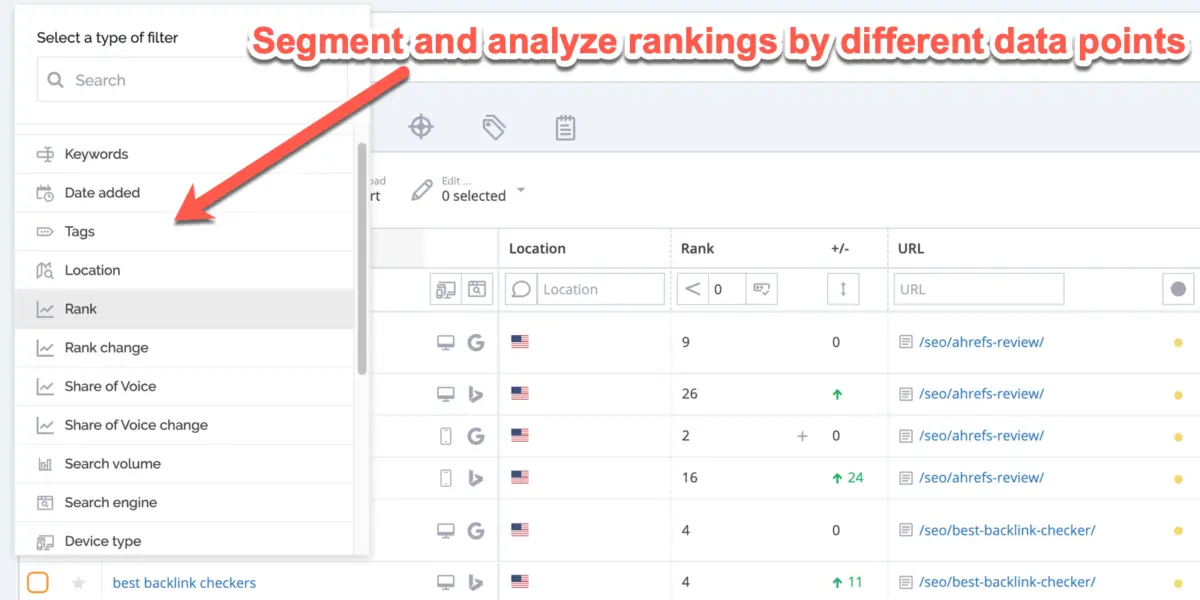
8. Tag and Segment Rankings Data
Managing thousands of keywords requires robust organizational architecture. Keyword tagging enables teams to segment performance data by content silos, marketing funnel stages (TOFU, MOFU, BOFU), product lines, or specific asset types.
9. Generate White-Label Reports
For agencies and enterprise consultants, client reporting must be clean, professional, and automated. Look for software that offers native white-label PDF reporting or seamless API connectors to third-party visualization platforms like Google Looker Studio and Databox.
Official Industry Perspectives
"It’s by far the best keyword ranking tracker in the market and has a ton of great reporting functions. If you want visibility on large volumes of keywords housed within a nice dashboard — this is for you." — Matthew Howells-Barby, Co-Founder, TrafficThinkTank
"The thing that really got me using them heavily in the last month or two is their Looker Studio connector. Combining the tag feature, as well as the Share of Voice metric, has been a big help in making these reports immediately digestible." — Ian Howells, Co-Founder, Traffic Think Tank
The 7 Best SERP Tracking Tools to Consider in 2025
The market features countless rank-tracking solutions, split into two primary categories: standalone trackers built exclusively for rank monitoring and reporting, and all-in-one SEO platforms that include robust tracking modules alongside auditing and keyword research suites.
1. AccuRanker
Category: Standalone SERP Tracker
Best For: Agencies, enterprise brands, and professionals requiring ultra-fast, on-demand data updates.
Overview:
AccuRanker is widely recognized as a premier standalone SERP tracking tool. Trusted by over 32,000 companies—including enterprise giants like HubSpot, IKEA, and Kinsta—it is engineered for speed and accuracy.
Key Features: Automated daily refreshes accompanied by on-demand manual updates; advanced SERP Analysis tracking 50+ distinct SERP features; deep integrations with Google Analytics and Adobe Analytics; robust tagging and segmentation capabilities; and native white-label reporting alongside a smooth Google Looker Studio connector.
Pricing: Plans scale based on tracked keyword volume, starting at $116 per month for up to 1,000 keywords.
2. Semrush Position Tracker and SERP Gap Analyzer
Category: All-in-One SEO Platform Module
Best For: Digital marketing professionals and enterprises seeking a comprehensive marketing suite with elite tracking capabilities.
Overview:
Semrush is an industry-standard all-in-one SEO platform used by over 10 million users, including global brands like Samsung, Vodafone, and Booking.com. Its Position Tracking Tool rivals the accuracy of dedicated standalone trackers.
Key Features: Hyper-local tracking from country down to zip-code/map-pack level; desktop and mobile comparison metrics; robust competitor visibility graphs; and access to advanced add-ons like the SERP Gap Analyzer app in the Semrush App Center, which automates content gap auditing and integrates directly with Google Search Console.
Pricing: Subscription plans start at $139.95 per month.
3. ProRankTracker
Category: Standalone SERP Tracker
Best For: International companies, agencies, and video marketers seeking cost-effective scalability.
Overview:
ProRankTracker is a robust, budget-friendly standalone rank-tracking platform trusted by over 60,000 users globally. It excels at delivering accurate, multi-language SERP data across diverse geographical locations and devices.
Pricing: Tiered pricing plans start at an accessible $39 per month.
4. Advanced Web Ranking (AWR)
Category: Standalone SERP Tracker
Best For: In-house enterprise teams and agencies needing deep data export options and white-label reporting.
Overview:
Advanced Web Ranking (AWR) is a veteran standalone SERP tracker utilized by major tech brands and enterprises like Microsoft. It is built to handle massive keyword portfolios with flexible update frequencies.
Key Features: Unlimited user seats on most plans; customizable white-label reporting engines; cross-device and multi-location tracking; and powerful data export options via API.
Pricing: Professional subscription plans begin at $99 per month.
5. SERPWatcher (by Mangools)
Category: All-in-One SEO Platform Module
Best For: Startups, small business owners, and freelancers looking for simplicity and affordability.
Overview:
SERPWatcher is the dedicated rank-tracking tool within the Mangools all-in-one SEO ecosystem. Trusted by brands like Airbnb and Adidas, it is celebrated for its clean, user-friendly interface.
Key Features: Proprietary Performance Index metric that evaluates total organic traffic potential based on current rankings and search volumes; interactive email alerts for significant rank changes; and seamless integration with Mangool’s companion tool, SERPChecker.
Pricing: Mangools bundle plans start at $29.90 per month.
6. SE Ranking
Category: All-in-One SEO Platform Module
Best For: Small-to-midsize businesses and digital agencies looking for an all-inclusive toolkit.
Overview:
SE Ranking is a feature-rich, all-in-one SEO software platform featuring a high-precision Position Tracking Tool. It simulates local user behavior to collect 100% accurate ranking data across major search engines.
Key Features: Daily ranking updates with zero data fluctuation issues; comprehensive competitor ranking matrices; marketing plan generators; and automated professional reporting.
Pricing: Subscription plans start at $52 per month (based on daily tracking for 500 keywords).
7. Nightwatch
Category: Standalone SERP Tracker
Best For: Global enterprises, agencies, and local businesses requiring hyper-localized data granularity.
Overview:
Nightwatch stands out as one of the most technologically advanced daily SERP trackers on the market. Trusted by brands like Shopify, Scotiabank, and Coinbase, it pulls data from over 107,296 distinct global locations.
Key Features: Advanced data segmentation; exceptional site-audit and backlink monitoring integrations; flexible custom reporting dashboards; and precise local intent tracking.
Pricing: Offers a 14-day free trial, with paid tiers starting at $32 per month for up to 250 keywords.
Future Outlook: The Next Generation of SERP Tracking
As we look further into 2025 and beyond, the definition of a "ranking" is undergoing a structural transformation. With the proliferation of generative artificial intelligence in search engine results, traditional blue links are increasingly sharing screen space with conversational AI answers, interactive widgets, and dynamic knowledge graphs.
Future-proof SERP trackers will no longer measure success solely by positional number (e.g., #1, #2, #3). Instead, platforms will evolve to measure Share of Screen, tracking how much visual real estate a brand commands across traditional organic listings, AI summaries, and rich media snippets.
Whether you choose a dedicated standalone solution like AccuRanker for pure tracking velocity or an all-in-one powerhouse like Semrush for holistic marketing insights, investing in the right SERP tracking software is no longer optional—it is the foundational cornerstone of sustainable organic growth.
Which SERP tracker is currently powering your SEO strategy? Share your experiences and tool preferences in the comments below.


![7 Best SERP Tracking Tools for 2022 [In-Depth Review]](https://www.robbierichards.com/wp-content/uploads/2020/05/Best-SERP-Trackers.jpg)
![7 Best SERP Tracking Tools for 2022 [In-Depth Review]](https://www.robbierichards.com/wp-content/uploads/2020/04/image16-2.png)
![7 Best SERP Tracking Tools for 2022 [In-Depth Review]](https://www.robbierichards.com/wp-content/uploads/2020/04/image2-3.png)
![7 Best SERP Tracking Tools for 2022 [In-Depth Review]](https://www.robbierichards.com/wp-content/uploads/2020/04/image6-2.png)
![7 Best SERP Tracking Tools for 2022 [In-Depth Review]](https://www.robbierichards.com/wp-content/uploads/2020/04/image15.jpg)
![7 Best SERP Tracking Tools for 2022 [In-Depth Review]](https://www.robbierichards.com/wp-content/uploads/2020/04/image12-1.png)
![7 Best SERP Tracking Tools for 2022 [In-Depth Review]](https://www.robbierichards.com/wp-content/uploads/2020/04/image13-2.png)
![7 Best SERP Tracking Tools for 2022 [In-Depth Review]](https://www.robbierichards.com/wp-content/uploads/2020/04/image3.jpg)
![7 Best SERP Tracking Tools for 2022 [In-Depth Review]](https://www.robbierichards.com/wp-content/uploads/2018/08/rj-employee_Robbie-color-new.png)
![7 Best SERP Tracking Tools for 2022 [In-Depth Review]](https://www.robbierichards.com/wp-content/uploads/2020/05/Databox-SEO-dashboard-1.jpg)
![7 Best SERP Tracking Tools for 2022 [In-Depth Review]](https://www.robbierichards.com/wp-content/uploads/2020/04/image4-2.png)
![7 Best SERP Tracking Tools for 2022 [In-Depth Review]](https://www.robbierichards.com/wp-content/uploads/2020/04/image5.jpg)
![7 Best SERP Tracking Tools for 2022 [In-Depth Review]](https://www.robbierichards.com/wp-content/uploads/2020/05/AccuRanker-Google-Data-Studio-integration.jpg)
![7 Best SERP Tracking Tools for 2022 [In-Depth Review]](https://www.robbierichards.com/wp-content/uploads/2018/11/Ian-Howells2.png)