

Executive Overview
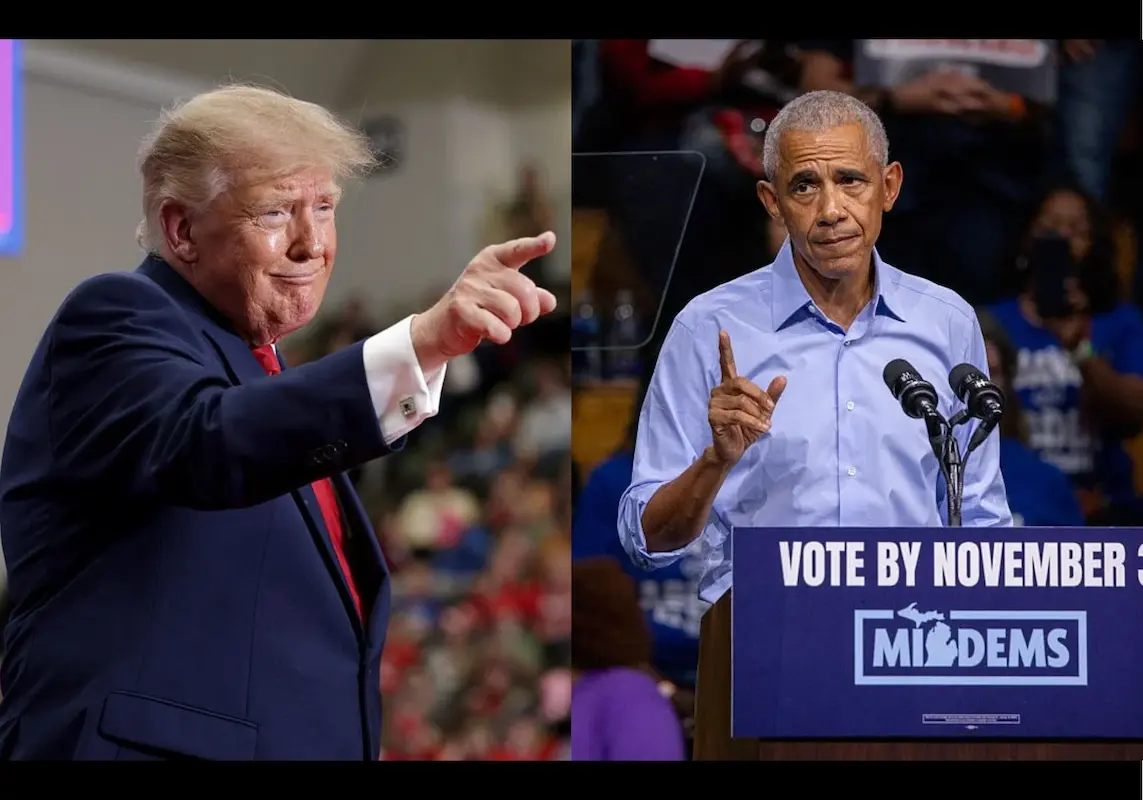
The political battlegrounds of the American Midwest transformed into a high-stakes ideological theater this weekend, as former President Barack Obama and President Donald Trump converged on the region in a striking, back-to-back duel of political heavyweights. With the critical midterm elections looming, both leaders utilized the campaign trail to rally their respective bases, offering starkly contrasting visions of the nation’s future. Yet, what began as a routine weekend of partisan mobilization quickly escalated into a fiery controversy centered on identity, xenophobia, and the boundaries of acceptable political discourse.
The flashpoint of the weekend occurred in Michigan, where President Trump launched a series of aggressive and unsubstantiated attacks against Democratic Senate candidate Abdul El-Sayed. Trump accused the physician and former public health official—who is running against Republican candidate Mike Rogers—of being a "jihadist" and a member of the Muslim Brotherhood, while leveling baseless claims that El-Sayed intended to impose Sharia law in the United States.
Trump’s vitriolic rhetoric arrived mere hours after former President Obama campaigned in Detroit specifically to defend El-Sayed. Drawing a direct parallel to the racist "birther" conspiracy theories that plagued his own political career, Obama urged voters to reject the weaponization of identity and faith in American politics.
As the race enters its final stretch, this weekend’s dueling rallies have crystallized the profound polarization defining the midterms. Beyond the immediate electoral implications for Michigan and neighboring Ohio, the escalating rhetoric signals a dangerous new normal in modern American politics—one where questions of patriotism and religious affiliation are deployed as weaponized wedge issues on the national stage.
Detailed Chronology
Saturday: Obama Rallies the Midwest in Ohio and Michigan
The weekend’s political drama kicked off on Saturday, October 24, 2026, when former President Barack Obama embarked on a multi-state swing through the industrial Midwest. His first major stop was in Cleveland, Ohio, where he campaigned alongside Democratic Senate candidate Sherrod Brown—who is locked in a fierce battle against Republican incumbent Jon Husted—and gubernatorial candidate Amy Acton, who faces Trump-backed contender Vivek Ramaswamy.
Addressing a fired-up crowd of supporters, Obama wasted little time launching into a critique of the current administration’s economic priorities and aesthetic choices. In a moment that quickly went viral across national media platforms, Obama mocked the opulent, gold-heavy interior renovations of the White House implemented under Trump’s watch.
"He’s got the White House looking like Saddam Hussein opened a Cheesecake Factory," Obama joked to roaring applause in Cleveland. "He should be on HGTV," he added, pivoting to a serious critique of how the administration’s focus on personal luxury starkly contrasted with the daily financial struggles of working-class Americans facing persistent inflation and rising living costs.
Obama also took aim at a controversial campaign advertisement produced by Vivek Ramaswamy’s gubernatorial campaign, which featured Acton’s estranged mother. The former president condemned the ad as a crossing of ethical lines, arguing that the ruthless pursuit of political ambition does not justify dragging personal family trauma into the public square.
Later on Saturday, Obama traveled to Detroit, Michigan, to stump for Abdul El-Sayed and Democratic gubernatorial candidate Jocelyn Benson. It was during this appearance that Obama addressed the rising tide of Islamophobic attacks directed at El-Sayed, a former public health official who stands to become the United States Senate’s first Muslim member if victorious in November.
Invoking the memories of the racist birther conspiracy theories that Donald Trump popularized during Obama’s own tenure in the White House, the former president offered a passionate defense of his fellow Democrat.
"We have seen this movie before. I starred in it," Obama told the Detroit crowd. "I have a long form birth certificate to prove it."
Sunday: Trump Escalates Attacks in Port Huron
The political temperature spiked dramatically the following day, Sunday, October 25, 2026, when President Trump traveled to Port Huron, Michigan, to hold a high-profile campaign rally intended to bolster Republican Senate candidate Mike Rogers. Rather than focusing solely on traditional economic talking points or policy debates, Trump used the platform to double down on an inflammatory narrative he had introduced earlier that morning via his social media platform, Truth Social.
Writing on Truth Social prior to the event, Trump declared: "Heading to Michigan to fight a Jihadist Member of the Muslim Brotherhood," explicitly referring to El-Sayed. He went on to claim that the Democratic candidate sought to impose Sharia law across the United States, concluding with the ominous assertion: "If it ever does, he should be the first that’s tried!" No evidence was offered to substantiate either claim.
At the Port Huron rally itself, Trump reiterated these baseless allegations before thousands of cheering supporters. "I’m here to keep a jihadist Muslim Brotherhood member from becoming a United States senator," Trump stated.
In a particularly striking rhetorical pivot, Trump invoked the harrowing events of the September 11, 2001, terrorist attacks to frame the Michigan Senate race as an existential battle. He explicitly compared political opposition to El-Sayed’s candidacy to the heroic actions of the passengers aboard United Flight 93, who fought back against terrorist hijackers on 9/11.
"Twenty-five years later, Michigan needs to stand up and fight, just like Todd did, to stop a jihadist from walking into the Capitol," Trump told the crowd, referencing passenger Todd Beamer, whose famous final words were "Let’s roll."
The rhetoric at the rally was further amplified by the appearance of David Beamer, the father of the late 9/11 hero. Taking the stage to address the crowd, the elder Beamer questioned El-Sayed’s fundamental claim to American identity, arguing that simply being born within the borders of the United States and holding an American birth certificate did not automatically qualify someone to be considered a "real American."
In addition to his attacks on El-Sayed, Trump’s wide-ranging speech touched on familiar grievances, including unsubstantiated allegations of widespread fraud during the 2020 presidential election, while launching direct verbal assaults against Michigan Secretary of State and gubernatorial nominee Jocelyn Benson. Republican candidates Mike Rogers and John James also spoke at the event, urging conservatives to turn out in force to secure a Republican majority in the Senate.
Supporting Context & Metrics
The intense political theater playing out in Michigan and Ohio is underpinned by razor-thin polling margins, shifting demographics, and a fiercely competitive map for control of the United States Senate.
The Michigan Senate Race: A Historical Milestone
The race between Republican Mike Rogers and Democrat Abdul El-Sayed represents one of the most closely watched Senate contests of the 2026 midterm cycle. Michigan has long stood as a crucial Rust Belt battleground, characterized by a diverse electorate that includes a substantial and politically active Arab-American and Muslim-American population, particularly centered around the Detroit metropolitan area.
Should El-Sayed secure victory in November, he will shatter a historic glass ceiling by becoming the first Muslim senator in the history of the United States. His platform has heavily emphasized public health infrastructure, economic equity, and investments in working-class communities—issues that resonated strongly during his tenure as a public health official. However, his historic candidacy has also made him a prime target for national conservative figures seeking to mobilize right-wing voters through cultural and religious anxieties.
The Role of Dog-Whistle Politics and Islamophobia
Political analysts note that Trump’s deployment of terms like "jihadist," "Muslim Brotherhood," and "Sharia law" against El-Sayed represents a deliberate escalation of Islamophobic rhetoric designed to energize core segments of the Republican base. Civil rights organizations, including the Council on American-Islamic Relations (CAIR), have repeatedly condemned such attacks, pointing out that painting a Muslim-American candidate with broad, unsubstantiated brushes of extremism endangers the safety of candidates and private citizens alike.
Furthermore, the invocation of 9/11 imagery and the questioning of a citizen’s Americanness based on their religion or ethnic background echoes historical patterns of nativism in American politics. By framing an ordinary democratic election as a literal battle against internal terrorism, the campaign has successfully polarized the electorate along deeply emotional and sectarian lines.
Midterm Landscape: The Battle for Congress
Beyond the individual personalities involved, this weekend’s events highlight the precarious balance of power in Washington. With the Senate evenly divided or hanging in the balance, both parties view the industrial Midwest as an absolute must-win region.
- Ohio: The race between incumbent Democrat Sherrod Brown and Republican challenger Jon Husted, alongside the high-profile gubernatorial battle featuring Amy Acton and Vivek Ramaswamy, serves as a referendum on economic populism and health care policy.
- Michigan: The contest between Rogers and El-Sayed serves as a test of whether progressive, diverse coalitions can hold their ground against traditional Rust Belt conservatism turbocharged by national culture-war politics.
Official Statements
The events of the weekend drew swift, sharply contrasting reactions from political campaigns, advocacy groups, and public figures across the country.
-
Abdul El-Sayed’s Campaign:
In response to Trump’s repeated allegations, El-Sayed has maintained a steadfast denial of any affiliations with extremist organizations, repeatedly pointing to his record as a public servant and physician dedicated to the well-being of all Michiganders. During recent media appearances, including an interview on national television, El-Sayed dismissed the attacks as desperate, bad-faith smears intended to distract voters from the real issues facing the state, such as healthcare access, education funding, and economic opportunity. -
Former President Barack Obama (via campaign remarks):
"We have seen this movie before. I starred in it. I have a long form birth certificate to prove it," Obama remarked in Detroit, drawing a direct line between the racially and religiously charged attacks directed at El-Sayed and the "birther" campaigns that targeted his own legitimacy years prior. Obama urged voters to reject politics rooted in division and fear. -
President Donald Trump (via Truth Social and Port Huron Rally):
"Heading to Michigan to fight a Jihadist Member of the Muslim Brotherhood… If it ever does, he should be the first that’s tried!" Trump wrote on Truth Social, later adding at his Port Huron rally: "Twenty-five years later, Michigan needs to stand up and fight, just like Todd did, to stop a jihadist from walking into the Capitol." -
Civil Rights and Interfaith Organizations:
National advocacy groups issued joint statements condemning the mainstreaming of Islamophobic rhetoric in high-level political campaigns. Leaders emphasized that questioning the patriotism and citizenship of candidates based on their faith undermines the foundational constitutional principle of religious freedom in the United States.
Future Outlook
As the calendar turns toward November, the final weeks of the 2026 midterm cycle promise an escalation of the fierce rhetorical battles witnessed this weekend in Michigan and Ohio.
The convergence of two former presidents on the campaign trail underscores a growing trend in American politics: national figures are increasingly stepping in to eclipse local candidates, transforming regional races into nationalized referendums on the broader direction of the country. For Donald Trump, keeping his name and his brand at the center of the political conversation remains a core strategy for driving Republican voter turnout, even in states where he is not personally on the ballot. For Democrats like Barack Obama, the mission is to mobilize multi-ethnic, urban, and suburban coalitions to counter high-intensity conservative enthusiasm.
Ultimately, the controversy surrounding Abdul El-Sayed’s candidacy in Michigan will serve as a profound test for the American electorate. It will determine whether campaigns driven by nativist rhetoric and unsubstantiated fear-mongering succeed at the ballot box, or whether voters ultimately reject such tactics in favor of debates centered on governance, policy, and community well-being. As both parties pour millions of dollars and heavy star power into the final stretch, the eyes of the nation remain firmly fixed on the Rust Belt.