

Executive Overview
Every digital native knows the unique, fleeting euphoria of launch day. The final Git branch merges cleanly, DNS propagation finishes, and the site goes live exactly as envisioned. For a brief, shining window, the website is pristine. It is perfectly coded, meticulously designed, and flawlessly aligned with the company’s current strategic messaging.
It will
never be this good again.
This is not because the site will inevitably break. Modern hosting infrastructure, continuous integration pipelines, and robust content management systems ensure that the core technology remains operational. Instead, a more insidious force takes over: environmental drift. Markets shift, competitors pivot, messaging evolves, and the meticulous creation of yesterday slowly, imperceptibly stops matching the reality of the enterprise it represents. Twelve months later, that once-cutting-edge digital property is effectively a period piece. It is not necessarily broken; it is merely behind.
For decades, digital teams have treated this steady, entropic decay as an immutable law of nature. Maintenance is viewed as a reactive tax—a cycle of emergency redesigns, ad-hoc bug fixes, and scramble-mode content updates that occur only when the gap between the website and the business becomes too wide to ignore.
However, a new paradigm threatens to upend this status quo. Enter the era of autonomous websites: digital properties continuously monitored, refined, and optimized by artificial intelligence agents long after the human development team has moved on to other projects.
Yet, when developers and platform architects begin to take the concept of full web autonomy seriously, they run into a psychological and organizational roadblock that has very little to do with raw technology: Almost nobody actually wants a website that changes entirely on its own.
Drawing from real-world development insights on platforms like Fimo, this article investigates the delicate intersection of web autonomy, human agency, and the future of digital maintenance. We explore why total automation is a flawed objective, how different stakeholders draw distinct boundaries of control, and why the ultimate goal of AI is not to replace human creativity, but to arrest digital decay.
Detailed Chronology: The Evolution of Web Maintenance and the Rise of Agents
To understand why autonomous websites represent such a profound shift, we must examine how the relationship between creators and their digital properties has evolved over the past three decades.
Era 1: The Static Web and Manual Edits (1990s–2000s)
In the early days of the internet, websites were literal files sitting on servers. Updating a page required writing raw HTML, utilizing an FTP client like FileZilla, and manually uploading files. Maintenance was intensely manual, slow, and prone to human error. If a brand logo changed or a phone number updated, a developer had to hunt down every instance across dozens of static pages.
Era 2: The Content Management System (CMS) Revolution (2000s–2015s)
The rise of platforms like WordPress, Drupal, and eventually headless architectures decoupled content from code. Non-technical stakeholders could finally update blog posts and landing pages without editing source files. However, while CMS platforms democratized content creation, they did nothing to solve the underlying problem of architectural maintenance. Broken links, accessibility regressions, unoptimized image assets, and outdated metadata still required active human vigilance.
Era 3: The Modern CI/CD and Design System Era (2015s–Present)
Version control, component libraries, and automated deployment pipelines streamlined the shipping process. Teams could deploy updates continuously. Yet, this paradoxically increased the cognitive load on engineering and design teams. A change in a central design token—such as altering a border-radius or adjusting a color palette—could easily fail to propagate to edge pages, legacy landing pages, or specific components buried deep within the site hierarchy.
The Agentic Pivot (The Near Future)
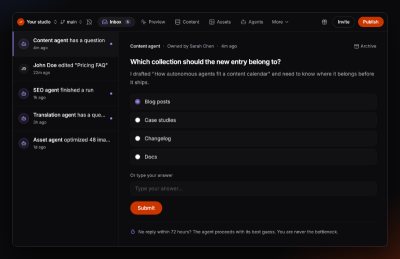
We are now entering the fourth phase: the agentic web. In this model, autonomous agents are integrated directly into the web infrastructure. Picture a workflow where, while you sleep, an AI agent detects that last week’s design-system update failed to propagate to the pricing page and automatically rectifies it. Another agent flags an uncompressed image asset uploaded during a rushed marketing push and compresses it without losing visual fidelity. A third agent identifies an accessibility regression introduced by a newly deployed component, drafting a patch or filing an intelligent pull request.
This is the promise of the autonomous website: a digital property that wakes up measurably better than the one you left behind, accompanied by a curated briefing of decisions requiring human oversight. But fulfilling this promise requires navigating a profound philosophical hurdle.
Supporting Context & Metrics: The Anatomy of Digital Decay
Why do websites rot? The answer lies in the velocity of modern business versus the friction of web operations.
According to internal analytics and developer surveys across major web agencies:
- Over 60% of enterprise websites contain broken links or orphaned internal pages within six months of a major redesign.
- Accessibility compliance (WCAG standards) degrades by an estimated 35% over a year as marketing teams rapidly ship new landing pages without running formal screen-reader or contrast checks.
- Asset bloat accumulates steadily, with uncompressed hero images and legacy JavaScript bundles compounding page-load latency by an average of 1.8 seconds annually.
These are not technical failures; they are organizational bottlenecks. Engineering teams are incentivized to build new features, not scrub metadata. Marketing teams are incentivized to drive conversions, not audit alt tags. Consequently, routine maintenance falls into a cultural blind spot.
When developers first experiment with autonomous agents, they frequently make the mistake of aiming for full autonomy: handing over the keys of the entire domain to an LLM-driven agentic loop, allowing it to write, edit, optimize, and publish continuously.
When users experience this in practice, however, they recoil. The hesitation does not stem from a distrust of artificial intelligence capabilities; rather, it stems from a fundamental organizational reality: A website has no single owner.
Different segments of a web property belong to different stakeholders, and each stakeholder demands a distinct threshold of autonomy. To build functional autonomous web platforms, engineering teams must dissect maintenance tasks into three distinct categories:
- The No-Brainers (The Chores): Rule-bound, repetitive, and entirely objective tasks. These include maintaining accessibility compliance, propagating design tokens, fixing broken meta tags, compressing assets, and correcting rotted hyperlinks. No human’s unique creative talent lies in spotting a missing alt attribute. Handing this 80% of administrative overhead to agents is an unmitigated relief.
- The Untouchables (Core Judgment): The subjective, high-touch creative work that defines a brand’s identity. An agent can check contrast ratios and heading structures, but it cannot decide what a page feels like or whether a campaign aligns with the company’s long-term artistic vision. This judgment is why human professionals are hired in the first place.
- The Variable Boundary: The gray area where tasks cannot be neatly categorized because the line of delegation depends entirely on who is looking at the change.
To illustrate this variable boundary, consider a single operational update: switching the default landing page theme to dark mode. An AI agent can execute this transition across the entire site in seconds.
However, the question of who holds the authority to approve that change depends entirely on the stakeholder:
- For the brand designer, the default theme is not a simple UI setting—it is a deliberate statement regarding how the brand wishes to project its identity to first-time visitors. They demand manual veto power.
- For the frontend developer, it is a rational, one-line configuration change with clear performance and user-preference logic. They would happily delegate this task to an agent and move on.
The same change, on the same site, elicits two entirely opposite workflows. This proves that "right" is not an objective setting baked into a software product; it is a function of where an individual’s professional value resides.
Official Industry Perspectives & Expert Insights
As platforms like Fimo and other agentic web ecosystems mature, industry leaders are recalibrating how they talk about automation. The conversation has shifted away from job displacement toward cognitive reallocation.
"The point of autonomy was never to remove you from your website. It was to remove the decay."
— Pierre Burgy, Co-Founder
Industry analysts point out that human-AI collaboration in web development mirrors the evolution of autopilot systems in aviation. Pilots do not fly planes manually during cruising altitude, nor are they absent from takeoff and landing. Instead, they manage systems, handle edge cases, and retain ultimate command authority while automation handles the grueling mechanics of flight stabilization.
Furthermore, security and compliance experts emphasize that autonomous agents must operate within strict guardrails. Unsupervised content generation risks brand safety, hallucinations, and compliance violations if agents are allowed to alter regulatory disclaimers or pricing terms without verification.
Therefore, modern platform architecture is moving away from a binary toggle ("Autonomous" vs. "Manual") toward composable agent architecture. Developers do not simply flip a switch; they assemble bespoke teams of specialized agents—such as an Asset Agent for media optimization, an Accessibility Agent for WCAG compliance, and a Translation Agent for localization—each configured with precise permissions and boundaries.
Crucially, these agents are dynamic. Trust is not granted upfront; it is earned over time. As an accessibility agent consistently flags and rectifies color contrast issues without error, human supervisors gradually widen its operational permissions. The boundary of autonomy becomes a living threshold that shifts outward as the agent proves its reliability.
Future Outlook: The Death of the Frozen Site
As we look toward the latter half of the 2020s, the implications of the autonomous web will fundamentally alter digital strategy.
First, the traditional "redesign cycle"—where companies suffer through 18 months of stagnation followed by an expensive, disruptive, multi-million-dollar website overhaul—will become obsolete. Websites will become living, breathing digital organisms that evolve continuously alongside market conditions, product updates, and user behavior.
Second, the role of the web developer and designer will elevate. Stripped of the soul-crushing administrative burden of hunting down broken links, updating copyright years, and resizing banner images, creative professionals will be free to focus entirely on high-level strategy, immersive storytelling, and innovative user experiences.
Finally, the psychological barrier of "fear of the machine" will dissolve as inspection and observability tools improve. With granular change logs, before-and-after visual diffs, and transparent reasoning trails, human operators will retain absolute visibility into every micro-adjustment made by their digital workforce.
The frozen site—static, neglected, and slowly drifting into irrelevance—will soon be viewed as a relic of an inefficient past. In its place stands the autonomous web: a self-healing, continuously optimized digital frontier where humans provide the vision, and agents handle the upkeep.
