For decades, the standard paradigm of human-computer interaction has relied on a rigid, transactional contract: if a user wanted to achieve a digital objective—whether purchasing an airline ticket, configuring a software dashboard, or researching a complex medical condition—they were expected to manually navigate a labyrinth of user interfaces. Modern software has long demanded that humans act as active data processors, clicking through menus, adjusting range sliders, filling out multi-step checkout forms, negotiating cookie consent pop-ups, and managing dozens of browser tabs simply to cross-reference basic information. We have quietly grown accustomed to spending more time managing the software than actually achieving our underlying goals.
Today, that foundational contract is breaking down. Driven by rapid advancements in artificial intelligence, machine learning architectures, and large language models (LLMs), a revolutionary paradigm is taking shape across the web: Intent-Driven Design.
Rather than expecting human users to learn complex menus and manually execute multi-step sales funnels, a new wave of digital platforms operates by capturing high-level human goals and silently executing the heavy lifting in the background. Built on long-standing Human-Computer Interaction (HCI) concepts—such as Golden Krishna’s premise that "The Best Interface Is No Interface" and Don Norman’s principles of human-centered design—the ultimate goal of modern web architecture is no longer to build prettier buttons or flashier animations. It is to eliminate the interface entirely.
This fundamental transformation forces UX designers, product architects, and software engineers to re-evaluate their roles. The profession is actively shifting its focus from designing static, visible interfaces to orchestrating transparent, intent-driven AI experiences that prioritize seamless, invisible completion over raw user engagement metrics.
Detailed Chronology: From Point-and-Click Roots to Autonomous AI Agents
To fully grasp the trajectory of modern web design, it is essential to trace the historical evolution of how humans interact with digital systems.
The Birth of the Graphical User Interface (1970s–1980s)
The journey began with the commercialization of the Graphical User Interface (GUI). Pioneered by experimental systems like the Xerox Star in the late 1970s and popularized en masse by the original Apple Macintosh in 1984, the GUI introduced the world to the desktop metaphor. Icons, windows, scrollbars, and pointing devices replaced command-line terminals. This was a monumental leap forward in accessibility, bridging the gap between abstract machine code and human cognition.
For nearly half a century, however, the fundamental mechanics of the GUI remained largely unchanged. Whether browsing the early web via Netscape Navigator or navigating modern single-page web apps, the core dynamic stayed the same: the user points, clicks, drags, and drops.
The Era of Hyper-Interaction and Friction (1990s–2010s)
As the commercial internet expanded, websites evolved from static digital brochures into complex software applications. Unfortunately, this expansion brought an exponential rise in digital friction.
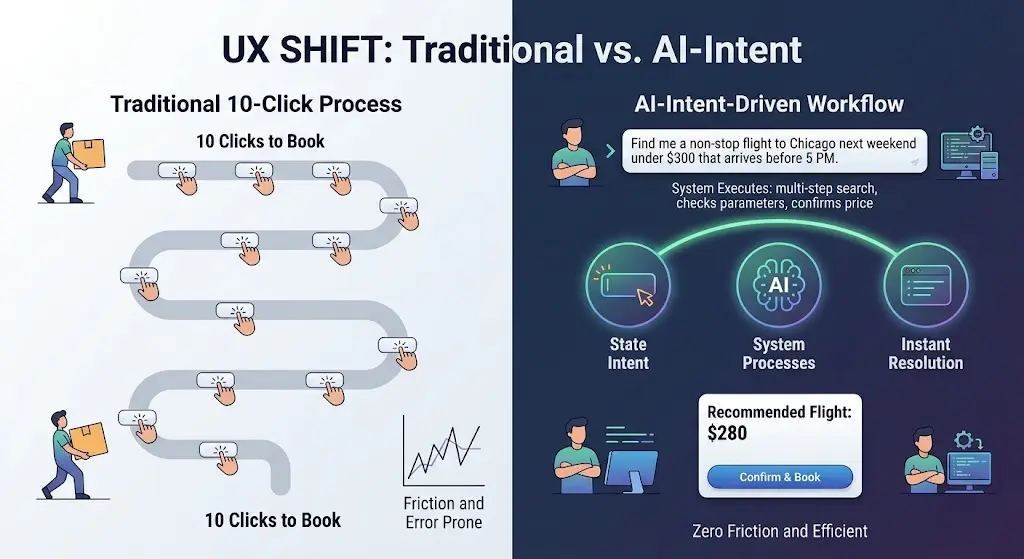
Consider the traditional workflow of booking a flight online, a process engineered to be hyper-interactive:
Navigating to an aggregator or airline website.
Manually selecting departure and arrival airports from dropdown menus.
Interacting with calendar widgets to pick travel dates.
Adjusting filters for stops, airlines, and baggage allowances.
Sifting through search results across multiple pages, opening various tabs to compare pricing and layovers.
Entering passenger details, seat preferences, and multi-layered payment information across sequential forms.
In this classic point-and-click UI paradigm, the computer acts as a passive container of data, while the human acts as the exhaustive orchestrator, manually inputting parameters, interpreting raw outputs, and executing each micro-step along the way.
The Shift to Ambient and Intent-Driven Computing (Present and Beyond)
The current era represents a clean break from this transactional paradigm. Driven by generative AI and autonomous agents, the relationship has flipped. Instead of forcing users to master how to execute a workflow step-by-step, intent-driven systems prompt a singular, human-centric question: What are you trying to accomplish?
When a user inputs a high-level goal—such as "Find me a non-stop flight to Chicago next weekend under $300 that arrives before 5 PM"—the software deciphers the intent, executes the complex multi-step search query behind the scenes, cross-references options, and presents a single, actionable resolution. The ten-click process dissolves into a single intent outcome.
Supporting Context & Metrics: Three Web Platforms Replacing Buttons With Intent
This transformation is not a theoretical vision of the distant future. Across the web ecosystem, pioneering platforms are actively dismantling traditional button-and-menu layouts in favor of intent-capturing systems.
1. Perplexity AI: Search Without the Open Tabs
Traditional search engines like Google were historically built as digital directories. Users typed a keyword string, and the interface rewarded them with "ten blue links." The actual labor of opening five separate tabs, skimming long articles, dodging intrusive ads, and manually synthesizing an answer was offloaded entirely to the user.
Platforms like Perplexity AI bypass this multi-tab friction by enabling instant, intent-based searches. Instead of forcing users to hunt for information across disparate sources, the interface synthesizes contextually relevant, highly accurate answers on the fly, complete with direct citations, transforming search from a browsing chore into an immediate cognitive resolution.
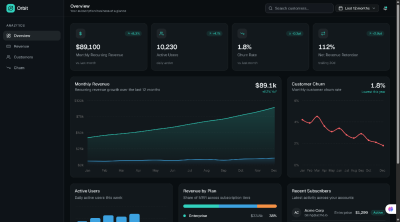
2. Vercel v0: Web Design Without Dragging and Dropping
For years, digital product creation required visual builders, wireframing tools like Figma, or drag-and-drop website editors. Designers spent countless hours manually drawing rectangles, picking hexadecimal color codes, adjusting padding values, and writing granular CSS rules.
Generative platforms like Vercel v0 have fundamentally altered this workflow. By allowing users to articulate a design concept in natural language directly from an input prompt, the platform instantly renders fully functional user interface components and layout code on the fly. Manual layout building is replaced by generative specification.
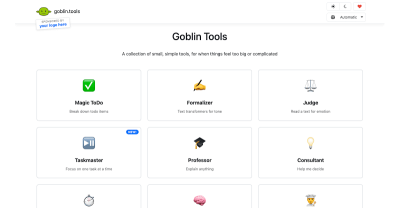
3. Goblin.tools: Breaking Down Overwhelming Tasks
Traditional productivity tools often require users to manually construct task lists, drag items across complex Kanban boards, and assign rigid micro-deadlines. For neurodivergent individuals or anyone experiencing cognitive overload, these interfaces can be paralyzing.
Goblin.tools provides a streamlined, single-page AI suite that takes a single overarching goal or a chaotic brain dump and automatically breaks it down into manageable, actionable checklists with zero configuration or sign-up friction required.
The Core Pillars of Intent-Driven Web Design
When traditional menus, sidebars, and forms are stripped away, maintaining usability requires a complete reimagining of foundational design pillars. Industry leaders pioneering this space rely on three core pillars:
Generative UI (Layouts rendered dynamically on the fly based on immediate needs)
Task Execution
Manual execution orchestrated by the human user
Autonomous execution handled by background AI agents
1. High-Level Goals and Ambient Context
An invisible interface does not always wait for a typed command; it leverages environmental context to anticipate user needs. Guided by standards such as Apple’s Human Interface Guidelines on Contextual & Ambient Design, modern systems read device state, physical location, and historical interaction patterns to trigger proactive assistance seamlessly.
2. Generative UI
In traditional web design, interfaces are static. An e-commerce dashboard displays the exact same navigation structure to a first-time visitor as it does to a returning customer tracking an active shipment.
As highlighted in the Nielsen Norman Group’s analysis on AI as a new UX paradigm, computing is shifting from command-based interaction to outcome-specification. This unlocks Generative UI, where interface elements appear precisely when needed and recede once the objective is met. If a user needs to compute complex financial data, a dynamic calculator widget materializes instantly, disappearing upon task completion.
3. Autonomous Execution by AI Agents
Traditional software design is obsessed with error prevention, constantly bombarding users with interruptive confirmation modals ("Are you sure you want to delete this file?"). Intent-driven systems adapt Jakob Nielsen’s Usability Heuristics by shifting the safety net from rigid prevention to easy reversibility. Because autonomous agents take actions on behalf of the user, products prioritize frictionless rollback mechanisms—such as prominent "Undo" buttons, simple revision prompts, and transparent audit logs—over intrusive warning dialogs.
Official Statements and Industry Expert Insights
The shift toward invisible, intent-driven interfaces has drawn commentary from leading usability authorities, human-computer interaction researchers, and design visionaries.
"The ultimate goal of modern web design is no longer to build prettier buttons or flashy animations; it is to eliminate the interface entirely."
— Golden Krishna, Author of The Best Interface Is No Interface
This perspective aligns closely with the broader Time Well Spent movement championed by organizations like the Center for Humane Technology, which challenges the traditional industry reliance on engagement metrics like time-on-site and click-through rates.
Furthermore, researchers from the Stanford Human-Computer Interaction (HCI) Group and guidelines published in the Google PAIR (People + AI Research) Guidebook emphasize that as software transitions toward autonomous execution, designers must address critical ethical and technical challenges:
The Illusion of Control: When software makes decisions on behalf of users, poorly designed automation can feel invasive or patronizing. Designers must establish clear ethical boundaries, automating routine tasks while explicitly prompting users for high-stakes confirmations (such as financial transactions or data privacy changes).
The Black Box Problem: In traditional UIs, unexpected outcomes can be easily diagnosed by checking filter settings or form inputs. With intent-driven interfaces, troubleshooting is more complex. Transparent feedback loops—where the system explicitly states its interpretation ("Searching for non-stop flights to Chicago under $300…")—are vital for calibrating user trust and correcting machine misinterpretations instantly.
As noted by design practitioners navigating this transition:
"Rather than designing static buttons and rigid forms, we need to learn to map and present dynamic, generative UI components that adapt on the fly to user intent."
Future Outlook: The Era of Seamless Completion
For decades, the digital product industry has evaluated success through metrics designed to maximize visual engagement and interaction volume: time spent in app, click-through rates, and page views per session. Websites were deliberately engineered to hold human attention by increasing friction and navigational depth.
The philosophy of intent-driven design turns these legacy metrics upside down. The ultimate test of a modern digital product is no longer how visually captivating its buttons are, but rather: How effectively did this software solve the problem and get out of the user’s way?
We are entering a definitive era where web applications will no longer be measured by the aesthetic complexity of their user interfaces, but by their ability to render those very interfaces completely obsolete. The future of the web is not defined by more interaction—it is defined by seamless, invisible completion.