

Executive Overview
In an era defined by a relentless digital cacophony—where 24-hour cable news networks, social media algorithms, and independent online influencers bombard consumers with unvetted hot takes—the role of traditional newspaper opinion sections faces an existential crossroads. Across the United States, decades of economic turbulence, shrinking newsroom headcounts, and corporate consolidation have decimated editorial boards and local commentary pages. Major media chains like Gannett began aggressively phasing out institutional editorials in 2022, while high-profile decisions, such as The Washington Post’s 2024 choice to forgo presidential endorsements, have sparked fierce debates over the relevance of institutional viewpoints.
Yet, against this turbulent industry backdrop, some local publications are not only surviving but thriving by reimagining the purpose of commentary. At the Indianapolis Star (IndyStar), the opinion section remains one of the publication’s most-read areas and a primary driver of subscriber retention.
This deep dive—part of the grant-funded Indianapolis Public Editor project administered by the Poynter Institute—explores how IndyStar successfully rebuilt its opinion desk from scratch in 2024 under Opinion Editor James Briggs. Through an exhaustive Q&A and industry analysis, this report examines the modern mandate for newspaper commentary, the shifting line between opinion and analysis, the business case for robust local storytelling, and what it takes to foster constructive civic debate in a hyper-polarized society.
Detailed Chronology and Industry Evolution
To understand the current state of local newspaper opinion, one must first look at how the architecture of the editorial page has shifted over the past century.
The Traditional Paradigm: Editorials vs. Op-Eds
Historically, the newspaper product was strictly divided. The editorial page served as the institutional megaphone for the paper’s leadership and its publisher. Composed of an anonymous editorial board, this section voiced the official stance of the news organization on vital civic matters. It endorsed political candidates, critiqued legislation, and aggressively advocated for systemic policy changes.
Conversely, the opinion section—colloquially known as the "op-ed" page because it literally ran on the page opposite the editorial section—featured syndicated columnists, outside guest writers, and diverse viewpoints from members of the local community.
The Great Decimation (2000–2022)
Over the last twenty years, the American newspaper industry has suffered severe structural declines. Plummeting print advertising revenues and slow digital transitions forced sweeping newsroom layoffs. Editorial boards and opinion columnists, viewed by some corporate executives as expensive and lightning rods for controversy, were often the first casualties.
Furthermore, as American society grew increasingly polarized, many newspaper owners and executives became reluctant to absorb the political heat and subscription cancellations triggered by controversial political endorsements. Veteran journalists and media scholars frequently lament these cuts, arguing that editorial boards and investigative units represented the ultimate institutional "weapons" available to a local paper to hold powerful entities accountable.
Ken Paulson, former editor-in-chief of USA Today, former president of the American Society of Newspaper Editors, and current head of the Free Speech Center at Middle Tennessee State University, remains a vocal proponent of traditional editorial leadership.
"In my view, the community wants leadership, wants an authoritative voice, and editorials are the best way to do that," Paulson stated. "I think they’re both beneficial… but too many newspapers have subbed the op-ed page for editorials and that, in my view, was a mistake."
According to Paulson, without the backbone of authoritative editorials and aggressive investigative reporting, local newspapers risk losing their unique institutional identity, devolving into little more than high-glorified community blogs.
The Modern Pivot: IndyStar’s Blueprint
While organizations like Gannett began systematically eliminating traditional editorial boards across its network of papers in 2022, IndyStar charted a different path. Rather than shutting down the space entirely or succumbing to controversy, the paper restructured its approach. It phased out anonymous institutional editorials, replacing them instead with a vibrant, highly localized ecosystem of named opinion columnists and contributing voices from the Indiana community.
When James Briggs stepped into the role of IndyStar Opinion Editor in January 2024, he faced a near-blank slate with virtually no staff or established contributors. Over the subsequent two years, Briggs and his colleagues systematically rebuilt the infrastructure of the section, expanding the Sunday print layout and generating a high volume of locally focused commentary.
Supporting Context & Metrics
The survival and growth of the IndyStar opinion desk are supported by strategic shifts in how commentary is produced, vetted, and consumed in the digital age.
The Business and Civic Case for Local Opinion
Contrary to the belief that polarizing opinions uniformly alienate readers, IndyStar’s leadership discovered that targeted, high-quality local analysis directly correlates with audience loyalty and subscription renewals. In a media ecosystem saturated with national talking points, consumers are starved for hyper-local context.
- Audience Engagement: The opinion section remains one of the most consistently trafficked segments of the IndyStar website and print edition.
- Geographic Focus: The paper has maintained one of the highest volumes of Indiana-focused opinion columns of any midwestern daily since the early 2000s.
- Viewpoint Diversity: The modern IndyStar opinion desk intentionally curates content ranging from the center-left to the center-right, strictly avoiding fringe extremism while enforcing a baseline requirement: columnists must agree on objective facts, even when drawing divergent ideological conclusions.
Official Statements: Q&A with IndyStar Opinion Editor James Briggs
To unpack the philosophy driving Indianapolis’ premier local opinion desk, IndyStar Opinion Editor James Briggs shared insights on the realities of modern commentary curation, the mechanics of building a diverse roster of writers, and the ongoing battle for reader attention.
+--------------------------------------------------------------------------+
|                  THE ANATOMY OF A MODERN OPINION DESK                    |
|                                                                          |
|  [Subject Matter Experts]   --->   Provide rigorous economic & policy    |
|                                    analysis (e.g., Michael Hicks)        |
|                                                                          |
|  [Compelling Generalists]   --->   Bridge cultural and political gaps    |
|                                    through accessible dialogue           |
|                                                                          |
|  [Engaging Communicators]   --->   Embrace constructive discomfort and   |
|                                    drive lively civic conversations      |
+--------------------------------------------------------------------------+
Q: What do you think is the role of an opinion columnist and section at a daily newspaper today?
James Briggs: Much the same as it’s always been: to drive conversations. Columnists make sense of the news, introduce ideas, and advocate on behalf of a particular worldview. One thing that has changed, I think, is that good column writing often looks more like analysis than a pure expression of opinion. In other words, a columnist today should aspire to make people smarter even as they’re seeking to persuade. Columns also should make people feel something—joy, anger, sadness, or hope. They should include humor. In an increasingly algorithmic world, columns should stimulate critical thinking and put people in touch with their humanity.
Q: What is your current vision for IndyStar’s opinion section? What did the former section lack and what did it get right that you would like to continue?
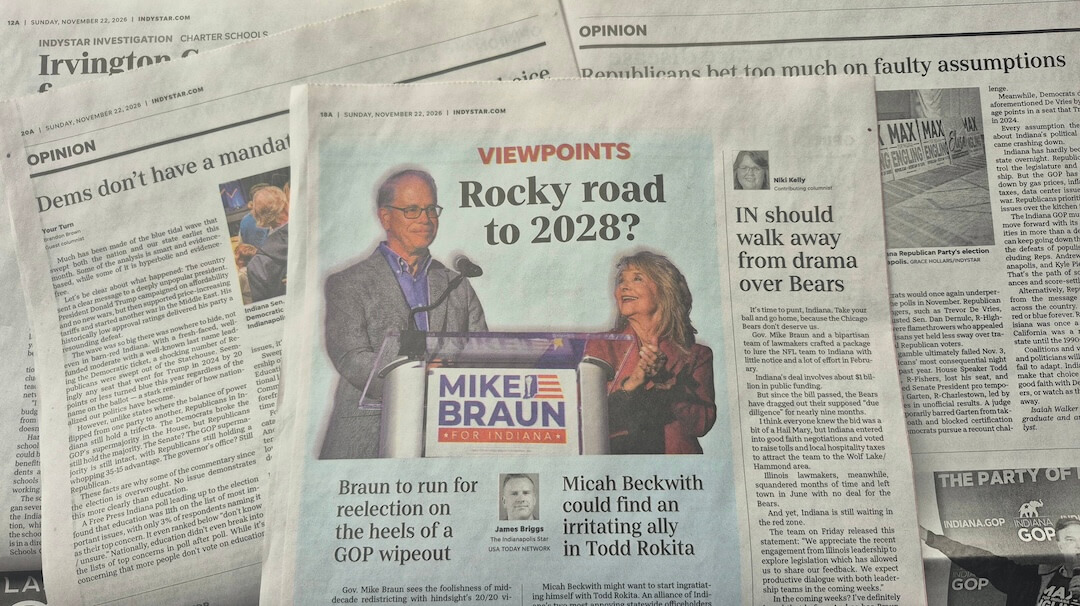
James Briggs: This is still evolving. I’m immensely proud of what we’ve accomplished so far. I started my job in January 2024 with no staff or contributors. It was just me sitting around writing as much as I could. We built the section up to over a half-dozen regular columnists between staff and contributors. We expanded the Sunday print section to make room for all the great columns we’ve been publishing online. IndyStar has been publishing the highest volume of Indiana-focused opinion columns since at least the early-2000s.
We’ve lost some of that momentum this year as columnists have moved onto other roles and opportunities. That has provided an opportunity for my colleague Jacob Stewart and me to expand our own voices in the section. We’ve been doing more writing lately, which I’ve enjoyed. We have a lot to talk about, especially after the midterm elections. We’re still working to find the right mix of contributor voices and also determine how to expand into video, which is a massive growth area in media.
Q: How did you choose the current mix of columnists?
James Briggs: I’m looking for a few qualities in columnists. I mentioned before that analysis is important, so I’m looking for subject matter experts who can share insights on topics that people have shown us they care about, including education, urban planning, and the economy. Economist Michael Hicks is the prototype. I’m also looking for compelling generalists. Rob Kendall, the radio host and podcaster, is a great example. Jeffery Tompkins fits into both buckets. Finally, I want engaging voices. People you’d actually want to talk to in real life, who enjoy lively discussions and don’t take themselves too seriously.
I’m pleased with the viewpoint diversity we’ve offered spanning center-left to center-right. We avoid the fringes. We try to publish columnists who agree on facts despite drawing different conclusions.
Q: You’ve written that you wanted “insightful writers who could offer rigorous good-faith analysis without fear of offending people.” Was there a trend or issue you observed that prompted this statement?
James Briggs: Opinion has to be provocative yet grounded in reality. That’s a difficult line to walk. Some people just want to say crazy things to get attention, and others just want to say smart things in a boring way. The latter instinct is especially common in Indiana, where there seems to be an aversion to causing offense. And I get it. There can be social and professional consequences to articulating sharp viewpoints on topics that people feel passionately about. But we need people to take those risks so we can grow as a society. People who are willing to embrace discomfort and earnestly work through disagreements in the public square are the people who counter bad-faith actors and move our city and state forward. I want IndyStar Opinion to be a platform for constructive debate.
Q: Gannett began eliminating editorial sections from its newspapers in 2022, but an opinion section prevailed at The Star. How did The Star manage to keep the section going, and why is that important? What purpose does the section serve in today’s media climate?
James Briggs: The company’s leadership has prioritized opinion in recent years. My hire in 2024 reflects that investment, as does our build-out. I couldn’t have grown this section if the company hadn’t committed to opinion. On top of the mission-driven case for opinion I’ve been making here, I’d say there’s also a business case for opinion. Strong opinion and analysis creates a special connection between us and our audience, which makes people want to join us as subscribers. I feel that connection from the people who reach out to share thoughts on what we’re doing.
Q: How do you distinguish the paper’s commentary and opinion columnists online when we are awash in online commentary from content creators and social media influencers?
James Briggs: We’re competing against every other way in which any person could be spending their time. That includes other news sites, Netflix, or TikTok. Anything. We have to prove we’re worthy of attention by providing analysis and insights that don’t exist anywhere else. That can be Jacob sharing his first-hand expertise on how the Indiana Statehouse will move forward in the current political climate or me writing about Indianapolis’ education landscape based on my sourcing and experience as a parent.
Q: Do you think opinion columnists still resonate in spite of all of the sources of commentary online?
James Briggs: I know they do. Our audience shows me that every single day.
Future Outlook
As local journalism navigates the digital frontier, the success of the IndyStar opinion desk offers a valuable blueprint for regional news organizations nationwide. The traditional model of anonymous, top-down institutional decrees may be fading, but the human desire for grounded, rigorous, and localized debate remains stronger than ever.
Looking ahead, the IndyStar opinion desk plans to expand its operational footprint into digital media formats—particularly video production—to capture younger demographics and meet audiences where they consume content. By maintaining a strict commitment to factual accuracy, ideological balance between the center-left and center-right, and deep subject-matter expertise, local opinion sections can successfully insulate themselves against the superficial noise of social media influencers. Ultimately, when executed with intellectual honesty and courage, local opinion journalism does not merely fill space on a page; it binds a community together, fostering the critical thinking essential for a functioning democracy.
