

Executive Overview
Few television formats combine the high-octane pressure of live performance, the intense scrutiny of social media, and the meticulous worlds of high fashion quite like ABC’s Dancing with the Stars (DWTS). As the cultural touchstone concluded another riveting chapter with Season 35, co-host Julianne Hough found herself at the epicenter of a classic pop-culture firestorm: a polarizing debate over her boundary-pushing, avant-garde wardrobe choices.
While viewers online passionately critiqued—and occasionally roasted—her risk-taking ensembles, Hough and her longtime stylist, Brad Goreski, embraced the digital commotion as a badge of honor. Rather than retreating into safe, predictable styling, Hough leaned heavily into a philosophy that apathy is the true enemy of modern entertainment.
Beyond the glittering sequins and viral internet commentary, the conclusion of Season 35 offers a rare, comprehensive window into the intricate machinery powering one of television’s longest-running reality competition shows. From the heavily guarded salary structures of celebrity contestants and professional dancers to the blistering pace of a costume department churning out hand-rhinostoned masterpieces in a matter of days, the ecosystem of Dancing with the Stars is as demanding behind the scenes as it is glamorous on screen. This in-depth report explores Hough’s fashion renaissance, examines the financial realities of the ballroom, and dissects the operational rigor required to keep America’s favorite dance competition spinning.
Detailed Chronology: The Evolution of Season 35’s Fashion Controversy
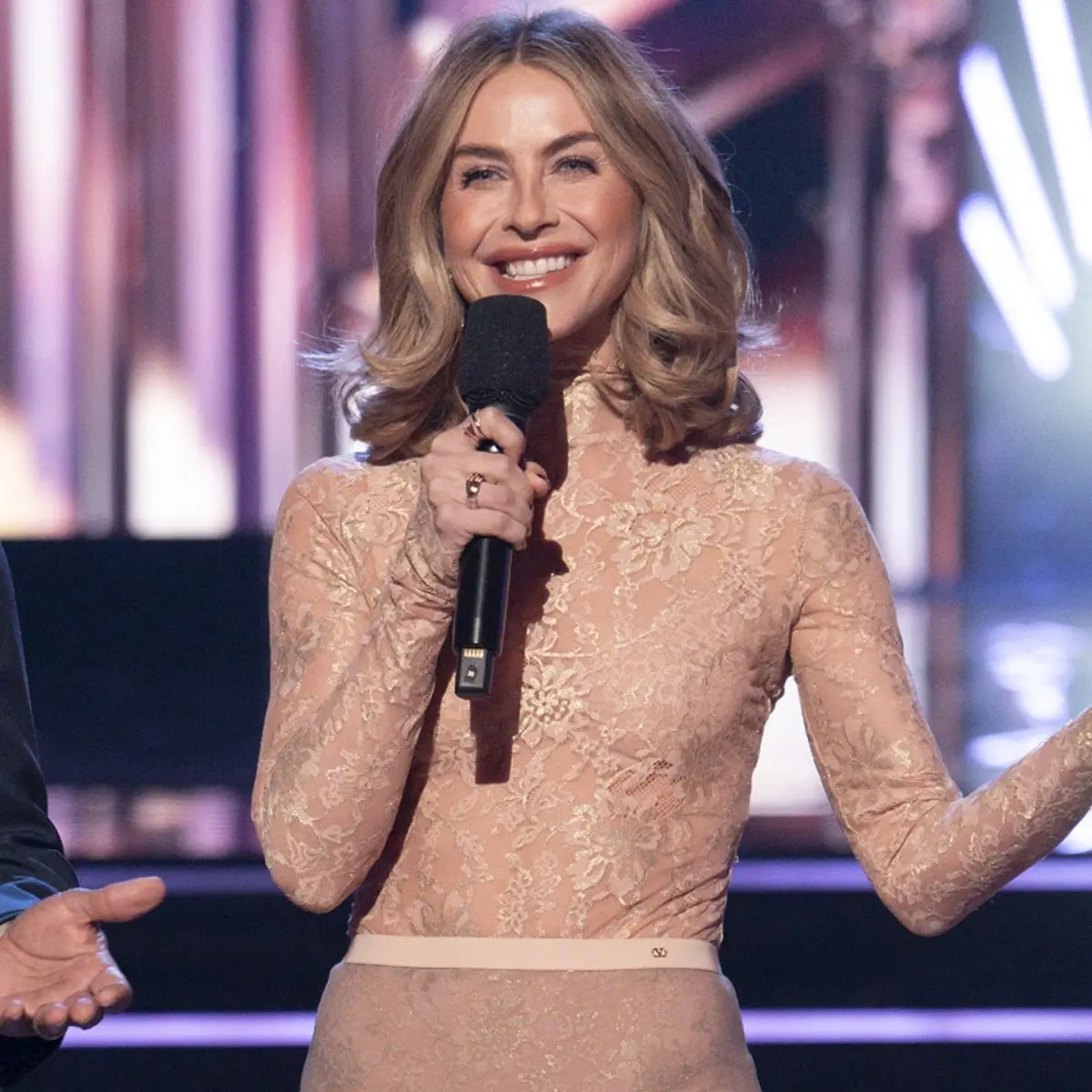
The friction between traditional television styling and modern high-fashion experimentation reached a boiling point mid-season, specifically during the high-stakes episode broadcast on November 17. As co-host alongside Alfonso Ribeiro, Julianne Hough stepped onto the ballroom floor in a striking, sultry Valentino creation. The ensemble featured a flesh-toned, illusion bodysuit layered beneath a diaphanous, sheer skirt—a look designed to challenge conventional broadcast television aesthetics and lean into a mature, empowered persona.
Almost immediately, the internet reacted. While high-fashion purists praised the structural audacity and Italian craftsmanship of the look, a vocal faction of the fan base took to digital platforms to express their disapproval. The critique culminated in a viral Instagram video that humorously—and pointedly—called for Hough’s stylist to be relieved of his duties.
Rather than issuing a defensive press release or quietly pivoting to safer silhouettes for subsequent episodes, Hough and Goreski addressed the backlash head-on in an extensive interview published on November 24 by Glamour.
Speaking candidly about her aesthetic choices, Hough explained that her sartorial shift was a deliberate manifestation of a broader personal and professional evolution. Entering her late thirties, the multi-hyphenate entertainer described shedding the pressure to conform to mainstream expectations of "what’s hot." Instead, she pivoted toward an intentional wardrobe rooted in self-expression.
"I really feel like I’m at this next inflection of my career," Hough told Glamour. "When you get into your late 30s, you just don’t give a f–k anymore. You’re like, ‘Who am I? What do I want to wear? What makes me feel incredible?’ It has more intention rather than trying to fit into what’s hot. I feel like I’m in my leading lady era. I mean that in the actual projects that I’m doing, but also me as a person."
For his part, Brad Goreski viewed the online chatter not as a crisis, but as a triumph of engagement. With over a decade and a half of high-profile styling experience under his belt, Goreski maintained that polarizing reactions are indicative of effective design. "Any conversation, good or bad, around fashion is great," Goreski noted. "I think Jules ultimately brings the looks to life. I’m glad that there’s another part of the show that people talk about. Not every person’s going to love every look. I know that from being a stylist for 15 years. And that’s okay."
Supporting Context & Metrics: The Anatomy of DWTS Production
While the fashion choices of the co-hosts capture weekly headlines, the structural framework of Dancing with the Stars relies on a complex network of financial compensation, rigorous physical training, and hyper-efficient design teams. As alumni, current pros, and industry insiders lift the veil on the inner workings of the show, a clearer picture emerges of what it truly takes to survive the ballroom.
The Financial Architecture: What Do Celebrities Earn?
The compensation model for celebrity contestants has long been a subject of industry fascination. According to reports originally published by Variety citing multiple production sources, contestants historically secure a base payment of $125,000 covering the initial rehearsal period and the first two weeks of live broadcasts. As competitors survive subsequent eliminations, incremental weekly bonuses push their earning potential higher, with historical maximums capping out near $295,000.
However, individual compensation agreements can vary wildly. Season 27 champion Bobby Bones offered a different perspective during a September 2025 appearance on Jason Tartick’s Trading Secrets podcast. Detailing his own financial trajectory during his 2018 run with partner Sharna Burgess, Bones outlined a scaling structure: "Like, first episode, no money. Second episode, $10,000. I think it’s like, $10,000, $10,000, $20,000, $20,000. It ends up being $50,000 an episode if you last." Factoring in base guarantees and milestone bonuses, Bones estimated his total earnings approached $400,000. ABC has consistently declined to publicly confirm or deny these figures.
Professional Dancers and the Economics of Longevity
The professional dancers—the backbone of the franchise—operate under similarly structured contracts, though exact figures remain closely guarded secrets. Elimination does not mean an immediate end to a pro’s paycheck; contracts guarantee compensation for a specific threshold of weeks, ensuring baseline financial security even for early exits.
Curiously, winning the coveted Len Goodman Mirrorball Trophy yields no additional financial windfall. Jenna Johnson, a multi-time champion (winning Season 26 with Adam Rippon and Season 33 with Joey Graziadei), clarified on the The Morning After podcast that victory brings no cash prize. "If you win, it’s not like you win a $1 million and split it with your partner," Johnson explained. "You’re just getting a cute trophy together." Instead, the incentive to reach the finale lies in securing full-season payouts alongside dedicated finalist performance bonuses.
The financial hierarchy also heavily impacts the dance troupe. Former pro Lindsay Arnold revealed on Trading Secrets that her transition from main professional roster dancer to troupe member resulted in a dramatic salary cut of "more than in half," illustrating the steep financial gradients within the show’s dance hierarchy.
The Science of Pairings and Grueling Rehearsal Schedules
The path to the ballroom floor is paved with exhaustion. According to Season 33 breakout star Rylee Arnold, who partnered with Olympic gymnast Stephen Nedoroscik, daily life during the season is entirely consumed by the show. Dancers endure mandatory four-hour daily rehearsals, slotted into rigid shifts—9 a.m. to 1 p.m., 1 p.m. to 5 p.m., or 5 p.m. to 9 p.m.—followed by administrative meetings, choreography development, and video study.
"Literally my whole life is devoted to it," Arnold shared on the Lightweights Podcast. "We have our show day on Tuesday and then it’s Wednesday to Sunday, straight rehearsals. And then Monday we have camera blocking and then Tuesday’s show day again."
This intense physical collaboration is dictated entirely by production. As Lindsay Arnold and Jenna Johnson have noted on various industry podcasts, professional dancers have virtually zero input regarding their celebrity partners. The pairings are meticulously calculated by producers—taking into account height, physical build, personality profiles, and interpersonal compatibility—months before the cast is officially unveiled to the public. Former showrunner Rob Wade emphasized that compatibility is paramount, noting that forced chemistry inevitably leads to a miserable experience for the celebrity, the crew, and the viewing audience.
The High-Speed Costume Department
Perhaps no department matches the physical exertion of the dancers quite like the Dancing with the Stars wardrobe atelier. Headed by elite designers such as Daniela Gschwendtner and Steven Norman Lee, the costume department operates on an almost impossibly compressed timeline.
In a behind-the-scenes breakdown, Gschwendtner revealed that the team has a maximum of five days to design, construct, fit, and embellish custom garments for every competing couple following weekly creative meetings. With a core staff of roughly twenty artisans supplemented by an independent tailor shop, every competitive look is built from scratch each week to ensure maximum visual impact, with garments rarely being recycled outside of group numbers or promotional photo shoots.
Official Statements and Industry Perspectives
The convergence of high fashion, social media scrutiny, and traditional television production has forced industry professionals to adapt to a new era of audience interaction. Julianne Hough’s embrace of her "vixen-y" persona—deliberately transitioning away from her historical "girl-next-door" image—highlights a calculated pivot toward narrative-driven styling.
"I’ve gone a little bit more vixen-y this year than I have girl next door because we’re trying to find that character," Hough shared during her joint profile with Brad Goreski. "It’s been very strategic."
This strategic positioning serves a dual purpose: it revitalizes the host’s personal brand for a mature demographic while injecting vital watercooler energy into a multi-decade television franchise. By adopting the personal mantra "Apathy is the enemy," Hough reframed stylistic risk not as an invitation for uniform praise, but as an essential catalyst for cultural relevance.
"The reason things exist and have charge and stay visible [is] people either love it or hate it," Hough observed. "They still want to talk about it."
Brad Goreski echoed this sentiment, emphasizing that the modern landscape of fashion criticism thrives on polarization. In an era where algorithms reward engagement—whether positive or negative—the worst fate for a television fashion choice is to be completely ignored.
Future Outlook
As Dancing with the Stars looks beyond Season 35, the intersections of live television, streaming metrics, and digital-age fashion commentary will undoubtedly continue to evolve. Julianne Hough’s willingness to court controversy through high-concept couture sets a new precedent for television co-hosts, proving that calculated risks can yield significant cultural visibility.
For the production at large, the ongoing discussions surrounding transparency in cast compensation, the brutal logistical realities of weekly custom costume design, and the psychological demands placed on professional athletes-turned-dancers ensure that the show remains a fascinating subject of both entertainment and industry analysis.
Ultimately, as long as the ballroom doors remain open, the glittering synthesis of high-stakes competition and high-fashion theater will continue to captivate audiences—ensuring that Hough, Goreski, and the entire DWTS family will keep giving the world something to talk about.
