In the fast-paced ecosystem of digital product design and brand development, project failures rarely materialize at the logo-design stage. Instead, they are quietly engineered months earlier, deep within the strategy phase. When abstract descriptors—such as modern, trustworthy, premium, friendly, and disruptive—are left undefined, a silent chasm opens between what a brand intends to communicate and what a designer is tasked to construct.
This critical, yet frequently overlooked, interim is what industry practitioners define as the “pre-concept” phase.
The strongest visual concepts do not begin in Figma; they begin with the interrogation of brand context. By actively researching organizational environments, unearthing hidden stakeholder assumptions, and forging a collective linguistic alignment into a concrete visual foundation, teams can eradicate costly ambiguity. This structural exploration acts as a vital bridge, transforming abstract business goals into actionable visual direction before a single original graphic asset is rendered.
Detailed Chronology: Navigating the Pre-Concept Roadmap
To successfully transition from a blank strategic slate to an authoritative visual execution, branding teams must navigate a structured sequence of discovery, mapping, and synthesis.
Stage 1: Researching Brand Context and Perception
A traditional brand workshop inherently covers baseline discovery metrics: the core business model, overarching goals, product or service offerings, the competitive landscape, and target demographics. However, the true value of pre-concept research lies in perception mapping.
As Marty Neumeier famously posited in The Brand Gap, a brand is fundamentally “a person’s gut feeling about a product, service, or company.” Because a brand lives entirely within external perception, internal stakeholders must explicitly define what perception they intend to author.
Words like "disruptive" or "bold" can easily derail a project if left unchecked. For instance, consider a health tech enterprise targeting large government medical institutions. Initially, leadership requested a "disruptive" visual presence. To the untrained eye, this might suggest a rebellious, neon-infused, highly unconventional aesthetic. However, within a deeply conservative healthcare environment, such visual loudness destroys credibility. Through pre-concept workshops, the team realized that their version of disruption relied on radical clarity, operational efficiency, and absolute confidence—yielding an aesthetic that was paradoxically more traditional than the terminology implied.
Stage 2: Facilitating Stakeholder Exercises
Passive clients invite subjective misalignment. When stakeholders merely receive a finalized strategy deck, they rubber-stamp concepts without recognizing their internal biases. To counter this, interactive frameworks must be deployed.
Competitor Perception Mapping: Before workshops convene, curators gather visual touchpoints—websites, UI interfaces, and marketing collateral—from across the competitive landscape. Stakeholders plot these entities across a two-axis grid (e.g., Understated to Bold, Accessible to Exclusive, or Traditional to Progressive). This exposes how leadership actually reads the market, illuminating whitespace opportunities and neutralizing divergent definitions of “credible” versus “generic.”
The Visual Brand Driver: Moving inward, stakeholders select images representing the company across unrelated categories (e.g., transport, architecture, typography, and fauna) through the lens of metaphor rather than personal taste. If the company were a mode of transport, is it a high-speed bullet train or a silent electric vehicle? By anchoring identity attributes to tangible metaphors, subjective aesthetic preferences are stripped away, exposing the foundational traits that truly define the corporate character.
Stage 3: Constructing the Visual Foundation
With semantic and metaphorical alignment secured, the process shifts to establishing practical design boundaries across three distinct layers:
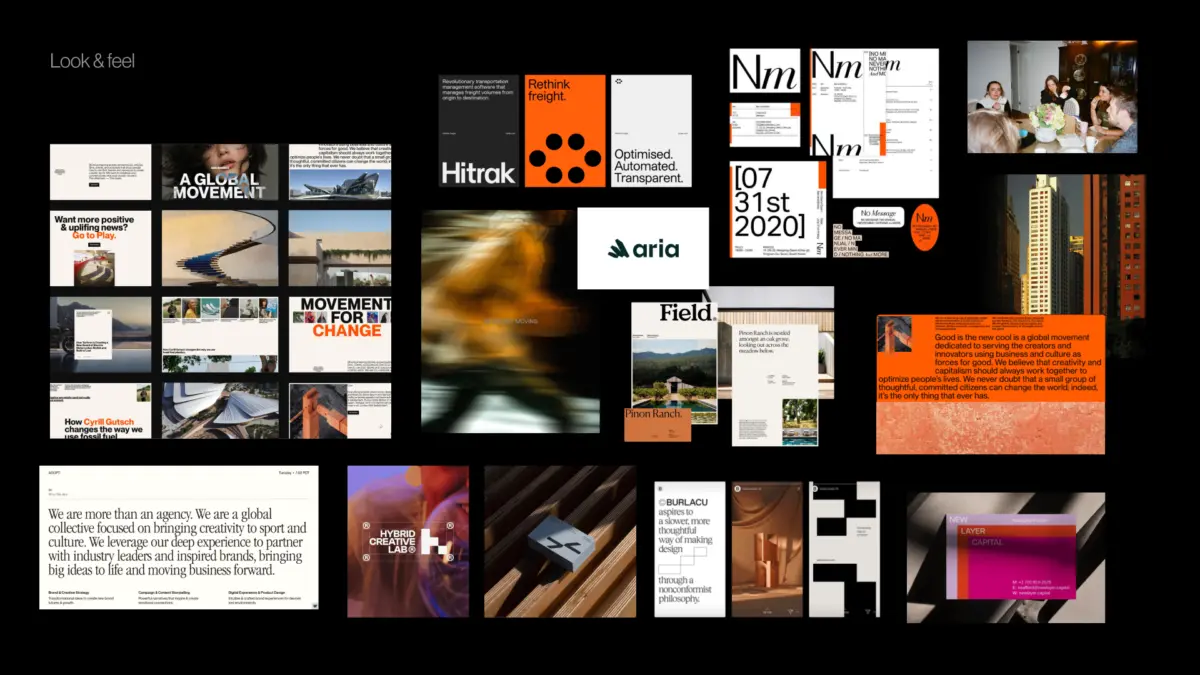
Look and Feel Boards: Curated not as moodboards of personal likes, but as perception boards that resolve category tensions and validate brand character.
Design Code: The translation of core brand narratives into distinct visual principles (e.g., translating "personalized support for a unique journey" into organic shapes and fluid compositions).
Brand Asset Direction: Preliminary explorations of typography, color harmony, illustration styles, and photographic grammar that establish structural guardrails without dictating the final logo architecture.
Supporting Context & Metrics: The Anatomy of Alignment
In brand identity strategy, the ambiguity of language is the single greatest threat to creative momentum. When three executives agree that a fintech startup must look "premium," their internal mental models can produce mutually exclusive outcomes:
Executive A visualizes editorial minimalism, quiet whitespace, and serif typography.
Executive B envisions high-contrast luxury, gold accents, and heavy exclusivity markers.
Executive C pictures hyper-clean, tech-forward minimalism.
Without the pre-concept phase to pressure-test these assumptions, designers are left guessing.
Industry data consistently shows that projects subjected to rigorous up-front brand alignment frameworks experience up to a 40% reduction in revision cycles during the UI/UX and visual identity handoff phases. By replacing vague adjectives with contextual design principles, teams drastically shorten the feedback loop. The conversation successfully migrates from the subjective minefield of "I like this" or "I don’t like this" to an objective, authoritative evaluation: "Does this visual direction faithfully express the brand we collectively agreed upon?"
Official Statements & Industry Perspectives
Reflecting on the integration of strategic frameworks into modern digital product design, prominent design leaders emphasize the necessity of moving from the abstract to the concrete early in the pipeline.
Jake Knapp, creator of GV’s renowned Three-Hour Brand Sprint, underscores the psychological shift required during early workshops:
"The point of these exercises is to make the abstract idea of ‘our brand’ into something concrete."
By forcing stakeholders to externalize their beliefs via relative positioning and metaphor, teams preemptively dismantle the friction that typically emerges during initial concept reviews.
Furthermore, branding experts emphasize that the ultimate deliverable of the pre-concept phase is not merely a moodboard, but a set of negative boundaries. Knowing what a brand must not look or feel like is equally as powerful as knowing its aesthetic destination.
Future Outlook: The Evolution of Brand Strategy in Digital Products
As digital products become increasingly complex—spanning multi-platform ecosystems, automated design systems, and AI-driven interfaces—the foundational pre-concept phase will only grow in importance.
Future brand identity workflows will likely see deeper integration of real-time collaborative mapping tools, data-driven perception modeling, and continuous stakeholder alignment loops integrated directly into product development pipelines. As AI tools accelerate the generation of visual assets, the differentiator for human designers will not be software execution speed, but their ability to orchestrate the pre-concept phase: asking the right questions, unearthing institutional assumptions, and translating volatile human language into unshakeable visual truths.
Ultimately, the first design concept should never feel like a gamble or an abrupt reveal. Through a rigorous pre-concept phase, it becomes the inevitable, logical next step in a journey the entire organization has already built together.