

Executive Overview
For product teams across the enterprise software landscape, artificial intelligence has quickly transformed from an experimental frontier into an urgent mandate. Spurred by competitive pressure and the relentless drumbeat of market announcements, organizations routinely rush to integrate machine learning capabilities into existing workflows. The prevailing corporate assumption—often driven by pro-innovation bias—is that introducing automated assistance is inherently progressive, saving users time, reducing cognitive strain, and streamlining daily operations.
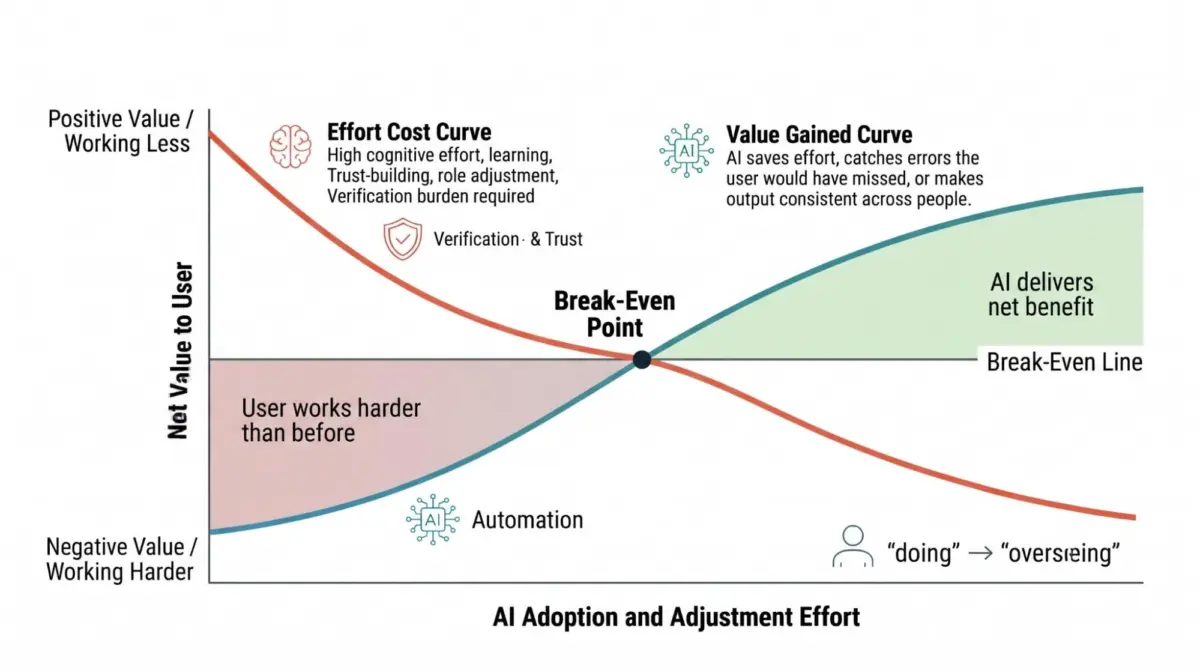
Yet, a silent productivity crisis is unfolding across desks in healthcare, finance, and human resources. When an AI feature saves users time on a specific sub-task, it frequently forces them to spend that exact surplus checking, correcting, and validating the results. In many cases, the effort required to verify machine-generated output completely eclipses the labor saved by automation. Users find themselves working harder, not smarter.
To combat this phenomenon, product teams require a rigorous, practical audit framework to determine whether a proposed AI feature truly earns its place in a workflow—and what specific guardrails users need to safely verify its output. By evaluating tools against a definitive "break-even line," organizations can shift away from speculative automation and toward precision engineering that genuinely amplifies human capability.
Detailed Chronology: The Anatomy of a Flawed AI Rollout
The friction between theoretical efficiency and operational reality is best illustrated by a real-world case study involving a product team at a major health insurer.
Phase 1: The Automation Trap
The team set out to solve a persistent bottleneck: writing comprehensive written determinations for benefits appeals specialists. To alleviate this burden, engineers developed an AI feature designed to ingest case notes and automatically generate the full, formal written determination letter.
Technically, the feature was an absolute success. The underlying large language model followed specifications flawlessly, producing fluent, grammatically correct text. However, behavioral data quickly painted a grim picture. Specialists actively stopped using the tool. Those who forced themselves to keep using it actually took longer to clear each case than colleagues who ignored the AI entirely.
Phase 2: Root Cause Analysis
A rapid, targeted evaluation with the specialists quickly surfaced the fundamental flaw. Reading an AI-written determination carefully enough to legally sign and submit it took just as much time as writing it from scratch. Worse yet, specialists had to hunt for subtle, counter-intuitive hallucinations and logical missteps—mistakes they would never have made themselves.
Rather than eliminating work, the feature had simply mutated the job: it stripped away creative drafting and replaced it with heavy-duty error-checking. For professionals who had already mastered the craft of writing determinations, the AI addition injected friction into an otherwise streamlined workflow.
Phase 3: Rescoping and Redemption
Armed with this operational insight, the product team completely rescoped the release. In the second version, the identical underlying technology was redirected. Instead of attempting to draft the final letter, the AI was programmed to surface relevant policy provisions, regulatory clauses, and historical prior decisions specific to each appeal, leaving the actual synthesis and writing entirely to the specialist.
The results were instantaneous. The manual search step disappeared entirely, review times plummeted, and the core part of the job that specialists excelled at remained firmly in human hands. The technology itself had not changed a single bit; the only modification was which part of the task the AI handled.
Supporting Context & Metrics: Finding the Break-Even Line
Every interface change, workflow modification, or automated integration exacts a cost from the user before it yields any tangible return. Users must mentally reconstruct their internal model of how the software operates, locate new interface elements, and continuously calculate how much trust to place in the automated output.
Cognitive psychology underscores the severe limits of this mental overhead. Seminal research on working memory capacity—such as Nelson Cowan’s foundational 2001 review—demonstrates that human working memory can hold only about four items in mind simultaneously. Features that demand constant monitoring or arbitrary verification pull heavily from this finite mental supply.
The Cost of Delegation and Professional Identity
In enterprise environments, introducing an AI feature changes the very nature of an employee’s day-to-day existence. Delegate the synthesis, and the user becomes a mere quality checker. Delegate the recommendation as well, and the job shrinks to passive sign-off.
For professionals whose identity, standing, and expertise are rooted in their specialized training, these shifts can feel dangerously close to a demotion. A prominent 2025 study by Sophia Ackerhans and colleagues revealed that physicians asked to sign AI-assisted medical decisions reported a profound threat to their professional identity. Intriguingly, providing explicit explanations of the AI’s underlying reasoning simultaneously raised user trust and heightened that professional threat.

+-------------------------------------------------------------------+
|                        THE BREAK-EVEN LINE                        |
|                                                                   |
|   [Adjustment Effort] ---> (Learning, Verifying, Trusting)        |
|            VS.                                                    |
|   [Net User Return]  ---> (Errors Caught, Scale, Speed, Ambiguity)|
|                                                                   |
|   * Net value is achieved only when Returns > Adjustment Effort.  |
+-------------------------------------------------------------------+
The Four Diagnostic Questions
To determine whether a proposed feature clears the break-even line, product teams must run through four critical questions before a single line of code is written or interface wireframe is drawn. This exercise must involve at least one frontline practitioner—such as a loan officer, claims analyst, or benefits specialist—whose day-to-day reality is being automated.
- Does this reduce the total effort the task takes for this user?
- The Metric: Count every cognitive and physical action, including the newly inherited checking duties. Fewer clicks prove nothing if the user must work harder to verify the output.
- Does this beat the way the user does the task now?
- The Metric: Compare the AI pipeline against existing user workarounds (spreadsheets, macros). AI wins on genuine ambiguity, scale, speed, consistency, or catching missed errors. It loses if a practiced manual path already exists.
- Can the user catch the errors?
- The Metric: Evaluate error visibility and consequences. Low-visibility, high-consequence errors (where an automated system is subtly wrong in a plausible way) create catastrophic risks amplified by automation bias—the well-documented human tendency to defer to machines even when they fail.
- After a year of using this, can the user still tell when the AI is wrong?
- The Metric: Account for skill atrophy. Research in radiology by Thomas Dratsch and colleagues (2023) demonstrated that incorrect AI suggestions severely degraded diagnostic accuracy across all experience levels over time. If the human’s core judgment goes unused for 12 months, their ability to catch automated mistakes vanishes.
Official Industry Insights & Decision Matrix
To operationalize these evaluations, product teams should integrate a structured decision matrix directly into their design briefs. Treating these considerations as mandatory project specifications ensures they are never sidelined when release deadlines slip.
The AI Addition Decision Matrix
| Audit Question | AI Earns Its Place When… | AI Costs the User When… | Mandatory Design Condition |
|---|---|---|---|
| 1. Total Effort | Tasks demand complex synthesis across large inputs; judgment bottlenecks exist. | The task follows a known manual path; verification equals original work effort. | Name the user segment served; provide an explicit exit for other segments. |
| 2. Current Method | AI outperforms manual work via scale, speed, ambiguity handling, or catch-rate. | The user’s current method reaches answers quickly and reliably. | Remove AI from steps already handled efficiently by existing user workflows. |
| 3. Error Detection | Errors are visually obvious; stakes are low; correction is inexpensive. | Errors are subtle; stakes are high; checking requires the delegated skill. | Require provenance displays and verification prompts—or do not ship. |
| 4. Long-term Skill | AI absorbs high-volume routine work while humans retain core judgment calls. | AI absorbs core judgment calls with zero feedback loops on output quality. | Build a named mechanism into the workflow to maintain verification skills. |
Future Outlook: Designing for Sustainable Human-AI Symbiosis
As artificial intelligence capabilities mature, the defining challenge for product design will no longer be technical feasibility, but rather human cognitive sustainability. The temptation to automate everything that can be automated must be systematically countered by rigorous pre-design audits.
Organizations that succeed in the coming years will reject the lazy binary of "human versus machine" in favor of sophisticated task-allocation models. By recognizing that human attention is a fixed, non-renewable daily resource, product teams can construct software that respects professional expertise, protects foundational cognitive skills, and ensures that technology genuinely serves its users rather than quietly increasing their administrative burden.
The future belongs not to the products that automate the most, but to those that draw the break-even line with uncompromising precision.
