

Executive Overview
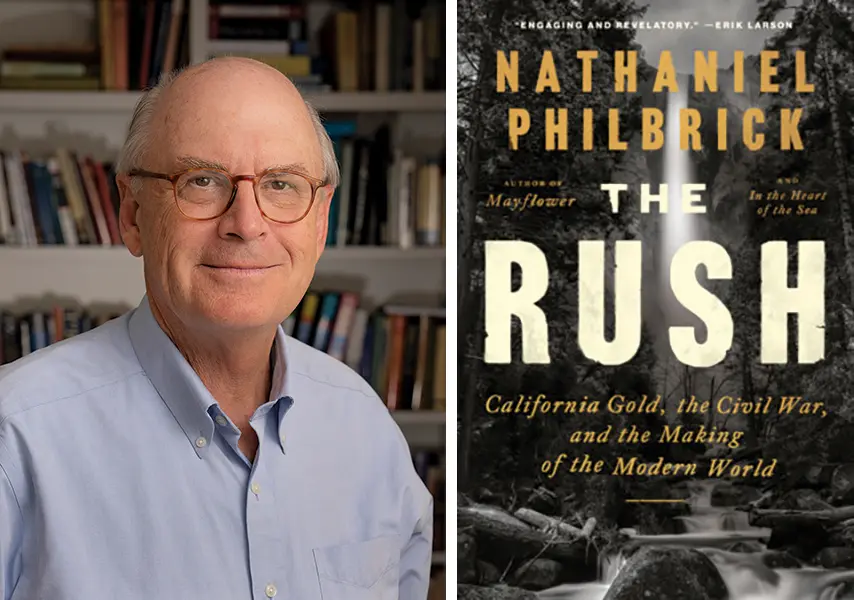
The narrative of the California Gold Rush has long been enshrined in the American consciousness as a romantic tale of rugged individualism, wooden sluice boxes, and fortune-seeking pioneers venturing westward into uncharted wilderness. However, in his groundbreaking historical analysis The Rush, acclaimed historian Nathaniel Philbrick dismantles this nostalgic mythology to reveal a far darker, more transformative reality. Philbrick argues that the discovery of gold at Sutter’s Mill in 1848 was not merely a localized migration event, but the fundamental catalyst for modern American capitalism—a high-velocity cultural and economic shock wave whose reverberations continue to shape the nation today.
Rather than viewing the Gold Rush as a closed chapter of 19th-century frontier history, Philbrick traces a direct line from the frantic gold fields of the 1850s to the industrial excesses of the Gilded Age, the fracture lines of the American Civil War, and the contemporary tech ecosystem of Silicon Valley. The movement unleashed an ethos defined by ruthless efficiency, hyper-competition, and an obsession with instant wealth. By centering the experiences of marginalized historical figures—including African American fugitive slaves and Indigenous writers—Philbrick re-examines how the frantic pursuit of gold rewired the American psychological landscape, transforming time into a commodified asset and establishing a culture of disruptive innovation that prioritizes speed and scale above all else.
Detailed Chronology
[1848] Gold Discovered at Sutter's Mill
  │
  ├──► [1849] Global Influx: 300,000 "Forty-Niners" Arrive
  │
  ├──► [1850] California Statehood & Compromise of 1850
  │      └── Heightens national tensions over slavery expansion
  │
  ├──► [1855–1860] Transition to Industrial & Hydraulic Mining
  │      └── Shifts focus from individual miners to capital-intensive corporate syndicates
  │
  ├──► [1861–1865] Financial Fuel for the Union
  │      └── Gold bullion directly funds Union victory in the American Civil War
  │
  └──► [20th–21st Century] Legacy Manifests in Silicon Valley
         └── "Move fast and break things" ethos takes root in tech culture
1848–1849: The Spark and the Global Stampede
In January 1848, James W. Marshall discovered gold flakes in the tailrace of a sawmill he was constructing for John Sutter in Coloma, California. Within months, news of the find spread across the globe, initiating one of the largest mass migrations in human history. By 1849, an estimated 300,000 people—dubbed "forty-niners"—poured into California by land and sea. This influx turned sleepy coastal villages like San Francisco into sprawling, chaotic metropolises overnight, completely overhauling the territory’s economic and political landscape.
1850–1860: Political Shockwaves and the Escalation toward Civil War
California’s rapid population explosion forced an immediate crisis in Washington, D.C. The territory bypassed traditional territorial status and applied directly for statehood as a free state in 1850. This application destabilized the fragile balance between slave and free states, leading directly to the Compromise of 1850 and the implementation of the draconian Fugitive Slave Act.
Throughout the 1850s, the flood of California gold injected billions of dollars into the northern banking systems, creating an economic dynamic that further alienated the agrarian, slave-holding South. Far from being an isolated western event, the Gold Rush threw financial and political "gasoline on the fire" that eventually ignited the American Civil War in 1861.
1855–1890s: Industrialization, Environmental Alteration, and the Gilded Age
As surface placer gold was quickly exhausted, individual miners with pans and rockers were replaced by heavily capitalized corporate syndicates. The mid-1850s saw the rise of industrial hydraulic mining—using massive water cannons to blast away whole mountainsides to extract buried ore.
This technological transition marked the birth of corporate extraction and modern wage labor in the American West. The capital accumulated in California funded the transcontinental railroad, established major banking dynasties, and created the economic framework for the late-19th-century Gilded Age, establishing corporate structures designed to maximize profit at scale.
20th Century to Present: The Direct Line to Silicon Valley
The geographic region that served as the operational hub for Northern California’s gold mining trade gradually evolved into the technological epicenter of the world: Silicon Valley. Philbrick asserts that the core cultural DNA of modern tech culture—risk tolerance, capital deployment, aggressive disruption, and the normalization of failure as a prerequisite for success—was directly inherited from the speculative fever that took root during the 1850s gold rush.
Supporting Context & Metrics
The transformation of California during this period offers a stark illustration of demographic shift, economic velocity, and resource extraction in the mid-19th century.
| Metric / Dimension | Pre-Gold Rush (1847) | Height of the Rush (1852–1855) | Long-Term Impact & Legacy |
|---|---|---|---|
| Non-Native Population in CA | ~14,000 | ~250,000–300,000 | Established California as the most populous U.S. state |
| Native Indigenous Population | ~150,000 | Substantially Reduced (<30,000) | Near-total collapse due to violence, disease, and displacement |
| Annual Gold Production | Negligible | ~$50M–$80M/year ($1.8B–$2.9B modern equiv.) | Fundamentally underwrote Union victory in the Civil War |
| Dominant Extraction Method | Pan and shovel (Individual) | Hydraulic mining & Quartz crushing (Corporate) | Pioneered modern corporate industrial extraction techniques |
| Dominant Cultural Ethos | Agrarian, localized commerce | Speculative, high-velocity, profit-maximization | Formed the psychological bedrock of modern venture capitalism |
Demographics and the Subversion of the Standard Narrative
The traditional Gold Rush narrative focused almost exclusively on white East Coast Americans heading West. However, historical data reveals an intensely international and multi-ethnic reality that was as complex as it was volatile.
       [Composition of California Migration (1850s)]
       ┌──────────────────────────────────────────┐
       │ ■ Eastern US Euro-Americans      (~55%)  │
       │ ■ Latin Americans (Chile, Mexico) (~15%) │
       │ ■ Chinese Immigrants              (~10%) │
       │ ■ European Immigrants             (~10%) │
       │ ■ African Americans & Native Peoples (~10%)│
       └──────────────────────────────────────────┘
The gold fields presented a complex environment where traditional societal hierarchies were constantly tested. African American fugitive slaves navigated complex legal and social landscapes, choosing the potential wealth and relative freedom of California over established escape routes to Canada. Concurrently, thousands of foreign miners—from Chile, Mexico, China, and Europe—arrived in the diggings, frequently facing systematic discrimination, foreign miners’ taxes, and physical violence from American prospectors.
Technology Born of Imperative: Peacetime as Warfare
The absolute necessity to extract maximum wealth before resources were depleted turned the California gold fields into an unprecedented laboratory for technology. The prevailing philosophy—that "time is money"—forced rapid innovation in transportation, telecommunications, and heavy machinery.
[Resource Scarcity] ──► [High Time Sensitivity] ──► [Rapid Technological Innovation]
                                                              │
   ┌──────────────────────────────────────────────────────────┴──────────────────────────┐
   ▼                                          ▼                                          ▼
Hydraulic Water Cannons               Steamship Networks                     Telegraph & Financial Rails
(Industrial Extraction)               (Global Logistics)                     (High-Velocity Capital)
The development of high-pressure water monitors (monitors or giants) allowed companies to wash away vast quantities of sediment, fundamentally changing landscape engineering. The logistical challenge of moving hundreds of thousands of people and millions of tons of freight spurred advancements in steamship technology, Panama railroad construction, and eventually the Transcontinental Railroad.
Official Statements & Author Commentary
In discussing The Rush, historian Nathaniel Philbrick provided key insights into the research methodology, thematic shifts, and contemporary implications of his work.
On Reframing the Historical Protagonists
Philbrick emphasized the extensive process required to break away from traditional historical tropes and locate figures whose lived experiences captured the true breadth of the era:
"That challenge took me two years to solve. Yes, there’s the discovery of gold, but then there’s the issue of slavery, of the gold mines—who best to tell this story? Who are the characters to follow? An African American fugitive slave who decides, ‘It’s too cold to go to Canada, I’ll go to California instead’; a Native American journalist who learns of an Indigenous Mexican so abused in the gold mines that he turns to robbery, and who uses that story as the basis for a novel—those are the people I need to follow. Once I identified the people, I knew it would work."
On the Nature of Greed and "Peacetime Warfare"
Addressing the unique dynamics of the era, Philbrick noted that the non-stop search for wealth altered societal norms around time, labor, and human relationships:
"What made the gold rush such a petri dish for technology was this overriding idea that time is money—we have to maximize as much as possible because we’ll only be able to do this for a few years. In that sense, peacetime in California was warfare. They were literally battling each other and Native peoples, all while imagining, at least initially, a looming endpoint. It spurred tremendous innovation."
On the Lineage Connecting 1849 to Silicon Valley
When asked about the book’s final destination in modern Silicon Valley, Philbrick identified a shared cultural heritage between 19th-century miners and modern tech pioneers:
"The discovery of gold unleashed a social juggernaut driven by greed. It was strikingly modern, with tentacles that reached into the future… The ethic of Silicon Valley was created by the gold rush. We break things, we try all sorts of stuff, failure is part of success—this approach began in the 1850s. We’re still on that hurtling train."
On the Civil War and National Identity
Philbrick highlighted the Gold Rush’s pivotal role in accelerating the political crisis that split the nation in 1861:
"I think it’s important to look at how the gold rush impacted the rest of the country, particularly how it threw gasoline on the fire that became the Civil War… America has a revolutionary core, we were founded with ideals, and those ideals led to the Civil War, but something else happened along the way: we became a society dedicated to each person getting not just rich, but instantly rich. And maybe it’s that insane need for wealth that most defined what came after."
Future Outlook
The historical legacy outlined in The Rush provides a critical lens for understanding modern economic and technological shifts. The underlying mechanics of the Gold Rush—rapid speculative capital deployment, regulatory arbitrage, environmental transformation, and a conviction that technology can transcend existing social structures—continue to define contemporary American capitalism.
       [1849 Speculative Gold Rush]
                     │
                     ▼
       [1880s Corporate Extraction & Gilded Age]
                     │
                     ▼
       [1990s Internet & Dot-Com Boom]
                     │
                     ▼
       [2020s AI Revolution & Venture Capital Boom]
The Persistence of the Disruption Ethos
The mentality born in the gold fields remains a dominant force in modern commerce. Whether in the rapid development of artificial intelligence, cryptocurrency markets, or private space exploration, the principle that traditional boundaries can be bypassed in pursuit of rapid scale remains active. Modern venture capital models—where numerous investments fail in search of a single massive return—mirror the economic behavior of 1850s prospectors and financiers.
Rethinking the Cost of Speed
As modern society grapples with the systemic consequences of rapid technological disruption—including wealth inequality, ethical questions around automated systems, and resource consumption—Philbrick’s analysis offers a timely reminder. The historic transition from idealized founding principles to hyper-velocity wealth accumulation established a national narrative that prioritizes speed and innovation. Understanding that this dynamic was forged in the Sierra Nevada gold fields provides vital context as society navigates the next generation of rapid economic and technological shifts.