

Executive Overview
Years after the flames of the Arab Spring first swept across the Middle East, the Syrian uprising remains one of the defining humanitarian and geopolitical tragedies of the 21st century. At the epicenter of this brutal conflict was the city of Homs—specifically its battered, besieged neighborhood of Baba Amr. In early 2012, as President Bashar al-Assad’s military waged a relentless campaign of artillery barrages, missile strikes, and sniper fire to crush the civilian uprising, a handful of foreign journalists took immense, calculated risks to pierce the government-imposed information blackout.
This comprehensive account examines a clandestine CNN journalistic mission into the heart of Homs. Relying on local opposition networks, safe houses, and secret agricultural smuggling routes, a veteran reporting crew slipped past military checkpoints to document an urban war zone where no frontline existed and nowhere was safe. Through the harrowing experiences of CNN correspondent Arwa Damon, cameraman Neil Hallsworth, and security specialist Tim Crockett, this report details the devastation of Baba Amr: a neighborhood where mothers gave birth in rudimentary bomb shelters, doctors operated without anesthesia, and the shadow of death hung over every shattered street.
The documentary evidence gathered during this dangerous assignment exposed the sheer scale of the regime’s assault, foreshadowing the tragic deaths of veteran foreign correspondents like Marie Colvin and Rémi Ochlik, and cementing Homs in global memory as a harrowing symbol of resilience and devastation.
Detailed Chronology: Smuggled into the Epicenter of the Uprising
The Dangerous Entry: Five Days Through the Shadows
For what should have been a standard two-hour drive from the surrounding countryside into Homs, the CNN team endured a grueling, five-day ordeal of clandestine transit. To evade the extensive network of checkpoints and patrols established by the Syrian Arab Army, the crew had to rely entirely on an intricate, highly secretive pipeline managed by local anti-regime activists.
The journey was a masterclass in operational security under fire. Moving through farmlands and desolate back roads, the journalists were shuffled from one safe house to another. Each leg of the journey was coordinated by a different local guide—an individual intimately familiar with the micro-topography of the terrain, government troop movements, and active sniper lines.
For the thousands of civilians trapped within Baba Amr, this clandestine network was not merely a route for journalists; it was their sole lifeline for external communication, medical supplies, and humanitarian aid. Recognizing the lethal implications of a security breach, the CNN crew agreed to protect the absolute secrecy of the route, knowing that any disclosure could spell execution for their guides and total isolation for the besieged population.
Life in the Crosshairs: The Reality of Baba Amr
Upon entering Homs, the team encountered a landscape stripped of normalcy. There was no traditional frontline; instead, the entire neighborhood of Baba Amr was subjected to an omnidirectional assault by tanks, artillery, and rocket fire.
Most buildings bore the devastating scars of impacts, their facades sheared off to reveal the domestic interiors of ruined apartments. Amid the destruction, ghost-like scenes unfolded: a child peeking cautiously from a scarred doorway, followed instantly by the chilling sight of an opposition fighter patrolling the rubble with an AK-47.
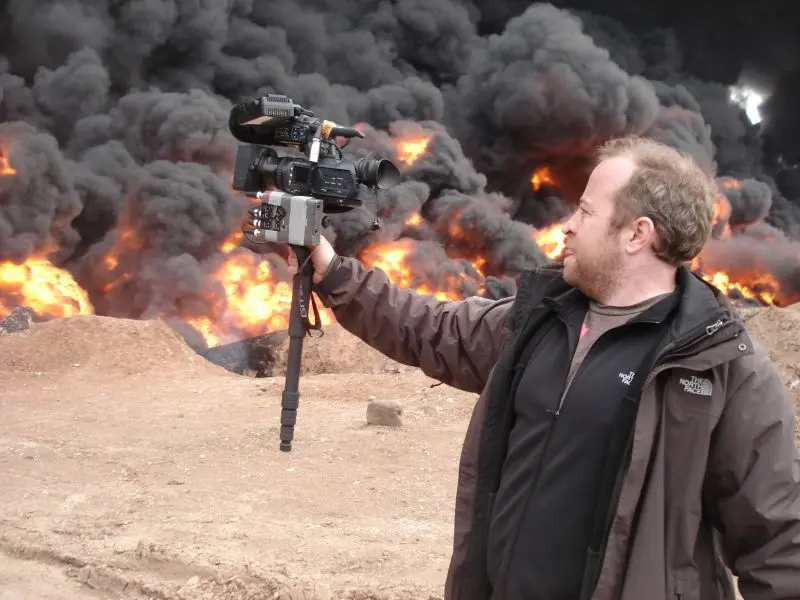
Veteran war correspondent Arwa Damon, despite her extensive experience covering conflicts in Iraq and Afghanistan, confessed to the profound psychological weight of the assignment. Before setting out, she took the precautionary step of writing a farewell letter to her family and visiting close friends—a sobering acknowledgment of the statistical unlikelihood of surviving an all-out urban siege. She was joined by Neil Hallsworth, a seasoned combat cameraman, and Tim Crockett, a former special forces officer tasked with managing team security who also served as an unofficial still photographer.
The Make-Shift Medical Frontlines
With hospitals in government-controlled areas closed off or actively targeting wounded protesters and defectors, medical care in Baba Amr was reduced to desperate improvisations. The injured were treated by a skeletal staff of courageous medical personnel—most notably two doctors, one of whom was a dentist—who worked around the clock in harrowing conditions.
Because the Syrian military systematically targeted known medical facilities, the doctors abandoned central clinics in favor of a decentralized network of temporary safe houses. Operating across multiple makeshift stations, they treated horrific trauma injuries: shrapnel-embedded head wounds, crushed limbs, and severe internal hemorrhaging. Antibiotics and surgical instruments were severely depleted, forcing medics to make agonizing triage decisions. Amputations often became the only viable option to save a patient from septic shock.
Underground Existence: Basements and Bunkers
When the bombardment intensified, residents retreated underground. Mosques broadcasted urgent warnings via loudspeakers before major shellings commenced, instructing families to abandon upper floors, stay away from glass windows, and huddle in interior rooms or subterranean levels.
In one such damp, dimly lit basement serving as a bomb shelter for roughly 300 civilians, the CNN crew encountered a microcosm of the city’s tragedy. A teenager had given birth to a baby girl, named Fatimah, just twenty-four hours earlier amid the concussive shock of falling missiles. Fatimah’s existence was a poignant portrait of innocence in the heart of hell; her father remained absent, having ventured out weeks prior to secure basic food supplies and never returning due to active sniper fire. Nearby, an elderly grandmother trembled as she recounted the violent deaths of two other family members.
Every family sheltered in that basement carried similar accounts of arbitrary loss. In Homs, survival was dictated not by military strategy or protective measures, but entirely by the cruel lottery of physics and sheer luck.
Supporting Context & Metrics: The Siege of Baba Amr
Anatomy of a Regime Crackdown
The assault on Homs was the culmination of a year of nationwide civil unrest. Beginning in early 2011, inspired by regional uprisings, Syrians poured into the streets demanding political reform, the release of political prisoners, and an end to the Ba’ath party’s decades-long monopoly on power. While protests erupted across multiple governorates—including Daraa, Idlib, and the suburbs of Damascus—Homs quickly emerged as the beating heart of the revolution.
Baba Amr, a working-class Sunni neighborhood in the southwestern sector of Homs, became a formidable bastion of armed opposition and civilian defiance. The regime of Bashar al-Assad responded with overwhelming military force, viewing the quarter as an existential threat to state control.
Key Metrics of the Siege
- Duration of Intense Shelling: Weeks of continuous, heavy artillery and rocket bombardments that reduced large swaths of residential infrastructure to rubble.
- Civilian Casualties: Hundreds of civilians were killed during the siege of Baba Amr alone, with thousands more wounded and denied access to professional surgical care.
- Journalistic Toll: The extreme danger of reporting from Baba Amr was tragically underscored when renowned Sunday Times war correspondent Marie Colvin and French photojournalist Rémi Ochlik were killed by a targeted rocket attack on a makeshift media center just days after the CNN crew’s departure.
- Activist Network Losses: At least three prominent local citizen-journalists and media activists who smuggled footage out of the neighborhood lost their lives during the military campaign.
Official Statements and International Reactions
The documentation smuggled out of Homs by CNN and other embedded journalists provided undeniable visual proof of war crimes, triggering sharp international condemnation and shifting diplomatic discourse regarding the Syrian conflict.
- Human Rights Organizations: Amnesty International and Human Rights Watch repeatedly condemned the Syrian government’s indiscriminate shelling of civilian-dense neighborhoods, classifying the tactics used in Homs as crimes against humanity.
- Local Opposition Networks: Activists inside Baba Amr broadcasted desperate pleas to the United Nations and the Arab League, accusing the international community of complicity through inaction while the regime systematically starved and bombarded a trapped civilian populace.
- The Journalistic Community: Following the deaths of Marie Colvin and Rémi Ochlik, global press freedom organizations highlighted the extreme perils faced by independent reporters attempting to break authoritarian information blockades. Media outlets underscored that reporting from inside besieged Syrian enclaves was essential to counteracting state-sponsored denialism and propaganda.
Reflecting on the psychological toll of evacuation, Arwa Damon articulated the profound ethical dilemma shared by many foreign correspondents who leave war zones:
"It is fundamentally unfair that we live in a world where we can go film this, report on it, and leave, knowing that the people we’ve left behind’s suffering is going to continue. Feeling as if we should’ve done more, we could’ve done more."
Future Outlook: The Legacy of Homs and Syria’s Ongoing Crisis
The Fall of Baba Amr and Beyond
By late February 2012, the relentless, scorched-earth military campaign finally broke the physical resistance of Baba Amr. Syrian government forces, reinforced by allied militias, launched a final ground offensive into the neighborhood. Opposition groups and human rights monitors subsequently reported widespread summary executions, arbitrary detentions of military-age males, and wholesale looting of abandoned properties as government troops secured the ruins.
The fall of Baba Amr served as a grim blueprint for the Assad regime’s subsequent military strategies across other rebellious enclaves, including the Ghouta suburbs of Damascus, Aleppo, and Daraa. The playbook remained consistent: total siege, starvation tactics, systematic destruction of hospitals and infrastructure, and intensive bombardment until opposition forces were forced into capitulation or displacement through negotiated green-bus evacuations.
The Long-Term Impact on Journalism and Accountability
The clandestine reporting from Homs permanently altered how conflict journalism is conducted in authoritarian states. The heavy reliance on citizen-journalists, encrypted communication channels, and underground smuggling routes became standard operating procedure for documenting atrocities in regions where traditional press accreditation was denied.
Furthermore, the high-definition visual evidence, medical logs, and eyewitness testimonies gathered during the siege of Homs laid foundational data for future international accountability mechanisms. Although justice has been slow and complicated by geopolitical vetoes in the United Nations Security Council, documentation compiled by organizations operating in areas like Homs remains crucial for eventual war crimes tribunals, universal jurisdiction prosecutions in European courts, and historical memory.
Ultimately, the story of Homs stands as an enduring testament to both the extreme brutality of modern state repression and the unbreakable courage of ordinary civilians and journalists who refused to let tyranny unfold in the dark.