

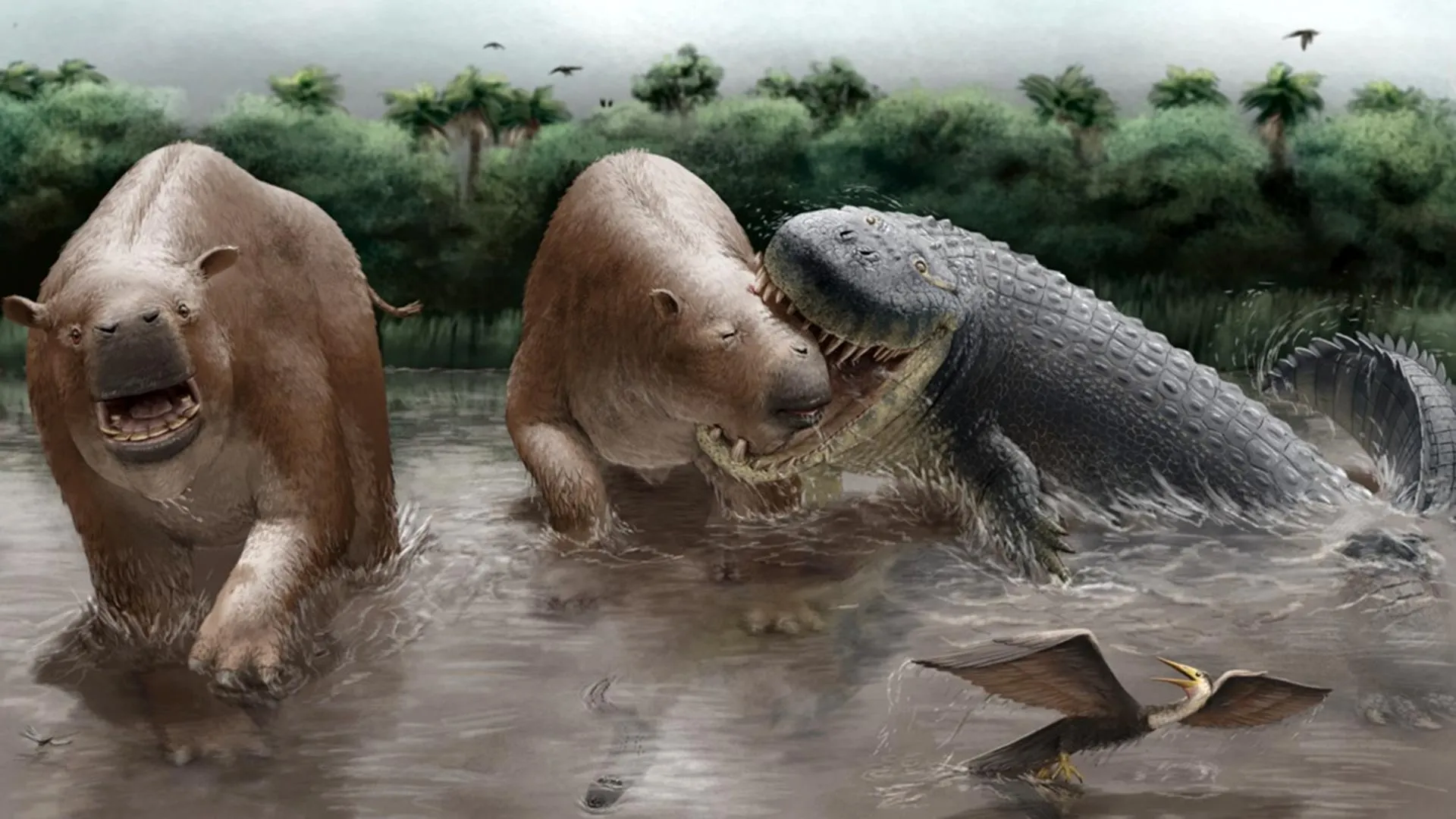
Executive Overview
More than ten million years ago, long before the emergence of modern human civilization and even before the Isthmus of Panama bridged the Americas, South America was an isolated island continent functioning as a natural laboratory of evolutionary gigantism. During the Miocene epoch—a dynamic geological chapter spanning from roughly 23 to 5 million years ago—a colossal, sprawling wetland ecosystem dominated the northern and central portions of the continent. Known to geologists and paleontologists as the Pebas and Pebas-transition mega-wetlands, this vast aquatic network created an environment of extraordinary biological productivity.
Within this humid, tropical crucible lived a staggering array of colossal creatures. The shores and waterways teemed with megafauna: armored herbivores weighing multiple metric tons, flightless avian apex predators, and mammalian carnivores sporting lethal adaptations. Yet, despite the presence of formidable competitors like saber-toothed mammals, giant anacondas, and terrestrial crocodylomorphs known as sebecids, new scientific research reveals that the apex of this food web belonged firmly to true crocodylians.
According to a groundbreaking study published in the Journal of Vertebrate Paleontology, these ancient scaled predators were not merely passive participants in a crowded ecosystem; they were the undisputed lords of the Miocene. Through a meticulous examination of fossilized bite marks and paleobiological data, researchers have established that giant crocodylians—most notably the monumental caiman relative Purussaurus neivensis—wielded ecological dominance so profound that they likely regulated entire herbivore populations. This comprehensive investigation challenges traditional views of mammalian dominance in South American prehistory, painting a vivid picture of a lost world where the supreme rulers of the ecosystem wore armor of bone and scales.
Detailed Chronology: The Rise and Reign of the Miocene Mega-Wetlands
To understand the scale of this prehistoric dominion, one must journey back through deep time to the Miocene epoch, specifically a window spanning roughly 16 million to 10.5 million years ago. During this period, South America was geographically isolated from North America, allowing its endemic fauna to evolve along entirely unique paths.
[23 Million Years Ago] ──► [16M - 10.5M YA] ──────► [5 Million Years Ago]
  Dawn of the Miocene      Peak Mega-Wetland          Closure of Seaway &
  Isolation of South       Pebas System; Dominance    Rise of Modern Amazon
  American Fauna           of Purussaurus             Basin Ecosystems
The Shaping of an Aquatic Empire
The geography of northern South America during the mid-Miocene bore little resemblance to the modern Amazon basin. Instead of dense rainforests laced by winding rivers, a massive, shallow inland sea and mega-wetland system covered vast portions of what is now Amazonia, Colombia, Peru, and Brazil. Fed by the nascent Andean uplift, this aquatic expanse fostered an environment rich in aquatic vegetation, fish, and freshwater fauna.
As the wetlands expanded and contracted over millions of years, they created dynamic ecological niches. The muddy shores and expansive floodplains supported an extraordinary diversity of mammalian herbivores. Among these were the ancestral groups of South American native ungulates (SANUs)—hoofed mammals that evolved completely independently of their northern hemisphere counterparts.
The Herbivore Menagerie
The sheer abundance of plant matter fueled a population of massive herbivores that pushed the boundaries of mammalian size:
- Glyptodonts: Heavily armored, turtle-like relatives of modern armadillos that could grow to the size of a small automobile.
- Giant Ground Sloths: Massive, slow-moving browsers that stood upright to feed on high canopy foliage, often reaching weights that rivaled modern elephants.
- Astrapotheres ("Lightning Beasts"): Bizarre, heavy-bodied ungulates characterized by massive tusks and short, trunk-like snouts, weighing well over a metric ton.
- Toxodontids: Barrel-chested, rhinoceros-like herbivores that constituted some of the most successful and populous large-bodied mammals of the epoch.
This incredible biomass of large-bodied prey created an unprecedented feeding ground for carnivores. However, unlike ecosystems in other parts of the world where mammalian carnivores typically dominated the apex tiers, the South American Miocene presented a multi-tiered predatory arena of exceptional ferocity.
Supporting Context & Metrics: Anatomy of an Apex Ecosystem
The recent study published in the Journal of Vertebrate Paleontology sheds new light on how this complex food web functioned. By shifting the analytical focus from mere speculation based on animal size to hard physical evidence preserved in the fossil record, researchers have quantified the true ecological impact of Miocene predators.
The Competitive Landscape
South America during the mid-Miocene hosted an eclectic and terrifying roster of meat-eaters:
- Sebecids: Terrestrial, long-legged crocodyliforms capable of running down prey on land, boasting laterally compressed, shark-like teeth.
- "Terror Birds" (Phorusrhacids): Flightless avian predators standing up to three meters tall, equipped with massive, axe-like beaks designed to deliver crippling blows to prey.
- Saber-Toothed Mammals (Sparassodonts): Metatherian carnivores featuring dagger-like canines designed for delivering lethal bites to large mammalian herbivores.
- Giant Anacondas: Enormous boid snakes capable of constricting and swallowing large prey in the swampy margins.
Despite this formidable lineup, the sheer volume of available prey meant that mammalian predators alone could never consume the surplus. Enter the true crocodylians—cold-blooded, highly efficient apex predators that leveraged the abundant waterways to stage devastating ambushes.
Purussaurus neivensis: The Ultimate Apex Predator
At the absolute peak of this ecosystem sat Purussaurus neivensis, a colossal relative of modern caimans that redefined the limits of crocodylian scale.
| Metric | Purussaurus neivensis Statistics |
|---|---|
| Maximum Estimated Length | ~7 meters (23 feet) |
| Estimated Body Weight | ~1,800 kilograms (approx. 4,000 lbs) |
| Biomechanical Role | Apex aquatic predator & top-tier ecosystem regulator |
| Dietary Scope | Megafaunal mammals, large turtles, aquatic prey |
| Geological Age Range | 16 million to 10.5 million years ago |
Purussaurus was not merely a large animal; it was an ecological juggernaut. With a skull broad and heavily reinforced to withstand the crushing forces of subduing massive prey, its bite force is estimated to have exceeded modern apex predators by an order of magnitude.
Fossilized Evidence: Reading the Marks of Death
To move beyond theoretical ecology, the research team, led by international paleontologists, examined extensive collections of fossilized mammal bones housed in museums. They searched specifically for taphonomic evidence—marks left by teeth and jaws on the bones of Miocene herbivores.
[Fossil Collection Inspection]
       │
       ▼
[Identification of Taphonomic Bite Marks]
       │
       ▼
[Morphological Matching to Predator Dentition]
       │
       ▼
[Establishing Purussaurus as Dominant Consumer of Large Prey]
These bite marks serve as the holy grail of paleoecology. Unlike skeletal reconstructions, which tell researchers what an animal could theoretically do, bite marks on bones provide direct, indisputable proof of predation and scavenging events. By matching the spacing, depth, and striation patterns of the tooth impressions to the known dentition of the region’s predators, the researchers isolated a high frequency of marks directly attributable to Purussaurus.
The concentration of these marks on massive herbivore fossils between 10.5 million and 16 million years old demonstrates that the giant caiman was actively hunting and consuming the largest animals in the ecosystem, rather than subsisting solely on fish or smaller prey.
Official Statements and Expert Analysis
The implications of this study extend far beyond local paleontology, offering fresh insights into how ancient tropical food webs operated. The research team emphasizes that the dominance of crocodylians in South America highlights a unique evolutionary trajectory driven by geographic isolation and environmental abundance.
"There was so much prey available that mammalian predators couldn’t have eaten it all," explains Oscar Wilson, a postdoctoral researcher at the University of Helsinki and lead contributor to the research initiative.
The mismatch between the boundless supply of massive herbivores and the metabolic capacities of mammalian carnivores created an ecological vacuum. While mammalian predators like sparassodonts specialized in specific niches, they were ultimately limited by energetics and competition. Crocodylians, with their ectothermic (cold-blooded) metabolisms, could process massive meals and survive extended periods between hunts while maintaining massive body sizes.
"Our new study shows that crocodylians in particular were the region’s most important predators, especially when it came to hunting large prey," Wilson notes.
This dietary dominance positioned Purussaurus not just as a consumer, but as a keystone predator. In modern ecosystems, top predators exert "top-down" control, regulating herbivore populations and, by extension, the structure of plant communities. The research suggests that Purussaurus played an analogous, hyper-scaled role in Miocene tropical wetlands.
Commenting on the fossil evidence recovered from museum archives, Wilson adds: "The frequency of marks likely made by Purussaurus suggests that it was an important predator in these tropical ecosystems, capable of influencing the demographic structure and population sizes of contemporary megafauna."
This perspective transforms our understanding of ancient tropical communities. Instead of passive coexistence among mega-predators, the Miocene wetlands were governed by a clear hierarchy dominated by armored, cold-blooded leviathans.
Future Outlook: Unlocking the Secrets of Deep-Time Ecosystems
As paleontological techniques advance, the methodologies used to decode the Miocene of South America are opening new frontiers in evolutionary research. The integration of taphonomy—the study of how organisms decay and become fossilized—with high-resolution biomechanical modeling is allowing scientists to reconstruct ancient food webs with unprecedented precision.
Emerging Research Directions
- Micro-Wear Analysis: Future studies aim to analyze microscopic wear patterns on fossil teeth to differentiate between animals that regularly hunted megafauna versus those that scavenged opportunistically.
- Stable Isotope Geochemistry: By examining the chemical composition of fossil tooth enamel, researchers hope to reconstruct the exact migratory and dietary habits of both Purussaurus and its mammalian prey across seasonal wet-dry cycles.
- Digital Biomechanics: Advanced finite element analysis (FEA) computer models are being deployed to simulate the skull stress of Purussaurus during high-impact strikes against armored glyptodonts and thick-skinned astrapotheres.
Conservation and Deep-Time Parallels
Understanding how apex predators managed vast ecosystems millions of years ago also provides valuable context for modern conservation biology. While the scale of the Miocene mega-wetlands dwarfs today’s Amazon basin, the fundamental ecological laws governing predator-prey dynamics remain constant. When top predators like giant caimans or large cats are removed or suppressed, cascading effects ripple through the entire habitat.
Ultimately, the revelation that giant crocodylians ruled South America’s golden age of megafauna forces us to look at modern tropical rivers with renewed awe. Beneath the murky waters of today’s Amazon lie the evolutionary echoes of a terrifying, magnificent epoch—a time when seven-meter caimans reigned supreme over a continent of giants.