


Executive Overview
For thousands of aspiring creators, breaking into the freelance writing industry feels like an uphill battle fought entirely in the dark. Every week, eager writers compile lists of prospective clients, draft carefully worded cold emails, and hit "Send"—only to be met with a demoralizing wall of silence. The common diagnosis for this widespread failure is usually poor writing, an inadequate portfolio, or targeting the wrong niche.
However, according to industry veterans and growth data from platforms like Location Rebel, the core issue is far simpler, yet chronically overlooked: the absolute failure to follow up.
In the hyper-competitive landscape of digital content creation, sending a single introductory email is practically the equivalent of whispering in a hurricane. Most freelancers abandon their outreach efforts after the first unanswered message, incorrectly assuming that silence equates to rejection. In reality, modern decision-makers are inundated with digital correspondence, and a lack of a reply almost always means the email was buried, forgotten, or mistimed—not actively rejected.
By failing to implement a structured, personalized follow-up cadence, writers are willingly leaving tens of thousands of dollars on the table. This comprehensive report explores the psychology of cold outreach, the mechanics of high-converting timing cadences, the vital importance of personalization, and the modern software tools—including AI assistants and CRM integrations—that transform chaotic outreach into a streamlined, high-converting pipeline.
Detailed Chronology: The Anatomy of a Modern Outreach Campaign
To understand why the follow-up is so critical, we must examine the typical lifecycle of a freelance pitch. Building a sustainable freelance writing business requires moving away from frantic, sporadic bursts of emailing and toward a methodical, predictable chronology.
Phase 1: Research and the Initial Letter of Introduction (LOI)
The journey begins well before an email is ever written. Successful freelance writing starts with rigorous prospecting: identifying businesses, blogs, digital publications, or corporate marketing departments that actively produce content but show clear gaps in quality, SEO optimization, or publishing frequency.
Once a target is identified, the writer crafts a Letter of Introduction (LOI). Contrary to spammy templates that focus entirely on the writer’s credentials, an effective LOI focuses on the client. It addresses a specific pain point, demonstrates an understanding of the brand’s voice, and opens with a customized hook. The objective of this initial email is not to secure an immediate contract; it is simply to establish an initial point of contact and plant a flag in the prospect’s inbox.
Phase 2: The Critical Waiting Period (Days 2 to 5)
A frequent beginner mistake is panicking immediately after sending an initial pitch. If a prospect does not reply within twenty-four hours, novice freelancers often assume they made a mistake and immediately fire off a frantic follow-up. This appears desperate and overbearing.
Industry best practices dictate a cooling-off period of two to five days. This window provides the recipient sufficient time to process their primary workload while keeping the sender’s message close enough to the top of the inbox to remain retrievable.
Phase 3: The First Strategic Follow-Up
When the waiting window closes without a response, the real work begins. The first follow-up should not be a resent copy of the original email with "Checking in?" scrawled at the top. Instead, it should add incremental value. This could be a fresh content idea tailored to their blog, a relevant statistic affecting their industry, or a polite inquiry framed around whether the email reached the correct person in the organization.

Phase 4: Establishing a Long-Term Cadence
Prospects rarely purchase on demand. Their need for a freelance writer fluctuates based on budget cycles, product launches, staff departures, and seasonal content demands. Therefore, the outreach chronology extends across weeks, quarters, and even years. By establishing a quarterly touchpoint system—such as reaching out ahead of the Q4 holiday rush or offering fresh editorial planning ideas in mid-January—freelancers position themselves as reliable, ever-present resources. When the client’s internal writer suddenly quits or a new content budget is approved in the spring, the freelancer whose name is fresh in the inbox wins the contract.
Supporting Context & Metrics: The Numbers Behind Sales and Outreach
The aversion to following up is largely driven by fear of being a nuisance. Writers worry that sending multiple emails makes them look desperate or aggressive, risking damage to their professional reputation. However, empirical sales and marketing data completely dismantle this anxiety.
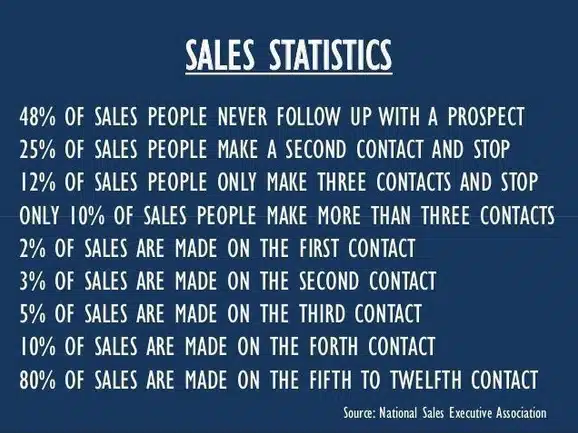
Sales and outreach statistics consistently demonstrate that the vast majority of all transactions and business relationships require multiple touchpoints to materialize:
- The 1-Email Fallacy: Data shows that roughly 48% of sales reps make a single follow-up attempt and then give up entirely. They abandon cold leads before the process has even truly begun.
- The Multi-Touch Reality: Conversely, historical sales data indicates that upwards of 80% of sales are closed between the fifth and twelfth contact. If a freelancer stops after email number one or two, they are missing out on the vast majority of potential conversions.
- The Timing Variable: At the precise moment a cold email lands in an inbox, the probability that the recipient is actively searching for a writer is microscopically small. Content needs are seasonal and cyclical. Persistence is the only mechanism that bridges the gap between a writer’s availability and a client’s sudden need.
As veteran online entrepreneur Sean Ogle points out, following up is frequently a service to the recipient rather than an annoyance. Decision-makers operate under immense cognitive loads. A thoughtful, well-timed email that arrives precisely when a content bottleneck occurs is welcomed as a solution to a stressful problem. If the timing is truly wrong, a simple "No thanks" or an unsubscribe request cleanly closes the loop without hard feelings.
Personalization: The Antidote to Digital Fatigue
The modern internet is flooded with low-quality, AI-generated spam. Decision-makers at growing companies receive dozens of generic pitches every single day—messages lacking context, featuring broken personalization tokens, and demanding immediate attention without offering any reciprocal value.
This environment has created widespread cynicism. When a generic cold email arrives, it is deleted instantly, and its sender is often blocked. This creates a severe challenge for legitimate, hardworking freelance writers who must work twice as hard to prove they are human and competent.
The Power of the Customized Hook
Overcoming this skepticism does not require spending hours dissecting a prospect’s entire corporate history. According to outreach experts, high-converting personalization can be achieved efficiently by focusing on a single, high-impact element: the opening sentence.
By taking sixty seconds to review the target’s recent blog post, a LinkedIn company update, or a podcast appearance they made, a writer can craft an authentic opening that proves actual human engagement. For example:
"Hi [Name], loved your recent breakdown on B2B SaaS churn rates—especially your point about onboarding friction."
This tiny investment of effort immediately separates a writer from 95% of other applicants. It signals professionalism, attention to detail, and genuine interest in the client’s ecosystem.
The "Easy Out" Strategy
Another vital component of sophisticated outreach copywriting is the inclusion of an "easy out." Traditional sales pitches often employ high-pressure tactics that make prospects feel trapped. Modern freelance copywriting takes the opposite approach.
By closing an email with a low-pressure escape hatch—such as, "If you’re fully staffed right now, no worries at all, just let me know and I’ll stay out of your hair"—the writer disarms the reader. Paradoxically, lowering the stakes dramatically increases response rates. It respects the prospect’s autonomy and leaves the door wide open for future communications when their operational needs change.
Systems and Tools for Scalable Tracking
One of the primary reasons freelancers abandon their follow-up schedules is administrative burnout. Trying to remember who was emailed on Tuesday, who needs a follow-up on Friday, and who should be contacted next quarter using memory alone is a recipe for failure. To scale a freelance writing business, you must implement a reliable tracking infrastructure.
Industry professionals generally rely on two distinct methodologies:
1. CRM Integration via Gmail (e.g., Streak)
For writers who live inside their email clients, tools like Streak transform a standard Gmail inbox into a lightweight, highly efficient Customer Relationship Management (CRM) platform.
- Core Benefits: Users can track when emails are opened, attach detailed notes to specific contacts, and schedule automated reminders for future follow-ups.
- Workflow Impact: When a follow-up cadence is mapped out, the system automatically flags when it is time to send the next message, removing the cognitive load of manual record-keeping.
2. AI-Powered Assistants (e.g., Claude or ChatGPT)
For freelancers who dislike traditional spreadsheets and complex databases, generative AI tools offer a revolutionary alternative.
- Core Benefits: Writers can maintain a running conversational thread with an AI model like Claude, updating it with dates, outreach metrics, and client names.
- Workflow Impact: The AI acts as a dedicated marketing assistant. A writer can prompt the system at the end of every week with queries like: "How many cold emails did I send this month, and who is due for a quarterly follow-up today?" The AI organizes the data, tracks conversion funnels from initial pitch to discovery call, and provides clear operational insights without manual sorting.
Regardless of whether a writer chooses a manual spreadsheet, a CRM plugin, or an AI assistant, the guiding principle remains absolute: having a system is non-negotiable. Once tracking is automated, consistency becomes effortless.
Future Outlook: The Evolution of Freelance Client Acquisition
As artificial intelligence continues to reshape the content creation and marketing landscapes, the nature of freelance writing is evolving rapidly. Low-end, generic writing tasks are increasingly automated, placing a higher premium on strategic thinking, deep industry expertise, and authentic human relationships.
In this shifting environment, cold outreach will remain a cornerstone of independent business growth. However, the margin for error will shrink. Writers who rely on lazy, unpersonalized blasts will find themselves completely filtered out by spam filters and exhausted gatekeepers. Conversely, disciplined freelancers who master the art of the personalized introduction, maintain rigorous tracking cadences, and leverage modern AI and CRM tools to stay consistently visible will continue to thrive.
The formula for making your first $1,000—and scaling far beyond it—is ultimately clear. Building a brilliant portfolio and writing a great initial pitch are essential first steps, but they are only the beginning. True freelance success belongs to those who possess the professionalism, resilience, and systematic discipline to follow through. Don’t let your hard work go to waste in an ignored inbox. Build your cadence, personalize your approach, stay top-of-mind, and let the power of the follow-up transform your freelance writing business.