

Executive Overview
In the high-stakes world of modern freelance writing and digital journalism, the margin between profit and burnout is often measured in minutes. For writers who rely on Subject Matter Expert (SME) interviews, client discovery calls, and conference coverage, turning spoken conversations into actionable, publication-ready text has historically been one of the most punishing bottlenecks of the trade. A standard 20-minute conversation with an industry expert can easily unfurl into more than 3,000 words of rich dialogue—a goldmine of insights that, without automated assistance, requires an agonizing, repetitive review process.
Enter automated transcription software, a technological shift that has fundamentally transformed how independent creators manage their workflows. Among the pioneers in this space is Otter.ai, a platform that has quietly become a staple for thousands of digital professionals since its widespread adoption around 2020.
This comprehensive review investigates the true utility, economic viability, and operational limitations of Otter.ai for freelance writers. By analyzing return-on-investment (ROI) metrics, workflow integration, and alternative solutions, this report evaluates whether the Pro tier’s $100 annual price tag represents a vital business investment or an unnecessary subscription for modern content creators.
Detailed Chronology: The Evolution of the Interview Workflow
To truly understand the impact of real-time AI transcription tools like Otter.ai, one must first examine the traditional friction points of the freelance writing process. For years, capturing an SME interview meant choosing between two deeply flawed methodologies: exhaustive real-time note-taking or tedious manual post-call transcription.
The Era of Manual Friction
Historically, conducting a 20-minute phone interview required an immense allocation of cognitive bandwidth. As the expert shared complex industry data, fintech trends, or personal anecdotes, the writer was forced to divide their attention between active listening and frantic typing or shorthand writing.
This dual-focus approach invariably compromised the quality of the interaction. When a writer is worried about capturing a specific quote verbatim, they miss the subtle nuances of the conversation, struggle to pursue organic follow-up questions, and fail to guide the narrative toward a compelling story angle.
Once the call concluded, the punishment continued. Reviewing a raw audio recording without a searchable transcript often meant scrubbing back and forth across the timeline five or six times just to verify a single quote. An hour of administrative labor—minimum—was routinely sacrificed for every 20 minutes of recorded audio.
The Integration of AI Transcription
The introduction of accessible AI-driven voice transcription around the turn of the decade fundamentally altered this dynamic. For writers covering fast-moving sectors like fintech, software-as-a-service (SaaS), and corporate strategy, tools like Otter.ai shifted the paradigm from retroactive stenography to proactive engagement.
By handling the heavy lifting of speech-to-text conversion in real time, these platforms allowed writers to enter interviews with a singular focus: the conversation itself. Audio recordings could be captured securely (with explicit permission), granting the interviewer the psychological freedom to abandon rigid interview scripts, explore unexpected tangents, and foster a more natural, conversational dialogue.
Supporting Context & Metrics: The Economics of Time Savings
In freelance writing, time is quite literally currency. To determine whether a $100-per-year software subscription is financially justifiable, one must look closely at the quantitative metrics of productivity and hourly yield.
The ROI Math of Content Creation
Consider a standard assignment: a freelance writer is contracted to produce a 1,000-word feature article backed by a single SME interview, commanding a flat fee of $1,200. Under a traditional workflow, the time investment typically breaks down as follows:
- Research & Preparation: 1 hour
- Outlining & Drafting: 3 hours
- Manual Transcription & Quote Verification: 1 to 2 hours
- Total Time Investment: ~5 hours
- Effective Hourly Rate: $240 per hour
By introducing an automated transcription tool that cuts the post-call transcription and verification phase down to a fraction of its former self, the administrative burden evaporates. Removing that manual hour brings the total time investment down to four hours, elevating the effective hourly rate to $300.
For a writer producing three to four interview-driven articles per month, the financial return is immediate. The time saved across a single month easily eclipses the annual subscription cost, rendering the tool self-funding almost instantly.
Key Functional Advantages
Beyond raw time savings, modern AI transcription platforms offer sophisticated feature sets designed to streamline editorial workflows:
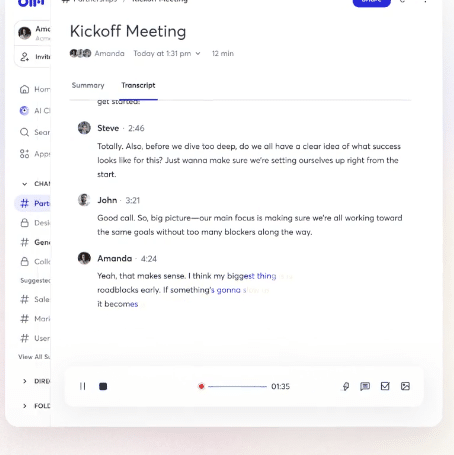
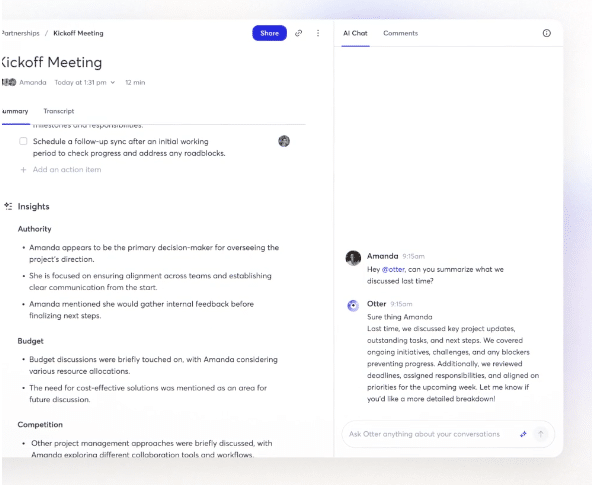
- AI Chat Search Capabilities: Rather than manually scrolling through pages of text to find a specific reference, users can query the transcript via an integrated chatbot. If an expert discussed "credit card fraud" or "AI-driven personalization" twenty minutes into a rambling dialogue, the AI can instantly pull up the relevant sections along with concise thematic summaries.
- Synchronized Audio Playback: Text and audio are inextricably linked within the platform interface. Clicking any word in the written transcript immediately triggers the audio recording to play from that precise timestamp, allowing for rapid verification of garbled words or industry jargon.
- Calendar Integration & Accessibility: Seamless synchronization with popular calendar applications allows the transcription assistant to auto-join scheduled Zoom, Microsoft Teams, or Google Meet sessions without manual intervention.
Operational Limitations and Trade-Offs
Despite its clear utility, automated transcription is not without its operational challenges. A realistic assessment of Otter.ai requires acknowledging its technical limitations and environmental constraints.
Environmental Constraints: The Speaker Mode Dilemma
A notable technical quirk of the platform involves its handling of audio routing. When a user has headphones plugged into their computer during a recorded call, the software often captures only the local speaker’s voice, failing to pick up the audio stream from the remote participant. Overcoming this requires relying on computer speakers to capture both sides of the conversation, which introduces acoustic challenges. While this is entirely manageable in a quiet home office or a private coworking booth, it becomes a significant hurdle for writers operating in shared spaces, coffee shops, or public environments where privacy and noise control are paramount.
Accuracy Margins and Verification Realities
While promotional materials often cite transcription accuracy rates as high as 95%, real-world conditions during SME interviews typically yield an accuracy rate closer to 80% to 85%. Proper nouns, complex technical nomenclature, and overlapping speech frequently result in mangled text or erroneous interpretations.
Consequently, professional writers cannot rely on raw AI transcripts as publication-ready copy. Verification remains a mandatory step. However, because the platform links written text directly to audio timestamps, checking a questionable quote requires only a few seconds of playback rather than a full replay of the interview.
Speaker Identification Inconsistencies
In multi-speaker environments—such as panel discussions, webinars, or chaotic conference calls—the software’s speaker diarization (the process of distinguishing who is speaking) can falter. Voices with similar timbres or poor microphone quality often result in generic designations like "Speaker 1" and "Speaker 2," necessitating manual oversight during post-production.
Alternative Solutions and Market Comparison
Otter.ai is far from a monopoly in the speech-to-text ecosystem. Freelance writers navigating the market have several alternative pathways to consider, each with distinct advantages and drawbacks.
Human Transcription Services
Traditional human transcription services offer superior accuracy and can navigate complex industry jargon with ease. However, they suffer from a fatal flaw in fast-paced journalism: turnaround time. Human-generated transcripts typically take anywhere from three to five days to return unless a steep rush fee is applied. For journalists operating on tight weekly deadlines—where an assignment requires finding an expert, conducting an interview, researching, drafting, and editing within seven days—waiting days for a transcript is untenable. Automated AI tools provide instant access the moment a call ends, eliminating deadline-induced stress.
Competing AI Platforms
Several prominent software alternatives occupy the same market space:
- Fireflies.ai: Widely utilized for automated meeting notes and CRM integrations, appealing heavily to corporate sales and project management teams.
- Fathom: Gaining popularity for its robust video conferencing summaries and user-friendly interface during remote client calls.
- Rev: A hybrid platform offering both automated AI transcription and human-verified services, catering to users who require absolute precision.
While these alternatives offer compelling feature sets, veteran freelancers who have established reliable routines around platforms like Otter often find little incentive to migrate, though newcomers are encouraged to leverage free trial periods to find the tool that best aligns with their specific workflows.
Future Outlook: The Trajectory of AI in Freelance Journalism
As artificial intelligence continues to mature, the boundary between raw recording and published prose will only become more porous. We are rapidly moving toward an era where transcription tools do not merely convert speech to text, but actively synthesize themes, draft structural outlines, and suggest narrative hooks based on conversational data.
For freelance writers, adopting these tools is no longer a matter of cutting-edge experimentation—it is a baseline requirement for maintaining competitiveness in an increasingly demanding digital economy. The democratization of transcription has leveled the playing field, allowing solo entrepreneurs and independent journalists to operate with the administrative efficiency of a fully staffed media newsroom.
Recommendations for Creators
- Test Before You Buy: Utilize the generous free tier (which offers hundreds of monthly transcription minutes) to put the software through its paces on two or three real assignments.
- Select the Right Tier: For the vast majority of freelance writers and content creators, the Pro tier (priced at approximately $8.33 per month billed annually) represents the optimal sweet spot, balancing adequate monthly minutes with extended recording limits.
- Maintain Editorial Rigor: Always treat AI transcripts as a foundational draft rather than final copy. Human verification of quotes and terminology remains the hallmark of professional journalism.
In summary, while Otter.ai possesses minor imperfections in speaker attribution and absolute accuracy, its ability to reclaim hours of lost productivity makes it an indispensable asset for any writer serious about scaling their business and maximizing their effective hourly earnings.