

Executive Overview
For billions of years, a celestial drama has been unfolding quietly across the cosmic void. Ancient, densely packed clusters of stars—known as globular clusters—are slowly being torn apart by the gravitational tides of their host galaxies. As these stellar nurseries disintegrate, they shed individual stars that do not scatter randomly into the abyss. Instead, they trace out faint, remarkably narrow ribbons across space, forming what astronomers call "stellar streams."
For decades, theoretical astrophysicists have predicted that these delicate structures should populate galaxies throughout the universe. Yet, detecting them outside our own cosmic backyard has remained an elusive holy grail of observational astronomy. Their extreme faintness causes them to wash out entirely against the blinding background light of their parent galaxies.
That barrier has finally been broken. In a landmark study published on August 12 in the prestigious journal Nature, an international research team announced the discovery of the first-ever globular cluster stellar stream observed outside the Milky Way. Located roughly 115 million light-years away in an ultra-diffuse galaxy designated UGC 9050-Dw1, this newly identified celestial thread offers much more than a striking visual confirmation of long-held theories. It provides scientists with an unprecedented, high-precision tool to map and measure dark matter—the invisible, enigmatic substance that constitutes roughly 85 percent of all matter in the universe.
By meticulously analyzing the gravitational forces that sculpted the stream’s orbital path, the research team successfully reconstructed the distribution of dark matter within UGC 9050-Dw1. This breakthrough not only validates a powerful new methodology for extragalactic astronomy but also sets the stage for future cosmic surveys that could fundamentally reshape our understanding of dark matter’s behavior across the universe.
Detailed Chronology: From Archival Curiosity to Landmark Discovery
The journey toward discovering the first extragalactic stellar stream began not with a brand-new, multi-billion-dollar targeted observation, but through the careful, meticulous re-examination of archival data—a testament to the adage that discovery favors the prepared mind.
The Breakthrough in Archival Data
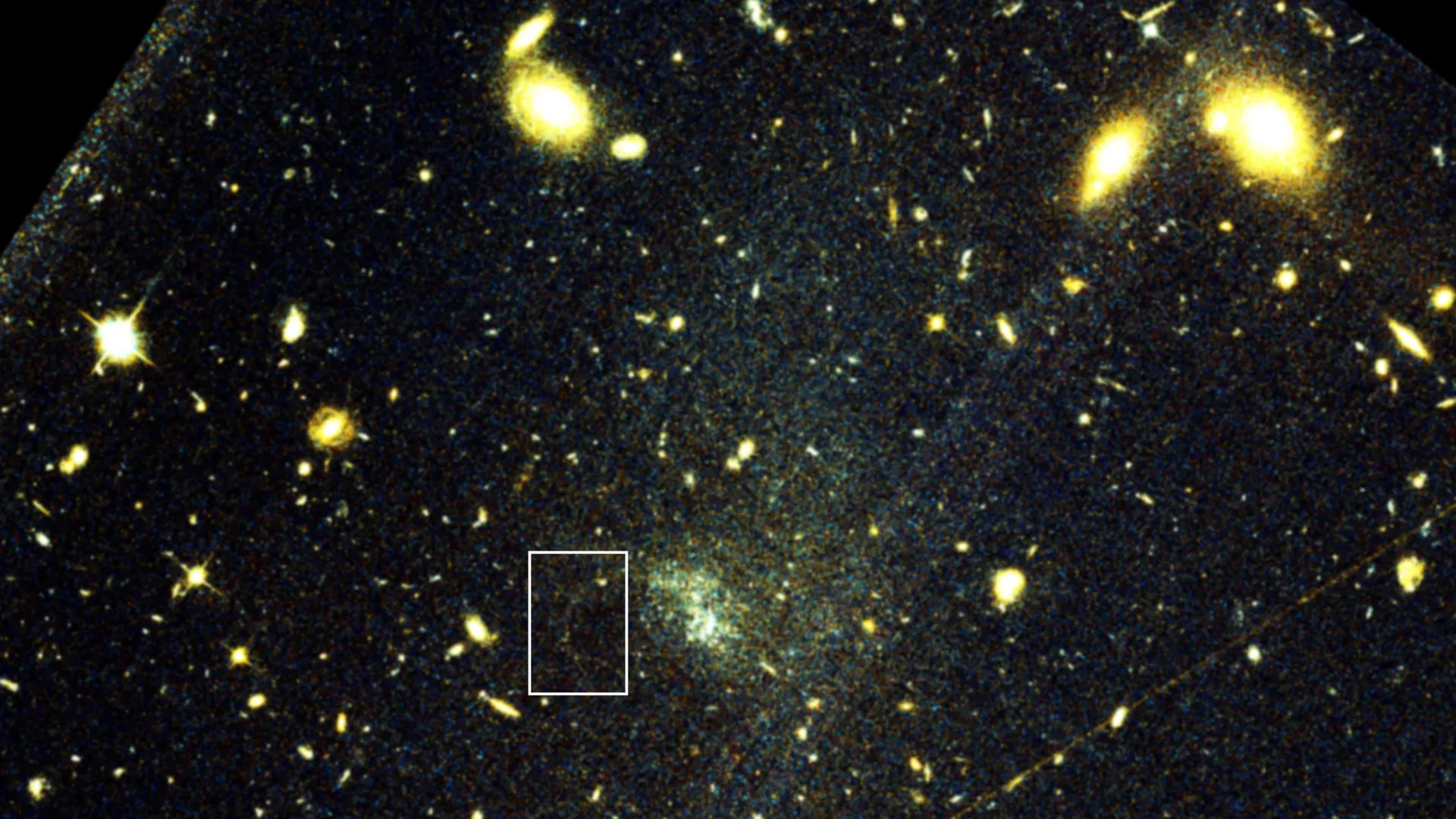
The breakthrough was catalyzed by astronomers David Sand and Catherine Fielder of the University of Arizona, both co-authors of the Nature study, who were working with archival observations captured by NASA’s legendary Hubble Space Telescope. While analyzing images of the ultra-diffuse galaxy UGC 9050-Dw1 as part of a separate publication effort, study co-author David Hendel noticed a peculiar anomaly. Cutting across the dim expanse of the galaxy was a faint, remarkably narrow arc of light.
Unlike the chaotic dust lanes or irregular star-forming clumps common in many galactic structures, this arc possessed the telltale geometry of a stellar stream. However, confirming such a faint structure 115 million light-years away required more than just visual inspection. It demanded rigorous verification, advanced computational modeling, and a collaborative, multidisciplinary global team.
Assembling the Global Research Collaborative
Recognizing the significance of the find, an international research team was rapidly assembled. The study was co-led by Julie Kiel Holm of the University of Copenhagen and Sarah Pearson of the Technical University of Denmark. They were joined by prominent astrophysicists from around the world, including Tjitske Starkenburg, an expert in extragalactic astronomy and research assistant professor at Northwestern University’s Center for Interdisciplinary Exploration and Research in Astrophysics (CIERA).
With the visual candidate identified via Hubble data, the team integrated ground-based telescope observations to verify the structure. They then embarked on a massive computational campaign, running thousands of complex computer simulations. These models tested various combinations of globular cluster properties, galactic mass configurations, and dark matter distributions to determine which physical scenarios could accurately reproduce the exact curvature, length, and density of the observed stream.
The simulations bore fruit: the models that most closely matched the real-world observations successfully constrained UGC 9050-Dw1’s total mass and mapped its spatial distribution. The results confirmed that the ultra-diffuse galaxy is heavily dominated by dark matter, aligning with theoretical expectations while proving that globular cluster streams can serve as reliable galactic scales far beyond the Milky Way.
Supporting Context & Metrics: The Physics of Streams and Dark Matter
To understand the magnitude of this discovery, one must examine the mechanics of stellar streams and the profound mysteries of dark matter that they help illuminate.
The Anatomy of a Stellar Stream
Globular clusters are some of the oldest objects in the universe, consisting of hundreds of thousands, or even millions, of stars bound tightly together by mutual gravity. As a globular cluster orbits its host galaxy, it experiences differential gravitational pulls—tidal forces—that are stronger on the side of the cluster closer to the galactic center and weaker on the far side.
Over billions of years, these tidal forces strip stars away from the cluster’s outer edges. Crucially, these liberated stars retain nearly the same orbital velocity and trajectory as the parent cluster. As they continue along this shared orbital path, they spread out ahead of and behind the cluster, stretching into long, thin stellar rivers.
Inside the Milky Way, astronomers have mapped dozens of such streams, using them as archaeological tracers of our galaxy’s assembly history and gravitational architecture. Until now, however, attempting to spot these structures in external galaxies was akin to trying to read a fine-print book illuminated by a stadium floodlight: the intrinsic surface brightness of the host galaxy invariably drowned out the faint, wispy light of the stream.
Why UGC 9050-Dw1 Provided the Ideal Laboratory
The discovery was made possible by the unique nature of the host galaxy itself. UGC 9050-Dw1 is classified as an "ultra-diffuse galaxy" (UDG). While it spans a physical size comparable to that of the Milky Way, it contains a minuscule fraction of the stars—roughly a hundredth or a thousandth of our galaxy’s stellar population.
This extreme sparsity proved to be a decisive advantage. Because UGC 9050-Dw1 possesses relatively few stars, its internal background illumination is exceptionally dark. This natural contrast reduction lowered the "noise" threshold sufficiently for the Hubble Space Telescope’s sharp optics to resolve the faint arc of the stellar stream against the galactic backdrop.
Decoding the Invisible: The Dark Matter Connection
Dark matter remains one of the most stubborn enigmas in modern physics. Making up approximately 85 percent of the universe’s mass budget, it neither absorbs, reflects, nor emits electromagnetic radiation, rendering it completely invisible to conventional telescopes. Scientists can only detect its presence indirectly through its gravitational footprint on visible matter.
Stellar streams act as sensitive gravitational probes. Because a stream’s trajectory is dictated entirely by the net gravitational field of its host galaxy—composed of both visible stars and invisible dark matter—mapping the exact shape of the stream allows researchers to work backward. By solving the gravitational equations, scientists can calculate the total mass of the galaxy and, by subtracting the known contribution of visible stars, precisely quantify the distribution of the dark matter halo enveloping it.
Furthermore, thin stellar streams hold the potential to reveal the microscopic granularity of dark matter. If small, invisible clumps or sub-halos of dark matter pass through a stellar stream, their gravitational encounters can physically disrupt the stream, leaving behind distinct gaps, kinks, or overdense clumps.
Official Statements & Expert Analysis
The implications of the discovery have resonated deeply within the international astrophysics community. Leading researchers involved in the Nature study have emphasized both the methodological breakthrough and the future horizons it opens.
Reflecting on the mechanics of the discovery, Tjitske Starkenburg of Northwestern University explained how the team leveraged orbital dynamics to weigh the galaxy:
"The stars in a stellar stream all travel along nearly the same orbit, and that orbit is shaped by the galaxy’s gravity. By modeling that gravity, we can estimate the galaxy’s total mass. We already know roughly how much of that mass comes from visible matter like stars, so the rest must be dark matter."
Starkenburg, an expert in extragalactic astronomy at Northwestern’s CIERA, underscored the broader implications for studying dark matter substructure:
"Thin stellar streams can develop gaps or clumps when small concentrations of dark matter pass through them. Astronomers have long debated whether we’ve seen this happen in streams within the Milky Way. If we can confirm that’s what’s causing these features, that will give us an entirely new way to test how dark matter is distributed—and ultimately learn more about its fundamental nature."
Co-lead author Julie Kiel Holm of the University of Copenhagen highlighted how the findings harmonize with existing astrophysical models while establishing an entirely new observational frontier:
"Our results are consistent with previous studies and what they have shown about dark matter in this ultra-diffuse galaxy. We are measuring it with a completely new tool for this type of galaxy, demonstrating that this method also works beyond our own galaxy."
Expressing optimism for the future of observational astronomy, Starkenburg noted how existing archival data paired with next-generation technology will radically accelerate discovery:
"It’s exciting that we discovered a thin stellar stream around a galaxy other than our own with already-existing Hubble Space Telescope data and confirmed it with ground-based telescope data. That makes it very promising for the new telescopes becoming available, including the Roman Space Telescope, which can see an area 100-times larger than that of the Hubble."
Future Outlook: A New Era for Extragalactic Astronomy
The publication of this study in Nature marks not a destination, but a departure point for an entirely new branch of observational cosmology. Having successfully demonstrated that globular cluster stellar streams can be detected and analyzed outside the Milky Way, astronomers are now poised to scale up their investigations.
Expanding the Galactic Census
Currently, the discovery rests on a single detailed case study of UGC 9050-Dw1. However, the techniques and computer simulation pipelines developed by Holm, Pearson, Starkenburg, and their colleagues can now be deployed across expansive astronomical datasets to search for similar structures in other low-surface-brightness and ultra-diffuse galaxies. As researchers examine a larger, statistically significant sample of galaxies, they will be able to compare dark matter distributions across diverse galactic environments, testing whether standard cosmological models hold true universally or if unexpected variations emerge.
The Next Generation of Space Observatories
The timing of this breakthrough coincides with a golden age of astronomical instrumentation. Detecting stellar streams has historically been bottlenecked by the narrow fields of view and sensitivity limits of legacy telescopes. However, upcoming space missions are specifically engineered to survey vast swaths of the cosmos with unprecedented depth and clarity.
- The Euclid Mission: Led by the European Space Agency (ESA), the Euclid space telescope is currently mapping the geometry of the dark Universe, surveying billions of galaxies across more than a third of the sky. Its wide-field visible and near-infrared instruments are exceptionally well-suited for catching the faint signatures of extended tidal structures around nearby galaxies.
- The Nancy Grace Roman Space Telescope: Set for launch later this decade by NASA, the Roman Space Telescope will possess a field of view 100 times greater than that of the Hubble Space Telescope while maintaining comparable sharpness. This monumental increase in survey speed and sky coverage will enable astronomers to systematically hunt for extragalactic stellar streams on a scale previously thought impossible.
Resolving the Nature of Dark Matter
As these next-generation telescopes come online and yield a rich harvest of new stellar streams, the payoff for fundamental physics could be immense. By capturing sharper images of streams peppered with gaps and density fluctuations caused by passing dark matter sub-halos, scientists may finally be able to distinguish between competing theories of dark matter—such as Cold Dark Matter (CDM) versus Warm Dark Matter (WDM).
For centuries, humanity looked up at the stars simply to map their positions. Today, by reading the delicate, torn ribbons of ancient star clusters floating 115 million light-years away, astronomers are learning to read the invisible skeleton of the cosmos itself. The first extragalactic stellar stream has been found, and the universe’s best-kept secrets are slowly beginning to unravel.
The study, "Evidence for the First Globular Cluster Stellar Stream beyond the Milky Way," was generously supported by VILLUM FONDEN (award number VIL53081) and the European Union (BeyondSTREAMS award number 101115754). Tjitske Starkenburg also gratefully acknowledges financial support from the National Science Foundation (grant number AST-2510183) and NASA (grant numbers 22-ROMAN22-0055 and 22-ROMAN22-0013).