

Executive Overview
In a monumental achievement that bridges the gap between cosmology and subatomic physics, an international team of researchers has successfully recreated the primordial state of matter that filled the Universe mere fractions of a second after the Big Bang. Working at the European Organization for Nuclear Research (CERN) in Switzerland, physicists from the Niels Bohr Institute at the University of Copenhagen—operating within the framework of the collaborative ALICE experiment—have demonstrated that quark-gluon plasma, the universe’s earliest known "soup," can be forged using atomic nuclei far smaller than previously thought possible.
For decades, the conventional wisdom within high-energy physics held that generating quark-gluon plasma required the colossal kinetic energy produced by smashing very heavy atomic nuclei together, such as lead. However, by accelerating and colliding much lighter oxygen-16 and neon-20 nuclei at velocities approaching the speed of light, researchers have shattered prior experimental boundaries.
This breakthrough does more than merely simulate cosmic history on a microscopic scale; it introduces an entirely novel paradigm for probing the internal structures of atomic nuclei. By measuring the trajectories and movement patterns of particles emerging from these subatomic impacts—a technique likened to reading the shadow of an object to determine its true shape—scientists have unlocked a powerful new diagnostic tool. These findings, recently published in the prestigious journal Physical Review Letters, promise to deepen our understanding of the strong nuclear force, illuminate the fundamental mechanics of the early Universe, and potentially solve decades-old mysteries regarding nuclear geometry.
Detailed Chronology
To comprehend the significance of this latest milestone, it is necessary to trace the convergence of theoretical cosmology and experimental particle physics over the past century.
The Primordial Epoch (Microseconds After the Big Bang)
Approximately 13.8 billion years ago, the Universe burst into existence in a hot, dense expansion known as the Big Bang. During the first millionth of a second of this cosmic dawn, conditions were so extreme that traditional atoms, protons, and neutrons could not exist. Instead, the universe was filled with a primordial soup known as quark-gluon plasma (QGP), wherein fundamental quarks and gluons moved freely without being bound into composite particles. As the cosmos expanded and cooled, this plasma condensed, giving rise to hadrons, atomic nuclei, stars, planets, and, eventually, life.
The Era of Heavy-Ion Collisions
Fast-forward to the late 20th and early 21st centuries. Physicists sought to reverse-engineer this evolutionary process by accelerating heavy ions to relativistic speeds in particle accelerators like the Large Hadron Collider (LHC) at CERN and the Relativistic Heavy Ion Collider (RHIC) at Brookhaven National Laboratory. By crashing heavy nuclei—such as gold and lead—together at near-light speeds, scientists successfully melted protons and neutrons back into quark-gluon plasma, confirming decades of theoretical predictions regarding quantum chromodynamics (QCD).
Pushing the Limits: The Oxygen and Neon Breakthrough
Until recently, the scientific consensus maintained that smaller nuclei lacked the volume and density required to sustain the collective behavior characteristic of quark-gluon plasma. The prevailing belief was that light nuclei would simply pass through one another or shatter into independent particle jets without forming a thermalized, fluid-like medium.
The turning point arrived when the ALICE collaboration turned its analytical instruments toward lighter systems. By executing high-energy collisions involving oxygen-16 and neon-20 nuclei, researchers observed definitive signatures of quark-gluon plasma. The system demonstrated fluid-like collective flow—a hallmark of QGP—proving that the boundary for creating primordial matter is substantially lower than previously imagined.
Supporting Context & Metrics
Anatomy of a Subatomic Collision
When two atomic nuclei collide at nearly the speed of light, the kinetic energy unleashed in the interaction zone is staggering. This energy density instantly vaporizes the nuclear bonds, liberating quarks and gluons from their confinement inside individual nucleons.
The resulting droplet of quark-gluon plasma is unimaginably minute and ephemeral, surviving for only a tiny fraction of a second before expanding, cooling, and hadronizing into thousands of secondary particles. Because scientists cannot directly photograph an object measuring mere femtometers across that exists for less than a zeptosecond, they must rely on "momentum anisotropy"—the statistical analysis of how particles fly away from the collision center.
The "Bowling Pin" Signature and Nuclear Geometry
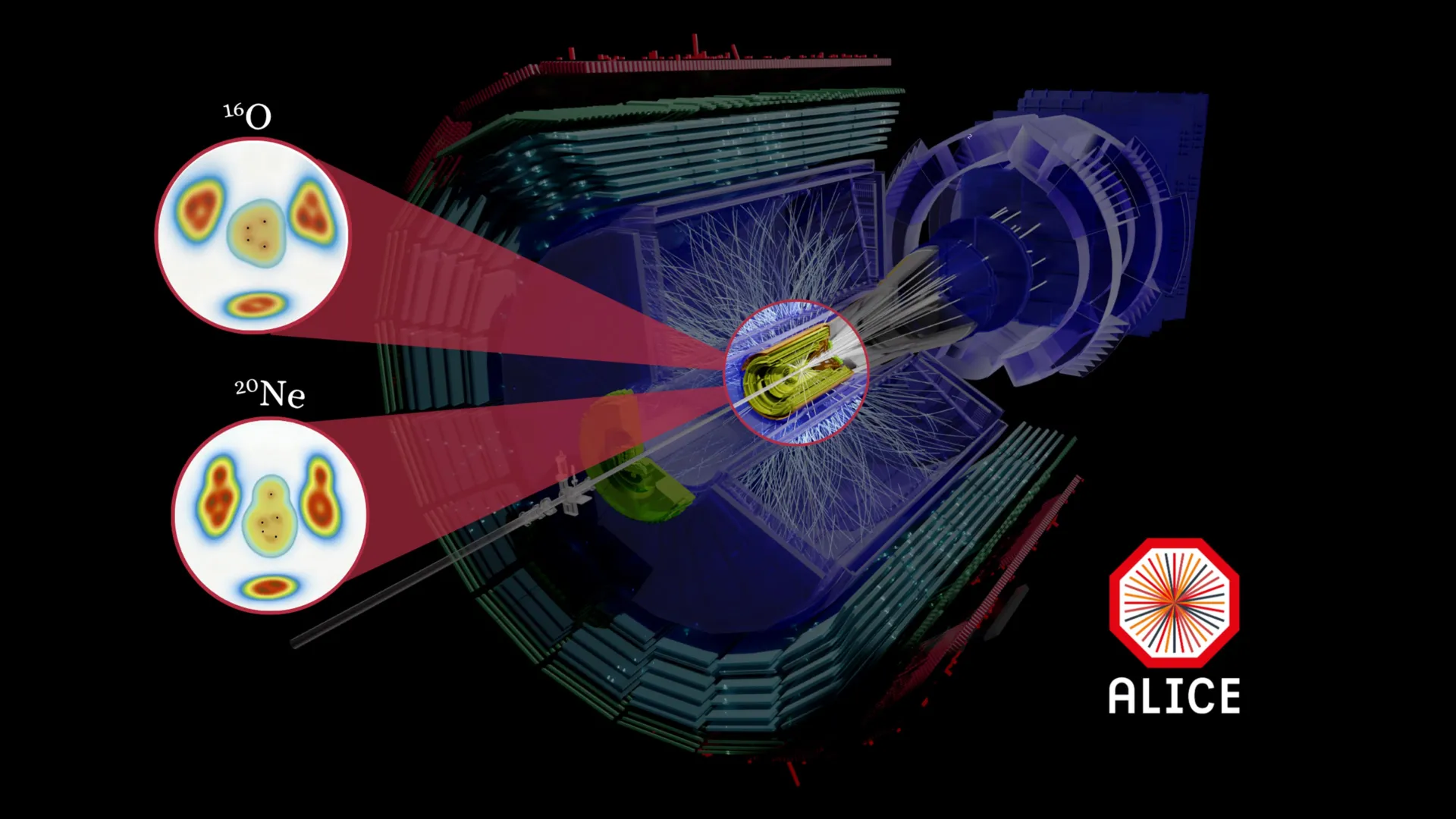
One of the most profound discoveries of the ALICE experiment is that the collective movement of particles resulting from the plasma’s expansion preserves a distinct memory of the colliding nuclei’s original geometric shapes.
- Oxygen-16 Collisions: These nuclei tend to be relatively spherical, resulting in a smooth, nearly symmetrical distribution of outgoing particles.
- Neon-20 Collisions: Neon nuclei possess an asymmetrical, elongated geometry often described as having a "bowling pin" or cluster-like structure. When neon nuclei collide, the resulting pressure gradients within the plasma translate this distinct shape into an anisotropic particle flow pattern.
By tracing these patterns backward, physicists can deduce the exact spatial arrangement of protons and neutrons inside the parent nuclei prior to the collision. This indirect imaging technique functions similarly to casting light on an opaque object to study its shadow, providing an ingenious alternative to traditional low-energy nuclear spectroscopy.
Official Statements
The implications of this research have reverberated across the global physics community. Dr. You Zhou, who led the experiment and was formerly stationed at the Niels Bohr Institute, emphasized the fundamental shift in how physicists view the limits of matter:
"We have pushed the boundary for how small the atomic nuclei can be while still recreating this primordial matter—what you could call a Little Big Bang. We now know more about the fundamental conditions required for matter to transition into this extreme state."
Zhou further underscored the dual utility of the discovery:
"Hopefully, this will help us better understand how the plasma behaved during first moments of the Universe—and how it later evolved into the forms of matter that everything around us is made of."
Adding to this perspective, Dr. Emil Gorm Dahlbæk Nielsen, a postdoctoral researcher at the Niels Bohr Institute and co-author of the study, elaborated on the mechanics of nuclear imaging via particle flow:
"The particles from the primordial matter are directly governed by the geometric shape of the atomic nucleus. If the two nuclei we smash together are spherical, we get one pattern. If they are shaped like bowling pins, we get another. By studying how the particles move after the collision, we can gain insights into atomic nuclei that are otherwise difficult for physicists to obtain."
Nielsen likened the analytical method to optical physics:
"It is a bit like shining light on an object and seeing its shadow. You cannot see the object directly, but its shadow reveals its shape. In the same way, the movement of the particles reveals the geometric shape of the atomic nuclei that was present at the beginning of the collision."
Connecting the current work to the storied heritage of Danish physics—specifically the legacy of Aage Bohr, who won the 1975 Nobel Prize for his foundational work on nuclear structure—You Zhou noted the convergence of micro- and macro-physics:
"A precise understanding of nuclear structure helps us understand the strong force. But instead of carefully investigating nuclei at low energies, we smash them together at the highest energies we can create and can now read their shape from the imprint they leave behind."
Future Outlook
With the successful demonstration that oxygen and neon nuclei can generate quark-gluon plasma, the frontier of high-energy nuclear physics has expanded dramatically. However, this breakthrough has also spawned new, compelling questions.
Determining the Absolute Lower Bound
The immediate priority for the ALICE collaboration is to test the limits of the system. Researchers are actively preparing subsequent rounds of experiments utilizing even lighter atomic nuclei, with helium-4 slated as an upcoming candidate. By progressively scaling down the atomic mass numbers, the research team aims to pinpoint the exact threshold where quark-gluon plasma ceases to form. Finding this lower limit will provide unprecedented insight into the thermodynamics of quantum chromodynamics and the phase transitions of nuclear matter.
Refining Nuclear Structure Models
For over seven decades, humanity’s understanding of the strong nuclear force—the fundamental interaction that binds quarks into nucleons and nucleons into atomic nuclei—has relied heavily on low-energy scattering and spectroscopic measurements. The validation of high-energy collision tomography offers a complementary, high-resolution lens through which to examine exotic nuclear isotopes and unstable configurations that are otherwise impervious to traditional study.
Unifying Cosmology and Quantum Mechanics
Ultimately, the convergence of cosmology and nuclear physics highlighted by this research illustrates a profound truth about the natural world: the largest questions regarding the origin of the Universe are inextricably linked to the behavior of its smallest building blocks. As the University of Copenhagen team and the international ALICE collaboration continue to refine their techniques, these miniature Big Bangs will undoubtedly serve as a master key, unlocking secrets of the cosmos that have remained hidden for nearly fourteen billion years.