

Executive Overview
In recent years, sequential art has established itself as an extraordinarily potent medium for biography, rivaling and often surpassing traditional prose in its ability to render the interior lives of historical figures. Recent acclaimed publications—such as Mimi Pond’s Do Admit: The Mitford Sisters and Me (Drawn & Quarterly) and Ken Krimstein’s Einstein in Kafkaland: How Albert Fell Down the Rabbit Hole and Came Up with the Universe (Bloomsbury)—have demonstrated how stylized, non-photorealistic illustrations can evoke complex psychological terrain and temporal atmosphere.
However, a distinct artistic and historiographical challenge emerges when graphic biographers turn their ink to the pioneers of their own medium. When illustrating the life of an iconic creator like Will Eisner, Jack Kirby, Stan Lee, or Ernie Bushmiller, contemporary cartoonists must navigate a delicate meta-narrative paradox: How does an artist depict the creator of a universally recognizable visual language without sacrificing their own artistic voice or falling into mimicry?
Recent non-fiction graphic novels tackle this challenge head-on. Writers and artists including Stephen Weiner, Dan Mazur, Tom Scioli, and Bill Griffith are expanding the boundaries of graphic biography. Rather than offering sanitized iconography, these creators use original visual methodologies to interrogate industry history, address institutional racism and creator-rights disputes, and unpack the formal architecture of comics history through sequential art itself.
Detailed Chronology
The evolution of graphic biographies documenting the comic book industry spans key historical milestones, from the birth of the modern comic book in the 1930s to today’s biographical renaissance.
[1936] Will Eisner enters the comic book industry at its inception.
[1940] Launch of 'The Spirit'; racially insensitive sidekick Ebony White introduced.
[1960s] Marvel Age begins; Jack Kirby & Stan Lee co-create fundamental superhero pantheon.
[1985] Eisner publishes autobiographical graphic novel 'The Dreamer'.
[1990] Stephen Weiner meets Eisner; begins 15-year advocacy to place graphic novels in libraries.
[2003] Eisner writes introduction for Weiner's 'Faster Than a Speeding Bullet'.
[2018] Olivia Jaimes assumes control of the 'Nancy' daily strip, revitalizing its surreal legacy.
[2020] Tom Scioli releases 'Jack Kirby: The Epic Life of the King of Comics' (Ten Speed Press).
[2023] Scioli releases 'I Am Stan: A Graphic Biography of the Legendary Stan Lee' (Ten Speed Press).
[2023] Bill Griffith releases 'Three Rocks: The Story of Ernie Bushmiller' (Abrams ComicArts).
[2025] NBM publishes 'Will Eisner: A Comics Biography' by Weiner and Dan Mazur.
[2026] Underground cartoonist Caroline Cash slated to take over the 'Nancy' daily strip.
The Golden and Silver Age Foundations (1936–1968)
The modern American comic book industry began taking shape in 1936 when Will Eisner and his contemporaries launched commercial production studios. By 1940, Eisner introduced The Spirit, a weekly newspaper insert that revolutionized page design, lighting, and visual narrative techniques. However, this era also codified persistent racial caricatures, such as The Spirit’s sidekick Ebony White—a character choice that would shadow Eisner’s legacy for decades.
By the early 1960s, the center of gravity shifted to Marvel Comics, where artist Jack Kirby and writer/editor Stan Lee spearheaded a creative revolution. Together, they co-created the Fantastic Four, the X-Men, the Avengers, and the Hulk. Despite their shared success, severe tensions regarding creative credit and financial remuneration eventually drove an acrimonious rift between Kirby, co-creator Steve Ditko, and Marvel management represented by Lee.
The Canonization and Library Movement (1985–2005)
In 1985, Eisner published The Dreamer, a thinly veiled autobiographical graphic novel reflecting on his early days in the industry. While acclaimed as a historic work by a pioneer, critics and peers noted its sanitized self-portraiture.
During the 1990s, librarian and comic historian Stephen Weiner formed a 15-year friendship and professional collaboration with Eisner. Together, they campaigned to legitimize graphic novels within public and academic libraries—a movement that succeeded in expanding the market for non-superhero graphic literature and culminated in Eisner contributing the foreword to Weiner’s 2003 history, Faster Than a Speeding Bullet: The Rise of the Graphic Novel.
The Modern Graphic Biography Era (2020–Present)
The 2020s marked a major wave of graphic biographies focused on comics history. Tom Scioli published back-to-back definitive visual biographies of Jack Kirby (2020) and Stan Lee (2023) through Ten Speed Press. Concurrently, Bill Griffith published Three Rocks (Abrams ComicArts), exploring the life of Nancy creator Ernie Bushmiller. Most recently, Weiner teamed up with artist Dan Mazur for Will Eisner: A Comics Biography (NBM), offering a candid re-examination of Eisner’s life, flaws, and historic achievements.
Supporting Context & Metrics
Visual Emulation vs. Stylistic Autonomy
A major challenge in creating a graphic biography of a master cartoonist is selecting a visual style. Drawing a biography of Will Eisner or Jack Kirby in their exact signature styles can distract from the narrative or invite unfavorable comparisons.
| Biography Work | Subject | Creator(s) | Publisher | Visual/Stylistic Approach |
|---|---|---|---|---|
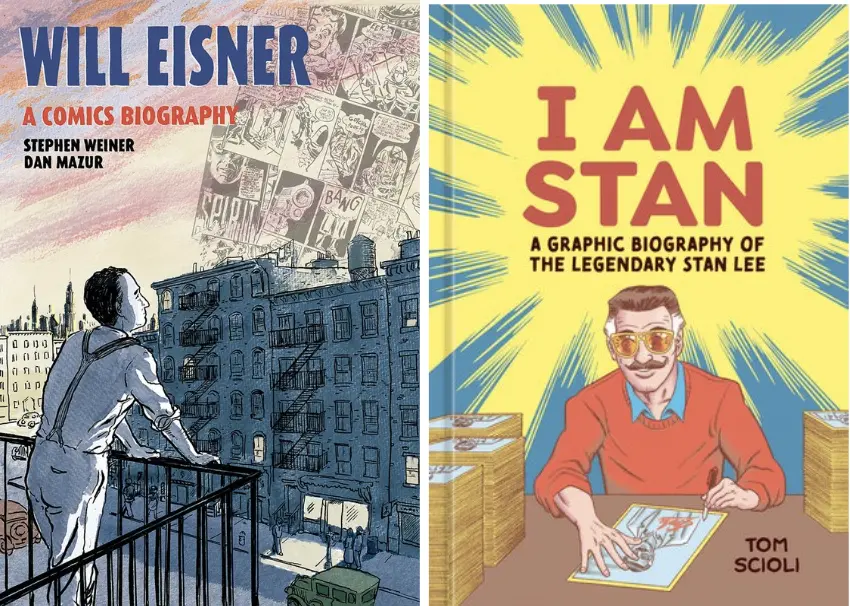
| Will Eisner: A Comics Biography | Will Eisner | Stephen Weiner & Dan Mazur | NBM | Contemporary independent graphic style; avoids mimicking Eisner’s shadows/line work. |
| Jack Kirby: The Epic Life… | Jack Kirby | Tom Scioli | Ten Speed Press | Maximalist, cosmic panel design echoing Kirby’s energy while retaining Scioli’s hand. |
| I Am Stan: A Graphic Biography… | Stan Lee | Tom Scioli | Ten Speed Press | Experimental Pop Art grids; ages Stan from cartoon strip (Dennis the Menace style) to realism. |
| Three Rocks | Ernie Bushmiller | Bill Griffith | Abrams ComicArts | Hybrid underground/formalist style dissecting Bushmiller’s spatial mechanics. |
In Will Eisner: A Comics Biography, artist Dan Mazur made a deliberate choice not to copy Eisner’s iconic technique—characterized by dramatic ink washes, cityscapes built of text, and heavy chiaroscuro. Because Eisner had already documented his own life in The Dreamer using his signature aesthetic, Mazur adopted a clean, modern independent style designed to appeal to contemporary readers unfamiliar with mid-century comics.
[Stylistic Evolution in "I Am Stan"]
Early Life (1920s-30s)  -->  Mid-Career (1960s)        -->  Late Life (1990s-2000s)
Cartoony, Hank Ketcham      Pop-Art Andy Warhol Grids      Photorealistic Realism
'Dennis the Menace' Style    & Multi-Panel Face Tracking    & Stylized Modern Portraiture
Tom Scioli took a structural approach in I Am Stan. Drawing inspiration from Andy Warhol and the 1960s "Marvel Pop Art Production" era, Scioli used recurring page grids featuring repeated portraits of Lee’s head at different ages. This technique allowed readers to physically watch the impresario age across decades while shifting his rendering style from a classic daily comic-strip aesthetic to realistic line work as the narrative matured.
Historical Revisionism and Handling Caricature
Biographers of graphic novelists must also confront uncomfortable aspects of industry history. A major issue for Weiner and Mazur was how to portray Ebony White, the African American sidekick in Eisner’s The Spirit, who was depicted using visual tropes now universally recognized as racist.
[Ethical Approaches to Handling Historical Stereotypes]
1. Reproduction (Risk: Perpetuating offensive imagery)
2. Erasure (Risk: Sanitizing history & absolving the author)
3. Contextual Documentation (Chosen Method: Excerpting primary interviews & addressing denial)
Rather than redrawing the offensive caricature, Weiner and Mazur addressed the issue directly. They cited archival documentation and a 2003 interview in which Eisner discussed his perspective on the character. The biography documents that public opposition to Ebony White was not merely a retrospective critique from the 1960s Civil Rights era, but an active debate in Black newspapers and letters to the editor during the 1940s—a critique Eisner largely minimized during his lifetime.
Official Statements
On the Challenge of Visual Style and Autonomy
"Because Eisner had already created an autobiographical graphic novel, 1985’s The Dreamer, in his own style, and is otherwise considered a master of the form, there was less need to emulate his style, which I would have had a hard time doing anyway. We wanted to reach an audience that doesn’t already know Will Eisner’s work that well. It’s my visual style, but it’s really got more to do with independent comics today."
— Dan Mazur, Co-Author and Artist, Will Eisner: A Comics Biography
On Correcting the Historical Record
"I felt like [The Dreamer] was really very insincere, and I felt like he had not done himself justice; he hadn’t really portrayed how hard it was. I really wanted to focus on how difficult the challenges that he faced were in trying to jumpstart this industry—because there really wasn’t an industry before he joined it in 1936.
The controversy was alive and active while Ebony was a character. It didn’t just come up in the 1960s. There were letters, there were debates, and Eisner was aware of it—and kind of in denial and resistant to it until the very, very end of his life."
— Stephen Weiner, Co-Author, Will Eisner: A Comics Biography
On Structural Experimentation and Archival Gaps
"After I had a decade-plus of experience making comic books, it just made a lot of sense to me to tell these guys’ stories. Jack Kirby was the person I’d studied the closest… once I’d done a Jack Kirby book, a Stan Lee book was almost expected as a next step.
With Stan, I had him start out as a comic strip character, like Hank Ketcham doing Dennis the Menace—which feels like the right era for a young Stan. And then as he ages, he’s drawn more realistically. [On a potential Steve Ditko biography]: I’d enjoy the challenge, but that’s a pretty big challenge. I have the benefit of there being decades of interviews and videos of Stan Lee and Jack Kirby; there’s nothing like that for Steve Ditko."
— Tom Scioli, Author and Artist, Jack Kirby and I Am Stan
On Formalism and Primary Research
"[Jim Carlsson] gave me the essential biographical sketch of Bushmiller that no one else could have done, because he was not only an assistant, he was his right-hand man. He was Bushmiller’s best friend on top of that… without him, the book would have been a repeat of things that have already been written.
To me, Nancy defines what comics are in the most basic sense. Bushmiller added such an incredible degree of unaware surrealism to that structure, to the way that comics work when you read them, that it was just the best of both worlds."
— Bill Griffith, Author and Artist, Three Rocks: The Story of Ernie Bushmiller
Future Outlook
The trend of comic creators documenting their predecessors marks an important maturation point for graphic literature. By analyzing the mechanics, industry struggles, and personal lives of foundational artists, graphic biographies serve both as historical preservation and formal critical analysis.
The Limits of Archival Access: The Steve Ditko Dilemma
While creators like Eisner, Lee, and Kirby left extensive media archives, public appearances, and recorded interviews, other foundational figures remain difficult subject matter. Steve Ditko, the co-creator of Spider-Man and Doctor Strange, famously retreated from public life in the late 1960s, refusing broadcast interviews and choosing to share personal perspectives only through self-published essays until his death in 2018.
As Tom Scioli noted, attempting a graphic biography without primary audio-visual records or personal interviews presents a major hurdle for future biographers, highlighting the boundary between historical documentation and speculation.
Legacy Continuity and Formal Evolution
At the same time, the legacies of foundational strips continue to evolve through new generations of talent:
[The Lineage of Ernie Bushmiller's 'Nancy']
Ernie Bushmiller (Original Creator: 1933–1982)
       │
       ▼
Olivia Jaimes (Modernization Era: 2018–2025)
       │
       ▼
Caroline Cash (Underground/Indie Integration: 2026 Onward)
As legacy properties transition into the hands of contemporary cartoonists—such as underground artist Caroline Cash assuming control of Nancy in 2026—graphic biographies like Bill Griffith’s Three Rocks provide an essential framework for understanding how classic layout rules can be preserved, subverted, and built upon.
By balancing historical accuracy with distinct visual styles, contemporary graphic biographers ensure that the history of American comics is recorded not just in text, but through the visual medium these pioneers helped build.
