

Executive Overview
In the rapidly evolving landscape of beauty marketing, prestige heritage brands face a constant, existential challenge: how to remain relevant to a digital-native consumer base that values peer-to-peer authenticity far above traditional glossy advertisements. For decades, legacy giants relied on top-down messaging, celebrity endorsements in high-fashion magazines, and sweeping television campaigns to dictate beauty trends. Today, that playbook is obsolete.
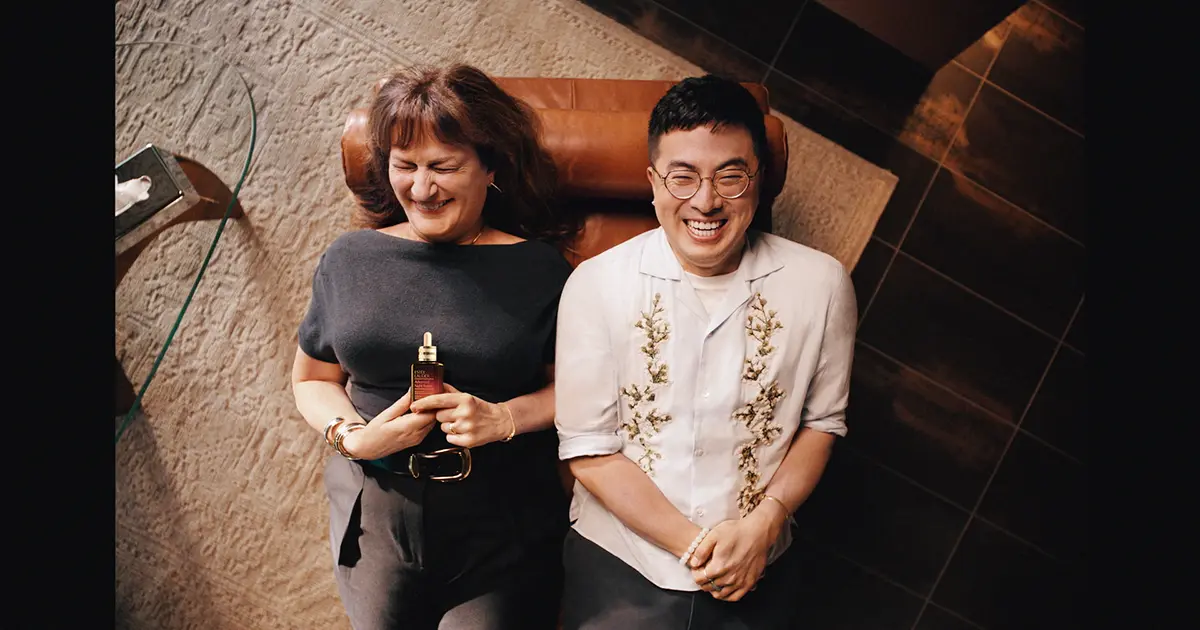
Enter Estée Lauder’s bold new marketing initiative: "Guilty as Skin."
By enlisting Saturday Night Live breakout star Bowen Yang and fellow SNL alum Ana Gasteyer, the century-old cosmetics titan is aiming for the most coveted and guarded real estate in modern communication—the group chat. Rather than shouting from a digital billboard, Estée Lauder wants to be the digital whisper shared between best friends debating skincare regimens at midnight.
This campaign is far more than a clever creative play featuring two comedic powerhouses; it represents a calculated pivot in how legacy beauty brands conceptualize consumer trust. Driven by contemporary data showing that the vast majority of consumers look to their peers—not influencers or brands—for validation before making purchasing decisions, "Guilty as Skin" positions the iconic Advanced Night Repair (ANR) serum not as an untouchable luxury item, but as an indispensable, slightly addictive secret shared among intimates.
This deep-dive report examines the mechanics of Estée Lauder’s latest strategic evolution, contextualizes the cultural and technological shifts forcing legacy brands to rethink digital community-building, analyzes the hard metrics governing modern consumer trust, and explores what this means for the future of prestige retail.
Detailed Chronology: The Anatomy of a Modern Beauty Campaign
To understand how Estée Lauder arrived at a campaign centered around the intimacy of group chats, it is necessary to trace the convergence of digital consumer behavior, shifting comedic talent partnerships, and the lifecycle of one of beauty’s most enduring hero products.
Phase One: The Diagnostic of Modern Discovery
For the past three years, marketing executives at Estée Lauder have closely monitored the fragmentation of digital media. Traditional social media channels—once the undisputed engines of discovery—have grown increasingly saturated, ad-heavy, and transactional. Consumers, particularly Millennials and Gen Z, have demonstrated fatigue toward overt influencer promotions.
Internal consumer insights revealed a fascinating behavioral loop: while discovery might happen on a public platform like TikTok or Instagram, the conversion decision—the moment a user decides to part with their hard-earned money for a prestige skincare item—happens entirely underground. It happens in iMessage threads, WhatsApp groups, and Discord channels.
Estée Lauder’s brand strategy team realized that to win the modern consumer, the brand needed to shift from being a spectator of digital culture to a participant in private social circles. The challenge was finding a narrative vehicle that could bridge the gap between high-end prestige and the casual, hyper-relatable banter of a group chat.
Phase Two: Casting Comedy and Credibility
The selection of Bowen Yang and Ana Gasteyer was not arbitrary; it represents a generational bridging of comedic timing and cultural cachet.
- Ana Gasteyer brings deep-seated nostalgia and a legacy of sharp, character-driven comedy that resonates across multiple generations. As an SNL veteran, she embodies the trusted, sophisticated humor that aligns with Estée Lauder’s storied heritage.
- Bowen Yang, conversely, is a modern icon of internet culture. Renowned for his biting wit, hyper-online fluency, and mastery of contemporary social dynamics, Yang serves as the ultimate proxy for today’s digitally native consumer.
By pairing Gasteyer and Yang, Estée Lauder constructed a dynamic of seasoned wisdom colliding with modern neurosis. The creative direction taps into the exact kind of theatrical, high-stakes overthinking that characterizes modern group chat culture—where agonizing over a skincare routine gets the same analytical weight as a major life crisis.
Phase Three: The Launch of "Guilty as Skin"
Unveiled as part of a broader push to modernize the narrative around the flagship Advanced Night Repair serum, "Guilty as Skin" casts the product as an irresistible indulgence that users almost feel "guilty" relying on so completely. The creative assets feature Yang and Gasteyer engaging in rapid-fire text exchanges and playful banter, mimicking the chaotic, hyper-engaged energy of a late-night group chat.
The campaign rollout leverages multi-platform digital distribution, ensuring that while the narrative is built around private conversations, the content is primed to be shared, screenshotted, and re-circulated back into the exact ecosystem it mimics: consumer text threads.
Supporting Context & Metrics: The Science of the Group Chat Economy
To fully appreciate the commercial logic undergirding Estée Lauder’s strategy, industry analysts must examine the sociological data defining modern consumer behavior. The campaign is built upon a foundation of robust market research regarding how decisions are made in the digital age.
The 85% Rule: Peer Validation Over Brand Proclamation
A landmark 2025 survey conducted by GIPHY and Censuswide uncovered staggering insights into the modern decision-making matrix:
- 85% of respondents reported that they actively consult their group chats before making major life decisions, ranging from career pivots to relationship milestones.
- More critically for the retail sector, 77% of consumers admitted to turning to these same private circles for smaller, everyday decisions—such as what to wear, what to eat for dinner, and crucially, which beauty products to invest in.
+-----------------------------------------------------------------+
|          CONSUMER DECISION-MAKING RELIANCE (GIPHY/Censuswide)   |
+-----------------------------------------------------------------+
|  Major Life Decisions (Career, Relationships)   |  85% Consult Chat
|  Everyday Purchases & Lifestyle Choices         |  77% Consult Chat
+-----------------------------------------------------------------+
In an era marked by skepticism toward institutional messaging, the group chat has emerged as the ultimate tribunal of truth. Consumers no longer trust brands telling them a product works; they trust their closest friends confirming it in a text thread annotated with emojis and voice notes.
The Advanced Night Repair Legacy
At the center of this campaign sits Advanced Night Repair (ANR), a product that has been a cornerstone of Estée Lauder’s portfolio since its launch in 1982. ANR was a pioneer in the skincare industry, introducing the concept of nighttime skin recovery and utilizing hyaluronic acid long before it became a ubiquitous buzzword.
However, heritage brands face a perpetual marketing paradox: how do you honor a 40+ year-old formulation while convincing a 24-year-old consumer that the product belongs in their contemporary routine?
By injecting ANR into the humorous, highly conversational context of "Guilty as Skin," Estée Lauder successfully de-ages the product. The serum is reframed not as an intimidating item sitting on a vanity table in one’s mother’s bathroom, but as an essential, high-performing tool for modern survival—something you confess to relying on when life gets chaotic.
Official Statements & Industry Perspective
While brands frequently deploy marketing campaigns without deeper philosophical framing, the leadership behind Estée Lauder’s digital evolution has been vocal about the necessity of meeting consumers where they emotionally reside.
Industry insiders note that the prestige beauty sector has undergone a profound democratization. Consumers are more educated about active ingredients, chemical formulations, and efficacy than ever before. Consequently, traditional marketing jargon fails to move the needle.
"The modern consumer does not want to be lectured by a brand; they want to be understood by their peers," notes a senior retail strategy consultant familiar with the Estée Lauder account. "When you look at a campaign like ‘Guilty as Skin,’ you see a brand acknowledging that the most powerful form of marketing is organic, peer-to-peer recommendation. By injecting Bowen Yang and Ana Gasteyer into that dynamic, Estée Lauder is essentially scripting the conversation that happens when friends debate their nighttime routines."
Estée Lauder’s executive leadership has increasingly emphasized the need for digital agility. The brand’s broader digital evolution encompasses not only creative campaigns like this one, but also enhanced e-commerce personalization, virtual try-on tools, and interactive content designed to foster community.
By targeting the group chat, Estée Lauder is attempting to solve the ultimate modern marketing puzzle: how to manufacture organic word-of-mouth advocacy at a global scale.
Future Outlook: What "Guilty as Skin" Signals for Prestige Retail
As we look toward the remainder of the decade, the "Guilty as Skin" campaign serves as a potential blueprint for how heritage luxury and prestige brands will navigate digital consumer engagement. Several key trends and implications emerge from this strategic pivot:
1. The Death of the Monologue, The Rise of the Dialogue
Brands that continue to broadcast one-way messages will find themselves increasingly ignored by digital natives. The future belongs to brands that can authentically simulate or integrate into conversational spaces. We can expect to see more campaigns designed explicitly to be screenshotted, memeified, and debated within private messaging apps.
2. Comedic Talent as Cultural Translators
The success of pairing Bowen Yang and Ana Gasteyer highlights a shift in talent partnerships. Traditional glamorous models are giving way to comedians, cultural commentators, and internet-native personalities who possess the self-awareness and comedic intelligence required to connect with skeptical audiences. Humor disarms skepticism; by making consumers laugh, brands lower their defenses and build genuine affinity.
3. The Reimagining of Digital Prestige
Prestige used to be synonymous with exclusivity, distance, and untouchability. Today, true digital prestige is about intimacy and access. Consumers want luxury brands to feel like an intimate part of their daily lives. Estée Lauder’s ability to position Advanced Night Repair as an item of shared, conspiratorial delight proves that heritage brands can modernize without losing their core identity.
4. Navigating the Paywall of Modern Commerce Insights
As campaigns like this become more sophisticated, the data underlying consumer habits—such as the dynamics of private messaging apps and closed-loop social networks—will become fiercely guarded corporate assets. Industry professionals will increasingly rely on deep analytical frameworks, proprietary consumer surveys, and cross-channel performance metrics to stay ahead of the curve.
Conclusion
Estée Lauder’s "Guilty as Skin" campaign is much more than a clever vehicle for Advanced Night Repair; it is a cultural mirror reflecting how modern commerce actually operates. By acknowledging that 85% of major life decisions and 77% of daily choices are forged in the crucible of the group chat, Estée Lauder has demonstrated a rare willingness for a legacy brand to meet its consumers on their own terms.
Through the comedic brilliance of Bowen Yang and Ana Gasteyer, the brand has successfully transformed a multi-decade-old skincare staple into a modern topic of conversation. As prestige beauty continues its rapid digital evolution, brands watching from the sidelines would do well to take notes—preferably in a group chat.