

Published: August 31, 2026
Analysis by Troy Farah
Executive Overview
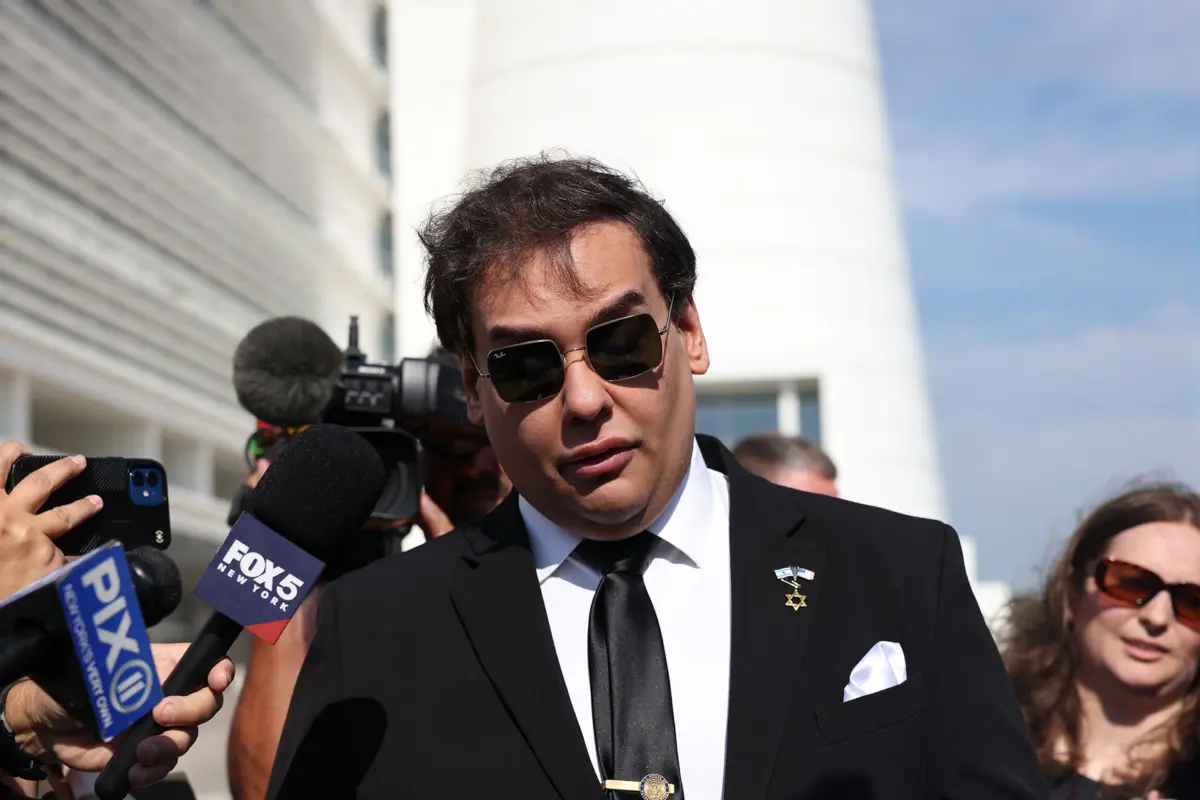
In a convergence of political notoriety, modern financial speculation, and high-stakes jurisprudence, online prediction market platform Kalshi has issued its first-ever lifetime ban to former U.S. Representative George Santos. The controversial ex-lawmaker, whose brief congressional career and subsequent legal downfall have been mired in spectacle, was penalized for egregious violations of the platform’s insider trading and market manipulation rules. Alongside the lifetime exclusion, Santos has been hit with a financial penalty exceeding $71,000.
The disciplinary action against Santos arrives at a precarious moment for the burgeoning prediction market industry. Platforms like Kalshi and Polymarket—which allow users to trade contracts based on the outcomes of real-world events, including elections, geopolitical conflicts, and pop culture milestones—have aggressively fought to distance themselves from the legal definition of traditional gambling. However, that defense suffered a catastrophic blow on Friday, when a federal appeals court delivered a unanimous 3–0 ruling affirming that individual states possess the sovereign authority to regulate prediction markets under standard state gambling laws.
As these platforms face mounting state-level scrutiny, legal challenges, and high-profile integrity failures like the Santos scandal, industry analysts predict the battlefield will ultimately shift to the U.S. Supreme Court. The core question remains: Are prediction markets a revolutionary financial asset class, or are they simply digital sportsbooks masquerading as Wall Street?
Detailed Chronology: The Rise and Fall of George Santos on Kalshi
The sequence of events leading to George Santos’s historic ban highlights the vulnerabilities inherent in crowdsourced prediction markets, where participants can simultaneously hold financial positions in an event and actively influence its outcome through public relations and media manipulation.
The Congressional Flameout and Legal Saga
To understand Santos’s presence on financial speculation platforms, one must first review his extraordinary political trajectory. Elected to represent New York’s 3rd Congressional District in 2022, Santos’s tenure was short-lived. Following revelations of systemic fabrication regarding his resume, financial disclosures, and personal background, he was expelled from the House of Representatives in December 2023.
Federal prosecutors subsequently indicted Santos on a battery of charges, including wire fraud, aggravated identity theft, and money laundering. He pleaded guilty and served a federal prison sentence before receiving a presidential commutation from Donald Trump in October 2025.
The State of the Union Scheme
Re-entering public life with a penchant for media provocation, Santos turned his attention to financial speculation. According to disclosures from Kalshi, Santos partook in a series of digital contracts tied to a very specific, highly visible event: whether he would attend President Donald Trump’s State of the Union address in February 2026.
Rather than acting as a passive observer or speculator, Santos allegedly attempted to rig the market in his favor. Platform investigators discovered that after purchasing financial contracts predicting his attendance, Santos orchestrated a deliberate disinformation campaign. He issued a series of public statements regarding his prospective attendance designed explicitly to manipulate contract pricing. According to Kalshi’s compliance notices, many of these statements were demonstrably "false or misleading."
By artificially driving market sentiment, Santos sought to profit off the fluctuations he engineered. Kalshi’s automated surveillance systems and compliance teams flagged the coordinated activity, resulting in the platform’s swift retaliation: a permanent bar from the service and a punitive fine north of $71,000.
True to form, Santos responded to his historic blacklisting with characteristic bravado. Taking to social media platform X (formerly Twitter), he sarcastically thanked the platform for the ban, writing, "Let’s see how much longer you guys are around for," punctuated by a mocking kiss-mark emoji.
Supporting Context & Metrics: The Blurry Line Between Speculation and Gambling
The Santos incident is more than a mere footnote in the annals of celebrity misbehavior; it exposes the fragile regulatory architecture underpinning the multi-billion-dollar prediction market industry.
What Are Prediction Markets?
Proponents of platforms like Kalshi and Polymarket market them as sophisticated forecasting tools that aggregate collective wisdom more accurately than traditional polling or expert analysis. Users buy and sell "shares" that resolve to $1 if an event occurs and $0 if it does not. Proponents argue that because real money is on the line, participants have a financial incentive to be accurate, creating an efficient market for future events.
Yet, critics and regulators point out that the mechanics of these platforms are functionally identical to sports betting and financial derivatives trading. Users can wager on:
- Elections: Presidential, congressional, and international leadership races.
- Geopolitics: Trade policy decisions, military conflicts, and legislative outcomes.
- Pop Culture & Media: Entertainment awards, corporate executive departures, and personal milestones of public figures.
The Federal Appeals Court Ruling
The regulatory pressure bearing down on prediction markets intensified dramatically when a federal appeals court ruled 3–0 that states maintain the legal right to treat these platforms as gambling operations.
The legal battle originated in Nevada, a state with some of the strictest gaming regulations in the world. The Nevada Gaming Control Board issued a formal cease-and-desist letter to Kalshi, asserting that the platform was operating an unlicensed sportsbook within state borders in direct violation of state statutes.
Kalshi challenged the state’s authority, arguing that its contracts fall under the exclusive regulatory purview of the federal Commodity Futures Trading Commission (CFTC) as financial derivatives. However, the three-judge panel unanimously sided with state regulators. The court determined that federal commodities laws do not preempt states from exercising their historic police powers to protect consumers and regulate gambling within their jurisdictions.
Official Statements and Industry Implications
The convergence of the Santos ban and the federal court ruling has sent shockwaves through the financial technology sector.
Industry advocates maintain that prediction markets provide vital economic data that traditional financial instruments cannot capture. In public statements following the appellate court decision, representatives for major prediction platforms warned that balkanizing the market through patchwork state-level regulations would stifle innovation and drive users toward unregulated, offshore black-market alternatives.
Conversely, state regulators and consumer protection advocates have hailed the court’s decision as a critical victory for public safety. State gaming boards across the country—emboldened by the 3–0 ruling—are reportedly preparing their own investigative sweeps and regulatory frameworks to rein in platforms that allow retail users to gamble on high-stakes political and social events without the consumer protections mandatory in traditional financial markets or state-regulated casinos.
Legal scholars note that the regulatory vacuum has created a "Wild West" environment. While federal regulators have wrestled with whether prediction markets constitute sound financial innovation or sophisticated wagering, bad actors like George Santos have demonstrated how easily the systems can be manipulated for quick profit.
Future Outlook: The Road to the Supreme Court
As the legal dust settles on the recent federal appeals court ruling, industry insiders and legal experts agree that the current state of affairs is legally untenable. With multiple lawsuits pending in various federal and state jurisdictions across the United States, conflicting rulings are all but guaranteed.
According to constitutional and regulatory law experts, the ultimate arbiter of this dispute will almost certainly be the Supreme Court of the United States. The high court will eventually be forced to decide a fundamental constitutional question: Does federal oversight of commodities and financial exchanges preempt state authority over gambling, or do states retain the right to ban or heavily regulate event-contract platforms?
Until the Supreme Court intervenes, prediction market operators face an increasingly hostile domestic landscape. They must navigate a fractured regulatory map where a platform legal in one state may be treated as an illegal gambling ring in the next.
Meanwhile, the lifetime ban handed down to George Santos serves as a warning shot to other speculative traders. As these platforms fight for institutional legitimacy and survival, they are discovering that policing bad actors, insider traders, and market manipulators is no longer optional—it is an existential necessity.
