

Executive Overview
The name LimeWire once conjured memories of the peer-to-peer file-sharing revolution of the early 2000s—an era defined by rapid music discovery, compressed MP3s, and relentless battles over digital copyright. Today, however, the brand has undergone one of the most radical corporate and technological metamorphoses in digital history. Reimagined as a cutting-edge generative AI publishing platform, LimeWire is positioning itself at the intersection of artificial intelligence, decentralized web technologies, and the creator economy.
No longer a tool for exchanging unauthorized media, the modern LimeWire ecosystem functions as a comprehensive creative studio. It empowers digital artists, musicians, designers, and everyday enthusiasts to generate sophisticated AI artwork, automatically mint their creations as blockchain-verified Non-Fungible Tokens (NFTs), and monetize their output through a combination of ad-revenue sharing, subscription models, and decentralized token economies.
By integrating industry-leading machine learning architectures—such as Stable Diffusion and DALL-E—alongside blockchain protocols like Polygon and Algorand, LimeWire has built a bridge between high-end synthetic media creation and digital asset ownership. This comprehensive review examines the mechanics of LimeWire Studio, analyzing its core features, monetization frameworks, structural pricing tiers, and its broader implications for the future of digital art creation.
Detailed Chronology & Evolution: From P2P Outlaw to Web3 AI Studio
The Legacy Era: The Rise and Fall of the Original LimeWire
To understand the significance of LimeWire’s current incarnation, one must look at its origins. Founded in 2000 by Mark Gorton, LimeWire was a dominant force in the peer-to-peer file-sharing space. Leveraging the Gnutella network, it allowed millions of users to download music, movies, and software free of charge.
However, its reliance on decentralized file sharing brought it into direct conflict with the Recording Industry Association of America (RIAA). Following years of high-stakes litigation, a federal court ruled in 2010 that LimeWire and Gorton had induced copyright infringement, forcing the platform to shut down permanently. For over a decade, the brand remained a digital ghost—a cultural touchstone for early internet users, but functionally defunct.
The Resurrection and Pivot to Web3
The turning point came years later when serial entrepreneurs Julian and Paul Zehetmayr acquired the rights to the LimeWire brand. Recognizing the enduring equity of the name, the new leadership envisioned a platform that leaned into the future of digital media rather than dwelling on its past.
Initially conceptualized as a marketplace for digital collectibles and music NFTs, the platform quickly recognized the seismic shift caused by the generative AI boom of 2022 and 2023. By merging NFT infrastructure with accessible, powerful machine learning models, LimeWire executed a strategic pivot. It transformed from a simple collectible marketplace into LimeWire Studio: an all-in-one AI content generation and publishing ecosystem designed to give creators ownership over their synthetic media.
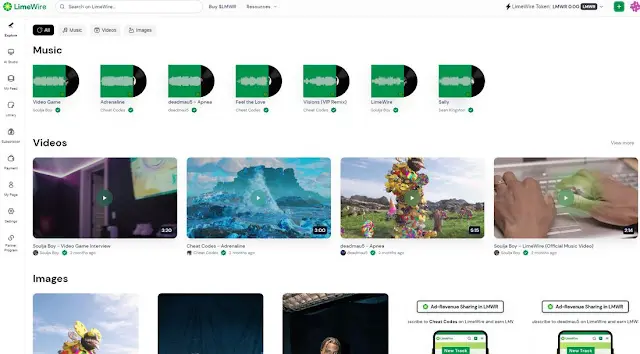
Today, the platform has attracted high-profile mainstream artists and musicians—including Deadmau5, Soulja Boy, and Sean Kingston—who utilize LimeWire to publish exclusive digital art, music tracks, and video content as tradable assets.
Core Features of the LimeWire AI Studio
At the heart of the modern ecosystem is the LimeWire AI Studio, an intuitive yet powerful browser-based environment tailored for synthetic media creation. While the platform currently centers heavily on AI-driven image generation, its technical architecture is designed to accommodate multi-modal creative workflows.
Advanced AI Image Generation Models
LimeWire does not rely on a single, proprietary machine learning model. Instead, it aggregates and integrates several of the industry’s most powerful open-source and proprietary diffusion models, providing users with a versatile toolkit:
- Stable Diffusion (Versions 2.1 and XL): Known for its flexibility, photorealism, and capability to render intricate details based on complex textual inputs.
- DALL-E 2: OpenAI’s influential text-to-image generator, celebrated for its conceptual understanding and ability to blend disparate objects in imaginative ways.
Customization and Stylistic Diversity
The platform caters to all skill levels, from novices experimenting with short descriptive prompts to professional digital artists utilizing advanced negative prompts, samplers, and seed adjustments. Users can effortlessly toggle between distinct visual aesthetics, including:
- Cinematic lighting and framing
- High-detail digital art and fantasy illustrations
- Retro pixel art and vector graphics
- Anime and manga styles
- Analog film emulations with realistic grain and lighting leaks
This stylistic fluidity allows creators to experiment rapidly, producing cohesive collections of art without needing mastery over traditional design software. Furthermore, LimeWire’s ongoing development of a proprietary in-house AI model signals the platform’s dedication to reducing reliance on third-party software and cementing its status as an independent technological powerhouse.
Expanding Horizons: Music and Video Generation
While image generation remains the flagship offering, LimeWire has outlined an ambitious roadmap to introduce native AI music and video generation tools. By expanding into multi-modal generation, the platform aims to capture a larger share of the digital creator market, allowing producers and filmmakers to draft soundtracks, conceptual video loops, and multimedia assets directly within the studio interface.
Supporting Context, Metrics & Monetization Frameworks
What separates LimeWire from standalone AI art generators like Midjourney or DALL-E is its deep integration with monetization and Web3 infrastructure. The platform views every generated piece of content not merely as a temporary visual file, but as an ownable, tradable digital asset.
Automated Blockchain Minting (NFT Integration)
Once a creator finalizes an image, music track, or video clip within the LimeWire Studio, they are given the option to publish it. Upon publication, LimeWire automatically mints the creation as a Non-Fungible Token (NFT) on either the Polygon or Algorand blockchain networks.
This automated minting process removes the technical hurdles traditionally associated with Web3 deployment—such as managing crypto wallets, calculating gas fees, and navigating smart contracts. Every asset receives a unique digital signature on the blockchain, verifying its authenticity and establishing immutable proof of ownership.
Dual-Publishing Models: Public vs. Exclusive Content
Creators retain total control over how their minted assets are distributed and consumed across the LimeWire community:
- Public Releases: Content is made discoverable to the entire LimeWire ecosystem. Anyone can view, engage with, and trade these NFTs on the secondary market, maximizing exposure and viral potential.
- Subscriber-Only Exclusives: Creators can lock specific posts behind a paywall, making them accessible exclusively to dedicated fans who subscribe to their page. This fosters intimate, direct-to-consumer digital communities akin to Patreon, but integrated with blockchain asset ownership.
The Royalty and Revenue-Sharing Engine
LimeWire’s economic model is designed to financially reward active participants in the ecosystem:
- Secondary Market Royalties: Whenever a collector trades an NFT on the LimeWire marketplace, the original creator automatically earns a 2.5% royalty on the transaction. This creates a passive income stream that scales with the artist’s popularity.
- Ad-Revenue Sharing: Creators receive up to 70% of all ad revenue generated when other users view their published images, music, and videos on the platform. This shifts the paradigm from traditional social media, where platform owners capture the vast majority of ad revenue, to a creator-first distribution model.
The LMWR Token Economy
All earnings generated through ad revenue shares and secondary market sales are distributed in LMWR, LimeWire’s native utility cryptocurrency token.
- Liquidity: LMWR is listed on several major cryptocurrency exchanges—including Kraken, ByBit, and Uniswap—allowing creators to easily convert their digital earnings into fiat currency or other digital assets.
- Utility: Within the ecosystem, LMWR tokens can be used directly to purchase generation credits, pay for prompt expansions, and unlock premium creator tiers.
Official Platform Structure & Pricing Tiers
To accommodate everyone from casual hobbyists to professional digital agencies, LimeWire operates on a tiered subscription model backed by a free entry-level option.
1. Free Tier (Free)
- Credits: 10 free credits upon sign-up.
- Generation Capacity: Up to 20 AI images per day.
- Ad Revenue Share: 50%.
- Ideal For: Casual users looking to test the platform’s generative capabilities without upfront financial commitment.
2. Basic Plan ($9.99 / month)
- Credits: 1,000 credits per month.
- Generation Capacity: Up to 2,000 image generations.
- Ad Revenue Share: 50%.
- Perks: Pro profile badge, full creation history, faster image generation, ad-free experience, and early access to new AI models.
3. Plus Plan ($29 / month)
- Credits: 3,750 credits per month.
- Generation Capacity: Up to 7,500 image generations.
- Ad Revenue Share: 60%.
- Perks: All standard Pro features, priority processing queues, and enhanced community visibility.
4. Pro Plan ($49 / month)
- Credits: 5,000 credits per month.
- Generation Capacity: Up to 10,000 image generations.
- Ad Revenue Share: 70% (maximum tier).
- Perks: Maximum ad revenue share, expedited generation speeds, and exclusive creator tools.
5. Ultimate Plan ($99 / month)
- Credits: 11,250 credits per month.
- Generation Capacity: Up to 22,500 image generations.
- Ad Revenue Share: 70%.
- Ideal For: Power users, digital marketing agencies, and high-volume content creators seeking maximum yield and generation capacity.
Future Outlook & Industry Implications
As the generative AI market becomes increasingly saturated with standalone art generators, platforms must evolve to offer tangible utility, community, and economic viability. LimeWire’s strategic pivot addresses these needs by fusing AI creation with Web3 ownership and traditional creator economy monetization.
Democratizing Digital Art and Commerce
By removing the technical barriers associated with both AI prompting and blockchain deployment, LimeWire lowers the entry barrier for aspiring digital creators. Musicians, graphic designers, and photographers no longer need deep coding knowledge or specialized financial infrastructure to tokenize their work, build a subscriber base, and earn passive income.
Navigating Regulatory and Market Challenges
Despite its innovative framework, LimeWire operates in two highly scrutinized sectors: artificial intelligence and cryptocurrency. The platform must continuously navigate evolving legal frameworks surrounding copyright law, AI-generated training data, and token securities regulations. However, by embracing decentralized protocols and offering transparent revenue splits, LimeWire has built a resilient structure designed to adapt to regulatory shifts.
Conclusion
LimeWire has successfully rewritten its corporate legacy, transitioning from a controversial file-sharing pioneer of the Web1 era into a sophisticated Web3-enabled AI studio for the modern digital economy. By combining state-of-the-art diffusion models, automated NFT minting, generous ad-revenue splits, and a thriving token ecosystem, LimeWire offers a compelling glimpse into the future of creative work—one where art, technology, and ownership converge seamlessly in the hands of the creator.
