

Executive Overview
The global technology landscape has spent the better part of the past few weeks bracing for impact. Headlines have flashed warnings of “drastic measures,” “ruinous fines,” and “sweeping new AI mandates” taking effect across the European Union. For product managers, UX designers, and legal teams alike, the atmosphere has been charged with anxiety regarding how artificial intelligence will be regulated, monetized, and presented to the public.
However, beneath the sensationalist media narratives lies a more nuanced, highly practical reality. The European Union’s transparency rules—which officially took effect under Article 50 of the landmark EU AI Act—are not designed to throttle innovation. Instead, they are engineered to establish a predictable, transparent baseline for artificial intelligence, ensuring that users can immediately recognize when content has been synthetically generated or manipulated.
Crucially, these mandates carry a broad jurisdictional footprint. Much like the General Data Protection Regulation (GDPR) and the European Accessibility Act (EAA), the regulations are not restricted to European corporations. Any business worldwide that deploys AI outputs destined for—or consumed by—citizens within the EU must comply.
As the digital ecosystem adapts to this paradigm shift, the core message for product teams is clear: compliance is no longer just about back-end algorithmic safety; it is an active, front-end user experience (UX) challenge. The era of ambiguous AI markers, hidden disclaimers, and casual design choices is officially drawing to a close.
Detailed Chronology & Regulatory Timeline
To understand the weight of the current compliance requirements, it is essential to trace how the European regulatory framework has evolved. The journey toward mandatory AI transparency is the result of years of legislative drafting, public consultations, and stakeholder reviews.
1. The Legislative Genesis
- April 2021: The European Commission initially proposed the Artificial Intelligence Act, marking the world’s first comprehensive attempt to establish a horizontal legal framework for AI. At the time, the focus was heavily skewed toward high-risk use cases, such as biometric surveillance, critical infrastructure, and law enforcement.
- Late 2022 – 2023: As generative AI exploded into the mainstream with the democratization of large language models (LLMs) and advanced image generators, regulators recognized a massive blind spot. The rapid proliferation of synthetic media—deepfakes, AI-generated journalism, and hyper-realistic synthetic imagery—posed immediate threats to public discourse, democratic elections, and consumer trust.
- December 2023: The European Parliament and Council reached a provisional political agreement on the AI Act, expanding provisions to address general-purpose AI (GPAI) systems and introducing strict transparency obligations for machine-generated content.
2. Ratification and Implementation Milestones
- March 2024: The European Parliament formally adopted the AI Act with an overwhelming majority, setting the stage for phased enforcement over the subsequent 24 to 36 months.
- August 2024: The AI Act officially entered into force, kicking off the countdown for various compliance tiers.
- August 2, 2026: A critical milestone for digital product teams. On this date, the stringent transparency and AI-content labelling obligations under Article 50 officially became enforceable law. From this point forward, providers and deployers of specific AI systems must ensure their outputs are explicitly marked as artificial.
Deconstructing the Mandate: What Actually Needs Labelling?
A common misconception is that every single piece of text, code, or pixel touched by an algorithm must now bear an intrusive warning label. This is entirely false. The regulation is surgically targeted at preventing deception and safeguarding the public interest.

According to Article 50(4) of the AI Act, mandatory labelling requirements are triggered in scenarios where AI output could be easily mistaken for authentic human creation, particularly within sensitive domains. Both providers (the entities developing or supplying the foundational AI model) and deployers (the businesses and organizations integrating the tool into user-facing products) share legal liability. Licensing an AI feature from a third-party vendor does not absolve a company of its transparency duties.
The Scope of "Public Interest" Content
The law places heavy emphasis on content touching upon the public interest. On a regulatory level, this encompasses:
- Public health and safety initiatives
- Environmental and ecological claims
- Economic, financial, and market-moving information
- Political discourse, electoral integrity, and civic engagement
- Scientific research and cultural artifacts
If an AI-generated asset—whether it is a marketing poster, a financial projection report, or a consumer health breakdown—touches upon these domains and resembles a real person, place, object, or event, it must be clearly disclosed. Legal experts specializing in advertising and public relations strongly advise brands to broadly adopt synthetic asset labeling for commercial imagery and marketing campaigns as a proactive safeguard against regulatory penalties.

The Fine Line: Edited vs. AI-Generated Content
One of the most complex gray areas for product designers and content creators involves the transition point between human-edited material and fully synthetic generation. When does an AI-assisted workflow cross the legal threshold into an AI-generated product that demands a formal label?
The European Commission’s official guidance clarifies that minor assistive edits do not constitute AI generation. Routine tasks such as:
- Automated spellchecking and grammatical corrections
- Basic text formatting and structural cleaning
- Standard image cropping, color grading, and exposure adjustments
- Machine-driven translation of human-authored text
…remain exempt from mandatory disclosure. If a human writer drafts an article and an AI tool helps polish the grammar, the human author retains primary editorial responsibility, and no synthetic label is required.

Where the Line is Drawn
Conversely, substantial interventions trigger mandatory labeling. The following workflows are legally classified as AI generation:
- AI-Generated Summaries: Generating a concise summary of a long report using an LLM.
- Composite and Generative Imagery: Using generative tools to add, remove, or synthesize elements within an image or video.
- Substantive Rewrites: Letting an AI completely rewrite, reframe, or invent paragraphs of text based on minimal human prompts.
Furthermore, the Commission has explicitly dismissed the defense that "a human skimmed the text before publishing." To bypass the labelling requirement under the human-review exemption, the editorial control must be substantive, with a clearly identified human or legal entity taking full editorial responsibility. A passive glance before hitting publish does not suffice.
Why AI "Sparkles" Are No Longer Enough
For years, the technology sector has relied on a lazy, ubiquitous UX shorthand to indicate the presence of artificial intelligence: the sparkle icon ($ast$$cdot$$ast$).

From mobile app navigation bars to complex data analytics suites, sparkles have been slapped onto every conceivable feature to signal that "magic" is happening under the hood. However, research conducted by user experience authorities like the Nielsen Norman Group (NNGroup), alongside updated guidance from the European Commission, indicates that sparkles are legally and functionally inadequate.
The Ambiguity Problem
The primary issue with the sparkle symbol is its inherent ambiguity. To an everyday user, a sparkle usually communicates: "This is an AI-powered feature" (e.g., "Click here to ask our chatbot"). It fails to answer the critical regulatory question: "Was this specific piece of content, image, or text generated by an algorithm?"
Recognizing this design failure, the European Commission has published an official EU AI Icon Set as part of its voluntary Code of Practice. This includes specific, standardized visual marks designed to differentiate between:

- Basic AI system integration
- Fully AI-generated content
- Partially AI-modified media
Designing for Compliance
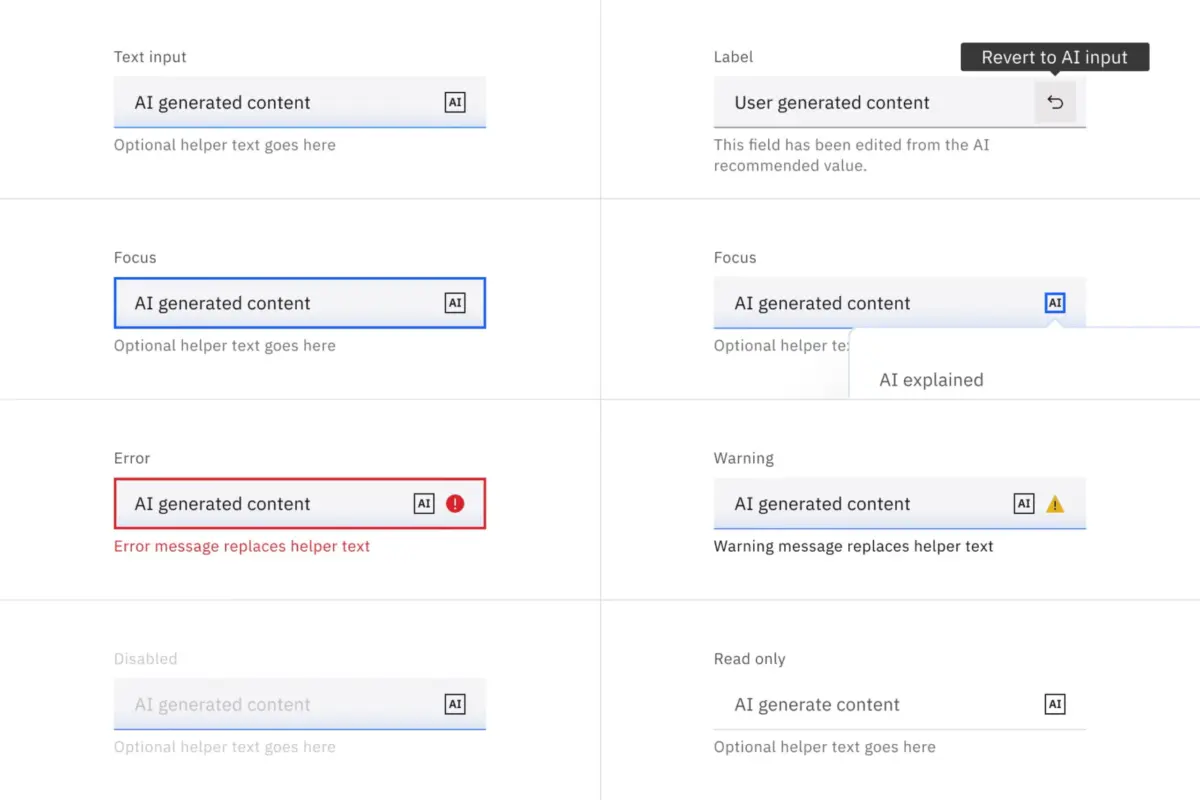
Under the new guidelines, hiding a compliance note in a footer, flashing an icon for a split second, or using a low-contrast badge will result in immediate non-compliance. To satisfy regulatory bodies, design patterns must adhere to strict UX principles:
- Clarity: The icon must be paired with plain-text disclosures (such as an explicit "AI-Generated" tag).
- Persistence: Labels cannot disappear when content is downloaded, shared, or exported to external platforms.
- Accessibility: Markers must be fully compatible with screen readers and other assistive technologies used by individuals with disabilities.
Global Alignment: A Regulatory Pattern, Not an Anomaly
While European tech companies often feel uniquely burdened by Brussels-led mandates, the transparency push surrounding synthetic media is rapidly becoming a global standard. Product teams operating internationally must recognize that this is a systemic shift rather than an isolated bureaucratic hurdle.
- United States: While lacking a single federal comprehensive AI law akin to the EU AI Act, multiple U.S. states have enacted or proposed strict disclosure laws. These target synthetic human performers (digital replicas), deepfakes in political advertising, and deceptive commercial AI practices.
- Asia-Pacific: Jurisdictions such as China have already implemented stringent regulations requiring clear watermarking and labelling of generative AI content to prevent social unrest and maintain information integrity.
For global enterprises, designing a unified, modular UI component system that incorporates robust AI labeling is the only sustainable way to future-proof products against a fragmented global regulatory matrix.

Future Outlook & Actionable Takeaways
As the compliance deadline arrives, technology leaders must shift from panic to strategic implementation. The overarching philosophy of these regulations is remarkably simple: If artificial intelligence generates content that could reasonably be mistaken for human work, creators and platforms must explicitly state so in an unambiguous, highly visible manner.
Rather than viewing these rules as an administrative nuisance, forward-thinking organizations should treat them as an opportunity to build trust with their user base. In an era increasingly saturated with low-quality, automated "AI slop," transparent labeling becomes a badge of quality and authenticity.
Recommended Next Steps for Product and Design Teams:
- Audit Existing AI Features: Conduct a comprehensive inventory of all product features that generate text, images, code, or audio destined for public or commercial consumption.
- Revise UI Design Systems: Move away from ambiguous sparkle icons. Adopt standardized, accessible iconography and explicit text labels that align with emerging regulatory guidelines.
- Establish Editorial Workflows: Implement strict internal guidelines regarding human-in-the-loop editing. Ensure that any content escaping the labelling requirement has verifiable, named human editorial oversight.
- Prepare for Cross-Border Enforcement: Treat EU standards as a baseline for global operations to ensure seamless compliance as similar laws take root in the US and Asia.
By leaning into transparency, product designers can help cultivate a healthier, more trustworthy digital ecosystem where human creativity and artificial intelligence coexist cleanly and clearly.