

ST. PETERSBURG, Florida — In an era defined by rapid technological disruption, shifting audience habits, and unprecedented economic pressures on the media ecosystem, the question of who steers the ship has never been more critical. Addressing this existential challenge head-on, The Poynter Institute has officially announced its exhaustive, synchronized lineup of leadership training programs for 2027.
By pulling back the curtain on its entire annual schedule simultaneously—breaking from the traditional practice of rolling program rollouts—Poynter is offering media professionals, newsroom executives, and project leaders a rare, panoramic view of a complete leadership development continuum. This unified approach is intentionally designed to allow candidates, supervisors, and human resources departments to map out multi-year career trajectories, ensuring that every journalist can identify the precise cohort, skill-building framework, and educational environment tailored to their exact professional inflection point.
Executive Overview: A Paradigm Shift in Media Management
For decades, the standard career trajectory in journalism followed a stubbornly predictable, often hazardous script: an individual excelled as a reporter, photographer, or editor, and as a reward for their exceptional independent output, they were promoted into management. Overnight, brilliant creators were thrust into complex supervisory roles without a single hour of formal instruction in people management, strategic delegation, financial literacy, or conflict resolution.
Poynter’s 2027 curriculum is built to dismantle this outdated archetype. Grounded in the foundational philosophy that leadership is not an innate, immutable trait but an acquired, highly technical skill set, the institute’s suite of programs targets every tier of the modern media enterprise. From individual contributors who must master the art of lateral influence to seasoned executives steering multiplatform newsrooms through turbulent digital transformations, Poynter’s offerings represent a rigorous, people-first intervention in an industry long overdue for systemic management reform.
The 2027 Leadership Roadmap: Detailed Program Chronology
The newly released 2027 catalog is strategically segmented to address distinct developmental milestones. By offering a blend of immersive, in-person residencies at Poynter’s iconic St. Petersburg campus and flexible virtual cohorts, the institute ensures accessibility for regional, national, and international media workers alike.
1. Lead With Influence (Virtual)
- Offered twice: Feb. 2–March 9, 2027 (Application Deadline: Jan. 8, 2027) | Sept. 1–Oct. 6, 2027 (Application Deadline: July 9, 2027)
- Target Audience: Project managers, data specialists, product developers, and individual contributors who drive cross-functional initiatives without formal authority or direct reports.
In the modern, matrixed media organization, traditional top-down hierarchies are increasingly obsolete. Much of the heavy lifting—whether launching a new audience analytics tool, spearheading a cross-newsroom investigative package, or redesigning a digital publishing platform—is executed by project leaders who possess zero direct reports.
The Lead With Influence virtual program is a six-week intensive deep dive into the mechanics of non-authority leadership. Participants dissect their personal leadership styles, master advanced communication frameworks, and learn pragmatic strategies for building consensus, negotiating competing priorities, and moving complex projects across the finish line. By focusing on emotional intelligence and strategic persuasion, this course equips professionals to lead effectively from the middle of an organization.
2. Essential Skills for New Managers (In-Person: St. Petersburg, FL)
- Offered twice: March 1–5, 2027 (Application Deadline: Aug. 16, 2026) | Nov. 8–12, 2027 (Application Deadline: Dec. 7, 2026)
- Target Audience: Newly minted managers with up to three years of supervisory experience, as well as high-potential senior staff members actively preparing to transition into people management.
The transition from peer to boss is widely considered one of the most perilous traps in corporate and newsroom life. The camaraderie of the assignment desk or the reporting bullpen can instantly curdle into resentment or isolation if a new manager lacks the tools to navigate authority, deliver constructive feedback, and delegate effectively.
This five-day immersive residential program addresses the core competencies of foundational management. Participants are guided through the mechanics of day-to-day supervision, including performance evaluations, active listening, workflow delegation, and the delicate art of managing former peers. Uniquely, the curriculum integrates industry-standard diagnostic tools, including the CliftonStrengths assessment and Poynter’s proprietary 360-degree feedback framework, ViewPoynt. This data-driven self-reflection allows new managers to calibrate their natural strengths and identify blind spots before they impact team morale.
3. Poynter Leadership Academy (In-Person: St. Petersburg, FL)
- Dates: April 12–16, 2027 (Application Deadline: Jan. 18, 2027)
- Target Audience: Experienced and senior newsroom managers, executive editors, and directors with more than three years of substantive leadership experience.
As media leaders ascend into senior executive ranks, the nature of their challenges shifts dramatically. Daily operational hurdles give way to strategic realignment, financial viability, legal and ethical minefields, and the psychological weight of steering organizational culture.
The flagship Poynter Leadership Academy is an intensive five-day crucible designed for those who have mastered basic management and are now charged with shaping the strategic destiny of their organizations. The curriculum challenges attendees to look beyond the immediate news cycle, exploring macro-level industry trends, crisis management, ethical decision-making in polarized environments, and the cultivation of sustainable business models. More than just a seminar, the academy functions as a high-level peer network, forging lifelong alliances among leaders grappling with parallel existential questions in newsrooms across the globe.
4. Leadership Academy for Women and Nonbinary Media Professionals (In-Person: St. Petersburg, FL)
- Dates: May 3–7, 2027 (Application Deadline: Feb. 8, 2027)
- Target Audience: Experienced managers who are women or nonbinary individuals, possessing more than three years of leadership experience within the media industry.
Structural inequalities, persistent pay gaps, and nuanced workplace biases continue to present unique barriers for women and nonbinary professionals ascending the media leadership ladder. Recognizing these systemic headwinds, Poynter’s Leadership Academy for Women provides a specialized, psychologically safe environment where participants can fortify their executive capabilities while openly examining the intersection of gender identity and power dynamics in the workplace.
Combining advanced leadership theory with candid, peer-led conversations, the program addresses negotiation tactics, executive presence, institutional navigation, and strategies for dismantling exclusionary workplace cultures. Graduates of this academy form a formidable, fiercely loyal alumni network that spans top-tier news organizations worldwide, continually lifting up subsequent generations of diverse media leaders.
Supporting Context & Metrics: The Human Cost of Untrained Management
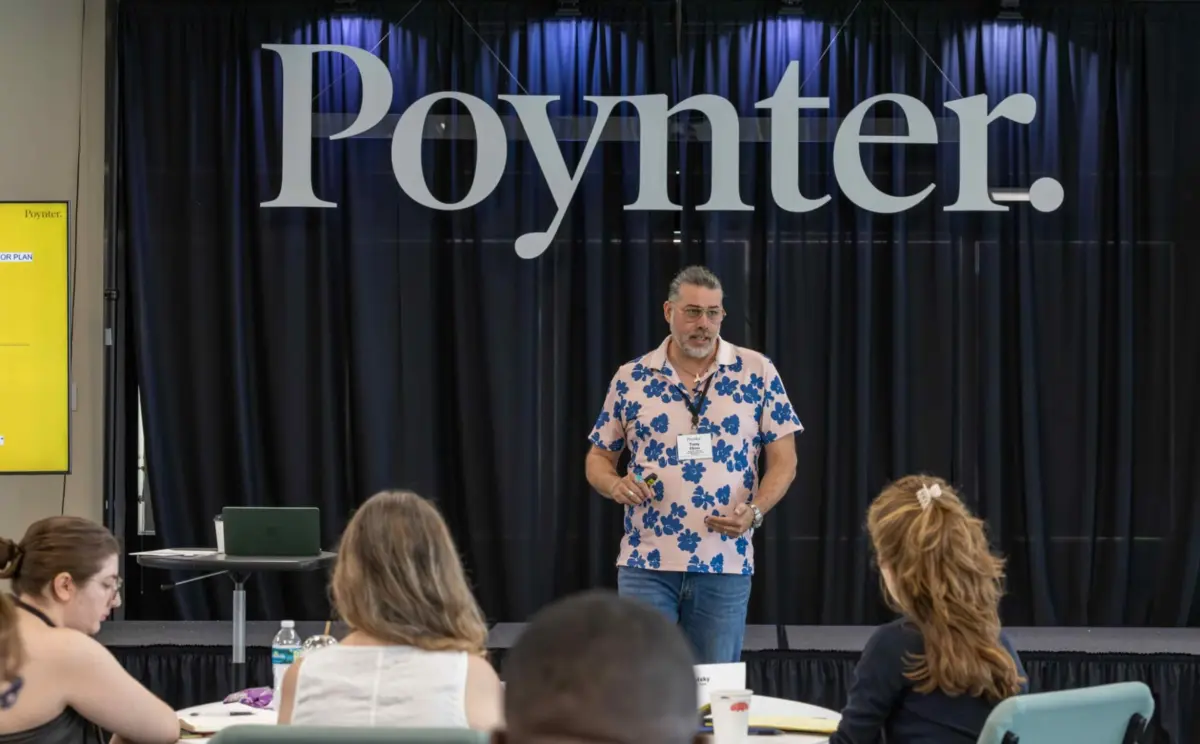
To understand why Poynter’s unified 2027 rollout is generating intense industry interest, one must examine the high-stakes economics of newsroom talent retention. Tony Elkins, a distinguished Poynter faculty member and veteran leadership instructor who has personally trained approximately 500 journalists-turned-managers, summarizes the industry’s historical systemic failure with stark candor.
"I often joke that journalism punishes some of its best and brightest by making them managers," Elkins observes. "We take people who become highly skilled in an area, and because we want to keep them in our organizations, we give them a big raise and promotion, and with it the added responsibility of leadership. If you do not train them, it leads to burnout, animosity, and they might even leave."
The financial and operational ramifications of this dynamic are severe. In an industry suffering from chronic contraction, staff burnouts, and institutional brain drain, losing top-tier editorial talent because of incompetent or unsupported middle management is a luxury newsrooms can no longer afford.
Elkins emphasizes that leadership training should never be viewed merely as an isolated perk for an individual employee; rather, it is a structural investment that yields exponential dividends.
"By investing in training, you’re setting them up for success," Elkins explains. "And it’s not just for them. It cascades down to everyone they manage and even other teams they collaborate with."
Poynter’s pedagogical framework is rooted in a deliberate philosophy: great leadership is inherently people-focused rather than purely metric-focused. While digital newsrooms are perpetually obsessed with click-through rates, subscription conversions, and algorithm changes, Elkins argues that sustainable metrics flow organically from healthy organizational cultures.
"Great leadership can be taught to everyone who comes to it with a desire to help people," Elkins says. "Our leadership training is very people-focused, not just outcomes. At its core, it’s about learning to listen and empathize, then turning what you learned into strategy that works for your team and your company. Even though that sounds simple, very few people in our industry are given the basic investment in their skillset to put that to practical use and succeed."
Institutional Legacy and Global Impact
Poynter’s 2027 initiatives do not exist in a vacuum; they draw upon more than five decades of specialized institutional experience in media training, coaching, and ethical standard-setting. The institute’s faculty roster comprises seasoned practitioners with deep expertise in executive coaching, organizational conflict resolution, human resources frameworks, and digital transformation.
As a global nonprofit organization, The Poynter Institute occupies a singular position in the international media ecosystem. Beyond its leadership academies, Poynter houses several of the world’s most vital journalistic watchdogs and educational initiatives, including:
- The International Fact-Checking Network (IFCN): The global arbiter of fact-checking standards and transparency in journalism.
- PolitiFact: The Pulitzer Prize-winning political fact-checking powerhouse.
- MediaWise: A groundbreaking digital media literacy initiative dedicated to teaching students and citizens how to spot misinformation online.
- The Newmark Ethics Center: A dedicated hub preserving and advancing journalistic integrity and ethics in the digital age.
Support for Poynter’s educational programs directly reinforces the constitutional pillars of a free press and the First Amendment, fostering public confidence in journalism at a time when institutional trust is under sustained global assault.
Future Outlook: Securing the Future of News
As the media landscape barrels toward 2027, the challenges facing newsrooms will only accelerate. Artificial intelligence integration, shifting platform distribution models, remote and hybrid newsroom dynamics, and relentless economic squeezes demand a new caliber of leadership—one defined by empathy, adaptability, clear strategic vision, and unyielding ethical grounding.
By opening the application windows for its entire 2027 leadership curriculum today, The Poynter Institute has thrown down a challenge to newsroom executives, media owners, and philanthropic funders: treat leadership development not as an afterthought, but as the foundational bedrock of organizational survival.
For individual journalists eyeing the next stage of their careers, and for media organizations desperate to stanch the hemorrhage of top talent, the path forward is now clearly illuminated.
Media Contact & Application Inquiries
For further information regarding program applications, curriculum specifics, or underwriting opportunities, media professionals are invited to contact:
Jennifer Orsi
Vice President, Publishing and Local News Initiatives
The Poynter Institute
Email: [email protected]
Official Website: poynter.org
