

Executive Overview
In the modern digital workspace, a quiet fatigue has settled over professionals and everyday software users alike. Every week brings promises of a revolution disguised as a new standalone application, a novel chat interface, or a radical, "AI-first" paradigm designed to completely rewrite how we approach daily productivity. Yet, beneath the polished marketing copy and venture capital hype lies a stark reality: users do not want more tools. They do not wake up hoping to juggle yet another subscription, configure another complex dashboard, or jump through endless back-and-forth chat interactions just to complete standard tasks.
What the modern market demands is not an accumulation of disparate software, but rather the seamless integration of useful capabilities that respect, honor, and align with already established human mental models.
This tension between the relentless pursuit of "AI-first" disruption and the quiet, practical need for invisible, contextual assistance forms the core challenge of contemporary UX design. As digital ecosystems grow increasingly cluttered, true innovation is no longer about building louder, more demanding tools. Instead, it is about designing Quiet AI—systems that recede into the background, operating transparently within the applications and workflows users already know and trust. By exploring concepts such as system-level folder instructions and contextual in-app integrations, designers can eliminate high-frequency friction points and deliver genuine utility without cognitive overhead.
Detailed Chronology: The Evolution of User Interfaces and the AI Paradox
The Era of Siloed Applications (2000s–2010s)
To understand why users are overwhelmed today, we must examine how modern software evolved. For the past two decades, the prevailing product design philosophy was built around siloed applications. Whether managing documents, compiling spreadsheets, or communicating with teams, users were encouraged to adopt specialized, best-of-breed tools for every microscopic task.
While this modular approach allowed software companies to rapidly scale niche products, it created an unintended consequence: context fragmentation. Professionals spent an escalating percentage of their working hours switching tabs, copying and pasting data between incompatible ecosystems, and managing notification fatigue. The mental model required of the user was outward-facing—the human had to adapt to the idiosyncratic logic of each individual tool.
The Generative AI Boom and the "Chat-First" Detour (2022–2024)
When generative artificial intelligence broke into the mainstream, the software industry experienced a collective knee-jerk reaction. Driven by the capabilities of large language models, tech companies rushed to build "AI-first" applications.
The prevailing archetype of this era became the chatbot: a dedicated, standalone window sitting on the right side of a screen, waiting for prompts. While these tools demonstrated unprecedented technological prowess, they frequently failed basic usability tests in real-world professional environments. Users were forced to abandon their native workflows—such as working inside an enterprise spreadsheet or an IDE—and export their context into a separate chat interface, only to manually copy the results back. Far from saving time, this "chat-first" approach often introduced a new layer of cognitive friction, requiring users to learn specialized prompt engineering techniques rather than relying on intuitive, system-level design patterns.
The Shift Toward Quiet AI and Contextual Integration (Present Day)
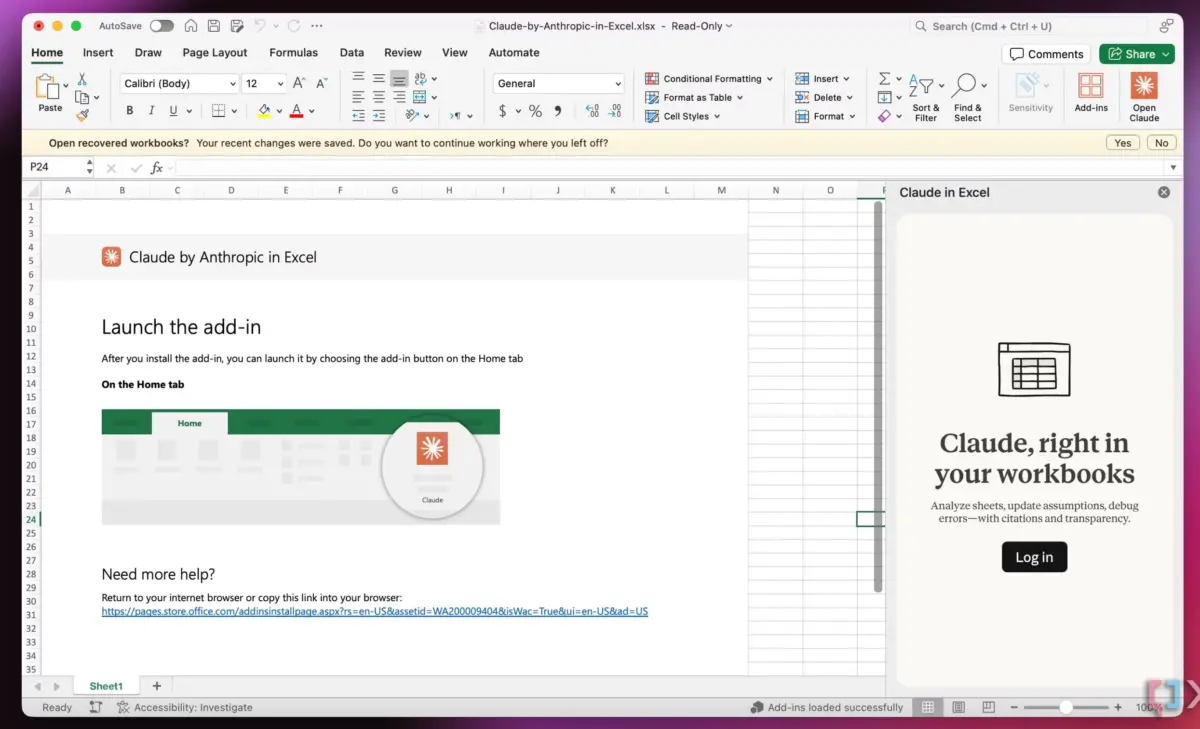
Recognizing the limitations of chat-centric silos, forward-thinking UX researchers and product designers have begun charting a different course. The current frontier of interface design focuses on Quiet AI—systems that integrate directly into existing environments (such as Claude’s native embeddings within Microsoft Excel, Word, and PowerPoint) and pioneering system-level concepts like folder instructions. This evolution marks a return to user-centric principles: technology must bend to human workflows, not the other way around.
Supporting Context & Metrics: The Cost of Cognitive Fragmentation
To quantify the urgency of this design shift, one must look at the hidden costs of software proliferation. Enterprise research consistently highlights how productivity is eroded not by a lack of raw processing power or feature sets, but by context switching and cognitive overload.
The Metrics of Disruption
- The Cost of Switching: Industry studies on workplace productivity indicate that knowledge workers switch between different apps and websites hundreds of times a day. Each transition incurs a "re-orientation lag," draining mental energy and drastically increasing the probability of human error.
- Feature Bloat vs. Adoption: Software analytics reveal that the vast majority of enterprise software features go entirely unused. Users consistently rely on a core set of familiar capabilities, while complex, multi-tiered workflows are abandoned due to steep learning curves.
- Frustration Severity: High-impact user dissatisfaction rarely stems from a lack of advanced features. Instead, it clusters around high-frequency, high-severity friction points: repetitive data entry, file organization, cross-application data synchronization, and formatting clean-up.
Mental Models as Unmovable Anchors
Human beings operate on mental models—internal representations of how the world and its tools work, built up over years of repetitive interaction. A user who has spent two decades organizing digital assets via hierarchical file structures (folders and sub-folders) possesses a deeply ingrained mental model.
When an "AI-first" startup introduces a radically novel paradigm—such as abandoning folders entirely in favor of abstract, vector-based semantic search graphs—it often forces the user to unlearn established habits. While semantic search is undeniably powerful, discarding familiar structures entirely creates unnecessary resistance. The winning design pattern does not replace the folder; it empowers it.
Official Statements & Industry Perspectives: Rethinking AI Interfaces
Industry leaders and design educators are increasingly speaking out against the trap of complexity, advocating for a return to understated, deeply integrated utility.
"We often hear about shiny new tools that change everything (yet again). But in practice, most people don’t need more tools to deal with in their daily lives. What we actually need are better integrations of useful capabilities that neatly align with our existing and established mental models."
— Vitaly Friedman, UX Consultant and Creator of Design Patterns For AI Interfaces
Friedman’s perspective underscores a vital critique of contemporary product development. The obsession with technological novelty often blinds creators to basic ergonomics. When developers focus purely on what an AI model can do, rather than how a human being wants to experience that capability within an existing task, usability plummets.
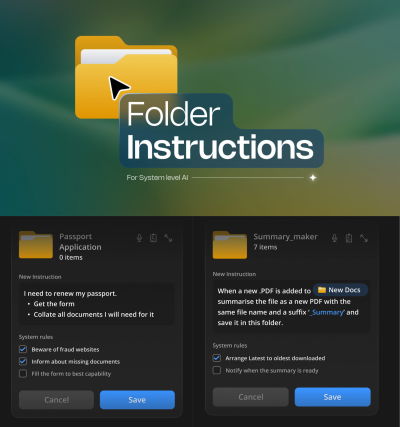
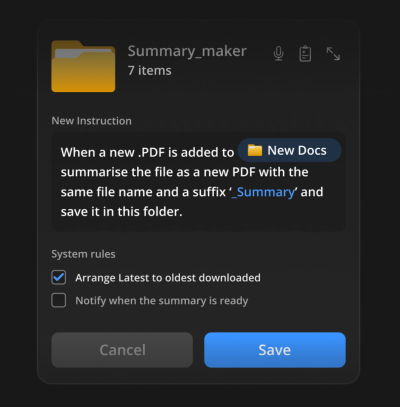
Further expanding on this philosophy, interface architectures are beginning to embrace system-level concepts that empower users at the point of action. As demonstrated in recent explorations of file management and system-level automation (such as Karthikeya GS’s work on system-level folder instructions), the goal is to embed intelligence directly into the environment where work actually happens.

Rather than requiring a user to open a separate application to summarize a batch of PDFs or format an incoming data set, the user simply defines the intent at the folder level. The system then quietly observes those rules, executing background tasks reliably and transparently.
Future Outlook: The Horizon of Quiet AI and Seamless UX
As we look toward the future of software design, the trajectory is clear: the most successful products will be those that become practically invisible.
1. From Applications to Capabilities
The boundary lines separating individual software applications will continue to blur. Instead of users opening distinct silos to write, analyze, design, and organize, ambient intelligence layers will stitch these capabilities together under unified, familiar interfaces. Software will no longer demand to be "opened"; it will be invoked contextually as a natural extension of the user’s immediate intent.
2. Radical Personalization Through Intent-Driven Rules
Systems will increasingly rely on lightweight, user-defined guardrails—such as folder instructions, contextual rule-sets, and localized permissions. This shifts the user’s role from a manual laborer executing repetitive tasks to an architectural director who sets high-level intent while automated, quiet assistants handle the execution.
3. The Rejection of Friction
In the coming years, market tolerance for software that requires onboarding marathons, extensive manual configuration, or disruptive context-switching will approach zero. Products that win market share will be those that respect human cognitive limits, integrate smoothly into established mental models, and solve high-severity frustrations with elegance and silence.
Ultimately, the future belongs not to the loudest AI tools, but to the quietest integrations. By anchoring technological capability to human habit, designers can finally deliver on the true promise of digital productivity: technology that works so harmoniously, we barely notice it is there.
