

Executive Overview
For millennia, the fundamental applications of textiles have remained remarkably consistent. Across human history, yarn and thread have been looped, woven, and knitted to provide shelter, warmth, and adornment—manifesting as familiar everyday items like sweaters, caps, scarves, and blankets. While industrial manufacturing processes have evolved drastically from hand-held needles to automated computerized looms, the foundational paradigm of fabrics has stayed largely static: they are soft, flexible, and ultimately passive coverings.
That long-standing paradigm is now undergoing a radical transformation.
In a groundbreaking interdisciplinary study published in Advanced Functional Materials, a team of researchers at the Harvard John A. Paulson School of Engineering and Applied Sciences (SEAS) has demonstrated that conventional industrial knitting techniques can be harnessed to fabricate responsive, programmable fabrics. These advanced textiles are not merely passive layers of cloth; they are capable of dynamically changing their three-dimensional shape, sensing physiological movement, and operating as soft electronic switches. By bridging the gap between historical textile arts and advanced nonlinear solid mechanics, the Harvard team has unlocked a new frontier in smart materials—one that promises to redefine the boundaries between clothing, computing, and robotics.
Led by recent Ph.D. graduate Kausalya Mahadevan—now a postdoctoral associate in the laboratory of Katia Bertoldi, the William and Ami Kuan Danoff Professor of Applied Mechanics—the research introduces a method for engineering "multistability" directly into knitted architectures. By carefully orchestrating yarn selection, structural geometry, and industrial weft-knitting parameters, the team has created fabrics that can sharply "snap" between multiple stable configurations. When integrated with thin conductive fibers, these shape-shifting textiles transform into functional, stretchable hardware capable of powering LEDs, tracking joint articulation for step-counting mechanisms, and serving as reconfigurable human-machine interfaces.
Crucially, because this manufacturing approach relies on standard industrial knitting machinery already widely deployed in the commercial garment sector, the technology sidesteps many of the scalability roadblocks that typically plague laboratory-born smart materials. As industries increasingly demand responsive, soft-robotic, and wearable technologies, this fusion of mechanical physics and textile engineering offers a highly scalable, economically viable path forward.
Detailed Chronology
The Genesis of a Hybrid Discipline: Merging Fiber Arts and Nonlinear Mechanics
The intellectual origins of this breakthrough trace back to a convergence of artistic insight and rigorous scientific inquiry. Kausalya Mahadevan’s fascination with textiles began long before her doctoral studies; she had long been captivated by what could be engineered and built using continuous strands of fiber. When she joined Katia Bertoldi’s laboratory as an undergraduate, she carried this passion into an environment traditionally dedicated to studying nonlinear mechanics in solid, hard materials—exploring how structures buckle, bend, and morph under extreme loads.
The intersection of these two domains proved fertile ground. While reviewing how textile artists manipulate loops and tension to create intricate, self-supporting spatial structures, Mahadevan and her colleagues realized that the mathematical and physical principles governing geometric buckling in solids could be directly mapped onto knitted loops.
In traditional engineering, materials designed to curve and securely hold that form—such as shape-memory polymers or engineered metal alloys—are typically produced through complex molding processes. These methods require precise control over internal residual stresses and are often rigid, brittle, or difficult to scale. The Harvard team asked a bold counter-factual question: Could these same complex, energy-storing, multistable behaviors be achieved using yarn alone, leveraging the inherent topological flexibility of loops?
Material Optimization and the Mechanics of Plating
To answer this question, the researchers had to rethink how yarns interact at a microscopic level. Traditional industrial knitting produces uniform, flat, or gently draped sheets. To induce the kind of aggressive, controlled structural transformations the team envisioned, they needed a fabric that possessed intrinsic internal stresses and an aggressive propensity to curl.
The team achieved this by selecting highly elastic, performance-driven yarns and utilizing a specialized industrial technique known as plating. In plating, two distinct types of yarn are fed into the knitting machine simultaneously in such a way that they occupy opposite faces of the resulting textile. Because the two yarns possess different physical properties—such as elasticity, thickness, and tension response—their juxtaposition creates an inherent mechanical imbalance across the thickness of the fabric.
This asymmetry mirrors the fundamental physical behavior observed when the bottom hem of a freshly cut cotton T-shirt spontaneously rolls upward. However, rather than treating this curling as an undesirable side effect, the Harvard researchers systematically weaponized it. By optimizing machine parameters and yarn combinations, they engineered fabrics that were primed to be as "snappy" as possible—storing elastic strain energy that could be abruptly released and redirected.
Programming Bistability Through Geometric Stripes
With the foundational curling behavior established, the team moved on to the next critical challenge: achieving multistability. In physics and engineering, a multistable system is one that possesses more than one stable mechanical configuration. A classic everyday example is a standard household light switch, which can rest stably in either the "ON" or "OFF" position, but actively resists resting anywhere in between.
To program this behavior into a knitted fabric, Mahadevan and her colleagues arranged horizontal and vertical stripes in systematic, mathematically informed combinations across the textile. By alternating zones of high and low tension, differing stitch densities, and varying yarn orientations, they created a geometric blueprint that forced the fabric to buckle into specific, predetermined three-dimensional topographies.
When an external mechanical force is applied to these structured fabrics, they do not merely deform smoothly; instead, they undergo a rapid, dynamic snap-through transition, jumping from one stable 3D shape to another. Remarkably, the team discovered they could accurately simulate and predict this complex behavior by treating each knitted textile as a continuous, homogenized elastic material rather than getting bogged down in the computationally prohibitive task of modeling every individual microscopic loop of yarn.
Integrating Conductive Pathways for Soft Electronics
A shape-shifting fabric is scientifically fascinating on its own, but its utility multiplies exponentially when it can interact with electronic systems. To demonstrate the practical viability of their approach, the researchers introduced functionalized elements into the textile architecture: thin, flexible conductive yarns.
By knitting these conductive pathways directly into the strategic hinges of the multistable fabric, the researchers transformed the mechanical structures into soft, stretchable electrical switches. When the textile snaps from its first stable configuration to its second, the physical movement alters the electrical continuity within the embedded conductive network. This transition either opens or closes the circuit, allowing the fabric to function as a seamless, batteryless interface capable of controlling digital and electrical systems without traditional metallic hardware.
Supporting Context & Metrics
To fully appreciate the significance of the Harvard SEAS breakthrough, it is essential to contextualize the work within the broader landscapes of materials science, soft robotics, and industrial manufacturing.
The Science of Mechanical Metamaterials
For decades, the field of mechanical metamaterials has focused on creating artificial structures with macroscopic properties dictated not by the inherent chemistry of their base substance, but by their meticulously designed internal geometry. These materials can exhibit counter-intuitive behaviors, such as negative Poisson’s ratio (expanding laterally when stretched longitudinally) or extreme energy absorption under impact.
However, traditional mechanical metamaterials are predominantly fabricated from rigid polymers, elastomers, or metals using advanced manufacturing techniques like 3D printing, laser cutting, or precision molding. While these methods allow for exquisite geometric control, they suffer from inherent limitations:
- Scalability: 3D printing large volumes of complex metamaterials is notoriously slow and cost-prohibitive.
- Comfort and Wearability: Hard or semi-rigid metamaterials are poorly suited for applications requiring intimate contact with the human body, such as medical garments or adaptive clothing.
By translating the principles of nonlinear mechanical metamaterials into knitted textiles, the Harvard team has effectively unlocked a new class of soft metamaterials. These fabrics combine the complex mechanical functionality of advanced engineering structures with the breathability, drapability, and comfort of everyday clothing.
Quantifying the Innovation
| Metric / Parameter | Traditional Smart Textiles | Harvard SEAS Multistable Knitted Fabrics |
|---|---|---|
| Primary Building Blocks | Rigid sensors, wires, surface-mounted electronics | Continuous elastomeric yarns and conductive threads |
| Shape-Shifting Mechanism | External pneumatic, thermal, or motor actuators | Intrinsic mechanical energy storage and snap-through buckling |
| Manufacturing Compatibility | Often requires specialized micro-assembly or cleanrooms | Directly compatible with standard industrial weft-knitting machinery |
| Electrical Integration | Bulky soldered joints, rigid circuit boards | Seamlessly integrated conductive plating yarns |
| Power Requirements | Frequently require continuous active power for actuation | Passive bistability requires energy only during state transitions |
Real-World Demonstrations and Prototyping
To validate the real-world utility of their programmable textiles, the research team constructed several distinct functional prototypes, each highlighting a different dimension of the technology’s capabilities:
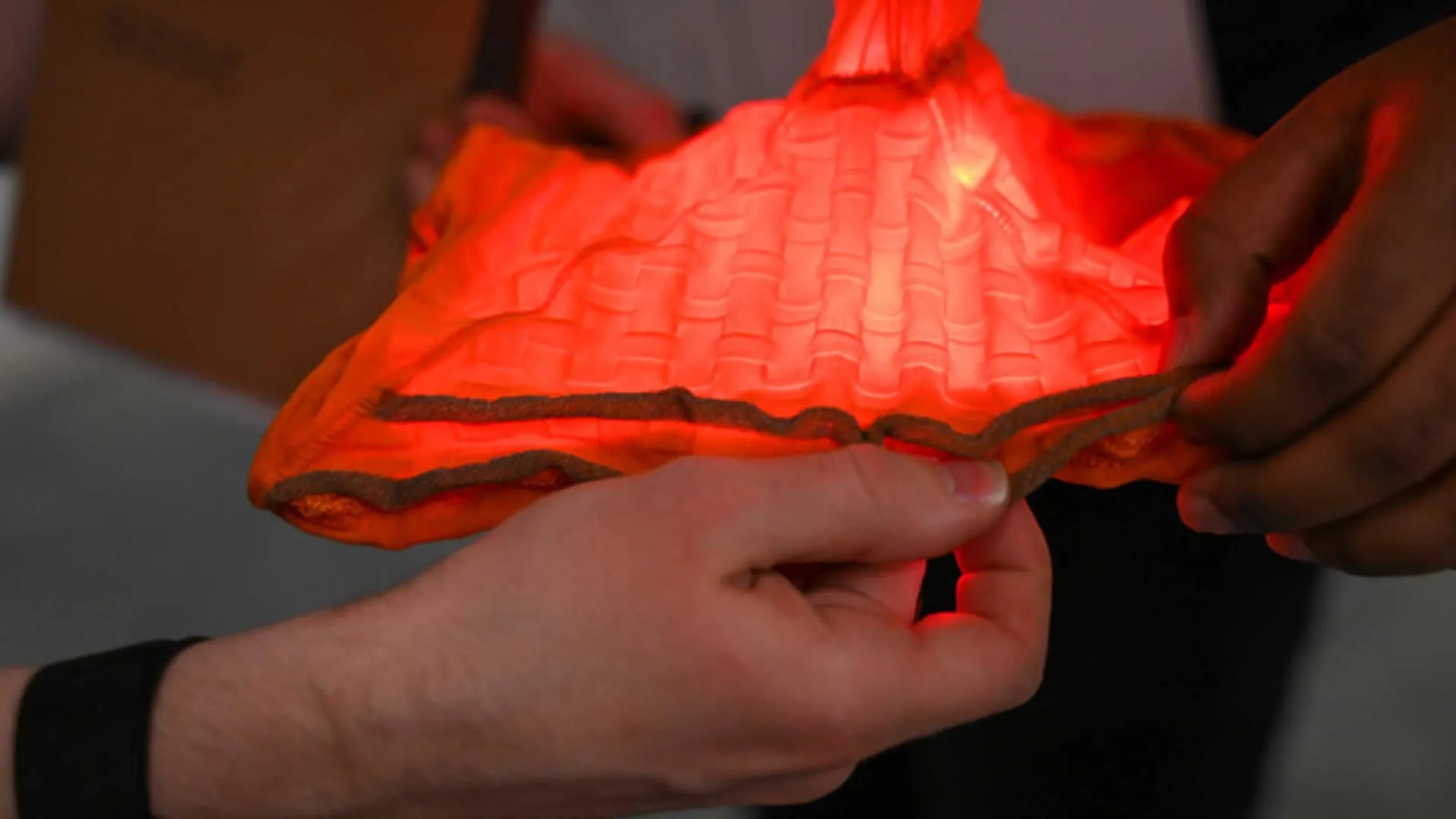
- The LED Interactive Shell: The researchers fabricated a multistable knitted shell integrated with a low-voltage circuit. As a user gently presses or manipulates the textile, it snaps between its stable configurations, toggling an LED light source on and off without the need for a traditional mechanical push-button switch.
- Wearable Joint-Angle and Step Counter: In a compelling demonstration of biometric integration, a prototype switch was mounted across a human knee joint. As the user walks, the natural bending and straightening of the leg deforms the fabric, forcing it to snap through its stable states. This mechanical motion is detected by a lightweight microcontroller (Arduino), translating physical articulation into accurate step-counting data.
- Reconfigurable Color-Changing Lampshade: The team designed an architectural lampshade incorporating three distinct multistable switches. By stretching and snapping different panels of the shade, users can independently alter the color output of the internal lighting system. These interactive luminaires, along with other artifacts from the study, were showcased in an exhibition at the Harvard Art Labs, bridging the worlds of high engineering and interactive sculpture.
Official Statements
The implications of this research extend far beyond the confines of the academic laboratory. In official statements accompanying the publication, the lead investigators reflected on the philosophy driving the work and its prospective trajectory.
"I’ve always been excited about fabrics and textiles, and what we can engineer and build with them,"
— Kausalya Mahadevan, Lead Author and Postdoctoral Associate
Reflecting on the intellectual synthesis that made the project possible, Mahadevan emphasized the collaborative nature of the discovery:
"Our ideas around multistability in textiles arose from being inspired by textile artists and how they approach structures, combined with how [Professor Bertoldi’s] lab has traditionally thought about nonlinear mechanics in solids. We tried to approach thinking about textiles in that context."
Detailing the precise tuning required to achieve the desired mechanical response, Mahadevan highlighted the synergy between material science and industrial machinery:
"The yarn selection and machine parameter choices allowed us to basically select a fabric that is going to be as snappy as we can possibly get."
While the research team maintains a rigorous focus on fundamental physics, the overarching vision championed by the lab points toward a future where our clothing and domestic environments are deeply responsive to our physical presence.
Future Outlook
As the boundaries between textiles, computing, and mechanics continue to dissolve, the work pioneered by Mahadevan, Bertoldi, and their colleagues at Harvard SEAS opens up vast new avenues for commercial and scientific exploration.
Commercial Scalability and Industrial Integration
One of the most profound advantages of the Harvard methodology is its profound respect for existing industrial infrastructure. Unlike many breakthrough smart materials that require entirely new manufacturing ecosystems, the techniques developed in this study utilize industrial weft-knitting machines—the very same equipment that populates commercial garment factories worldwide.
This compatibility suggests that the transition from academic prototype to mass-produced consumer goods could happen much faster than is typical for advanced materials. Textile mills do not need to retool their entire operations; rather, they can simply adopt new programming codes, specialized yarn inventories (combining elastomeric cores with conductive platings), and structural design schematics to begin producing programmable, shape-shifting fabrics at scale.
Horizons in Soft Robotics, Biomedicine, and Wearable Tech
Looking ahead, the research team envisions a wide array of transformative applications across multiple industries:
- Next-Generation Wearable Health Monitors: Future garments could embed multistable sensor arrays that quietly and unobtrusively track posture, joint movement, respiration rates, and muscle fatigue without encumbering the user with rigid sensors or adhesive patches.
- Haptic Feedback and Soft Robotics: By utilizing programmable textiles that can rapidly alter their geometry or stiffness on demand, engineers could develop soft robotic suits that assist rehabilitation patients, enhance ergonomic lifting in industrial workplaces, or provide rich, tactile feedback in virtual reality environments.
- Adaptive Architecture and Interior Design: Beyond clothing, multistable knitted fabrics could be deployed in intelligent interior environments—such as self-adjusting acoustic panels, reconfigurable window shades that adapt dynamically to sunlight angles, and interactive architectural skins that change shape to regulate interior climate conditions passively.
Conclusion
The traditional textile has long served as a silent, compliant second skin for humanity. By injecting the rigorous principles of nonlinear solid mechanics into the ancient art of knitting, the Harvard SEAS research team has rewritten that narrative. Yarn is no longer just for keeping us warm; it is becoming a medium for computation, physical actuation, and responsive design. As this technology scales from laboratory looms to global manufacturing lines, we stand on the cusp of an era where our clothing, our furniture, and our architecture will literally come alive at our touch.
This research was generously supported by the National Science Foundation under grant DMR-2011754 and the Army Research Office (ARO) MURI program under award W911NF-22-1-0219. Specialized laboratory equipment was funded by the Office of Naval Research (ONR) DURIP Award N00014-19-1-2220.