

Published: September 7, 2026
Location: Miami, Florida
Executive Overview
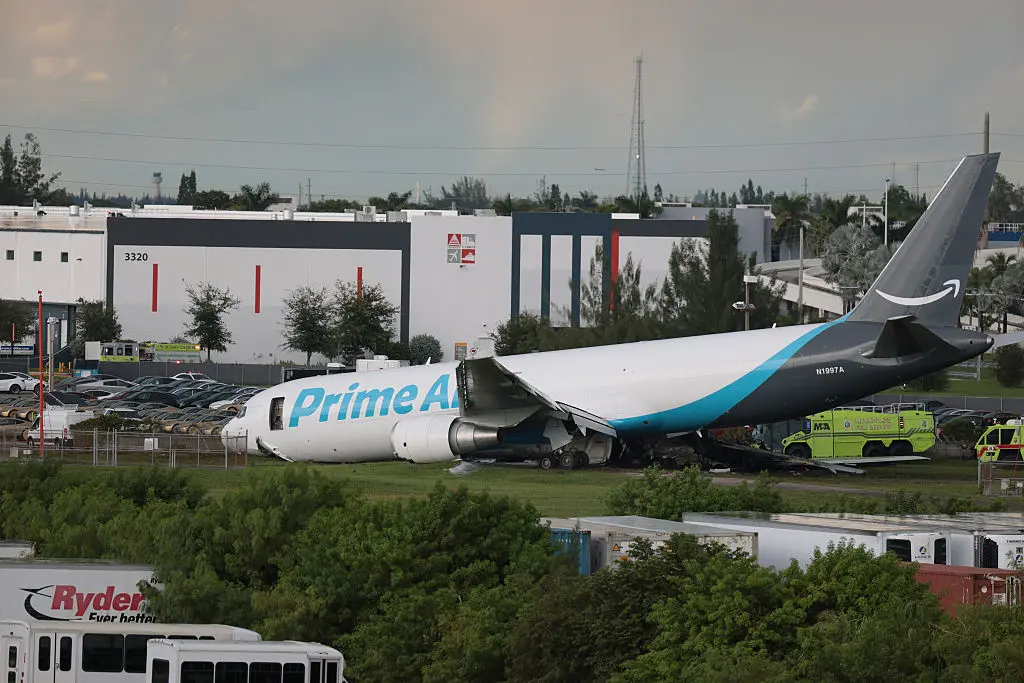
Federal aviation safety investigators have launched a rigorous multi-agency inquiry into a catastrophic aviation accident at Miami International Airport (MIA) that left five people dead and several others seriously injured. The tragedy unfolded on Sunday afternoon, September 6, 2026, when an Amazon Prime cargo plane—a Boeing 767-300 operated by carrier 21 Air—failed to stop within the confines of the runway.
The heavy transport aircraft overran the tarmac, breached airport perimeter boundaries, smashed into multiple civilian vehicles on an adjacent perimeter roadway, and erupted into a massive fire. The disaster immediately paralyzed operations at one of the busiest aviation hubs in the United States, forcing hundreds of flight cancellations and delays, while drawing an overwhelming, multi-unit emergency response from Miami-Dade County fire and rescue teams.
As recovery efforts wind down, the focus of national transport authorities has shifted entirely to forensics and prevention. Led by the National Transportation Safety Board (NTSB), investigators are combing through physical wreckage, flight data recorder metrics, and maintenance histories to determine why the 32-year-old aircraft failed to decelerate before plunging past the runway threshold.
Detailed Chronology of the Disaster
Approach and Touchdown
The sequence of events began shortly before 2:00 p.m. (EDT) on Sunday. The Boeing 767-300 freighter was completing a routine scheduled domestic cargo flight, originating from Luis Muñoz Marín International Airport in San Juan, Puerto Rico. Meteorological conditions at the time of arrival are currently under formal review, though preliminary operational reports suggest standard landing configurations were maintained during initial approach.
According to preliminary flight-tracking metrics and local eyewitness accounts, the aircraft touched down on the runway surface during the early afternoon hours. However, instead of executing a standard deceleration profile, the plane failed to shed forward momentum effectively.
The Breaching of the Perimeter
Footage captured by airport surveillance and bystanders reveals the terrifying final moments of the landing sequence. The aircraft can be seen continuing past the paved limits of the runway at a high rate of speed—subsequent flight-tracking data indicates the jet was still traveling at approximately 112 miles per hour as it breached the runway end.
The aircraft did not stop at the grass safety zones typically designed to slow overshooting planes. Instead, it tore through the airport perimeter barrier and crossed a heavily utilized perimeter service road. This roadway is frequently traversed by employees and service vehicles supporting surrounding airport-adjacent commercial enterprises.
Impact and Conflagration
Upon crossing the roadway, the Boeing 767 struck multiple civilian vehicles traveling or parked along the route. The immense kinetic energy of the wide-body jet obliterated the smaller motor vehicles on impact. Instantly following the collisions, the aircraft’s fuel tanks ruptured, triggering an explosive, multi-acre fire that sent towering plumes of dense black smoke billowing into the Miami sky.
The severity of the impact and subsequent fire overwhelmed the immediate area. More than 60 specialized Miami-Dade Fire Rescue (MDFR) units were swiftly dispatched to the scene. First responders confronted an inferno engulfing the wreckage of both the aircraft and the struck automobiles. Firefighters worked feverishly to suppress the flames and deploy hazardous materials teams, while paramedics established triage areas for the wounded.
Supporting Context & Metrics
Human Toll and Casualties
Local health and emergency authorities confirmed that five individuals lost their lives in the disaster. Due to the catastrophic nature of the impact and ongoing family notifications, officials have withheld the identities of the deceased.
An additional five people sustained severe injuries. Among the injured, three individuals remain hospitalized in critical condition, fighting for their lives under intensive medical care. Given the nature of the vehicles struck on the perimeter service road, emergency personnel worked methodically through Sunday evening to secure the scene and ensure no additional motorists remained trapped beneath the wreckage.
Aircraft Profile and Operational History
The aircraft involved was a Boeing 767-300, a wide-body twinjet that has served as a cornerstone of international long-haul and domestic cargo logistics for decades. However, public records and aviation databases reveal that the specific airframe was 32 years old.
Originally manufactured and delivered in the 1990s as a commercial passenger airliner, the jet had later undergone a comprehensive industrial conversion to serve as a dedicated freighter. In modern logistics ecosystems, aging passenger airframes frequently receive a "second life" as cargo haulers. While these retrofitted planes must clear rigorous airworthiness standards, their advanced age naturally draws heightened scrutiny from federal safety inspectors during post-accident failure analyses.
At the time of the crash, the aircraft was being operated by 21 Air, a certified air cargo carrier that routinely contracts with major e-commerce enterprises, including Amazon’s dedicated logistics arm, Amazon Air.
Impact on National Airspace and Operations
The accident caused an immediate paralysis of Miami International Airport, consistently ranked among the top cargo and passenger hubs in the United States. Federal authorities enacted a strict, full ground stop at MIA shortly after the crash occurred, halting all incoming and outgoing flights while emergency crews operated on the active tarmac and surrounding perimeters.
Transportation data provider FlightAware reported widespread ripple effects across the national airspace system. On Sunday alone:
- Over 160 flights were completely canceled.
- Roughly 325 flights experienced severe delays.
- Tens of thousands of passengers faced stranded itineraries, missed connections, and redirected aircraft as airlines scrambled to reroute planes scheduled to land in South Florida.
Federal and airport officials lifted the ground stop in a phased manner late Sunday evening, prioritizing emergency lanes and safety clearances, though lingering schedule disruptions bled well into Monday morning.
Official Statements & Government Response
The scale of the disaster prompted immediate, high-level statements from corporate leadership and federal transportation officials.
The Federal Response
Transportation Secretary Sean Duffy took to social media and emergency briefing rooms shortly after the incident to confirm the federal government’s mobilization.
"We’ve issued a full ground stop at Miami International while first responders assess the scene after an Amazon cargo plane overran the runway," Secretary Duffy stated via public channels. "If you’re traveling through the area, please expect significant delays and potential cancellations. The FAA will send inspectors…"
The Federal Aviation Administration (FAA) immediately dispatched a team of safety inspectors to the airfield. Simultaneously, the National Transportation Safety Board (NTSB) invoked its statutory authority to lead the overarching accident investigation. An elite "Go-Team," led personally by NTSB Chair Jennifer Homendy, deployed to Miami to secure perishable evidence and oversee the meticulous forensic reconstruction of the crash site.
Corporate Accountability and Response
Amazon, whose corporate branding and delivery network were tied to the ill-fated flight, released a formal statement expressing deep sorrow over the tragedy:
"We are heartbroken by the loss of life resulting from this tragic incident in Miami," an Amazon corporate representative said. "Our deepest sympathies go out to the families and loved ones of those who died, and our thoughts are with the injured. We are fully cooperating with the FAA, NTSB, and local authorities as they conduct their investigation."
Representatives for 21 Air echoed these sentiments, noting that their primary focus remains supporting the emergency response teams, assisting the families of the affected flight crew and ground victims, and providing unrestricted access to operational logs for federal investigators.
Future Outlook: The Investigation Ahead
As the smoking wreckage is cleared from the Miami International Airport perimeter, the arduous investigative phase begins. The NTSB’s multi-disciplinary investigation is expected to take months—and potentially over a year—before a definitive final report is published.
Federal investigators will systematically evaluate several core hypotheses:
- Mechanical Systems and Deceleration: Specialists will recover and analyze the aircraft’s flight data recorder (FDR) and cockpit voice recorder (CVR)—the "black boxes"—to assess throttle inputs, spoiler deployment, thrust reverser functionality, and anti-skid braking performance.
- Weather and Environmental Factors: Meteorological data at the exact minute of touchdown will be scrutinized to determine if sudden wind shear, heavy localized rainfall, or hydroplaning conditions compromised the aircraft’s stopping capability.
- Airframe Maintenance Logs: Given the 32-year age of the converted Boeing 767, investigators will pore over historical maintenance records to verify whether structural fatigue, hydraulic line integrity, or component wear played a role in the failure to brake.
- Airport Infrastructure and Runway Safety Areas (RSAs): Questions are already being raised regarding the spatial dimensions of the runway safety overrun zones at MIA. Investigators will assess whether current safety buffers met federal guidelines and whether structural modifications could prevent future perimeter breaches.
For Miami International Airport, the immediate challenge is restoring complete operational confidence to travelers and logistics partners alike. For the broader aviation and e-commerce industries, the tragedy serves as a grim reminder of the high-stakes intersection between mass commercial logistics and public safety—an intersection that federal authorities are now determined to re-examine down to the final detail.
