

Executive Overview
During a high-stakes diplomatic visit to the Republic of Ireland, President Donald Trump made explosive remarks that fundamentally shattered decades of carefully managed American foreign policy neutrality regarding the political status of Northern Ireland. Speaking alongside Irish Taoiseach Micheál Martin during a joint press conference, Trump asserted that he would “love to see” the island reunified and suggested that the constitutional question—which fueled decades of sectarian violence known as "The Troubles"—should be resolved immediately.
“I don’t want to cause any problems, but I’d love to see it unified,” Trump remarked. “It’s going to happen eventually. It may as well happen now.”
The comments mark an unprecedented departure from the long-standing diplomatic playbook of successive U.S. administrations. Traditionally, Washington has walked a tightrope of delicate neutrality, serving as an interested international guarantor of the 1998 Good Friday Agreement while deferring strictly to the principle of self-determination for the people of Northern Ireland. Trump’s casual dismissal of this complex diplomatic architecture has reignited fierce debates across the Irish Sea, drawing sharp rebukes from unionist leaders who view his comments as an unwarranted outside intervention, while emboldening nationalist factions calling for immediate contingency planning for a border poll.
Beyond the political fallout over reunification, Trump’s weekend itinerary was underscored by high-tension diplomatic theater. His private meeting with Irish President Catherine Connolly—a sharp-tongued critic of the American president who previously protested his 2019 visit—served as a stark reminder of the deep ideological currents running through contemporary Irish politics. As Connolly pressed Trump on international humanitarian norms and presented him with literature rooted in the legacy of the Northern Ireland peace process, the visit underscored a complex web of historical memory, modern geopolitics, and shifting diplomatic norms.
Detailed Chronology: A Weekend of Diplomatic Turbulence
The unfolding events of the presidential visit trace a rapid escalation from standard diplomatic protocols to contentious geopolitical posturing:
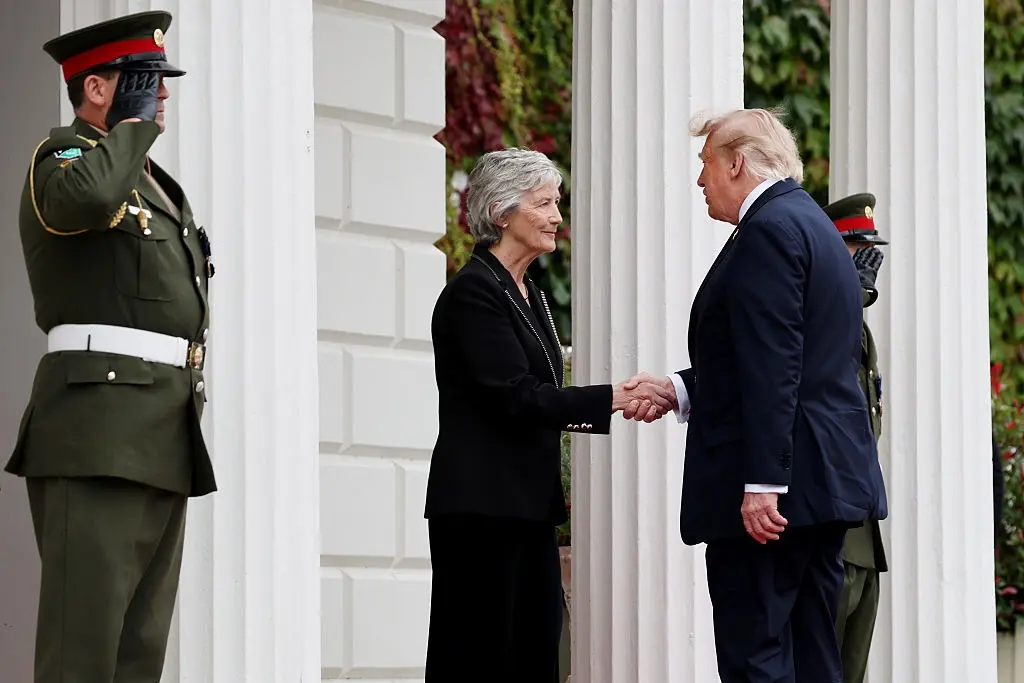
- Saturday Morning (Arrival and State Greetings): President Donald Trump touched down in Ireland, greeted formally by Irish President Catherine Connolly at the outset of a trip that immediately drew intense media scrutiny. The initial pleasantries quickly gave way to substantive political engagement.
- Saturday Afternoon (The Private Meeting with President Connolly): Trump held a closed-door meeting with President Connolly, a prominent progressive figure and vocal critic of American foreign policy. According to post-meeting readouts, Connolly used the platform to challenge the normalization of modern warfare and mass casualties, drawing explicit parallels to Ireland’s historical trauma of famine, colonization, and sectarian violence. She gifted Trump a volume of poetry by Michael Longley, prominently featuring the poem “Ceasefire,” which was inspired by the 1994 IRA cessation of hostilities. Trump later brushed off the substantive gravity of the encounter, describing it casually as “very nice” and noting that they “discussed a lot of things, quickly.”
- Saturday Late Afternoon (The Joint Press Conference): During a joint appearance with Taoiseach Micheál Martin, Trump broke decades of U.S. diplomatic orthodoxy. He publicly endorsed the concept of a united Ireland, declaring that the constitutional division “may as well happen now.” The remarks sent immediate shockwaves through Dublin, London, and Belfast.
- Sunday (Retreat to Doonbeg): Eschewing further diplomatic engagements, Trump spent Sunday at his privately owned Doonbeg luxury golf resort, which was concurrently hosting the prestigious Irish Open. The venue change provided a stark contrast between high-end leisure and the diplomatic firestorm still raging across British and Irish political spheres.
- Monday and Beyond (Fallout and Return): As Trump prepared to depart for Washington, political fallout intensified. Unionist leadership slammed the comments as external interference, while nationalist politicians leveraged the momentum to demand that the Irish government begin concrete preparations for a unification referendum.
Supporting Context & Metrics: The Shadow of History and the Good Friday Agreement
To understand the weight of President Trump’s off-the-cuff remarks, one must examine the profound historical and political mechanics governing Northern Ireland’s constitutional status.
Northern Ireland has remained a constituent part of the United Kingdom since the Government of Ireland Act partitioned the island in 1921. For decades, the structural exclusion of the Catholic nationalist minority from equitable housing, employment, and political power sparked mass civil rights marches in the late 1960s. This civil unrest spiraled into a multi-decade paramilitary conflict known as The Troubles.
The Cost of Conflict and the Architecture of Peace
- Human Toll: The sectarian conflict claimed the lives of more 3,500 people, with thousands more severely maimed and traumatized across a population base that made it one of the most intense conflicts in modern Western Europe.
- The Good Friday Agreement (1998): Brokered with heavy diplomatic assistance from the Clinton administration—and specifically U.S. Special Envoy George Mitchell—the historic accord established a power-sharing devolved government in Stormont. Crucially, the agreement codified the "Consent Principle." This legal and political mechanism dictates that Northern Ireland will remain part of the United Kingdom until such time as a majority of its citizens voting in a referendum (often referred to as a border poll) choose otherwise.
By suggesting that unification "may as well happen now," critics argue that Trump bypassed the fundamental premise of the Consent Principle, which relies on grassroots democratic volition within Northern Ireland rather than unilateral timelines or external pronouncements by foreign leaders.
Official Statements: Reactions Across the Political Spectrum
The immediate aftermath of Trump’s remarks revealed a deeply polarized response from leaders across the political divide, highlighting how sensitive the constitutional question remains nearly three decades after the signing of the Good Friday Agreement.
Unionist Opposition
Protestant and unionist leaders, whose political identity is anchored in maintaining the union with Great Britain, reacted with swift indignation. Gavin Robinson, leader of the Democratic Unionist Party (DUP), delivered a pointed rebuke to foreign commentary regarding the region’s future.
"Northern Ireland’s future will be decided by its people—not by commentary in London, Dublin or Washington," Robinson stated bluntly, emphasizing that the democratic guardrails of the Good Friday Agreement must be respected without external pressure or prescriptive timelines from foreign heads of state.
Nationalist Encouragement
Conversely, nationalist and republican leaders viewed the American president’s intervention as a monumental shift in the international discourse surrounding Irish unity. Mary Lou McDonald, president of Sinn Féin, seized upon the remarks to argue that the conversation surrounding a post-partition Ireland has entered an irreversible new phase.
"President Trump’s comments show clearly that the debate over reunification has shifted fundamentally," McDonald declared. She subsequently urged Taoiseach Micheál Martin’s administration to drop its hesitations and initiate immediate, formal state preparations for the economic, social, and constitutional realities of an integrated island.
The Official Irish Government Stance
Taoiseach Micheál Martin, standing alongside Trump during the fateful press conference, found himself in a delicate diplomatic bind. While successive Dublin administrations have long maintained that unity is an ultimate constitutional aspiration under Article 3 of the Irish Constitution, official policy has consistently emphasized that any transition must be achieved peacefully, with the consent of a majority in Northern Ireland, and through carefully managed preparatory dialogue rather than rushed political maneuvers.
Future Outlook: Geopolitical Repercussions and Domestic Fallout
President Trump’s unscheduled dive into the delicate politics of Northern Ireland leaves a complex legacy in its wake, with several key trajectories likely to unfold in the coming months:
- Heightened Pressure on Dublin: Sinn Féin and other nationalist parties will likely use Trump’s high-profile endorsement to pressure the Irish government into establishing a citizens’ assembly or formal governmental task force dedicated to modeling the financial and structural integration of Northern Ireland.
- Entrenchment of Unionist Skepticism: Unionist communities, already grappling with post-Brexit trade friction (such as the Windsor Framework) that they argue creates an economic sea border with Great Britain, will view foreign interventions like Trump’s with increased suspicion, hardening their defensive posture regarding the Union.
- A Shift in U.S. Diplomatic Posture: Whether future U.S. administrations will treat Trump’s remarks as an aberration or a dangerous precedent remains to be seen. However, foreign policy analysts warn that casual commentary on complex territorial disputes risks destabilizing fragile peace accords where American neutrality and trusted mediation have historically served as indispensable stabilizing forces.
As the political dust settles over Dublin, Belfast, and Washington, Trump’s parting words serve as a potent reminder that the ghosts of the past remain active participants in modern political discourse—and that careless words from the world’s most powerful stages can instantly reignite debates that took generations to pacify.
