

Executive Overview
In the immediate, chaotic wake of the September 11, 2001, terrorist attacks on the World Trade Center, the primary crisis facing New York City was not merely one of rescue; it was a profound, terrifying mismatch between institutional expectation and grim reality. Anticipating an unprecedented wave of mass casualties, municipal authorities, emergency management agencies, and private health networks mobilized every available resource. They established massive, state-of-the-art triage and trauma centers across Manhattan to process what they assumed would be thousands of surviving victims pulled from the rubble.
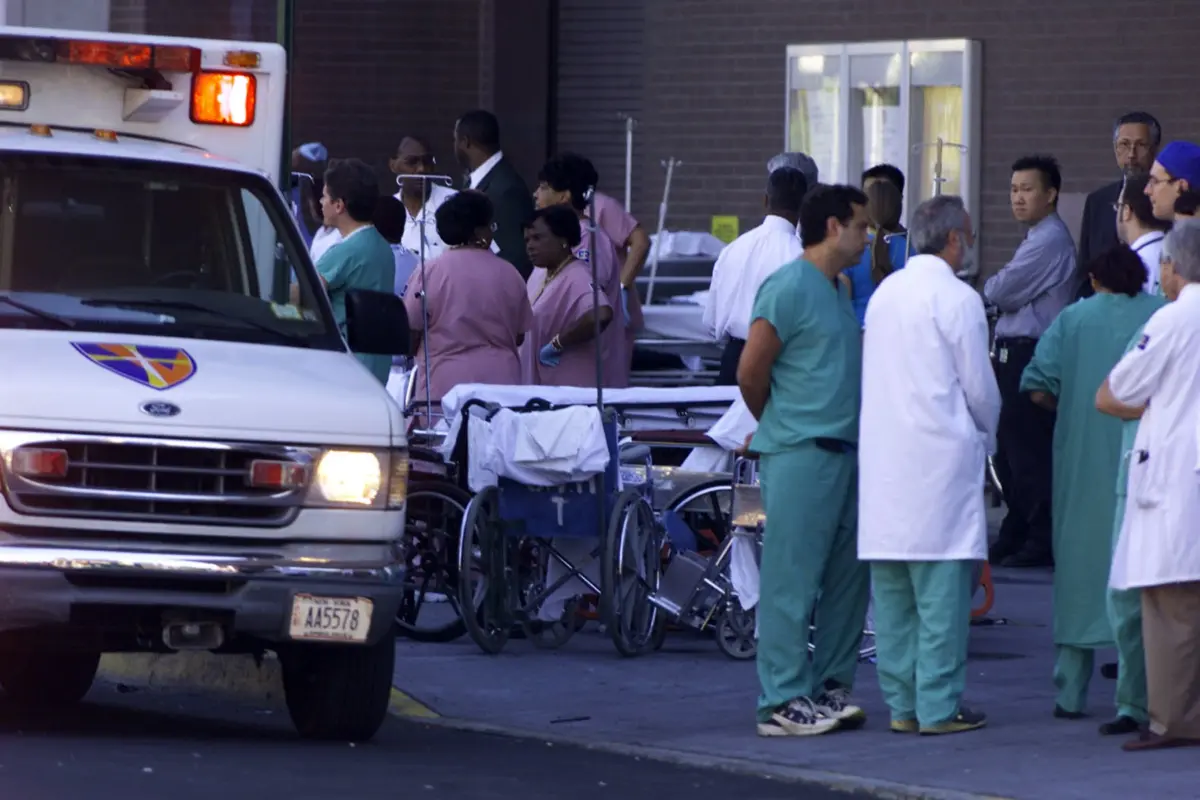
Among these makeshift medical facilities, none was more surreal or emblematic of the day’s agonizing false hope than the emergency room erected inside Chelsea Piers—the sprawling sports-and-leisure complex situated along the Hudson River at West 23rd Street. By Tuesday night, September 11, hundreds of elite trauma surgeons, specialized nurses, emergency medical technicians (EMTs), and volunteers had gathered under the bright lights of the complex’s soundstages and athletic facilities. They stood ready to operate, armed with vast quantities of medical supplies, surgical tools, and organizational discipline.
Yet, as the hours melted away into the early morning of September 12, a devastating truth materialized: the trauma teams were ready, the operating rooms were sterile, the supplies were stacked to the ceilings—but there were no survivors to treat.
This retrospective account examines the operations at Chelsea Piers on that fateful night, drawing on firsthand journalistic testimony, eyewitness chronicles, and broader historical context. It explores the psychological toll of enforced idleness during a national catastrophe, the mechanics of civilian mobilization in the face of communication blackouts, and the haunting realization that the scale of the tragedy at Ground Zero had completely eliminated the traditional window for medical rescue.
Detailed Chronology: A Tuesday Night in Limbo
17:00 – Mobilization and the Search for Purpose
By late afternoon on Tuesday, September 11, lower Manhattan was an exclusion zone, choked by toxic smoke, ash, and the lingering structural instability of the collapsed Twin Towers. Residents displaced from neighborhoods like John Street—situated just blocks from the disaster site—wandered uptown with nowhere to go, uncertain if their homes even remained standing.
For many citizens, the compulsion to act was an existential necessity. Hospitals such as St. Vincent’s in the West Village were immediately overwhelmed by citizens lining up around the block to donate blood, most notably for O-positive fractions. When medical staff inevitably had to turn away the massive crowds—having quickly reached capacity for immediate blood intake—volunteers sought other avenues of utility.
It was under these desperate conditions that volunteers converged on Chelsea Piers around 5:00 PM. Facility managers and emergency coordinators, rather than turning them away, quickly organized the civilian influx. Twenty individuals were selected for immediate duty: processing and escorting incoming patients through a makeshift triage labyrinth. In an eerie twist of surrealism, the designated operating room was established on the very soundstage where the television drama Law & Order was routinely filmed.
18:30 – Establishing the Protocol
The organizational structure at Chelsea Piers mirrored a military-grade disaster response. A briefing led by disaster coordinators armed with megaphones outlined the intake procedure:
- Volunteers were instructed to collect vital personal data from arriving patients, including chronic conditions, allergies, and religious affiliations.
- Escorts would guide patients from ambulances through a color-coded routing system: the green room for minor injuries, the yellow room for serious trauma, and the red room for near-death critical care.
- Strips of masking tape served as rudimentary name tags, scrawled with the designation VOLLY (and occasionally VOLLY PAD), accompanied by the distribution of standard-issue blue rubber gloves.
Despite the clinical precision of the instructions, an undercurrent of palpable fear permeated the complex. The arrival of an emergency medical services van—its windshield coated in thick, gray soot and ash, bearing a handwritten scrawl of "God Bless You" in the grime—brought the grim reality of the disaster to the doorstep of the leisure complex. Yet, no patients followed. Organizers repeatedly reassured the restless volunteers that the first wave of survivors was merely half an hour away.
20:00 – The Information Vacuum and Rumor Mill
As darkness fell over the Hudson River, the absence of incoming ambulances was filled by an overwhelming tide of unverified rumors. Inside the cavernous piers, cut off from reliable cellular communication and standard news broadcasts, the psychological pressure mounted.
Without a functioning information network, every catastrophic rumor found fertile ground. Volunteers and medical personnel traded terrifying reports:
- The United States military had allegedly launched retaliatory bombing raids in Afghanistan.
- Explosives had reportedly been discovered planted beneath the George Washington Bridge.
- The borders of New York State had been completely blockaded by federal authorities.
While some of these claims contained fragments of truth, most were baseless fabrications born of collective trauma and sensory deprivation. Yet, in the absence of hard data, the psychological weight of each rumor exacerbated the physical exhaustion of the room. The collective heartbeat of the emergency room quickened with every rumored ETA, only to settle back into a weary, anxious stasis when the ambulances failed to appear.
22:00 – Logistics of the Idle
By mid-evening, the surreal dichotomy of the Chelsea Piers operation became starkly apparent. The facility was fully provisioned for a catastrophe of historic proportions:
- Nutrition and Comfort: The complex’s basketball court was converted into a sprawling mess hall, offering surprisingly high-grade deli sandwiches, fresh fruit, coffee, orange juice, bottled water, and chocolate chip cookies.
- Rest Facilities: Mattresses from the gymnastics room were laid out directly on the floors, providing makeshift quarters for surgeons, nurses, med students, and emergency responders who refused to leave their posts.
- Psychological Support: Social workers, rabbis, friars, and nuns manned grief-counseling stations, waiting patiently for a chance to minister to survivors who had not materialized.
In a pathetic bid to maintain order and preparedness, police officers delivered instructional lectures to volunteers on how to read an unconscious or wounded officer’s uniform to extract their name, badge number, and precinct.
Later in the evening, an eighteen-wheeler truck loaded with vital medical supplies finally arrived at the loading bay. Desperate for any physical task that might justify their presence, volunteers formed an organic fire line—standing arms-length apart across the facility—and systematically unloaded the heavy boxes. Not a single participant dared voice the devastating probability that these sterile bandages, IV lines, and surgical instruments would remain entirely unused, destined only to be reloaded onto the truck the following morning for transport down to Ground Zero.
01:00 (Sept 12) – The Wind-Down and the Ghost Highway
Past midnight, the sobering reality finally pierced the administrative resolve of the commanders in charge. Police officers began quietly instructing volunteers to leave their contact numbers and return home. Not a single patient had been admitted for surgery. Not one ambulance had pulled into the bays with a survivor from the collapsed towers.
Exhausted by hours of hyper-vigilance and absolute inactivity, civilian volunteers filtered back out into the night. Attempts to use cellular phones proved futile; networks were heavily congested, and dying batteries could no longer find a signal.
The walk back to the West Village along the West Side Highway offered an apocalyptic tableau. The major thoroughfare—ordinarily a pulsing artery of relentless Manhattan traffic—was a literal ghost town. There were no cars, no pedestrians, and no sound save for the distant, lonely flashing of red emergency lights near the disaster zone.
A mile and a half from home, the full scope of the tragedy was rendered visible. Hanging suspended over lower Manhattan was a vast, monolithic cloud of smoke and ash—blank, inarticulate, and utterly indifferent to the human grief unfolding below it.
Supporting Context & Metrics: The Anatomy of a Mass-Casualty Void
To understand why Chelsea Piers sat empty while thousands perished requires an examination of the logistical and epidemiological realities of the World Trade Center attacks.
The Pre-Hospital Expectation vs. Reality
In standard mass-casualty planning—such as mass transit accidents, building fires, or even conventional bombings—trauma systems expect a ratio of roughly three to four injured survivors for every confirmed fatality. Municipal planners operating under these historical models projected thousands of severe crush injuries, severe burns, smoke inhalation cases, and lacerations.
However, the complete and rapid progressive pancake collapse of both the North and South Towers of the World Trade Center created a closed-system catastrophe. The physical forces involved were catastrophic and total:
- The Lethality Rate: The vast majority of individuals trapped within or immediately adjacent to the collapse zones suffered instantaneous, non-survivable trauma, or were interred within millions of tons of pulverized concrete, steel, and office debris.
- The "Golden Hour": In emergency medicine, the "Golden Hour" refers to the critical window in which medical and surgical intervention can prevent death following traumatic injury. Because the towers collapsed entirely into catastrophic rubble piles rather than leaving partially standing structures accessible to rapid extraction teams, the window for rescuing viable surgical candidates closed almost before emergency services could deploy.
The Regional Medical Mobilization
The mobilization of New York’s health infrastructure on September 11 was nonetheless historic in its speed and scale. Major hospital networks—including NYU Medical Center, New York-Presbyterian, St. Vincent’s, Bellevue, and Mount Sinai—cleared thousands of beds within hours, discharged stable patients, recalled off-duty personnel, and established secondary triage nodes like the one at Chelsea Piers.
Blood donation centers experienced unprecedented surges. Within days, over half a million units of blood were pledged nationwide—a testament to civic solidarity, though tragically, the vast majority of those reserves ultimately expired unused because the anticipated wave of exsanguinating survivors never materialized.
Official Statements and Reflections
In the weeks and months following the attacks, public health officials and emergency directors reflected on the operational paradox of September 11: the systems designed to save lives had functioned with flawless precision, yet they were rendered obsolete by the unprecedented nature of the destruction.
Dr. Gilipc, an emergency coordinator involved in the municipal response, noted in subsequent post-action reports:
"We prepared for the worst-case scenario based on every historical precedent available to modern urban civilization. We had the beds, we had the hands, we had the will. What we did not calculate—what no one could calculate—was an event of such absolute structural annihilation that the categories of ‘injured’ and ‘fatality’ essentially collapsed into one another."
Civilian accounts, such as those recorded by participants at Chelsea Piers, emphasized the psychological weight of non-action. The trauma experienced by those on the periphery of Ground Zero was not limited to physical danger, but extended to the profound helplessness of being surrounded by medical might while mourning a city that had vanished overnight.
Future Outlook: Lessons for Urban Disaster Preparedness
The haunting silence of the operating rooms at Chelsea Piers fundamentally reshaped modern emergency management, civil defense protocols, and mass-casualty disaster planning across the globe. The lessons learned from September 11 continue to inform how megacities prepare for asymmetric threats:
- Shift from Treatment to Recovery Focus: Modern disaster planning has largely abandoned the assumption that catastrophic structural collapses will yield traditional surgical triage queues. Protocols now heavily emphasize rapid urban search and rescue (USAR), specialized canine units, heavy engineering response, and immediate recovery operations rather than secondary field hospitals designed for surgical interventions that cannot be reached in time.
- Dynamic Resource Allocation: The over-mobilization of blood donations and trauma centers in 2001 highlighted the need for real-time information systems. Contemporary emergency frameworks incorporate dynamic communications networks designed to update public volunteers and secondary medical sites instantaneously, preventing the massive bottlenecks of idle personnel seen at locations like Chelsea Piers.
- Psychological Trauma Management: Recognizing that enforced idleness during a crisis breeds severe secondary psychological trauma, modern disaster response models integrate volunteer management systems that channel civic energy into functional, communicative, and distributed support tasks rather than concentrating unutilized personnel in centralized waiting loops.
Ultimately, the makeshift emergency room at Chelsea Piers stands in history not as a failure of medical mobilization, but as a monument to human solidarity. It captured a moment in time when a traumatized city stood fully armed with compassion, expertise, and hope—waiting in the dark for brothers and sisters who could no longer be saved, staring up at a silent cloud of smoke that refused to offer answers.