

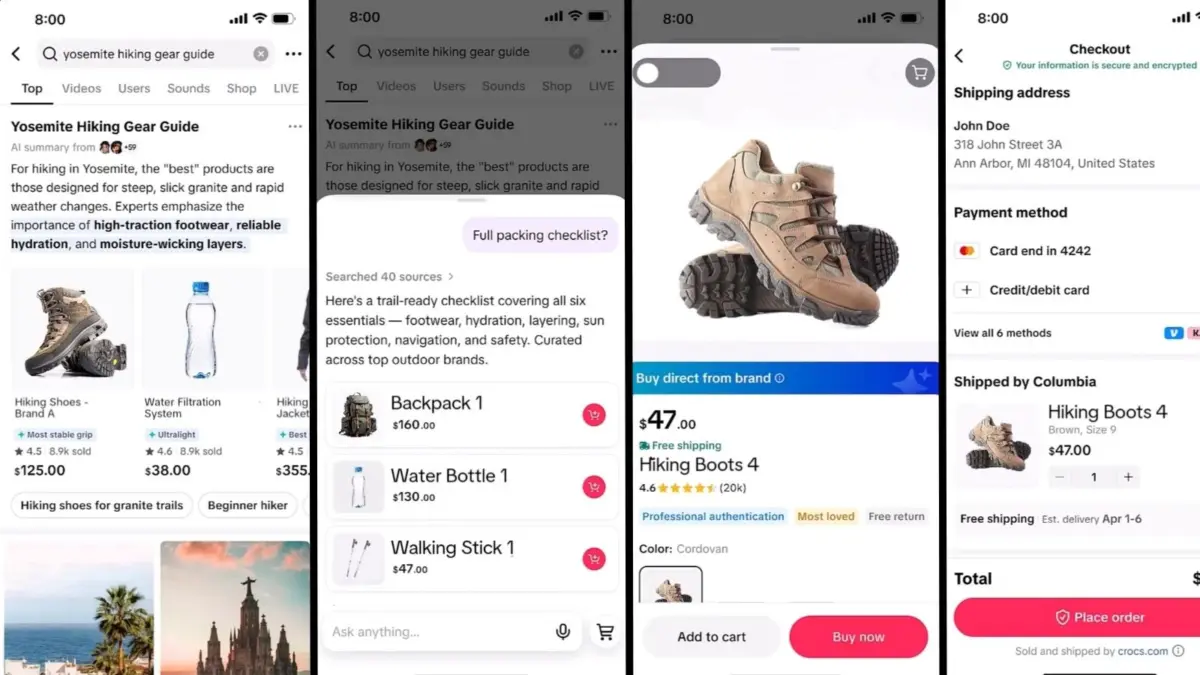
NEW YORK — In a strategic escalation of its retail ambitions, social media powerhouse TikTok has announced the rollout of two transformative shopping features designed to fundamentally alter how digital consumers discover, evaluate, and purchase products. Revealed on Monday at the company’s New York corporate offices, the updates include a streamlined direct checkout mechanism enabling users to buy merchandise directly from partnering brands within the native application—distinctly separate from the platform’s existing TikTok Shop ecosystem—alongside a sophisticated artificial intelligence shopping assistant engineered to drive conversions.
The deployment of these features signals a mature phase in TikTok’s evolution from an entertainment-driven video-sharing network into a dominant global retail infrastructure. By bridging the critical gap between passive content consumption and active commercial transactions, TikTok is aggressively positioning itself to capture a larger share of the trillion-dollar global e-commerce market, challenging legacy search engines and traditional online marketplaces alike.
Executive Overview
The contemporary digital landscape is defined by the convergence of entertainment and commerce, a phenomenon often described as "social commerce." TikTok has long dominated the top of the retail funnel, acting as an unprecedented engine for product discovery through viral trends, creator reviews, and algorithmic content delivery. However, converting that viral attention into measurable sales has historically required friction-heavy redirection to external e-commerce sites.
The newly unveiled dual-feature rollout seeks to eliminate that friction entirely:
- Direct Brand Checkout: Operating independently of the pre-existing TikTok Shop marketplace, this capability allows individual merchants to integrate their native checkout systems directly into the TikTok application experience. Users can complete transactions securely without ever leaving their feeds.
- AI Shopping Assistant: A conversational, intent-driven artificial intelligence tool designed to guide users through the buyer’s journey. By interpreting nuanced queries, contextualizing video content, and recommending relevant products, the assistant serves as an interactive concierge designed to accelerate transaction completion.
According to company executives, these tools are not built in a vacuum. TikTok has forged strategic partnerships with major enterprise commerce platforms and payment gateways—including Salesforce, Shopify, Shoplazza, and Stripe—to ensure seamless infrastructural integration for brands of all sizes. As these features begin rolling out to U.S.-based users and merchants, they represent a watershed moment for digital retail, fusing generative artificial intelligence with social media engagement at an unprecedented scale.
Detailed Chronology: The Evolution of TikTok Commerce
To understand the weight of Monday’s announcement, it is necessary to examine the systematic trajectory of TikTok’s e-commerce strategy over the past several years. What began as a platform for 15-second dance videos has methodically evolved into a commercial behemoth.
Phase One: The Discovery Engine (2019–2021)
In the early years of hyper-growth, TikTok’s value proposition to brands was strictly top-of-funnel. Companies recognized that the platform’s recommendation engine—powered by the "For You" feed—possessed an uncanny ability to surface niche products to receptive audiences. The organic hashtag #TikTokMadeMeBuyIt emerged organically from user behavior, accumulating billions of views and driving historic windfalls for independent brands and massive consumer packaged goods (CPG) companies alike. Despite this commercial momentum, the user journey remained fragmented: users had to click an external link in a creator’s bio, open an external mobile browser, and manually input payment details on a brand’s third-party website, resulting in substantial drop-off rates.
Phase Two: Internalized Marketplaces and TikTok Shop (2022–2023)
Recognizing the revenue leakage inherent in external redirects, TikTok began developing proprietary retail infrastructure. The introduction of TikTok Shop marked a decisive pivot, allowing users to buy products directly from within the app via a centralized marketplace tab and in-feed product cards. While TikTok Shop successfully captured billions of dollars in gross merchandise value (GMV), it operated primarily as a walled garden—a consolidated marketplace ecosystem that mirrored platforms like Amazon or Shein, requiring brands to list and manage inventory specifically within TikTok’s proprietary environment.
Phase Three: The Hybrid Frontier and Direct-Brand Integration (Present)
Monday’s announcement represents the logical next step: a decentralized yet deeply integrated retail architecture. Rather than forcing every brand to sell exclusively through a centralized TikTok marketplace, the new direct checkout feature empowers independent merchants to connect their existing enterprise infrastructure—facilitated by partners like Shopify and Salesforce—directly to the TikTok application interface. Simultaneously, the introduction of conversational artificial intelligence moves the platform from a passive browsing environment to an active, intent-driven shopping destination.
Supporting Context & Metrics: The Mechanics of Social Commerce
The urgency behind TikTok’s retail expansion is underscored by shifting macroeconomic trends and evolving consumer behaviors. Modern shoppers—particularly Generation Z and Millennials—increasingly bypass traditional search engines like Google when searching for products, turning instead to social platforms for authentic, peer-driven recommendations.
The Friction Reduction Imperative
In digital commerce, every additional click or page load introduces friction, leading to cart abandonment. Industry analyses consistently demonstrate that mobile checkout abandonment rates hover around 70%. By keeping the entire transaction lifecycle—from algorithmic discovery to AI-assisted curation and secure payment processing—within a single application environment, TikTok is attacking the primary sources of conversion loss.
- Ecosystem Partnerships: By integrating with industry heavyweights such as Stripe for payment processing and Shopify and Salesforce for backend inventory management, TikTok ensures that enterprise brands do not have to overhaul their existing operational workflows to participate.
- Payment Security: Leveraging established payment providers instills consumer confidence, mitigating security concerns that frequently plague emerging social shopping channels.
- Algorithmic Synergy: The integration of an AI shopping assistant capitalizes on TikTok’s core competency: hyper-personalized data processing. The assistant can synthesize watch history, engagement patterns, and real-time contextual queries to surface products precisely when consumer intent is peaking.
Official Statements and Industry Insights
Speaking to reporters at TikTok’s New York City offices on Monday morning, David Kaufman, Global Head of Monetization and Product Partnerships, articulated the strategic vision driving the new releases.
"We’re trying to move people from discovery all the way through to action, and there’s a lot that we can do to bring AI to that journey," Kaufman explained to the assembled press corps.
Kaufman emphasized that the initiative is designed to empower merchants by reducing the complexity of social selling while providing consumers with an intuitive, frictionless retail experience. By bridging the gap between inspiration and execution, TikTok is effectively redefining the boundaries of digital marketing.
Industry analysts have responded to the announcement with a mixture of awe and cautionary analysis. Retail technology strategist Elena Rostova noted:
"TikTok is no longer just a marketing channel; it is becoming the operating system for modern consumer culture. By partnering with backend giants like Shopify and Salesforce rather than trying to build an entirely isolated ecosystem, TikTok has lowered the barrier to entry for enterprise brands. This forces Amazon, Meta, and Google to rethink their own social commerce and AI search strategies."
Furthermore, early pilot participants among enterprise brands have praised the flexibility of the new direct checkout feature. Unlike TikTok Shop, which requires brands to adapt to a specific marketplace aesthetic and operational protocol, the new framework allows brands to maintain greater sovereignty over their customer relationships and data pipelines while leveraging TikTok’s unrivaled traffic generation capabilities.
Future Outlook: The Next Decade of Digital Retail
As these features roll out to U.S. users and brands over the coming weeks and months, the broader implications for the global digital economy are profound.
1. The Death of the Linear Funnel
The traditional marketing funnel—awareness, consideration, intent, purchase—is rapidly compressing into a simultaneous, compressed experience. With AI assistants capable of instantly answering product questions, checking inventory, and executing secure checkouts based on a single video clip, the time elapsed between seeing a product and owning it is shrinking to mere seconds.
2. Heightened Competition for Tech Giants
TikTok’s aggressive push into direct checkout and conversational AI places it on a direct collision course with established technology titans. Meta has long relied on Instagram and Facebook shops to capture social commerce dollars, while Google continues to refine its visual and generative search capabilities to capture retail intent. Meanwhile, Amazon remains the undisputed king of transactional search, but its discovery mechanisms lack the viral, entertainment-driven engine that fuels TikTok’s momentum. The battle for the modern consumer’s digital wallet will be fought on the terrain of artificial intelligence and frictionless integration.
3. Creator Economy Implications
For the millions of content creators who power TikTok’s ecosystem, these updates unlock unprecedented monetization potential. Creators will no longer rely solely on ad revenue splits or external affiliate links; they can serve as direct storefronts or affiliates within a seamless, integrated purchasing environment, aligning creator influence with immediate, trackable sales conversions.
Conclusion
TikTok’s introduction of direct brand checkout and AI-powered shopping assistants marks a defining moment in the maturation of social commerce. By harmonizing algorithmic discovery, enterprise-grade backend partnerships, and conversational artificial intelligence, TikTok is constructing a comprehensive retail apparatus that blurs the lines between entertainment and commerce. As the rollout expands across the United States and sets the stage for global deployment, brands, consumers, and competing technology platforms must adapt to a new reality where every video is a storefront, and every interaction is an opportunity for a transaction.