

By Global Business & Media Correspondent
Published: October 2026
Executive Overview
In what marks one of the most seismic shifts in modern sports marketing and corporate sponsorship history, fast-food giant McDonald’s has officially announced the termination of its decades-long partnership with FIFA, ending a historic 32-year run as an official World Cup sponsor.
The decision, which brings down the curtain on a relationship that began ahead of the 1994 tournament in the United States, is not merely a routine contract expiration. Instead, it is the cornerstone of a sweeping, aggressive overhaul of McDonald’s global marketing architecture, budget allocation, and return-on-investment (ROI) criteria.
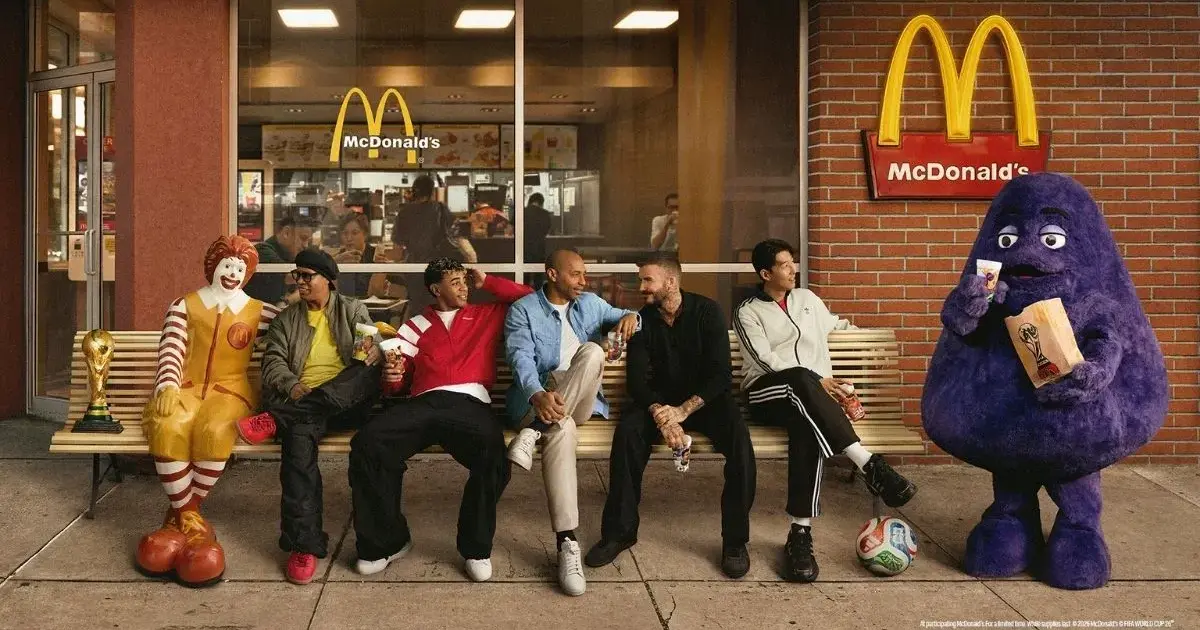
The announcement arrives on the heels of the 2026 FIFA World Cup, hosted jointly across North America, which played host to what McDonald’s executives proudly touted at the time as the company’s largest-ever global marketing push. Spearheaded by agency powerhouse Wieden+Kennedy New York, the summer campaign spanned over 110 countries, leveraging cultural touchstones, massive digital integrations, and iconic brand assets like Grimace to capture the global sporting spotlight.
However, beneath the celebratory veneer of global reach lay a sobering financial reality. Despite generating immense brand visibility and system-wide enthusiasm among franchisees, the colossal capital investment failed to deliver the anticipated conversion rates, particularly in domestic markets wrestling with consumer fatigue and shifting dining habits.
As McDonald’s pivots toward an internal digital retail media network (aiming to construct a $1 billion advertising ecosystem) and demands hyper-measurable, performance-driven marketing models, the parting of ways with FIFA signals a fundamental industry truth: even the world’s most prestigious legacy sponsorships must now justify their existence through direct, measurable impact on the bottom line.
Detailed Chronology: From 1994 to the 2026 Shift
To truly understand the weight of McDonald’s departure from FIFA, one must examine the arc of a partnership that grew alongside the commercialization of modern soccer.
The Formative Years (1994–2006)
McDonald’s officially aligned itself with soccer’s global governing body prior to the 1994 FIFA World Cup in the U.S. At the time, the partnership was designed to establish McDonald’s not just as an American fast-food chain, but as a ubiquitous global lifestyle brand. Throughout the late 1990s and early 2000s, as the World Cup expanded its television footprint and global appeal into Asia, Africa, and the Middle East, McDonald’s leveraged exclusive pouring and feeding rights at venues, family-focused promotions, and the beloved "Player Escort" program, which gave thousands of children the chance to walk hand-in-hand with soccer legends onto the pitch.
The Digital Era and Rising Costs (2010–2022)
As media consumption fragmented, the cost of maintaining tier-one FIFA sponsorship rights skyrocketed, reportedly running into tens—if not hundreds—of millions of dollars per four-year cycle, alongside the immense activation budgets required to bring these campaigns to life. During the 2014 Brazil, 2018 Russia, and 2022 Qatar tournaments, McDonald’s adapted by pivoting toward digital engagement, fantasy leagues, and mobile app-based promotions. Yet, internal murmurs regarding the cost-to-benefit ratio began to circulate as alternative digital marketing channels proved capable of targeting consumers with pinpoint precision at a fraction of the cost.
The 2026 Apex and the Turning Point
The final chapter of the partnership was set into motion during the lead-up to the 2026 tournament. Tasked with maximizing the commercial potential of a tournament hosted in its backyard (the U.S., Canada, and Mexico), McDonald’s launched its most ambitious campaign to date. Developed by Wieden+Kennedy New York, the multi-continental initiative utilized surrealist humor, cross-cultural storytelling, and heavy reliance on the brand’s revitalized mascot culture—symbolized by campaigns featuring Grimace.
Yet, the macro-economic climate had drastically shifted. High inflation, tightening consumer discretionary spending, and shifting value perceptions among fast-food diners meant that brand awareness alone was no longer enough to drive necessary transaction volumes.
Supporting Context & Metrics: The Financial Realities Behind the Split
The termination of the FIFA agreement cannot be viewed in isolation; it is directly tied to a broader recalibration of McDonald’s corporate financial strategy and quarterly performance metrics.
Q2 2026 Earnings and the Reality Check
The friction between massive top-of-funnel spending and actualized business returns came to a head during McDonald’s Q2 2026 earnings call. Chief Financial Officer Ian Borden addressed analysts with a candid assessment that stunned parts of the advertising industry.
While acknowledging that the summer’s World Cup campaign successfully "provided a lift to the business and generated excellent system excitement," Borden delivered the crucial caveat: the activation "underperformed versus our expectations."

This underperformance coincided with a well-documented slowdown in U.S. sales growth. Throughout mid-2026, reports highlighted that McDonald’s domestic sales had begun to disappoint as aggressive value deals and traditional promotional items failed to draw enough traffic to offset rising operational and ingredient costs. Consumers, squeezed by economic pressures, were prioritizing everyday affordability over celebratory, event-driven purchases. Consequently, the massive cash outflow required to secure and activate global sports rights came under intense internal scrutiny.
The Shift Toward a $1 Billion Ad Business
Compounding the retreat from traditional sports sponsorships is McDonald’s strategic ambition to build a proprietary $1 billion retail media network.
In recent years, quick-service restaurant (QSR) giants have realized that owning first-party customer data—gathered through loyalty apps, digital ordering kiosks, and delivery partnerships—is vastly more lucrative than renting audience attention on third-party global stages. By redirecting capital away from legacy sponsorships like FIFA and the International Olympic Committee (though historical ties vary), McDonald’s is aggressively scaling its internal ad business. This ecosystem allows consumer packaged goods (CPG) partners and internal brands to buy targeted ad space directly on McDonald’s digital properties, ensuring a closed-loop attribution model where every marketing dollar spent can be directly traced to a digital order or in-app redemption.
Official Statements and Industry Reactions
The announcement has sent shockwaves through the sports marketing, advertising, and agency landscapes, prompting swift commentary from corporate executives and industry analysts alike.
The Corporate Stance
In official communications, McDonald’s has framed the conclusion of the FIFA relationship as a natural evolution of its global marketing strategy rather than a bitter divorce. A company spokesperson emphasized that McDonald’s remains committed to connecting with consumers through passion points like music, gaming, and localized cultural moments, but underscored that future marketing investments will be subjected to rigorous, performance-based metrics.
"Our marketing model is evolving to meet the modern consumer where they are, with agility, personalization, and undeniable business impact," a company representative noted following the earnings disclosure. "We thank FIFA for 32 incredible years of partnership and wish them the best in their next chapter."
Industry Analyst Perspectives
Media and advertising analysts have largely interpreted the move as a watershed moment for mega-sponsorships.
"The era of writing blank checks for broad-stroke global awareness is officially drawing to a close," noted a prominent retail media strategist. "Brands like McDonald’s no longer need a global football pitch to tell consumers they exist. They have their own apps in hundreds of millions of pockets. What they need now is data, conversion, and undeniable ROI—metrics that traditional sports sponsorships have notoriously struggled to prove in real-time."
Meanwhile, creative agencies are noting the pressure this places on traditional agency-client relationships. While Wieden+Kennedy New York successfully executed a critically acclaimed campaign for the 2026 tournament, the overarching financial verdict handed down by CFO Ian Borden proves that even award-winning creative brilliance cannot insulate a massive rights fee from rigorous financial accountability.
Future Outlook: What’s Next for McDonald’s and FIFA?
As the dust settles on this historic separation, both organizations face distinct futures in how they approach marketing, partnership architecture, and revenue generation.
McDonald’s: Agility, Apps, and Alternative Partnerships
Moving forward, McDonald’s marketing playbook is expected to lean heavily into:
- Hyper-Localized and Digital-First Campaigns: Utilizing localized social media trends, regional menu innovations, and influencer partnerships that can be spun up or scaled down with minimal friction.
- First-Party Data Monetization: Accelerating the build-out of its retail media network to capture high-margin ad revenue from third-party brands looking to reach McDonald’s massive digital user base.
- Flexible Cultural Investments: Partnering with gaming ecosystems (such as Roblox or esports tournaments) and music festivals where younger demographics spend their time and where engagement can be tracked digitally.
FIFA: Finding a Successor in a Changing Commercial Landscape
For FIFA, losing a cornerstone global partner after over three decades presents a formidable commercial challenge. As soccer looks toward future tournaments—including the expanded 48-team structures and subsequent cycles—FIFA must navigate an advertising market where legacy brands are demanding more flexible, data-rich, and performance-oriented packages.
FIFA will undoubtedly seek to fill the void left by McDonald’s, likely targeting emerging tech giants, financial technology firms, or expanding global e-commerce platforms that are eager to plant their flag on the world’s biggest sporting stage. However, replacing a brand that spent 32 years embedding itself into the fabric of the World Cup fan experience will require a reimagining of what a modern tier-one sponsorship package can—and must—offer.
Conclusion
The end of McDonald’s 32-year partnership with FIFA is more than a corporate breakup; it is a clear symptom of a transforming global economy and media landscape. As brands navigate consumer caution, digital transformation, and the relentless demand for measurable return on investment, the luxury of brand-building for its own sake is being phased out. For McDonald’s, the future of marketing is personal, digital, and strictly accountable—leaving the world’s most famous soccer tournament behind in pursuit of a leaner, more data-driven horizon.