For decades, the standard procedure for measuring search engine optimization (SEO) success was both tedious and fraught with error. Digital marketers, in-house teams, and agency owners would dutifully open sprawling spreadsheets every morning, manually punching in target keywords to see whether their URLs had climbed or fallen in the Search Engine Results Pages (SERPs). Today, that manual approach is not only obsolete; it is a business liability.
Modern SERPs are dynamic, hyper-localized, multi-device, and increasingly dominated by algorithmic shifts, such as Google’s AI Overviews, rich snippets, video carousels, and local map packs. Relying on weekly data points or inaccurate manual records leaves organizations blind to rapid ranking fluctuations that directly impact traffic, conversions, and top-line revenue.
Investing in robust SERP tracking software is no longer a luxury reserved for enterprise-level brands—it is a core foundational pillar of any competitive digital strategy. Modern tools allow organizations to monitor tens of thousands of keywords instantaneously, track competitors down to the zip-code level, map rankings directly to bottom-line analytics, and automate white-label reporting for stakeholders.
This comprehensive review explores the current state of SERP tracking for 2025, breaking down the essential features required to validate SEO investments, evaluating the top seven standalone and all-in-one platforms on the market, and offering an authoritative guide on how to select the right software for your organizational needs.
Detailed Chronology: The Evolution of Rank Tracking
To understand why modern SERP tracking tools operate the way they do, it is helpful to look at how the technology has evolved over the past fifteen years:
The Early 2010s (The Spreadsheet Era): SEO professionals relied heavily on manual browser searches or rudimentary desktop scrapers. Data was inconsistent, heavily influenced by personalized search history, and updated infrequently—often on a weekly or monthly cadence.
The Mid-2010s (Cloud-Based Automation): As cloud infrastructure matured, early SaaS rank trackers emerged. These platforms automated daily desktop tracking for Google and Bing. However, features were limited, and mobile search tracking was still treated as an afterthought.
The Late 2010s (Granular Localization & Mobile-First): With mobile searches overtaking desktop queries, tools shifted to mobile-first indexing. Granular geo-tracking (down to city and neighborhood levels) became standard, and integrations with Google Analytics began bridging the gap between rankings and revenue.
The Early 2020s (SERP Feature Proliferation): Search engines evolved past simple blue links. Knowledge cards, People Also Ask (PAA) boxes, and video carousels transformed the SERP layout. Trackers had to adapt by introducing Share of Voice (SoV) metrics and specialized SERP feature monitoring.
2025 and Beyond (AI-Driven Search & On-Demand Insights): Today’s landscape is defined by generative AI integration, real-time data refreshing, and sophisticated SERP gap analysis tools. Modern trackers do not just record where a page ranks; they analyze why it ranks, identify structural weaknesses in competing content, and provide predictive intelligence.
Why Invest in Enterprise-Grade SERP Tracking Software?
One of the greatest challenges digital marketers face is justifying SEO budgets to executive boards and financial stakeholders. Unlike paid search (PPC), where a dollar spent yields immediate, direct, and predictable traffic metrics, organic search requires patience, continuous content optimization, and technical investment.
Accurate SERP tracking software serves as the ultimate validation engine for these efforts. By capturing precise positional shifts across multiple search engines, devices, and geographic locations, the right software transforms abstract algorithmic movements into tangible business intelligence.
Specifically, professional-grade SERP tracking software empowers organizations to:
Validate SEO ROI: Correlate ranking improvements with organic traffic spikes, lead generation milestones, and e-commerce revenue.
Identify Early Threats: Detect sudden algorithmic penalties or aggressive competitor surges before they severely erode organic market share.
Capitalize on Low-Hanging Fruit: Spot URLs hovering just outside the top three positions that can quickly capture high-value SERP features with minor optimizations.
Streamline Client Reporting: Eliminate hours of manual data compilation by deploying automated, real-time white-label dashboards.
9 Essential Features to Look for in SERP Tracking Software
When auditing software solutions, not all rank trackers are created equal. To ensure your investment future-proofs your digital operations, look for these nine non-negotiable features:
1. Access Accurate On-Demand Ranking Updates
SERP positions change rapidly. Waiting days for a scheduled batch update leaves you vulnerable to blind spots during algorithm updates. Leading tools like AccuRanker update keyword sets automatically every 24 hours while also offering instant, on-demand manual refreshes at the click of a button.
2. Monitor Performance Across Diverse SERP Features
Ranking #1 is no longer the sole objective. Securing Position #0 via featured snippets, AI Overviews, PAAs, and video carousels requires specialized tracking. Comprehensive dashboards should monitor 50+ distinct SERP features, allowing you to filter opportunities and reclaim lost real estate from competitors.
3. Track SERP Movement Across All Major Search Engines
While Google commands the lion’s share of search traffic globally, international campaigns often require multi-engine visibility. Platforms must support alternative heavyweights like Bing, Baidu, Yandex, and YouTube to ensure complete global market coverage.
4. Granular Tracking (Location and Device)
Consumer search behavior differs drastically between a smartphone in a downtown metropolitan area and a desktop computer in a rural suburb. Tools like Semrush enable precise tracking down to the country, state, city, and zip-code level, while cleanly separating mobile and desktop data sets.
5. Map SERP Movements to Traffic and Revenue
Rankings without business context are vanity metrics. Advanced platforms integrate seamlessly with Google Analytics and Adobe Analytics, merging keyword positions with bounce rates, load times, conversion goals, and bottom-line revenue into a unified landing page report.
6. View Historical Rank Performance
Point-in-time snapshots provide zero context regarding long-term trajectory. True professional trackers maintain deep historical data archives, letting you analyze multi-year trend lines and evaluate how seasonal algorithm adjustments impact your domain versus your key competitors.
7. Run Advanced Competitor Comparisons
Search engines are zero-sum games: when your competitor gains a position, someone else loses one. Effective software groups keywords into strategic buckets (e.g., Positions 1–3, 4–10, 11–50) to measure your relative dominance against industry rivals.
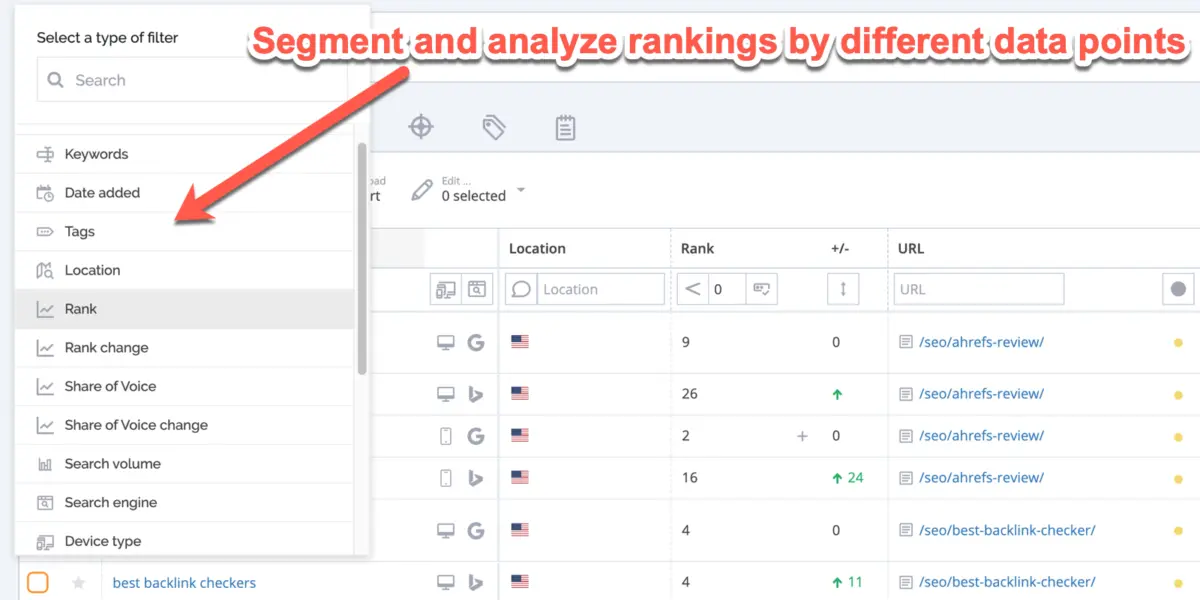
8. Tag and Segment Rankings Data
Not all keywords hold equal weight. Robust tagging systems allow you to segment your portfolio by product category, sales funnel stage (TOFU, MOFU, BOFU), content asset type, or target geographic region, making massive keyword databases digestible.
9. Generate White-Label Reports and Third-Party Integrations
For agencies and large enterprise teams, client communication is paramount. Look for tools that offer native, scheduled white-label reporting or frictionless API connectors to data visualization powerhouses like Google Looker Studio and Databox.
The 7 Best SERP Tracking Tools for 2025
The market is saturated with options, but our research highlights the top seven platforms that successfully deliver on the core requirements outlined above.
1. AccuRanker (Best Standalone SERP Tracker)
Trusted by over 32,000 global companies—including heavyweight brands like HubSpot, IKEA, and Kinsta—AccuRanker is widely recognized as the premier standalone rank-tracking platform on the market.
Key Strengths: Lightning-fast, on-demand data refreshes; robust Share of Voice metrics; advanced SERP feature analysis; and deep integrations with Google Analytics and Looker Studio.
Ideal For: Agencies, enterprise-level brands, and SEO consultants who demand hyper-accurate, real-time data without the bloat of an all-in-one suite.
Pricing: Subscription plans scale based on tracked keyword volume, starting at approximately $116/month for up to 1,000 keywords.
2. Semrush Position Tracker & SERP Gap Analyzer (Best All-in-One Platform)
As a titan in the digital marketing space utilized by over 10 million users (including Samsung and Vodafone), Semrush offers a Position Tracking tool that rivals any standalone competitor. Furthermore, its specialized SERP Gap Analyzer app in the Semrush App Center scans Google SERPs to identify under-optimized content, saving teams hours of manual research.
Key Strengths: Exceptional daily tracking accuracy, local map pack monitoring, integrated technical auditing, and actionable content optimization recommendations driven by Search Console data.
Ideal For: Digital marketing professionals, e-commerce brands, and enterprise teams seeking an all-in-one suite.
Serving over 60,000 customers, ProRankTracker delivers reliable, highly scalable tracking and reporting capabilities without an enterprise price tag.
Key Strengths: Comprehensive multi-language support, accurate local/global tracking across all major devices, and flexible white-label reporting engines.
Ideal For: Small-to-medium agencies, international companies, and video marketers on a budget.
Pricing: Entry-level plans begin at an accessible $39/month.
4. Advanced Web Ranking – AWR (Best for Enterprise Customization)
Long trusted by enterprise corporations and household names like Microsoft, Advanced Web Ranking stands out for its high degree of data customization and reporting flexibility.
Key Strengths: Robust historical data retention, flexible cloud infrastructure, and fully customizable white-label client dashboards.
Ideal For: In-house marketing teams and large agencies managing complex enterprise portfolios.
Pricing: Subscription tiers start at $99/month.
5. SERPWatcher by Mangools (Best for Simplicity and Ease of Use)
Developed by the team behind Mangools, SERPWatcher is celebrated for its clean, intuitive interface and unique Performance Index metric, which calculates organic traffic potential based on current rankings and search volumes.
Key Strengths: User-friendly design, affordable entry pricing, and integration with the broader Mangools SEO toolkit (including SERPChecker).
Ideal For: Startups, small business owners, and solo freelancers who value simplicity over complex enterprise features.
Pricing: Plans start at $29.90/month.
6. SE Ranking (Best Feature-Rich Mid-Market Suite)
SE Ranking is a comprehensive all-in-one SEO platform known for simulating authentic user behavior to gather 100% accurate, location-specific SERP data.
Key Strengths: Highly precise local tracking, competitive research depth, automated site auditing, and flexible pricing structures.
Ideal For: Small business owners and growing digital agencies looking for a balanced, feature-rich toolkit.
Pricing: Starts at $52/month for daily updates on 500 keywords.
7. Nightwatch (Best for Hyper-Local & Global Scale)
Rounding out our list, Nightwatch is utilized by global brands like Shopify and Coinbase, offering tracking capabilities across more than 107,000 unique global locations.
Key Strengths: Unrivaled geographic data granularity, clean visualization dashboards, and robust API capabilities.
Ideal For: Companies scaling international campaigns or managing hyper-local multi-location businesses.
Pricing: Paid plans begin at $32/month for up to 250 keywords, backed by a 14-day free trial.
Official Statements and Industry Insights
Industry leaders continually emphasize the shift toward data-driven reporting and integrated dashboards. Reflecting on modern agency workflows, Ian Howells, Co-Founder of Traffic Think Tank, notes:
"The thing that really got me using them heavily in the last month or two is their Google Data Studio connector. Combining the tag feature, as well as the Share of Voice metric… has been a big help in making these reports immediately digestible for clients."
Similarly, seasoned digital marketing strategist Matthew Howells-Barby underscores the value of high-volume visibility:
"It’s by far the best keyword ranking tracker in the market and has a ton of great reporting functions. If you want visibility on large volumes of keywords housed within a nice dashboard — this is for you."
Future Outlook: The Next Frontier in SERP Intelligence
As search engines continue to integrate generative artificial intelligence into core discovery experiences, the role of SERP tracking software will evolve beyond simple ranking positions. Looking ahead, we can expect the following trends to shape the industry:
AI Overview Domination Tracking: Tools will increasingly measure brand citation frequency inside generative AI answer boxes rather than just traditional blue-link positions.
Predictive Opportunity Modeling: Machine learning models embedded within rank trackers will automatically forecast which content pieces are most susceptible to ranking decay before drops occur.
Unified Omnichannel Visibility: Convergence between traditional search engines, video platforms (YouTube/TikTok), and voice-activated search feeds will require unified reporting dashboards.
Conclusion: Which SERP Tracking Tool is Right for You?
Selecting the ideal SERP tracking software ultimately depends on your organization’s scale, budget, and technical requirements:
If you need a dedicated, lightning-fast, standalone enterprise tracker with zero feature bloat, AccuRanker remains the definitive market leader.
If you operate an agency or growing brand that requires an all-in-one SEO ecosystem coupled with advanced content gap analysis, Semrush is an exceptional investment.
For bootstrapped startups and lean teams looking for cost-effective simplicity, tools like SERPWatcher or ProRankTracker offer incredible value without compromising core data accuracy.
Evaluate your workflow, audit your current data bottlenecks, and choose a platform that not only tracks your rankings today but prepares your organization for the algorithmic complexities of tomorrow.

![7 Best SERP Tracking Tools for 2022 [In-Depth Review]](https://www.robbierichards.com/wp-content/uploads/2020/05/Best-SERP-Trackers.jpg)
![7 Best SERP Tracking Tools for 2022 [In-Depth Review]](https://www.robbierichards.com/wp-content/uploads/2020/04/image16-2.png)
![7 Best SERP Tracking Tools for 2022 [In-Depth Review]](https://www.robbierichards.com/wp-content/uploads/2020/04/image2-3.png)
![7 Best SERP Tracking Tools for 2022 [In-Depth Review]](https://www.robbierichards.com/wp-content/uploads/2020/04/image6-2.png)
![7 Best SERP Tracking Tools for 2022 [In-Depth Review]](https://www.robbierichards.com/wp-content/uploads/2020/04/image15.jpg)
![7 Best SERP Tracking Tools for 2022 [In-Depth Review]](https://www.robbierichards.com/wp-content/uploads/2020/04/image12-1.png)
![7 Best SERP Tracking Tools for 2022 [In-Depth Review]](https://www.robbierichards.com/wp-content/uploads/2020/04/image13-2.png)
![7 Best SERP Tracking Tools for 2022 [In-Depth Review]](https://www.robbierichards.com/wp-content/uploads/2020/04/image3.jpg)
![7 Best SERP Tracking Tools for 2022 [In-Depth Review]](https://www.robbierichards.com/wp-content/uploads/2018/08/rj-employee_Robbie-color-new.png)
![7 Best SERP Tracking Tools for 2022 [In-Depth Review]](https://www.robbierichards.com/wp-content/uploads/2020/05/Databox-SEO-dashboard-1.jpg)
![7 Best SERP Tracking Tools for 2022 [In-Depth Review]](https://www.robbierichards.com/wp-content/uploads/2020/04/image4-2.png)
![7 Best SERP Tracking Tools for 2022 [In-Depth Review]](https://www.robbierichards.com/wp-content/uploads/2020/04/image5.jpg)
![7 Best SERP Tracking Tools for 2022 [In-Depth Review]](https://www.robbierichards.com/wp-content/uploads/2020/05/AccuRanker-Google-Data-Studio-integration.jpg)
![7 Best SERP Tracking Tools for 2022 [In-Depth Review]](https://www.robbierichards.com/wp-content/uploads/2018/11/Ian-Howells2.png)
![7 Best SERP Tracking Tools for 2022 [In-Depth Review]](https://www.robbierichards.com/wp-content/uploads/2019/01/Google-Data-Studio-KW-rankings-dashboard.png)
![7 Best SERP Tracking Tools for 2022 [In-Depth Review]](https://www.robbierichards.com/wp-content/uploads/2025/01/AccuRanker-home-page.jpg)