

Executive Overview
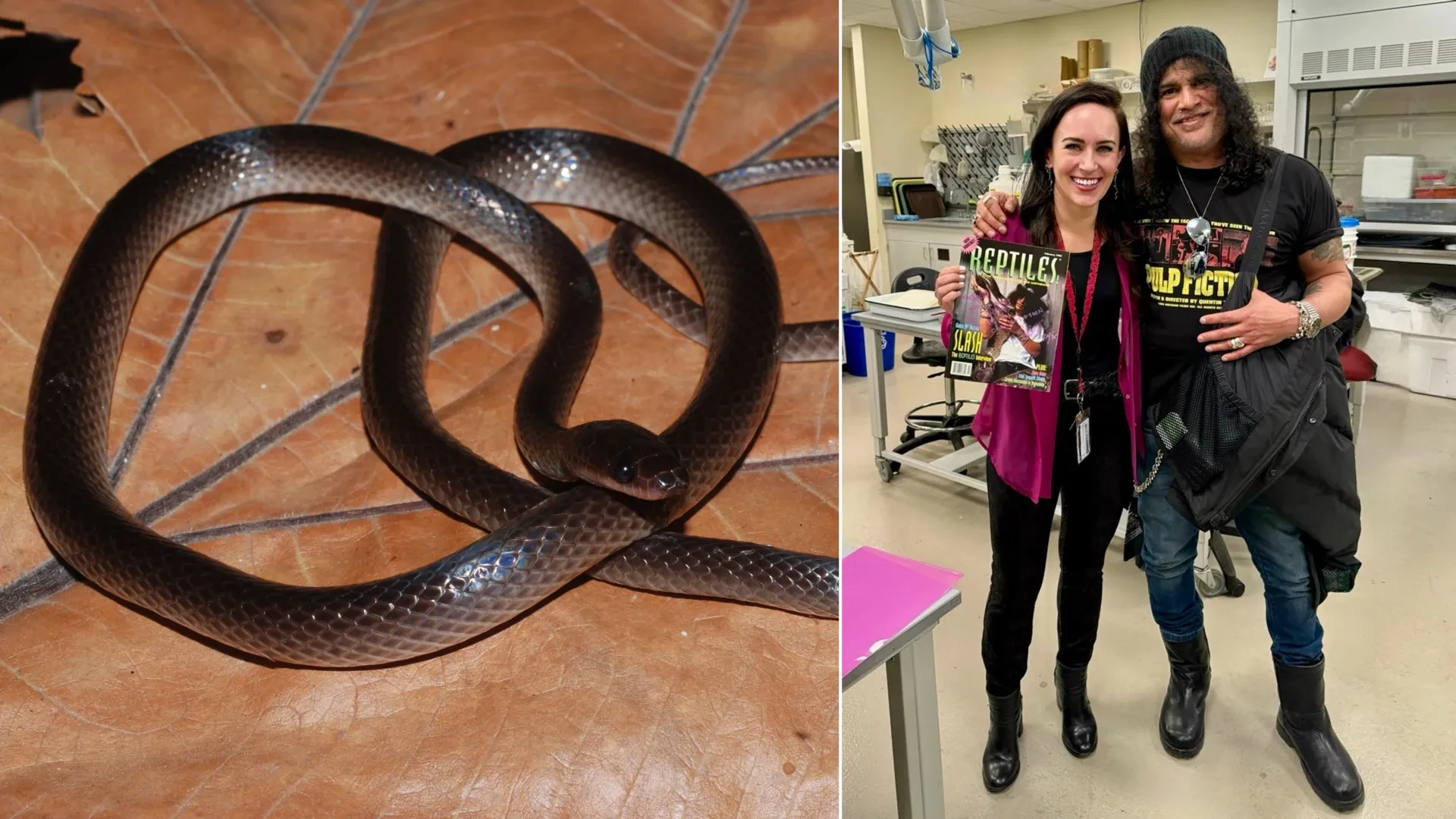
In the dense, shadow-draped tropical forests of New Guinea—the world’s second-largest island—scientists have officially discovered and described a brand-new species of snake. Yet, the story behind this biological breakthrough extends far beyond traditional taxonomy, bridging the worlds of evolutionary biology and heavy metal history. Researchers have named the 28-inch, reddish-brown reptile Lielaphis slashi, commonly known as Slash’s groundsnake, in honor of Saul Hudson, the globally celebrated lead guitarist of Guns N’ Roses.
While millions know Slash for his iconic top hat, cascading curls, and searing guitar solos, his lifelong fascination with herpetology—the study of reptiles and amphibians—is equally profound. For decades, the musician has been a passionate advocate for natural history, museums, and zoos. This unlikely intersection of rock stardom and scientific discovery culminated in a recently published paper in the journal Zootaxa.
Led by a collaborative team from the Field Museum, the Louisiana State University (LSU) Museum of Natural Science, and international institutions, the identification of L. slashi required advanced genetic sequencing, meticulous morphological examination, and ecological niche modeling. Beyond honoring a cultural icon, the formal description of this nocturnal hunter highlights the urgent conservation imperatives facing New Guinea’s rapidly changing ecosystems. As industrial agriculture and resource extraction encroach upon the island’s biodiverse habitats, documenting species like L. slashi represents a critical race against time to understand and protect the natural world before it vanishes.
Detailed Chronology
The Seed Planted: A Childhood Inspiration (1990s)
The story of Lielaphis slashi begins decades before the snake was formally named, rooted in the parallel childhood trajectories of a rock legend and a future scientist. Growing up, Saul Hudson found solace and fascination not just in music, but in the untamed world of reptiles. Long before filling stadiums with Guns N’ Roses, he could often be found outdoors searching for snakes, an affinity he maintained into adulthood, famously keeping a reticulated python as a pet.
Across the country, a young Sara Ruane experienced a remarkably similar awakening. A dedicated fan of Guns N’ Roses since the first grade, Ruane had set her career ambitions by the fifth grade, informing her teacher that she intended to become a herpetologist. Her dedication solidified at age twelve when she opened an issue of Reptiles Magazine to find Slash featured on the cover, cradling his pet python.
"I thought, ‘This guy is so cool,’" recalls Ruane, now the Field Museum’s Associate Curator of Herpetology and senior author of the Zootaxa study. Years later, after achieving her doctorate and securing a position where she had the authority to name newly discovered species, Ruane revisited that foundational magazine interview. Noting Slash’s vocal support for zoos, museums, and herpetology, she realized the rock icon would make an ideal namesake for a newly uncovered organism.
The Midnight Encounter in New Guinea (2006)
The physical specimen that would become the type specimen for Lielaphis slashi was collected years before its formal description. In 2006, Dr. Chris Austin—a professor and curator of herpetology at the LSU Museum of Natural Science and a co-author of the study—was conducting nocturnal fieldwork in the remote rainforests of New Guinea.
New Guinea, situated just north of Australia and split politically between Indonesia and Papua New Guinea, boasts staggering biological richness. However, much of its fauna remains scientifically undocumented. Navigating these jungles after dark requires immense caution; nocturnal groundsnakes share their habitat with several highly venomous elapids that bear a striking mimicry to harmless species.
While scouring the base of a large forest tree just after sunset—the prime hunting window for nocturnal groundsnakes—Austin encountered an unfamiliar reddish-brown serpent. Recognizing that it did not neatly fit the profiles of known regional taxa, Austin collected the specimen for deeper scientific analysis.
Collaboration and Genetic Breakthrough (2016–Present)
Following the completion of her doctoral studies, Ruane joined Austin at LSU in 2016. The two researchers united their expertise to unravel the complex evolutionary histories of New Guinea’s enigmatic snake populations.
At first glance, the 2006 specimen did not immediately stand out as an undiscovered species. However, modern molecular techniques exposed hidden diversity. Tianqi Huang, a post-doctoral researcher at the Field Museum and the study’s first author, spearheaded the laboratory investigations. Utilizing cutting-edge genetic analyses, the team compared the DNA of the New Guinea specimen against related taxa within the genus.
"We found that L. slashi is genetically distinct from other similar snakes in the same genus," Huang explains. Combined with microscopic physical evaluations—such as precise scale-count differentials—and ecological modeling that mapped out distinct habitat preferences, the scientific consensus became clear: they were looking at a species entirely new to science.
Supporting Context & Metrics
Geographic and Ecological Profile
Lielaphis slashi inhabits the complex, lowland, and montane tropical forests of New Guinea, an island characterized by some of the highest biodiversity indices on Earth.
- Taxonomic Classification: Belongs to the genus Lielaphis within the colubroid radiation of snakes.
- Morphological Characteristics: Measures approximately 28 inches (71 centimeters) in length, featuring a distinct reddish-brown dorsal coloration.
- Activity Patterns: Strictly nocturnal; surface activity peaks immediately following sunset as individuals forage at the bases of massive tropical trees.
- Dietary Mechanics: Unlike constrictors (such as boas or pythons) that dispatch prey through suffocation, L. slashi relies on specialized anatomy. The species possesses enlarged rear teeth designed to snap onto, secure, and ingest slippery-scaled lizards and reptilian eggs.
- Toxicity: Non-venomous and entirely harmless to humans. Despite Guns N’ Roses once being famously branded as "the most dangerous band in the world," its reptilian namesake poses zero biological threat to mankind.
Research Team and Institutional Contributions
The formal description of Lielaphis slashi was a multidisciplinary, multi-institutional endeavor. The research paper, published in Zootaxa, reflects contributions from an international coalition of scientists:
- Tianqi Huang: Field Museum and Rutgers University (Lead Author)
- Sara Ruane: Field Museum (Senior Author and Associate Curator of Herpetology)
- Chris Austin: Louisiana State University Museum of Natural Science
- Justin Bernstein: Slippery Rock University and the American Museum of Natural History
- Bulisa Iova: Papua New Guinea National Museum and Art Gallery
- Jackson Roberts: Virginia Museum of Natural History
- Jeffrey Frederick: University of Kentucky
Official Statements
The intersection of rock-and-roll legacy and rigorous field science has generated widespread public interest, prompting enthusiastic responses from both the musician and the lead researchers.
Slash (Saul Hudson):
"As a long-time herpetophile, I am extremely honored and humbled to have Lielaphis slashi from New Guinea named after me. It is really exciting; I never would have imagined this moment would arrive."Sara Ruane, Senior Author and Field Museum Associate Curator of Herpetology:
"Guns N’ Roses has been one of my favorite bands since I was in first grade, and by fifth grade, I had already told my teacher that I wanted to be a herpetologist… So when I was twelve years old and got my copy of Reptiles Magazine in the mail and it had a picture of Slash holding his pet reticulated python on the cover, I thought, ‘This guy is so cool.’Years later, I reread his interview, and he talked about how much he loves museums and zoos and natural history, and about how when he was a kid, he’d go outside and look for snakes—it was all stuff that I really related to, and it made me think that he’d be a great person to name a new species after."
Tianqi Huang, First Author and Post-doctoral Researcher:
"Using multiple cutting-edge genetic analyses, we found that L. slashi is genetically distinct from other similar snakes in the same genus. The combination of physical characteristics, like differences in numbers of scales when compared with other species, and the genetic evidence is what led us to realize that it is an entirely new species. We also used ecological modeling to show that L. slashi‘s preferred habitat is different from similar snakes."Chris Austin, Co-author and LSU Professor of Herpetology:
"These New Guinea groundsnakes are nocturnal, so the best way to find them is at night. They are typically found just after sunset at the base of large trees where they are looking for something to eat. When working at night in New Guinea you need to be very careful as there are several highly venomous species that look very similar to the non-venomous groundsnakes."
Future Outlook: Conservation and Biodiversity in Peril
While the naming of Lielaphis slashi celebrates a whimsical connection between pop culture and biological discovery, the underlying context of the research points toward an escalating environmental crisis. Tropical ecosystems across New Guinea are facing unprecedented pressure from human industrial activities.
Forest habitats that harbor L. slashi and thousands of other endemic species are rapidly deteriorating due to expanding commercial agriculture—particularly coffee farming—and aggressive mining operations. For conservation biologists, formal taxonomic descriptions are not merely academic exercises; they are essential survival tools for the planet’s most fragile environments.
"That’s part of why describing the species that live there is important," emphasizes Dr. Ruane. "Every species should be recognized in order for us to better understand how ecosystems work, how everything fits into the environment. We can’t conserve animals or other living things that we don’t know about."
By formally cataloging Lielaphis slashi, researchers have established a baseline metric for New Guinea’s subterranean and nocturnal biodiversity. As international conservation groups lobby for enhanced protective measures across the island’s interior, data driven by genetic taxonomy and ecological modeling will prove indispensable. Ultimately, while Slash’s musical legacy is etched into vinyl and digital streams worldwide, his biological namesake now stands as a permanent fixture in the scientific record—a nocturnal guardian of the New Guinea rainforest, reminding humanity of the precious, wild diversity that still waits in the dark.