

Executive Overview
The landscape of American journalism and media corporate structure is undergoing a seismic, unprecedented transformation. In a single 48-hour cycle, the long-standing norms governing the relationship between the executive branch and the press were upended, while a landmark $111 billion entertainment acquisition cleared a major regulatory hurdle.
For the first time in modern presidential history, the White House barred specific, critical news organizations from the grounds, prompting a sweeping, solidarity-driven boycott by the traditional rotating television press pool. Veterans of the Washington press corps—some with three decades of experience covering the executive office—reported witnessing a day completely without historical precedent.
Simultaneously, a coalition of Democratic state attorneys general finalized a settlement permitting David Ellison’s Paramount to acquire Warner Bros. Discovery (WBD). This colossal corporate consolidation will bring two major journalistic institutions—CNN and CBS News—under a single corporate umbrella, introducing complex new governance structures, including a controversial independent editorial board.
Together, these twin developments point toward an increasingly volatile era for American newsrooms: one defined by direct political clashes over constitutional access and foundational shifts in media ownership.
Detailed Chronology: The White House Press Boycott and Legal Showdown
The Spark and the Ban
The crisis began when President Donald Trump, visibly infuriated after viewing critical broadcast clips and digital graphics presented by aides like Natalie Harp, executed a long-threatened escalation against mainstream news organizations. Via social media, the president announced an immediate ban targeting CNN, MS NOW, and Politico, stripping them of White House hard passes, briefing room seats, and access rights.
The administration’s official posture was swift and unyielding. Released under the banner "White House Access Is a Privilege — Not a Right," the administration’s statement argued that the First Amendment protects the right of outlets to publish, but does not entitle them to institutionalized federal real estate or rotational pool privileges. The statement framed the action as a necessary countermeasure against years of what it termed coordinated, malicious reporting, drawing historical comparisons to press restrictions allegedly enforced by previous administrations.
The Solidarity Boycott
Rather than quietly absorbing the exclusion of their peers, the remaining members of the White House television pool—ABC News, CBS News, NBC News, and Fox News—staged an immediate, coordinated walkout. In a joint statement, the five major networks declared:
"The public has a vital interest in receiving accurate, independent information about its government. No administration should restrict a news organization because it objects to its reporting."
When President Trump stepped out of the West Wing on Monday, the consequences of this solidarity were immediately visible. For the first time, no television network cameras accompanied the commander-in-chief. The vacuum was filled only by fringe or independent outlets operating outside the standard pool structure. Even those alternative feeds suffered technical and logistical failures; during a ribbon-cutting ceremony, Newsmax was forced to awkwardly cut away from its live broadcast because studio anchors could not hear the president over the ambient noise—a direct result of the missing professional audio-visual pool infrastructure.
The Legal Counteroffensive
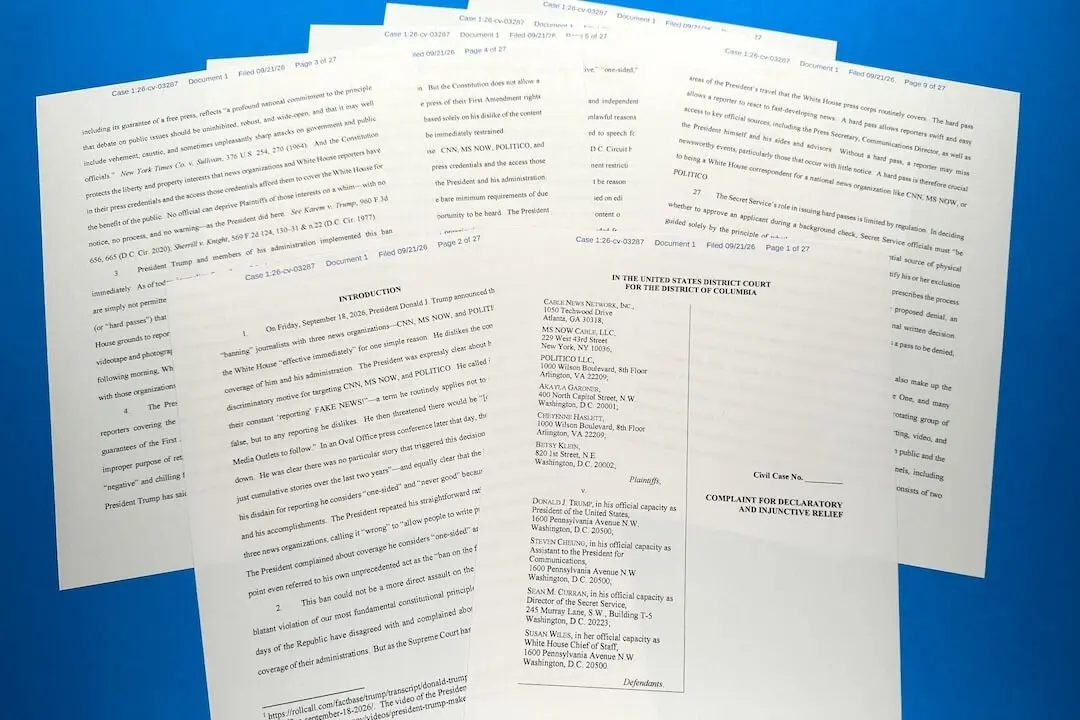
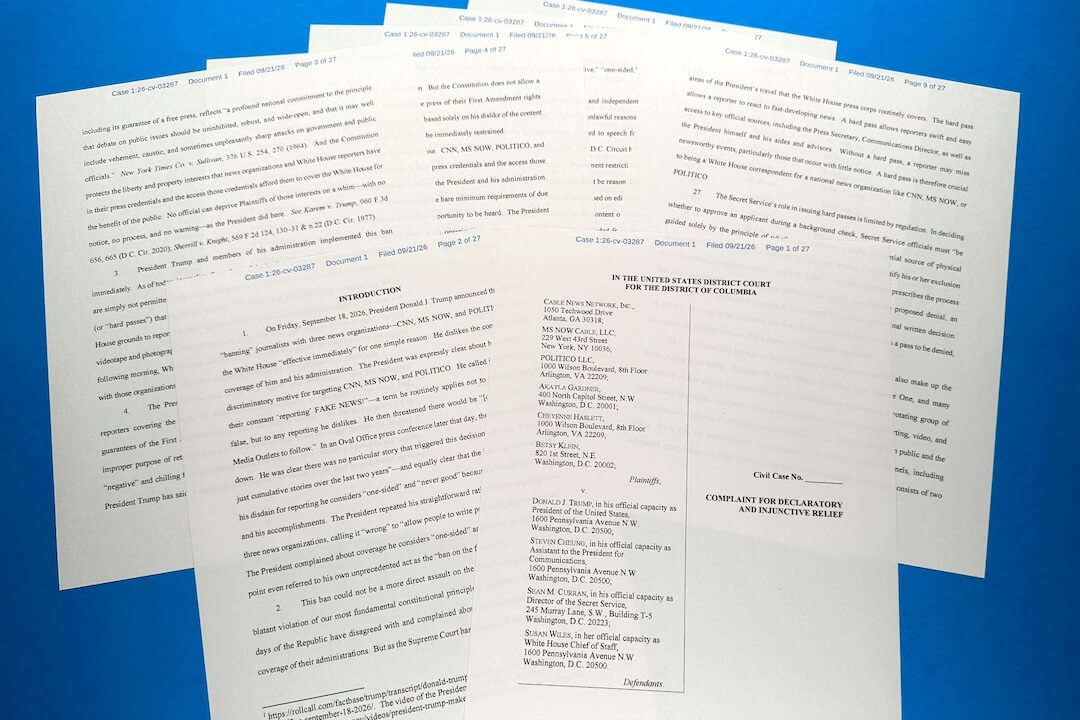
Hours after the ban went into effect, the targeted outlets—CNN, MS NOW, and Politico—filed a joint federal lawsuit against the Trump administration. The complaint asserted that the executive branch had violated core constitutional protections:
"The Constitution does not allow a president or any other government official to deprive the press of their First Amendment rights and liberty and property interests with no notice or process based solely on his dislike of the content of their reporting."
The case was assigned to U.S. District Judge Timothy Kelly, a Trump appointee. Notably, Judge Kelly was the same jurist who ordered the White House to restore the press pass of then-CNN reporter Jim Acosta during a similar 2018 standoff. Judge Kelly promptly scheduled a high-stakes videoconference hearing.
As the litigation commenced, other major media organizations enacted parallel measures of solidarity. The Washington Post withheld the publication of all photos from Monday’s presidential events until midnight. C-SPAN pulled back normal coverage routines, and NPR issued an internal memo prohibiting its broadcasts from utilizing audio tape from White House events, with NPR Editor-in-Chief Tommy Evans denouncing the ban as a "blatant violation of the First Amendment."
Supporting Context & Metrics: The Mechanics of the Broadcast Pool and Corporate Consolidation
Understanding the White House TV Pool
To fully grasp the magnitude of Monday’s blackout, one must understand the logistical backbone of presidential reporting. The White House TV pool consists of five primary networks: ABC News, CBS News, NBC News, CNN, and Fox News.
These networks coordinate a rigorous rotating daily schedule to secure vital audio-visual footage of the president. They share this material amongst themselves and their affiliates, while also selling feeds to roughly a dozen subscriber outlets, including The New York Times. When this infrastructure is severed or boycotted, the national and international public loses its primary, independent window into the physical and verbal actions of the executive branch.
The Paramount-WBD Megamerger Metrics
While the White House engaged in a high-stakes battle over media access, the business side of the industry experienced an equally tectonic shift. A coalition of Democratic states, spearheaded by California Attorney General Rob Bonta, had initially filed an antitrust lawsuit to block Paramount’s $111 billion acquisition of Warner Bros. Discovery.
The legal challenge dissolved following intense, behind-the-scenes negotiations. To secure approval, Paramount agreed to several major concessions:
- The Investment: A commitment to spend an additional $1.5 billion on film production over the next five years.
- The Theatrical Commitment: A pledge to guarantee the distribution of at least 30 movies in theaters annually.
- The Editorial Board: The establishment of a specialized oversight mechanism designed to insulate its newly acquired journalistic properties.
The resulting corporate titan unites two historic movie studios, combines streaming powerhouses Paramount+ and HBO Max, and—most critically—places both CBS News and CNN under the financial control of David Ellison, backed by his father, billionaire Oracle co-founder Larry Ellison.
Official Statements & Institutional Reactions
The fallout from both the press ban and the merger generated intense rhetoric from government officials, media executives, and press freedom advocates.
The White House and Administration Defenders
Vice President JD Vance forcefully defended the administration’s actions during a press briefing, attempting to reframe the exclusion:
"He’s not banning media outlets. What he’s doing is saying we’re not going to give you special access to the White House if you engage in what is effectively propaganda."
President Trump echoed this sentiment on social media platforms, writing that the administration was launching an assault not on a free press, but on "FAKE NEWS," which he categorized as a cancer and an existential threat to national security.
Press Freedom Advocates and Legal Critics
In stark contrast, civil liberties and press advocacy groups condemned both the White House actions and the structural implications of the Paramount-WBD settlement.
Seth Stern, chief of advocacy for the Freedom of the Press Foundation, dismissed the proposed independent editorial board for CNN and CBS News as an ineffective safeguard:
"A Paramount-appointed editorial independence board for CNN and CBS is worthless. The fish rots from the head, and this particular fish is headed by a compromised oligarch with a history of throwing journalists under the bus to advance his business interests."
Similarly, Clayton Weimers, executive director of Reporters Without Borders (RSF), criticized the state attorneys general for dropping their antitrust opposition to the merger:
"This sorry conclusion effectively greenlights a merger that benefits a small number of billionaires and authoritarian states as they consolidate more control over the media in an era of expanding news deserts."
Future Outlook: Navigating an Uncertain Media Landscape
As the dust settles on an extraordinary week, media analysts, legal scholars, and industry professionals are left projecting the long-term ramifications of these parallel crises.
+---------------------------------------------------------------------------------+
                 THE DUAL FRONTS FACING MODERN JOURNALISM
+---------------------------------------------------------------------------------+

  [EXECUTIVE BRANCH]                      [CORPORATE CONSOLIDATION]
         │                                            │
         ▼                                            ▼
  First Amendment Clashes                 Massive Industry Consolidation
  • White House press bans                • $111B Paramount-WBD merger
  • Coordinated network boycotts          • CNN & CBS News under one roof
  • Judicial intervention (Judge Kelly)   • Disputed "independent" boards
         │                                            │
         └─────────────────────┬──────────────────────┘
                               │
                               ▼
            [THE FUTURE OF THE INDEPENDENT PRESS]
       Ensuring democratic accountability amid rising
political hostility and corporate conglomeration.- The Legal Battlefield: All eyes remain fixed on U.S. District Judge Timothy Kelly’s courtroom. The outcome of the lawsuit brought by CNN, MS NOW, and Politico will establish a modern constitutional precedent regarding the limits of executive authority over press credentials. Should the courts rule in favor of the outlets, it could check presidential retaliation. Conversely, a ruling upholding the administration’s stance would permanently alter the ground rules of executive branch reporting.
- Corporate Oversight Challenges: Within the newly merged Paramount-WBD entity, the efficacy of the five-person "independent" journalistic editorial board will be aggressively tested. Skeptics, including media critics from Nieman Lab and various press freedom watchdogs, argue that billionaire owners can easily circumvent structural workarounds designed to placate regulators. Furthermore, the political affiliations—or lack thereof—among the designated board members will determine whether the public perceives the unified newsrooms of CBS News and CNN as genuinely balanced or politically compromised.
- The Survival of the Press Pool: The willingness of mainstream networks to sacrifice daily access in solidarity with banned peers signals a newfound unity within legacy media. However, prolonged blackouts risk starving the public of essential, unvarnished reporting from the seat of government.
Ultimately, the events mark a dangerous inflection point. As political hostility toward independent media intersects with aggressive corporate consolidation, the core constitutional mission of the press—to hold the powerful to account and inform a self-governing people—faces its most formidable stress test in decades.