

Executive Overview
Every digital agency, independent developer, and enterprise marketing team recognizes a universal, unspoken truth of the internet: a website is never more pristine, precisely designed, or functionally flawless than it is on the day it officially launches.
The final code branch is successfully merged, the DNS propagates, and for a fleeting moment, the digital storefront exists in a state of absolute perfection. Yet, almost immediately, a slow, invisible decay begins. This degradation is rarely caused by catastrophic server outages or broken code libraries. Instead, it is driven by the relentless, unyielding march of the real world. Competitors update their value propositions, shifting market conditions render last quarter’s copy obsolete, brand guidelines evolve, and a continuous stream of minor optimizations gets backlogged, forgotten, or deferred.
A year later, that once-cutting-edge digital property often functions as a digital period piece. It is not necessarily broken, but it is fundamentally behind. Traditionally, organizations have accepted this digital rot as an inevitable law of nature—a logistical tax paid for maintaining a web presence.
However, the advent of continuous, agent-driven artificial intelligence is poised to fundamentally disrupt this paradigm. Enter the concept of the autonomous website: digital properties monitored, updated, and continuously optimized by autonomous software agents long after human developers and designers have moved on to new projects.
Yet, as industry practitioners are discovering, engineering the technology is only half the battle. When software developers and product architects attempt to deploy fully autonomous websites in the wild, they immediately collide with a deeply human, counterintuitive hurdle: almost nobody actually wants a website that changes entirely on its own.
This profound tension between technical capability and human agency sits at the heart of modern web architecture. Based on insights and lessons drawn from building Fimo, an autonomous website platform, industry pioneer Pierre Burgy highlights a vital realization: the goal of web autonomy is not to bypass human input entirely, but to strategically redefine where human judgment is applied.
Detailed Chronology: From Static Launches to Dynamic Evolution
To understand the current shift toward autonomous web infrastructure, it is necessary to examine how the lifecycle of website development has evolved over the past three decades.
Phase 1: The Static Era (Late 1990s – 2010s)
In the early days of web development, websites were treated as digital brochures. Updates required manual intervention via FTP clients, content management systems (CMS), or raw code deployments. Because updating a site was friction-heavy, websites were refreshed in massive, multi-month overhauls every few years. The space between these redesigns was characterized by stagnant messaging and accumulating technical debt.
Phase 2: The CMS and Continuous Deployment Era (2010s – 2023)
The rise of robust Content Management Systems (WordPress, Drupal) and modern frontend frameworks (React, Vue, Next.js) dramatically accelerated deployment cycles. Continuous Integration and Continuous Deployment (CI/CD) pipelines allowed teams to push code updates daily. However, this shift created a new bottleneck: human attention. While shipping code became frictionless, deciding what to ship, ensuring design-system compliance across dozens of contributors, and fixing low-priority bugs still demanded scarce human hours.
Phase 3: The Autonomous Agent Era (2024 and Beyond)
The integration of Large Language Models (LLMs) and specialized autonomous agents has introduced a new capability. Modern agents can parse codebases, execute design tokens, audit accessibility metrics, and rewrite copy in real-time.
When developers first encountered these capabilities, the natural instinct was to push the pendulum to its extreme: hand the entire website over to the agents. Let autonomous systems write, edit, optimize, and publish unassisted.
The reality check was swift. When users were given fully autonomous tools, they hesitated. The hesitation did not stem from a lack of technical trust in the AI; rather, it exposed a fundamental organizational truth: a website has no single owner. Different components of a website belong to different stakeholders—designers, copywriters, developers, and product managers—each demanding a radically different threshold of autonomy.
Supporting Context & Metrics: The Anatomy of Website Decay and Delegation
To conceptualize how autonomous systems interact with digital properties, we must break down the operational workload of a modern website into three distinct categories.
1. The 80%: The No-Brainer Chores
The vast majority of web maintenance is rule-bound, repetitive, and entirely divorced from creative expression. This includes:
- Maintaining WCAG accessibility compliance as new components are introduced.
- Propagating design-system updates (such as shifting padding tokens or brand color variables) across thousands of pages.
- Fixing broken meta tags, unoptimized asset files, or routing links broken by URL restructuring three sprints ago.
None of this work is where human talent thrives. Nobody joins a marketing or engineering team because of their burning passion for spotting missing alt attributes on thumbnail images. According to platform telemetry from automated maintenance systems, roughly 80% to 85% of routine website upkeep falls into this deterministic, rule-based category. Delegating this operational layer to agents does not threaten human jobs; it simply removes administrative drag.
2. The Intouchables: High-Judgment Creative Work
At the opposite end of the spectrum sits the critical work that no organization would willingly delegate to an algorithm. An agent can verify contrast ratios, confirm heading hierarchies, and run spell checks against a style guide.
What an AI cannot do is determine the emotional resonance of a landing page or evaluate whether a marketing narrative possesses authentic, culturally resonant taste. That high-level editorial and aesthetic judgment is precisely why human teams are hired. Protecting this creative core is non-negotiable, and recognizing that autonomy does not mean surrendering this layer is critical to broad adoption.
3. The Grey Area: Context-Dependent Autonomy
Between the automated chores and the untouchable creative core lies a vast, nuanced grey area where no universal product setting can suffice. Why? Because the boundary line runs through different places for different people within the same organization.
Consider a practical example: Transitioning the default site theme to dark mode.
- For the Lead Brand Designer, the default theme is not a simple settings toggle; it is a profound brand statement. It dictates how the company’s identity is perceived by first-time visitors, and the designer fiercely guards that creative prerogative.
- For the Frontend Developer, switching a default theme configuration is a routine one-line logic change backed by straightforward user-engagement metrics. They would gladly let an agent apply the change and move on.
The exact same task carries fundamentally different weights of judgment depending on the stakeholder. Consequently, successful autonomous platforms cannot rely on a binary "on/off" switch for autonomy. Control must be granular, customizable, and tailored per task and per person.
Official Insights & Platform Architecture
In architecting platforms designed for autonomous web management, developers have had to pivot away from static preference menus toward dynamic agent composition.
As Pierre Burgy notes regarding the architecture of Fimo:
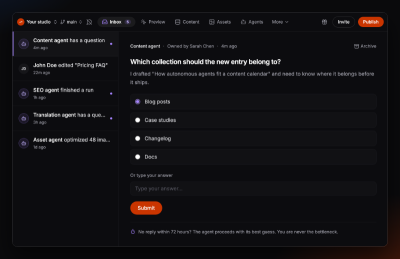
"You don’t pick from a fixed menu of behaviors. You compose the agents, deciding what each one is even allowed to touch. You can build one from scratch, or take one close to your needs and shape it to your own line: an accessibility agent you trust to run unattended, a content agent you keep close to anything brand-facing."
Rather than serving as static utilities, modern autonomous agents are designed to learn. They adapt based on historical logs, explicit human feedback, and successful past interventions. Trust is not established by fiat; it is earned iteratively.
When a developer or designer reviews an agent’s audit log—comparing a before-and-after snapshot of a minor layout optimization or performance fix—confidence builds naturally. Over time, tasks that initially required strict manual approval graduate into autonomous execution, steadily shrinking the administrative burden on human teams.
Future Outlook: The Death of the Frozen Site
As artificial intelligence continues to reshape software engineering, the traditional lifecycle of the website is undergoing a fundamental philosophical inversion.
For decades, the standard operating procedure has treated the website as a static artifact punctuated by sporadic, high-stress overhauls. The primary risk discussed in boardrooms has traditionally been the fear of uncontrolled changes breaking a pristine production environment.
However, industry leaders argue that this mindset fundamentally misjudges modern digital risk. The true vulnerability in the modern digital economy is not a website that changes too much; it is a website that never changes at all.
A frozen website does not preserve security or brand integrity; it simply drifts backward. It silently falls out of alignment with shifting markets, evolving product lines, and changing customer expectations until it represents an enterprise that bears little resemblance to its current reality.
The ultimate promise of web autonomy is not to alienate human creators from their digital domains, but to liberate them from administrative decay. By delegating rule-based chores to autonomous agents and reserving human insight strictly for high-value strategic judgment, teams can ensure their digital presence remains as dynamic, responsive, and alive as the organizations behind them.