

Executive Overview
For the discerning real estate buyer with a deep appreciation for American culinary history, a rare and storied property has just hit the market. Julia Child’s longtime residence in Cambridge, Massachusetts—a sprawling, soft-purple 1889 home located just blocks from Harvard Yard—is officially listed for sale at $6.475 million.
Spanning an impressive 6,321 square feet, the historic estate features six bedrooms, six bathrooms, and a delicate balance of preserved architectural heritage and modern luxury. However, prospective buyers looking to channel the legendary chef in her original environment will find one notable caveat: you cannot cook in Julia Child’s kitchen.
When Child departed the Cambridge residence in 2001, she famously donated her iconic culinary workshop—complete with its trademark pegboard walls, raised countertops, and specialized workspaces—to the Smithsonian’s National Museum of American History, where it remains preserved as a permanent cultural artifact. Nevertheless, the residence still hums with the spirit of the woman who revolutionized American home cooking. From the verdant garden beds originally tended by Julia and her husband, Paul, to the historical marker recently approved by the Cambridge City Council, the property remains an irreplaceable monument to an extraordinary life.
Detailed Chronology: Four Decades of Gastronomic Innovation
To understand the weight of the $6.475 million price tag, one must look back at the decades of cultural history embedded within the home’s timber and masonry.
The Cambridge Era Begins (1961–2001)
Julia and Paul Child moved into the shingle-style house on Irving Street in Cambridge in 1961, the very same year her groundbreaking masterpiece, Mastering the Art of French Cooking, was published. The home quickly transformed from a private residence into the epicenter of American culinary experimentation.
As Child’s fame skyrocketed through her pioneering public television series, The French Chef, the Cambridge kitchen evolved into a character in its own right. Paul Child, an artist, photographer, and diplomat with an immaculate eye for design, custom-built many of the kitchen’s features to accommodate Julia’s towering six-foot-two-inch frame. He raised the countertops to prevent her from hunching over while kneading bread or chopping mirepoix, and installed the legendary pegboard walls that allowed every pot, pan, and utensil to be outlined in pencil, ensuring everything had its precise place.
Filming Later Masterpieces
While the earliest seasons of The French Chef were filmed elsewhere (primarily at WGBH studios in Boston and later in a purpose-built kitchen in her home), the Cambridge residence served as the backdrop for her later career defining television projects. Shows such as In Julia’s Kitchen with Master Chefs and Julia and Jacques Cooking at Home (co-starring French culinary icon Jacques Pépin) utilized the domestic warmth and functional layout of the Irving Street home to invite viewers directly into her creative process.
The Smithsonian Transition (2001)
As Child prepared to leave Cambridge in 2001 to move to a retirement community in California (she passed away in 2004 at the age of 91), she faced the question of what to do with the most famous kitchen in America. Rather than leaving it to a future private owner, she orchestrated its painstaking disassembly. Smithsonian curators meticulously cataloged, packed, and shipped every inch of the kitchen—down to the appliances, utensils, and pegboards—to Washington, D.C., where it was reconstructed inside the National Museum of American History. It has since stood as one of the museum’s most beloved and heavily visited permanent exhibits.
Modernization and the 2026 Listing
Following Child’s departure, the house changed hands, undergoing sensitive renovations to update its living spaces for the 21st century. The current offering, managed by listing agent Ed Feijo, brings the historic estate back into the public eye, sparking a massive wave of interest from architectural historians, food enthusiasts, and luxury real estate buyers alike.
Supporting Context & Metrics: Inside the $6.475 Million Estate
While the absence of the original Smithsonian-housed kitchen might deter purists, the rest of the residence offers an extraordinary blend of late-19th-century Victorian charm and high-end contemporary updates.
Architectural and Spatial Breakdown
- Listing Price: $6.475 million
- Property Size: 6,321 square feet
- Lot Features: Tree-lined urban setting, established perennial gardens, and a private porte-cochère
- Bedrooms: 6 generously proportioned rooms with period moldings and abundant natural light
- Bathrooms: 6 modern, elegantly appointed bathrooms
- Year Built: 1889
The Evolution of the Kitchen
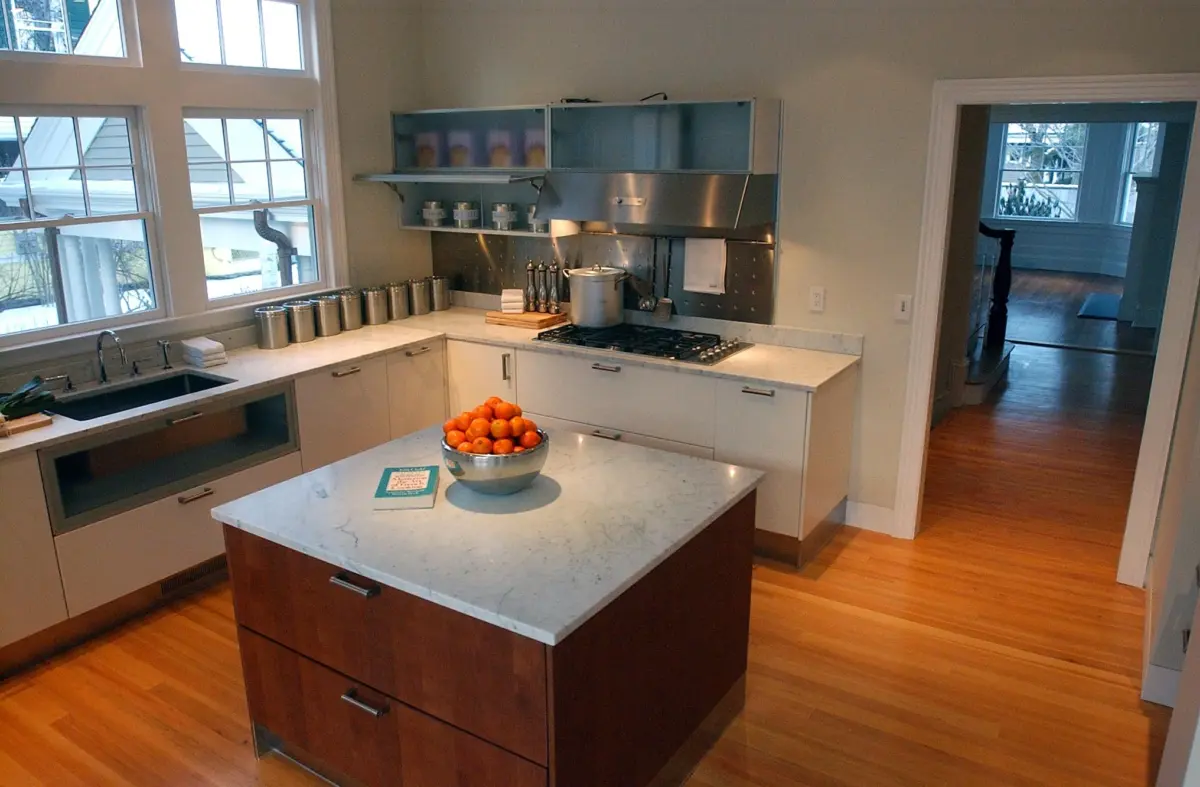
Though Julia’s original workspace resides in Washington, the current kitchen is far from a downgrade. It has been thoroughly modernized into a sleek, culinary-grade space featuring:
- Pristine white marble countertops
- A professional-grade six-burner cooktop
- Top-tier appliances designed for contemporary gourmet cooking
Traces of Paul and Julia
Despite comprehensive interior updates, reminders of the Childs’ eccentric and vibrant life are embedded throughout the property:
- The Garden: Many of the botanical specimens and plantings in the lush backyard were personally selected and planted by Julia and Paul, reflecting their shared passion for botany and fresh, local ingredients.
- The Porte-Cochère: The home’s covered driveway once sheltered Julia’s iconic Volkswagen Beetle—affectionately known as the "Carpet Beetle"—upon her return from local Cambridge markets and butcher shops.
- The Butler’s Pantry: In the space where Paul Child famously mixed evening martinis for guests, the room has been updated with high-end Poggenpohl cabinetry, Sub-Zero refrigeration, and a modern beverage cooler, seamlessly blending historical reverence with modern utility.
Official Statements and Local Recognition
The impending sale has not only captured the attention of national real estate publications and food blogs but has also prompted formal recognition from the local municipal government in Cambridge.
The Listing Agent’s Perspective
In interviews with regional media, listing agent Ed Feijo emphasized that despite decades of updates and the removal of the original kitchen, the intangible essence of America’s favorite chef remains palpable within the walls.
"The feel of her is still in there," Feijo noted to the Boston Globe, pointing to the home’s grand proportions, natural light, and the enduring layout of the formal entertaining spaces where Child hosted luminaries, fellow chefs, and close friends for decades.
Municipal Honors: The Cambridge Historical Marker
Recognizing the cultural gravity of the Irving Street property, the Cambridge City Council took definitive action ahead of the home’s market debut. In a unanimous vote over the summer, the council approved a motion to install an official historical marker at the residence.
This designation formally cements the home’s status as a landmark of American cultural heritage. City officials noted that while private homes inevitably evolve through successive ownership, the physical structure serves as an irreplaceable touchstone for Cambridge’s rich intellectual and artistic history.
Digital Frenzy
The public fascination surrounding the property was immediate. Upon the listing’s launch in late September 2026, real estate websites featuring the home experienced unprecedented traffic surges, with digital archives reportedly crashing under the weight of thousands of virtual visitors eager to peek inside the hallways where modern American gastronomy was shaped.
Future Outlook: Preserving a Culinary Legacy
As the Irving Street estate enters its next chapter, the central question facing potential buyers is one of legacy stewardship. At $6.475 million, the property commands top-tier luxury pricing in the competitive Greater Boston real estate market. Yet, its value extends far beyond square footage or high-end finishes.
Real estate analysts anticipate robust interest from high-net-worth individuals, institutional buyers, and devoted admirers of Child’s work. Unlike standard luxury acquisitions, purchasing this home carries a civic responsibility: preserving a space that fundamentally transformed how Americans view food, television, and domestic life.
Whether the eventual buyer is a passionate home cook looking to break in the modern marble countertops or a historic preservationist dedicated to maintaining the home’s storied integrity, one thing is certain. The spirit of Julia Child—her infectious laughter, her uncompromising dedication to the craft, and her belief that "the only real stumbling block is fear of failure"—will continue to echo through the tree-lined streets of Cambridge for generations to come.