

By Troy Farah
Enriched & Expanded Editorial Coverage
Executive Overview
The escalating friction between President Donald Trump’s administration and the mainstream press reached a temporary legal roadblock on Thursday, when a federal judge ordered the White House to reinstate press credentials for journalists from CNN, MS Now, and Politico. The directive, handed down by U.S. District Judge Timothy Kelly—an appointee of Donald Trump himself—granted a two-week reprieve, ruling that the executive branch had failed to adhere to fundamental due process protections when executing the media ban.
The controversy erupted late last week when the White House summarily revoked the hard passes of reporters from the three targeted organizations, branding them "fake news" and barring them from the executive mansion grounds effective immediately. In response, the affected newsrooms swiftly filed a joint lawsuit challenging the constitutionality of the exclusion under the First Amendment and administrative law.
While reporters from the outlets have temporarily returned to their posts on the White House beat, the ruling has triggered a sweeping legal and political debate over executive overreach, the limits of presidential authority over federal property, and the broader implications for the future of American journalism. As the judicial clock ticks down on the temporary restraining order, legal analysts and free-press advocates are left weighing a critical question: Can the administration attempt the ban a second time, provided it formally establishes a due process framework?
Detailed Chronology: From Executive Ban to Judicial Intervention
The genesis of the latest standoff traces back to a sudden policy enforcement last Friday, when administration officials locked out accredited journalists representing CNN, MS Now, and Politico. Without prior warning, formal administrative hearings, or written justifications detailing specific infractions, the White House declared the organizations persona non grata, citing generalized grievances regarding editorial tone and coverage.
The ban immediately disrupted daily reporting routines. For decades, physical access to the White House press briefing room and working quarters has served as an essential operational baseline for national political journalists. Cut off from these facilities, the targeted networks were forced to pivot their logistics while mobilizing legal teams.
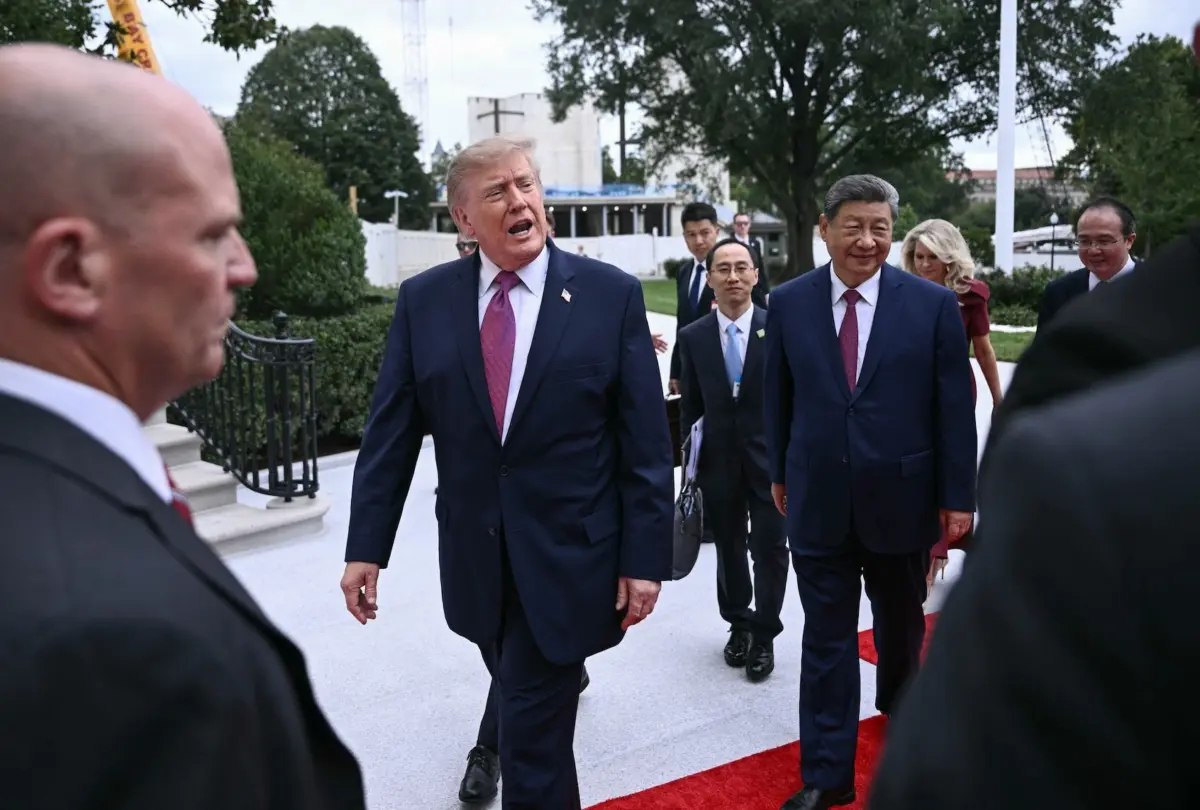
By early this week, the conflict spilled onto the international stage during the United Nations General Assembly in New York. Amid a flurry of diplomatic engagements—including a high-profile walk alongside Chinese President Xi Jinping and a controversial speech in which the Trump administration sparred with Iranian officials—tensions boiled over between the executive branch and the press corps.
When CNN anchor and chief White House correspondent Kaitlan Collins attempted to question the president, Trump publicly upbraided her.
"You should not be here," Trump told Collins, according to reports from the exchange. "You should not be here covering me. You said you weren’t going to cover me."
Collins firmly refuted the premise on-air later that evening, clarifying, "We never said we were never going to cover the president."
Parallel to the legal battle, the administration rolled out an alternative communications strategy dubbed "Trump TV." Functioning primarily as a continuous livestream of presidential speeches, rally archives, and select reruns, the platform was pitched as an unfiltered direct line to the public. However, early metrics and media analyses indicated that the initiative garnered negligible viewership, underscoring the enduring demand for independent journalistic curation and scrutiny of executive power.
The legal challenge culminated on Thursday before Judge Timothy Kelly. In his assessment, Kelly homed in on the administrative procedure—or lack thereof—surrounding the revocation of press credentials. Finding that the administration had bypassed established legal safeguards and stripped journalists of their access arbitrarily, Kelly issued an order forcing the White House to restore credentials for the three outlets for a duration of two weeks while the broader litigation moves through the courts.
Supporting Context & Metrics: The Shrinking Perimeter of Press Access
The current standoff is not an isolated event, but rather the latest chapter in a long-term contraction of transparent access between successive U.S. administrations and the independent press. Press freedom advocates argue that the trajectory under recent executive branches has increasingly favored institutional insulation over open accountability.
According to Gabe Rottman, vice president of policy at the Committee for Freedom of the Press, the constitutional thresholds governing White House access are delicate but distinct. While the physical facility of the White House is not legally mandated to open its doors to every media outlet, constitutional jurisprudence—rooted heavily in historic precedents such as Sherrill v. Knight (1978)—dictates that once an administration creates a public forum for the press, it cannot arbitrarily exclude specific journalists or organizations based on viewpoint discrimination or animus toward their reporting.
"The White House facility doesn’t need to let journalists in … But once it does … it cannot exclude journalists or news organizations because it doesn’t like what they report," Rottman told NPR in an interview analyzing the case.
"Certainly, the trajectory has been in the direction of more restraints on press access than less," Rottman added, contextualizing the systemic risks. "I think the public can easily wrap their head around the danger of the leader of the country retaliating against news organizations, denying them access because he doesn’t like their coverage."
Beyond the legal technicalities, the episode has exposed ideological fissures within the broader media landscape. While mainstream legacy outlets rallied around CNN, MS Now, and Politico as standard-bearers of constitutional protections, independent journalists and progressive commentators raised questions regarding selective institutional solidarity.
David Sirota, an investigative journalist and former senior advisor to Bernie Sanders’ 2020 presidential campaign, pointed to a persistent double standard regarding press credentials on social media platform X.
"Trump blocking access is bad, but what’s so annoying about Big Media folks’ self-righteous indignation is that the White House and Congress routinely deny credentials to smaller independent outlets and Big Media folks say nothing and show no solidarity," Sirota wrote. "They don’t actually care about the press freedom principles they are pretending to care about here. They care about their own access, their own business models, and virtue signaling to their own elite class of media."
Official Statements and Digital Dispatches
True to form, President Trump bypassed traditional press channels to address the unfolding legal defeat directly through his preferred digital megaphone on Truth Social. Choosing not to acknowledge Judge Kelly’s specific legal reasoning regarding due process, Trump instead pivoted to attacking the economic performance and viewership metrics of the targeted networks.
In his social media post, Trump decried CNN and MS Now’s "low ratings," asserting that their viewership numbers "have considerably dropped," while simultaneously disparaging their editorial coverage of his bilateral meetings with Chinese President Xi Jinping.
The strategy reflects a familiar playbook: reframing a constitutional dispute over government censorship into a commercial critique of corporate media competitiveness. Yet, legal scholars note that market performance or editorial disagreements do not legally substitute for the administrative due process required when revoking a journalist’s accreditation to cover the federal government.
Meanwhile, representatives for CNN, MS Now, and Politico have maintained a unified front, emphasizing that the temporary restoration of press badges is a vital win not just for their respective newsrooms, but for the principle of an unobstructed, inquisitive press corps capable of holding executive authority accountable on behalf of the American public.
Future Outlook: What Lies Ahead for the White House Press Corps
As the two-week clock set by Judge Kelly ticks down, all eyes remain fixed on the federal courthouse in Washington, D.C. The immediate legal question centers on whether the administration will attempt to construct a formal, legally defensible due process framework to re-impose the ban, or if the Justice Department will seek an expedited appeal to higher courts.
If the administration opts to pursue a procedural route—such as establishing formal criteria for credential revocation based on behavioral standards rather than editorial content—it could force federal judges to grapple with uncharted constitutional territory regarding executive discretion over executive branch property. Conversely, if the courts ultimately rule that viewpoint discrimination is permanently barred under the First Amendment regardless of procedural wrappers, it could establish a landmark precedent limiting presidential leverage over the press corps for generations to come.
Ultimately, the outcome of this legal battle extends far beyond the physical confines of the White House briefing room. It serves as a high-stakes stress test for the resilience of democratic norms, the enforcement of judicial checks and balances, and the enduring independence of the American news media in an increasingly polarized political climate.