

Executive Overview
For more than a decade, American public and political life has operated under the long shadow of the Donald Trump show. Built on a relentless, 24-hour news cycle, his political survival has historically relied on a symbiotic and often toxic relationship with the mainstream media. Through bombastic press conferences, aggressive social media salvos, and carefully managed visual dominance, the self-described "king of ratings" mastered the art of sucking all the oxygen out of the room.
However, a fundamental axiom of the modern media landscape is that when an entertainer’s primary trick relies on a live, responsive audience, the worst thing that can happen is for the cameras to simply turn away.
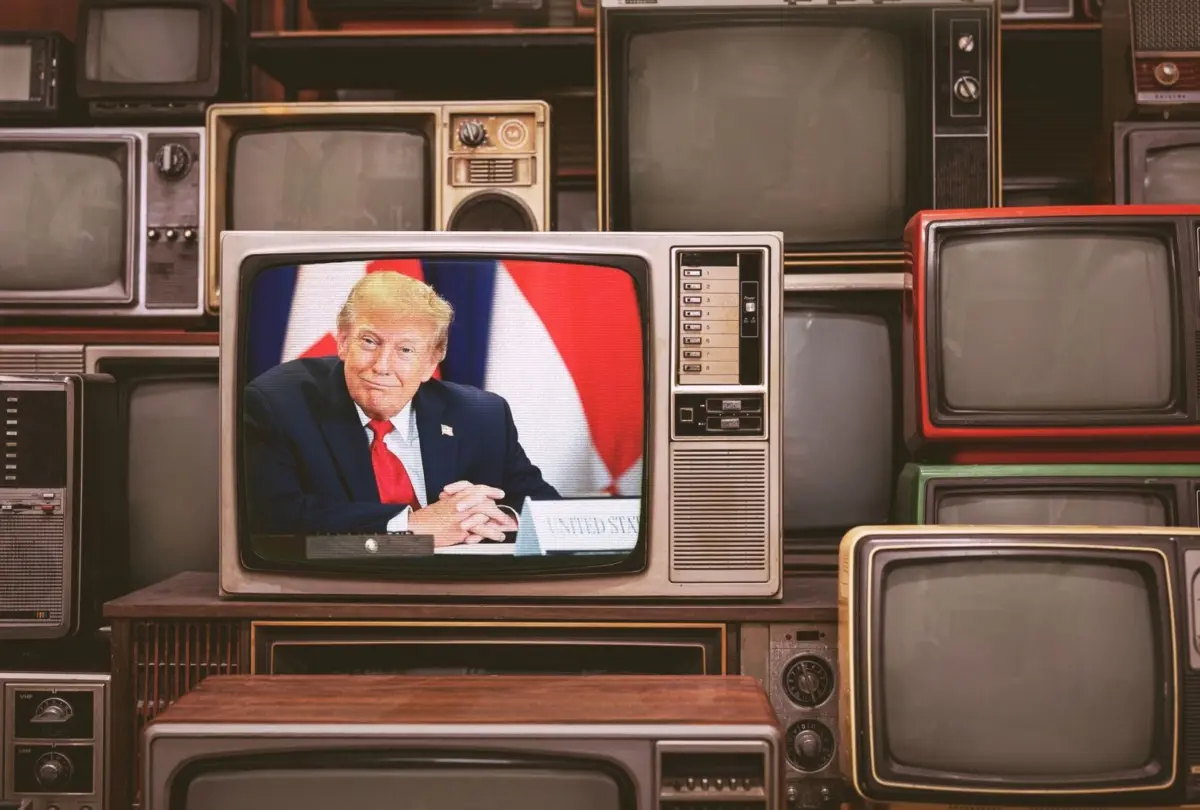
Recent events at the White House indicate that this worst-case scenario has finally materialized. Facing a unified pushback from major news organizations—which collectively boycotted the White House press pool following an authoritarian ban on specific outlets—the administration attempted to pivot by launching its own in-house broadcast experiment: “Trump TV: The Essentials Station.”
Far from a triumphant technological work-around, the initiative quickly devolved into a technical farce and a viewership desert. Coupled with plummeting mentions of the president even within conservative podcasting ecosystems, the episode signals a profound shift: the broader media ecosystem, and perhaps the American public at large, is finally changing the channel. Beyond the immediate public relations disaster, the administration’s actions have triggered high-stakes legal battles over First Amendment rights, alongside serious questions regarding federal anti-deficiency and anti-propaganda laws.
Detailed Chronology
The White House Press Ban and Media Solidarity
The latest fracture in the relationship between the executive branch and the press corps began in a display of authoritarian pique when the administration barred CNN, POLITICO, and MS NOW from the White House press pool. Historically, such maneuvers were designed to divide news organizations, forcing excluded outlets to scramble while competitors quietly accepted the scraps of access.
Instead, the move triggered a rare and long-overdue display of institutional solidarity across the major news networks. In an unprecedented unified front, NBC, ABC, CBS, and even Fox News suspended their pool coverage of the president. Photographers representing major wire services, The New York Times, and The Washington Post simultaneously ceased publishing new images of the chief executive.
The immediate result was an unadulterated farce. Stripped of the professional camera crews and audio feeds typically provided by the unified pool, Trump stepped onto the White House lawn to host a ribbon-cutting ceremony for his newly constructed helipad. He preened before the physical crowd, grabbed an oversized pair of ceremonial scissors, and began to speak—only for his voice to be entirely drowned out by the deafening roar of Marine One’s idling engines. Lacking independent professional audio equipment, the official White House feed produced a silent-movie spectacle of an isolated figure gesticulating wildly into the wind. Even right-wing cable commentators on networks like Newsmax were forced to concede on air that the self-imposed media blackout was backfiring.
The Debut and Collapse of "Trump TV"
Desperate to circumvent what the administration framed as mainstream media censorship, Trump’s team spent a weekend cobbling together a digital replacement. On Monday, the White House rolled out “Trump TV: The Essentials Station,” a 24-hour YouTube livestream hosted on the official White House channel.
Promoted as an unedited, nonstop look at the administration’s greatest hits, the reality of "Trump TV" fell flat. Rather than cutting-edge digital propaganda, viewers were greeted by a glorified, automated graveyard of outdated archival footage. The initial broadcast featured a two-month-old speech from Mount Rushmore, followed hours later by a rerun of an address concerning artificial intelligence, and eventually a year-old broadcast documenting a dinner with Britain’s King Charles III. The technical and editorial disarray reached its peak on Tuesday morning when, while Trump was actively delivering a live, high-stakes address to the United Nations General Assembly, his own proprietary channel was busy broadcasting a White House prayer breakfast from the previous February.
The viewership metrics reflected the chaotic rollout. Going live on Monday at 7 p.m., the channel’s premiere drew roughly 8,000 concurrent viewers. Within 90 minutes, that number had been cut in half. By Tuesday morning—precisely as the traditional cable news programs Trump sought to render obsolete went on the air—his own channel’s viewership cratered to just over 1,000 concurrent viewers out of a total subscriber base exceeding three million accounts on the official White House YouTube page.
Relocating for a Camera: New York and the United Nations
Unable to command the traditional airwaves from the Oval Office, Trump decamped to New York City in search of guaranteed camera time. In an ironic twist for a politician who built his brand on adversarial politics, he relied on a joint appearance with New York City Mayor Zohran Mamdani—a meeting that reportedly incensed conservative factions within the Republican Party—to secure national television feeds.
Standing at Gracie Mansion, Trump attempted to spin the boycott as a non-issue, boasting about his visibility while visibly shrinking in stature. Mayor Mamdani used the platform to gracefully underscore the critical importance of a free and unhindered press, contrasting sharply with Trump’s self-referential ramblings.
Later, at United Nations headquarters, the president engaged in a public dispute after spotting CNN reporter Kaitlan Collins in the briefing room, complaining that she should be barred from covering him due to her network’s editorial stance. Collins calmly and methodically noted that her credentials were issued by the United Nations rather than the West Wing, before pressing him on complex national security concerns surrounding unsanctioned military maneuvers in Iran.
Supporting Context & Metrics
The Pattern of Vanity Projects
The hasty launch of "Trump TV" fits a decades-long pattern of grandiose vanity projects that have historically collapsed under the weight of their own operational shortcuts. Long before entering politics, Trump functioned primarily as a brand seeking a commercial platform.
The historical ledger of family-branded enterprises reads as a catalog of short-lived commercial ventures:
- Trump-branded frozen steaks
- The fraudulent enterprise known as Trump University
- The ill-fated Trump Shuttle airline
- Bankrupt Atlantic City casino ventures
- A short-lived reality dating show spun off from The Apprentice that was canceled after two seasons
- An aborted search engine initiative
- A defunct charitable foundation
- A short-lived consumer furniture line
- A mortgage company launched immediately preceding the 2008 housing market collapse
Viewed through this historical lens, "Trump TV" represents merely the latest iteration in a long legacy of promotional grifts designed for immediate self-aggrandizement rather than sustainable operations.
The Shifting Media Landscape and Audience Exhaustion
The decline of Trump’s media dominance extends far beyond the traditional broadcast networks. Independent metrics indicate that the broader media ecosystem is actively tuning him out.
An exhaustive data analysis of nearly 70,000 hours of political podcasts conducted by The Wall Street Journal revealed that explicit mentions of Trump’s name on prominent conservative podcasting platforms have plummeted by nearly 70% compared to their pre-election peaks in 2024. The data suggests that even within his most reliable political bases, audiences are experiencing profound fatigue with the perpetual crisis machine.
Legal & Constitutional Ramifications
The Antitrust and First Amendment Lawsuits
The administration’s decision to revoke press credentials has triggered a parallel and highly consequential legal battle. On Monday, CNN, POLITICO, and MS NOW filed a joint federal lawsuit against the administration, asserting that stripping their credentials without due process or an opportunity to respond violates both the First Amendment and fundamental constitutional due process.
The legal challenge relies heavily on Sherrill v. Knight (1977), a landmark D.C. Circuit Court of Appeals ruling establishing that once press access is granted to bona fide journalists, it cannot be revoked arbitrarily or vindictively simply because government officials disapprove of specific coverage.
The case has been assigned to U.S. District Judge Timothy Kelly, a Trump appointee who previously ordered the White House to restore press credentials to then-CNN correspondent Jim Acosta in 2018 based on that exact precedent.
In its initial legal response, the Department of Justice did not merely defend the specific revocation. Instead, the administration formally requested that the courts overturn Sherrill v. Knight entirely. The DOJ argued that physical access to the White House complex should be classified as a revocable government privilege rather than a protected right, granting the executive branch absolute discretion over who may cover the presidency. Legal analysts note that this filing amounts to a bid to institutionalize selective press access as a permanent punitive tool for the remainder of the administration.
Appropriated Funds and Federal Anti-Deficiency Statutes
Beyond constitutional questions, the creation and operation of "Trump TV" raise severe statutory concerns regarding the use of taxpayer funds.
For 75 years, Congress has codified strict statutory prohibitions preventing federal agencies and executive offices from utilizing appropriated public funds for publicity or propaganda initiatives that have not been explicitly authorized by lawmakers. This restriction, currently codified as Section 718 of the Financial Services and General Government Appropriations Act, establishes that any government resource deployed to produce partisan content that glorifies a specific official or administration violates federal spending limits, with no minimum financial threshold required to trigger a violation.
Under the federal Antideficiency Act, government employees who knowingly commit public funds to unauthorized appropriations face personal fines, potential imprisonment, or both, backed by a five-year statute of limitations. Critics argue that utilizing federal infrastructure to produce an unedited, staff-backed YouTube channel dedicated entirely to replaying past campaign speeches and political addresses directly violates these statutes. While observers suggest that the current Justice Department—led by Trump’s former personal attorney, Todd Blanche—is unlikely to initiate self-investigation, future congressional oversight committees will inevitably face the task of auditing how the operational expenses behind "Trump TV" were justified and accounted for.
Future Outlook
As the legal battles wind their way through the federal judiciary and the public relations fallout from "Trump TV" continues to mount, media analysts suggest that the most effective response to the administration’s manufactured spectacles remains institutional discipline.
For an individual who has spent decades treating media attention as an indispensable oxygen supply, the sudden drop in mainstream amplification represents an existential challenge. If the unified press corps maintains its posture of disciplined boundary-setting—allowing unvetted digital broadcasts to preach strictly to an isolated choir of true believers—the political landscape may finally be entering a post-Trump-show era. Whether the administration can adapt to a political ecosystem that is actively turning the dial remains the definitive question of the current political cycle.