

Executive Overview
Deep beneath the Franco-Swiss border, nested in a subterranean ring that spans 27 kilometers, a monumental transformation is underway. The European Organization for Nuclear Research (CERN) has officially crossed a major threshold in particle physics history by cutting the first magnet interconnection of the Large Hadron Collider (LHC), signaling the formal commencement of its third long shutdown (LS3). This intricate engineering ballet marks the beginning of a multi-year, multi-billion-dollar endeavor to usher in the High-Luminosity LHC (HiLumi LHC) era—an upgrade designed to radically increase the machine’s data output and propel humanity deeper into the foundational mysteries of matter, mass, and the cosmos.
At the heart of this unprecedented engineering undertaking is the replacement of the machine’s critical "inner triplets": specialized clusters of superconducting quadrupole magnets that perform the delicate task of squeezing particle beams to microscopic dimensions just fractions of a second before they collide. The current generation of magnets, faithful workhorses installed between 2005 and 2007 during the initial construction of the LHC, is being retired after nearly two decades of groundbreaking service. They will be superseded by an advanced generation of niobium-tin ($Nb_3Sn$) superconducting magnets capable of generating staggering magnetic fields of 11.3 tesla—representing a roughly 40 percent increase in strength over their niobium-titanium predecessors.
This comprehensive modernization campaign touches nearly every aspect of the world’s largest and most powerful particle accelerator. Over the course of LS3, specialized technical teams will systematically extract, transport, and replace 28 superconducting magnets around the collision points of the ATLAS and CMS detectors. This massive logistical and technical challenge requires sub-millimeter precision, robotics, specialized radiation-shielding handling equipment, and the synchronized efforts of hundreds of physicists, engineers, and technicians.
When the LHC restarts, the resulting surge in luminosity—the measure of how many particle collisions occur in a given area over a given time—will flood researchers with an unprecedented torrent of data. By dramatically boosting collision rates, the HiLumi LHC will empower scientists to probe elusive phenomena such as the fine structure of the Higgs boson, search for extensions to the Standard Model of particle physics, and hunt for the elusive nature of dark matter with a level of statistical precision previously thought impossible.
Detailed Chronology: The Road to LS3 and the HiLumi Overhaul
The genesis of the High-Luminosity LHC dates back decades, conceived long before the original machine even recorded its first physics collision in 2008. Recognizing that the ultimate scientific potential of the LHC would eventually be bottlenecked by its initial beam-focusing capabilities, CERN’s scientific community began planning for a major luminosity upgrade as early as 2010, shortly after the collider achieved its first high-energy proton beams.
The Blueprint of Innovation
The HiLumi LHC project was officially approved by the CERN Council as a major priority in the update of the European Strategy for Particle Physics. The engineering roadmap was divided into distinct operational phases, anchored primarily around CERN’s scheduled long shutdowns—extended periods where the beam is turned off to allow for massive infrastructure upgrades, maintenance, and technological retrofits.
- Long Shutdown 1 (LS1: 2013–2015): Focused on consolidating the machine to safely operate at its design energy of 13 teraelectronvolts (TeV) center-of-mass, repairing thousands of high-current superconducting splices, and strengthening the infrastructure.
- Long Shutdown 2 (LS2: 2019–2022): Prepared the accelerator complex for higher beam intensities, upgrading the injector chain (including the LINAC4 and the Proton Synchrotron Booster) and laying down foundational cabling and cryogenics for the upcoming HiLumi era.
- Long Shutdown 3 (LS3: Present–Late 2020s): The definitive crucible of the HiLumi project. LS3 is dedicated to the wholesale replacement of the inner triplets, the installation of crab cavities for beam manipulation, and major radiation-hardening of the experimental caverns.
The First Cut: A Symbolic and Technical Watershed
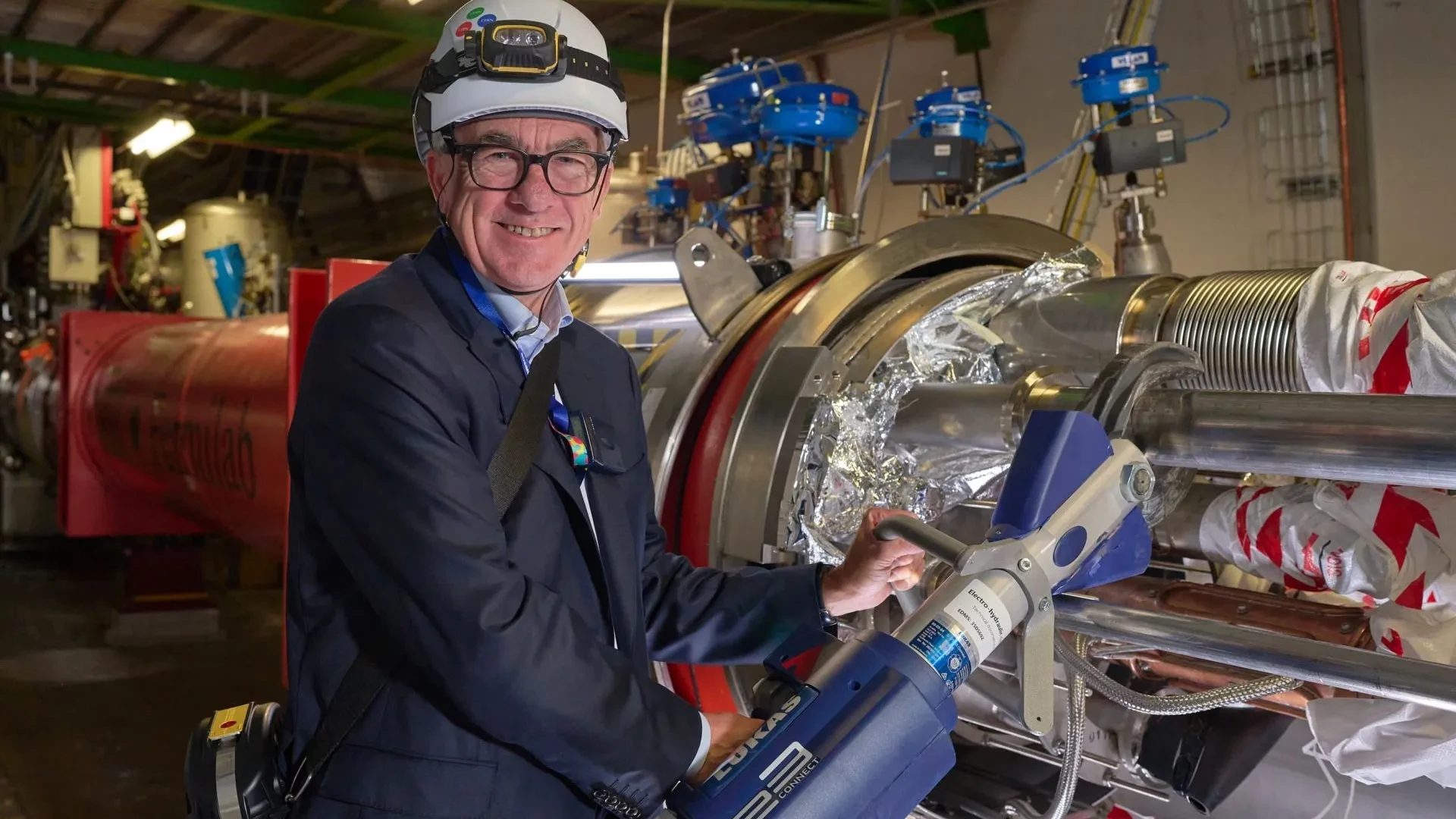
The official kick-off of the magnet extraction phase occurred in late 2024 and early 2025, culminating in a high-profile visit by CERN Director-General Mark Thomson to LHC Point 1, home to the colossal ATLAS experiment. Standing in the subterranean cavern, surrounded by the intricate labyrinth of cryogenics, power cables, and radiation shields, technical crews executed the first physical cut on a magnet interconnection.
This ceremonial yet intensely practical act severed the vacuum and electrical continuity of the beam line, paving the way for the extraction of the first wave of superconducting hardware. The meticulous de-installation process requires engineers to cut multi-layer thermal insulation, drain and recover thousands of liters of liquid helium, and systematically uncouple massive multi-tonne cold masses from their housing.
According to the current schedule, the dismantling of the old hardware will continue methodically through the mid-2020s. Following the removal phase, the tunnel infrastructure will undergo civil engineering modifications to accommodate larger, more robust cryostats and improved cooling systems. The first newly minted quadrupole magnets are scheduled to arrive in the LHC tunnel by the start of 2029. In total, the project will see the installation of 16 specialized cryostats and 28 complex cryo-assemblies, setting the stage for beam commissioning and the dawn of the high-luminosity physics run in the early 2030s.
Supporting Context & Metrics: The Engineering Marvel of Inner Triplets
To understand the magnitude of the LS3 upgrade, one must first examine the physics and engineering constraints that govern particle accelerators. The Large Accelerator operates on a simple yet violently energetic premise: accelerate two beams of hadrons (protons or lead ions) in opposite directions around a 27-kilometer ring at speeds approaching the speed of light, and guide them into microscopic head-on collisions inside massive detectors.
However, particles are notoriously difficult to herd. Because protons carry a positive electric charge, they naturally repel one another, causing particle beams to "bloom" or spread out as they travel. If left unchecked, the beams would be too diffuse when they meet at the collision points, resulting in few meaningful interactions and wasting billions of accelerated particles.
The Anatomy of an Inner Triplet
This is where the inner triplets enter the equation. Positioned symmetrically on both sides of the four main interaction points (ATLAS, CMS, ALICE, and LHCb), these clusters consist of three distinct quadrupole (four-pole) magnets working in concert.
- Focusing and Defocusing: While a dipole magnet is used to bend the beam around the circular ring, a quadrupole magnet acts like an optical lens for charged particles. One quadrupole focuses the beam horizontally while defocusing it vertically; the next does the exact opposite. By arranging them in a carefully calculated triplet configuration, beam physicists can squeeze the particle packets—known as bunches—in both transverse planes simultaneously.
- Squeezing to the Micron Scale: Just prior to entering the detectors at ATLAS and CMS, the inner triplets compress the particle beams down to a cross-sectional diameter of just a few tens of microns—thinner than a human hair. This extreme spatial confinement maximizes the spatial density of the beam, radically escalating the probability that two protons will violently intersect and smash into one another.
The Physics of Luminosity
In accelerator physics, the performance of a collider is quantified by a metric called luminosity ($L$). Luminosity measures the intensity of the particle collisions, defined mathematically as the proportionality factor between the number of events per second ($N$) and the interaction cross-section ($sigma$).
$$fracdNdt = L cdot sigma$$
To generate rare subatomic particles—such as the Higgs boson, supersymmetric partners, or hypothetical dark sector particles—researchers need massive datasets. By increasing instantaneous luminosity, the HiLumi LHC will multiply the collision rate by a factor of five to ten compared to the original design parameters.
While the original LHC was designed to deliver an integrated luminosity (the total accumulated data over a period) of around 300 inverse femtobarns ($fb^-1$) by the end of its operational lifetime, the HiLumi LHC aims to push that figure to an astonishing 3,000 to 4,000 inverse femtobarns. This tenfold increase in data collection capability will transform rare statistical anomalies into clear, definitive discoveries.
The Material Revolution: Niobium-Titanium to Niobium-Tin ($Nb_3Sn$)
The technological leap enabling this luminosity surge lies deep within the material science of the magnets themselves. For decades, particle accelerators have relied on niobium-titanium (Nb-Ti) alloys for superconducting wire. Nb-Ti is ductile, relatively easy to manufacture into multi-filamentary cables, and exhibits reliable superconducting properties at liquid helium temperatures (around 1.9 Kelvin).
However, Nb-Ti reaches a fundamental physical limit when attempting to generate magnetic fields significantly above 8 to 9 tesla. Beyond this threshold, the intense magnetic field disrupts the superconducting state, causing the material to transition back to a normal resistive state—a catastrophic event known as a "quench" that can damage the hardware.
To break past this barrier, CERN and its global industrial partners spent over a decade perfecting the synthesis, cabling, and winding of niobium-tin ($Nb_3Sn$) composite wires.
- Higher Critical Fields: $Nb_3Sn$ can remain superconducting in much stronger magnetic fields, allowing engineers to design magnets that operate routinely at 11.3 tesla or higher.
- Manufacturing Complexities: Unlike niobium-titanium, $Nb_3Sn$ is extremely brittle in its final superconducting phase. To build a magnet with it, technicians must wind the coils using unreacted precursor materials (niobium and tin filaments inside a bronze or copper matrix), subject the entire massive coil assembly to a grueling heat treatment furnace cycle at roughly 650°C to form the superconducting compound, and then impregnate it with epoxy resin without cracking the delicate structure.
This masterclass in materials engineering is what makes the HiLumi inner triplets possible, permitting a much stronger magnetic "lens" to be packed into the same physical footprint, thereby achieving a tighter squeeze on the beam.
Official Statements and Leadership Perspectives
The transition from the foundational LHC architecture to the high-luminosity era represents a generational handoff within the global scientific community. Leaders at CERN have emphasized both the technical triumph of the current machine and the visionary necessity of the upcoming upgrades.
Reflecting on the historical significance of the extraction operations, Markus Zerlauth, the HiLumi LHC Project Leader, highlighted the temporal bridge connecting the past two decades of discovery with the future of particle physics:
"Today’s event is a major milestone for CERN, especially for the HiLumi LHC project team. The current inner triplets date back to the LHC construction phase and were installed in the machine between 2005 and 2007. After nearly twenty years of operation, they will give way to a new generation of even more powerful magnets. It’s truly remarkable to witness such a handover from one generation of innovation to the next."
The operational complexity of executing this transition cannot be overstated. Coordinating thousands of contractors, specialized engineers, radiation safety officers, and cryogenics experts requires rigorous choreography. Jean-Philippe Tock, Head of the LS3 Coordination Team, elaborated on the scale of the physical deployment expected over the coming years:
"The replacement of these magnets with the new HiLumi LHC inner triplets is crucial for the coming high-luminosity years. The first quadrupole of the new triplets should arrive in the tunnel at the start of 2029. In total, 16 cryostats and 28 cryo-assemblies will be installed—a major undertaking."
These sentiments are echoed throughout the management structures of CERN’s major experimental collaborations. While ATLAS and CMS are undergoing direct, heavy retrofits to handle the immense particle debris resulting from tighter beams, the complementary experiments—ALICE and LHCb—are also realigning their strategies.
Although ALICE (specializing in quark-gluon plasma and heavy-ion collisions) and LHCb (probing matter-antimatter asymmetry and quark flavor physics) operate under different kinematic requirements and do not require the same raw instantaneous luminosity increases as ATLAS and CMS, their infrastructure is nonetheless being comprehensively overhauled. Their existing inner triplets will be maintained, but critical upstream and downstream components will be upgraded, ensuring that the entire CERN complex reaps the rewards of a modernized accelerator complex.
Future Outlook: What the HiLumi Era Means for Physics
As the last of the old inner triplets are pulled from the subterranean tunnels and the first $Nb_3Sn$ magnets are prepared for their eventual installation in 2029, the global high-energy physics community is looking ahead to the next horizon of discovery. The completion of LS3 and the launch of the HiLumi LHC will not merely represent an engineering upgrade; it will fundamentally rewrite the boundaries of our empirical understanding of nature.
Probing the Higgs Sector with Unprecedented Precision
Since its historic discovery in 2012 by the ATLAS and CMS collaborations, the Higgs boson has occupied a central role in the Standard Model of particle physics. It is the excitation of the Higgs field that imparts mass to fundamental elementary particles.
However, many questions about the Higgs boson remain shrouded in mystery:
- Does it couple to dark matter particles?
- Are there heavier, undiscovered scalar cousins of the Higgs predicted by theories like supersymmetry?
- What is the exact shape of the Higgs potential, and how did it behave during the electroweak phase transition in the early universe?
Answering these questions requires an astronomical volume of data. While the initial LHC runs provided enough Higgs bosons to establish its basic properties, the HiLumi LHC will produce at least 15 million Higgs bosons per year—transforming the discovery machine into a high-precision factory. With this immense statistical sample, physicists will be able to measure rare Higgs decay channels, search for deviations from Standard Model predictions, and detect subtle quantum loops that could point directly to physics beyond our current theoretical framework.
The Hunt for Dark Matter and Beyond-Standard-Model Physics
Astrophysical observations indicate that all visible stars, planets, and gas clouds account for a mere 5 percent of the mass-energy content of the universe. The rest is comprised of dark matter (roughly 27 percent) and dark energy (roughly 68 percent). Yet, the exact particulate nature of dark matter remains completely unknown.
The increased luminosity of the HiLumi LHC dramatically expands the collider’s kinematic reach. By ramping up the collision rate, researchers can probe higher energy scales and search for elusive, weakly interacting massive particles (WIMPs), sterile neutrinos, or supersymmetric partners that have thus far remained hidden beneath the statistical noise of background events.
A Global Technological Legacy
Beyond pure physics, the development of the HiLumi LHC continues to drive technological spillovers that benefit broader society. The advancements required to build, insulate, power, and cool high-field $Nb_3Sn$ superconducting magnets directly feed into other fields, including:
- Medical Technology: Improvements in high-field superconducting magnets enhance the resolution of Magnetic Resonance Imaging (MRI) scanners and compact particle accelerators used in advanced cancer proton-beam therapy.
- Power Grid Innovations: High-temperature and low-temperature superconducting cable research paves the way for lossless electrical power transmission over long distances.
- Big Data & Computing: The extreme data output of the HiLumi era—generating petabytes of information per second—drives innovations in distributed grid computing, machine learning, and artificial intelligence, echoing the legacy of the World Wide Web, which was famously invented at CERN in 1989.
As the technicians in the subterranean vaults beneath the Swiss countryside continue their meticulous work, tightening bolts, sealing cryostats, and laying the groundwork for a new decade of discovery, the Large Hadron Collider stands as a testament to human ingenuity. The cutting of that first magnet interconnection in late 2024 was more than just a mechanical disassembly—it was the opening chapter in a new quest to decode the fundamental laws of the universe.