

Executive Overview
The design and product development communities have fallen headfirst into a pervasive trap: conversational tunnel vision. Because Large Language Models (LLMs) are fundamentally trained on dialogue data, the industry has collectively—and lazily—decided that the chat bubble is the universal home for every conceivable AI capability.
While the conversational interface is a viable and powerful option for specific, exploratory tasks, it represents merely a single tool within an expansive digital toolkit. UX practitioners, product managers, and engineers must be deliberately intentional about the modalities they select for how users provide data and commands, and how systems present their outputs.
Modality—defined as the sensory channel a person uses to interact with a system, spanning sight, sound, touch, speech, and physical movement—dictates the success or failure of digital tools. Great user experience (UX) is never about forcing humans to adapt to machine mechanics; it is about matching modality directly to the user’s immediate context, intent, and cognitive load.
To break free from this conversational monolith, organizations must adopt rigorous evaluation frameworks, including Task Audits and Input/Output Alignment Matrices, ensuring that artificial intelligence is delivered through the most frictionless, context-aware interfaces possible.
Detailed Chronology: The Rise, Fall, and Realization of the Chat Bubble
Phase 1: The Generative AI Gold Rush (2022–2023)
When foundational LLMs burst into the mainstream public consciousness, software development experienced a seismic shift. Companies rushed to integrate generative capabilities into existing products overnight. The path of least resistance dominated boardrooms: wrap an API in a minimalist chat window featuring a blinking cursor and a text input box.

This blank slate signaled infinite possibilities, promising users that the system could handle anything they typed. However, it completely ignored decades of established Human-Computer Interaction (HCI) research.
Phase 2: The Hidden Cognitive and Linguistic Tax (2023–2024)
As enterprise users integrated generative AI into daily workflows, hidden friction points emerged. The text-heavy interface revealed severe operational flaws. Users began experiencing choice paralysis, forced to guess the exact phrasing required to trigger desired AI outputs.
Furthermore, systems returning dense blocks of text transferred heavy interpretive work onto the human. Users were no longer glancing at dashboards for rapid insights; they were forced to execute slow, sequential readings of narrative paragraphs—introducing an unnecessary cognitive tax into high-stakes environments.
Phase 3: The Context-Aware Pivot (2024–Present)
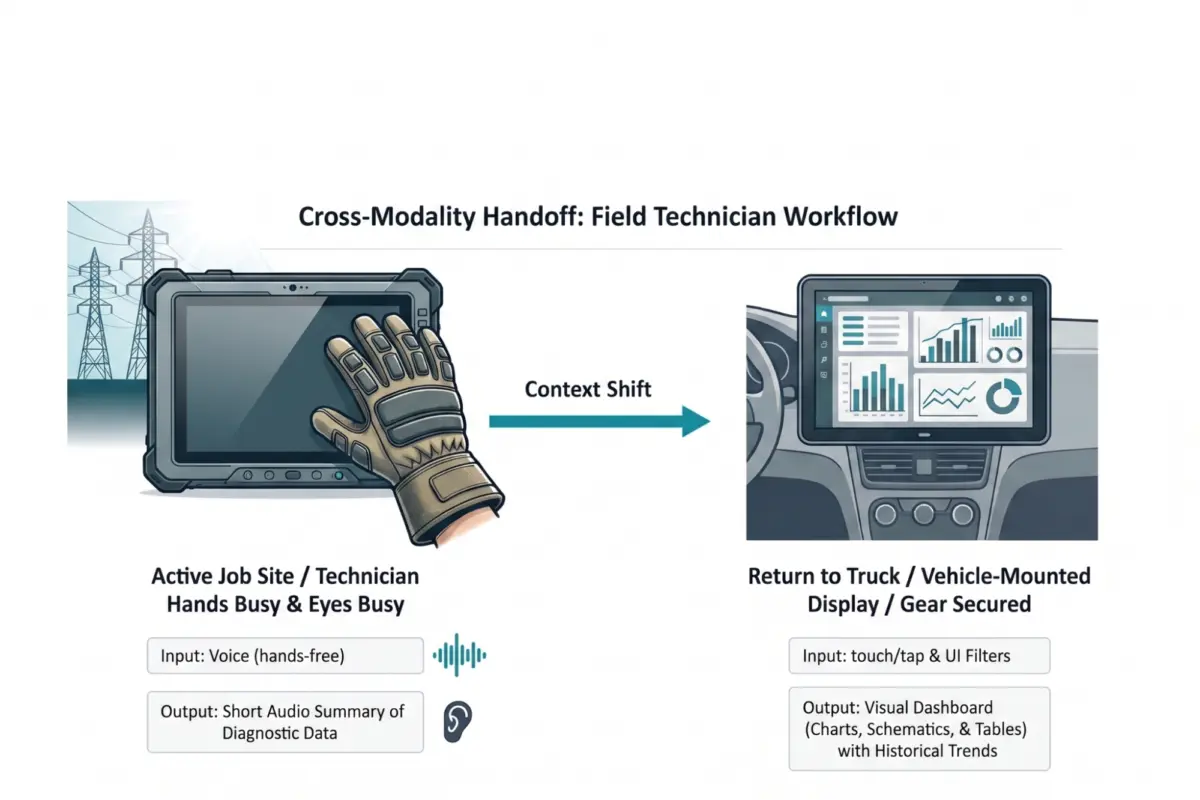
Today, the industry is experiencing a necessary maturation. Leading design teams are realizing that environmental constraints—such as a technician dangling from a high-voltage utility pole or a traveler dashing through a chaotic airport—make chat boxes not just inefficient, but hazardous.
The focus has shifted from what an AI model can generate to how that output is delivered across diverse, multi-modal ecosystems spanning voice, haptics, interactive canvases, and ambient visual displays.

Supporting Context & Metrics: The Reality of Cognitive and Physical Load
To understand why the default chat interface frequently fails, one must examine the physical and psychological burdens it imposes on users. These barriers can be broken down into two distinct categories: linguistic input barriers and cognitive output costs.
Input: The Linguistic Barrier of the Blank Box
In a traditional Graphical User Interface (GUI), menus, buttons, sliders, and filters provide clear visual affordances that signal every available option. They rely on recognition rather than recall.
Conversely, a blank chat box demands that users become active writers and prompt engineers.
- The Data Analyst Example: In a standard spreadsheet tool, an analyst applies logic via sorting and filtering buttons. In a chat interface, they must translate that complex logic into a perfectly structured natural language sentence, introducing choice paralysis and linguistic friction.
- The Creative Example: A digital designer knows precisely how they want an image’s lighting to feel, but forcing them to describe those fine textual nuances creates a massive barrier compared to adjusting a simple color picker or opacity slider.
Output: The Cognitive Tax of Serial Text Reading
Human brains process visuals through parallel processing—a user can look at a color-coded chart and spot a trend in under a second. Text, however, is a serial medium. The brain must ingest one word after another to extract meaning.
When an AI responds to a project status update with three long paragraphs instead of a visual dashboard, it replaces a quick glance with an exhaustive reading assignment. In high-stakes environments—such as a medical professional reviewing patient vitals or a stock trader monitoring a market spike—forced textual extraction slows down operations and drastically increases the margin for error.

Input and Output Modalities Taxonomy
| Modality | Best For | Example Contexts | Rationale |
|---|---|---|---|
| Button / Tap | Single-step, binary actions | Launching a feature; confirming an alert | Eliminates recall overhead via recognition; maximizes speed. |
| Voice | Hands-busy / eyes-busy tasks | Field technician queries; driving navigation | Offloads physical interaction to speech; bounded by noise and privacy. |
| Natural Language Chat | Ambiguous or exploratory queries | Researching options; multi-turn brainstorming | Offers creative freedom, though heavily dependent on prompt quality. |
| GUI (Sliders, Filters) | Complex parameter setting | Scheduling; data filtering; image editing | Prevents errors by dividing complicated tasks into visual parts. |
| Push Notification | Time-sensitive awareness | Price spikes; critical task completion | Provides rapid updates without demanding deep concentration breaks. |
| Visual Dashboard | High-density comparative analysis | Project tracking; resource allocation | Enables rapid outlier detection without line-by-line reading. |
Official Statements and Industry Insights
Design leaders and human-computer interaction researchers have increasingly spoken out against the lazy universalization of conversational interfaces.
"Modality is not merely an aesthetic choice; it is a profound ergonomic and cognitive alignment between human sensory channels and system capabilities," notes leading enterprise UX architects. "When we force a high-stress, physically demanding environment into a text-chat paradigm, we are failing our fundamental duty as designers: reducing friction, not inventing new barriers."
Industry analyses consistently demonstrate that enterprise AI tool adoption skyrockets when systems adapt to user environments rather than demanding workflow overhauls. Organizations that embrace multi-modal design—matching voice inputs with audio summaries in the field, and transitionary visual dashboards back in the office—report measurable efficiency gains of up to 20% alongside significant reductions in operational errors.
Future Outlook: The Multi-Modal Ecosystem
The future of human-AI interaction is not singular; it is a rich, responsive ecosystem. As hardware evolves through ambient computing, wearable devices, augmented reality (AR) glasses, and advanced haptic feedback, the reliance on glass screens and text boxes will diminish.
The Rise of Adaptive Handoffs
Future AI applications will dynamically shift modalities based on real-time telemetry and environmental context. Consider a workflow that begins with a hands-free voice query while a worker is on an active factory floor, seamlessly transitions to an interactive spatial canvas on a tablet during a mid-shift review meeting, and concludes with an ambient push notification sent directly to a smartwatch.

Grounding Design in Field Evidence
To achieve this future, product teams must abandon assumptions. Before writing a single line of code, designers must step out of the office and conduct rigorous Task Audits. By evaluating physical constraints (such as protective gloves, extreme glare, and high noise levels) and cognitive baselines (such as verification anxiety and reading density), teams can build truly resilient interfaces.
The chat window will always remain a vital room in the AI house. But it is time to stop trying to live in the hallway. By aligning input and output modalities with the genuine needs, environments, and intents of human users, we can finally bridge the gap between brilliant machine intelligence and intuitive human experience.