

Executive Overview
Over the past week, media cycles have been dominated by urgent warnings of “drastic measures,” “astronomical fines,” and “sweeping new AI rules” set to alter the digital landscape in Europe. For product managers, UX designers, and compliance officers serving the European Union, the panic is palpable. However, cutting through the hyperbolic headlines reveals a regulatory framework that is far more nuanced, pragmatic, and measured than initially feared.
At its core, the European Union’s new transparency mandate—which officially took effect on August 2, 2026—is not about penalizing innovation. Rather, it is designed to establish baseline honesty across digital ecosystems. Specifically, it mandates that when artificial intelligence generates or manipulates content that could easily be mistaken for human work, users must be informed clearly, explicitly, and unambiguously.
Much like the European Accessibility Act (EAA) and the General Data Protection Regulation (GDPR), these regulations do not exclusively apply to companies headquartered within the EU. Any enterprise worldwide that operates within the EU market, serves European citizens, or deploys AI-generated outputs consumed by EU residents must comply.
As digital product teams race to adapt, the old playbook of dropping a vague, ambiguous "sparkle" icon into a user interface is officially dead. This article breaks down what the new EU guidelines mandate, where the fine lines of compliance lie, why standard UI tropes fall short, and how product teams can design future-proof, transparent AI interfaces.
Detailed Chronology and Legal Framework
The journey toward the August 2026 transparency mandates has been years in the making, reflecting the European Commission’s methodical approach to reigning in unbridled generative technology while preserving technological competitiveness.
The Timeline of Transparency
- April 2021: The European Commission first proposes the comprehensive Artificial Intelligence Act, introducing risk tiers ranging from unacceptable to minimal risk.
- March 2024: The European Parliament formally adopts the final compromise text of the AI Act, setting the stage for staggered enforcement deadlines.
- Late 2024 – 2025: Regulatory bodies draft Codes of Practice, inviting industry feedback on digital watermarking, machine-readable metadata, and user interface (UI) design patterns for AI disclosures.
- August 2, 2026: Article 50 transparency obligations officially take effect. Providers and deployers of AI systems must now ensure that artificially generated or manipulated content is explicitly labelled.
Article 50(4): Providers vs. Deployers
Under Article 50(4) of the AI Act, legal obligations are split between two primary actors:

- Providers: The entities that build, train, or place an AI system on the market under their own name or trademark.
- Deployers: The organizations or businesses that utilize an AI system in a professional capacity to deliver services or content to end-users.
Crucially, businesses cannot bypass their legal obligations simply by licensing an external AI model or third-party tool via an API. If a marketing agency or e-commerce platform uses a third-party generative model to produce commercial content for EU consumers, the deployer shares the responsibility for ensuring transparent labelling.
What Actually Needs Labelling (and What Doesn’t)
A common misconception is that every piece of text, code, or image touched by an algorithm must carry an intrusive disclaimer. This is fundamentally untrue. The vast majority of everyday AI-assisted workflows—such as using an LLM to brainstorm outlines, debugging code snippets, or organizing internal data—fall entirely outside the scope of the transparency rules.
Clear Triggers for Mandatory Disclosure
According to the European Commission’s final guidelines, explicit labelling is legally required in the following scenarios:

- Synthetic Media (Deepfakes): Any AI-generated or heavily manipulated image, video, or audio file that depicts real people, places, objects, or events in a way that appears authentic.
- Public Interest Content: AI-generated text, articles, or automated communications addressing matters of public interest—defined broadly to include health, safety, environmental policy, economic conditions, financial markets, politics, science, and culture.
- Chatbots and Conversational Agents: Users interacting with a conversational AI must be explicitly notified that they are communicating with a machine, unless it is entirely obvious from the context.
The Human-in-the-Loop Exemption
The most crucial nuance for content creators, publishers, and marketers is the editorial review exemption. The disclosure obligation does not apply if the AI-generated text has undergone a substantive, manual review and edit by a human being, with a named individual or legal entity taking formal editorial responsibility for the final output.
However, the Commission has set a high bar for what qualifies as "edited." A mere quick skim or passive approval does not suffice.
The Fine Line Between "Edited" and "AI-Generated"
Where exactly does human editing end and AI generation begin? This grey area has kept corporate legal teams awake at night.

What Does NOT Count as AI Generation
The EU guidelines explicitly carve out standard assistive tools and minor modifications. The following workflows do not trigger disclosure requirements:
- Spellcheck, grammar corrections, and syntactic formatting.
- Basic image cropping, resizing, and color correction.
- Automated mechanical translation (where a human provides the source text, and an algorithm translates it).
- Minor text polishes on content originally drafted by a human writer.
What DEFINITELY Counts as AI Generation
Conversely, substantial automated alterations require clear and permanent disclosure:
- AI-generated summaries of lengthy documents or articles.
- Composite imagery, inpainting, or adding/removing significant elements from a photograph.
- Substantive AI rewrites where the core structure and phrasing are autonomously synthesized by a model.
- Pre-filled form fields generated entirely by AI without meaningful human validation.
In practice, if an AI model drafts a paragraph from scratch, it requires a label. If a human writes a rough draft and an AI simply fixes a typo, it does not. The rule of thumb relies on the locus of creative intent: if the machine did the heavy lifting of creation, the audience has a right to know.

Why AI Sparkles Are No Longer Enough
For years, product designers have relied on shorthand visual cues—most notably the ubiquitous "sparkle" icon ($star cdot diamond$)—to signal to users that a feature is powered by artificial intelligence. UX research, however, reveals a fundamental flaw in this pattern: ambiguity.
The Ambiguity of the Sparkle
As highlighted by recent research from the Nielsen Norman Group (NNG) and digital design communities, the sparkle icon is frequently overused. Product teams slap sparkles onto everything from cloud sync features and smart folders to predictive text and deep generative models.
Consequently, users view sparkles as a generic branding motif for "modern software" rather than a precise factual disclosure. A user cannot look at a sparkle icon and determine whether the specific content on their screen was generated by an algorithm or written by a human.

The Official EU AI Icon Set
To resolve this ambiguity, the European Commission has published an official EU AI icon set. These standardized visual marks are designed to cleanly differentiate between:
- Basic AI-powered utility features.
- Fully AI-generated content.
- Partially AI-modified content.
Crucially, the European Commission has issued a stark warning: simply displaying an icon does not establish legal compliance.
- Icons tucked away in low-contrast footer menus violate the mandate.
- Transient labels that fade away after three seconds are non-compliant.
- Visual cues must be accessible to assistive technologies (such as screen readers for visually impaired users) and must persist even if the content is downloaded, exported, or reshared across platforms.
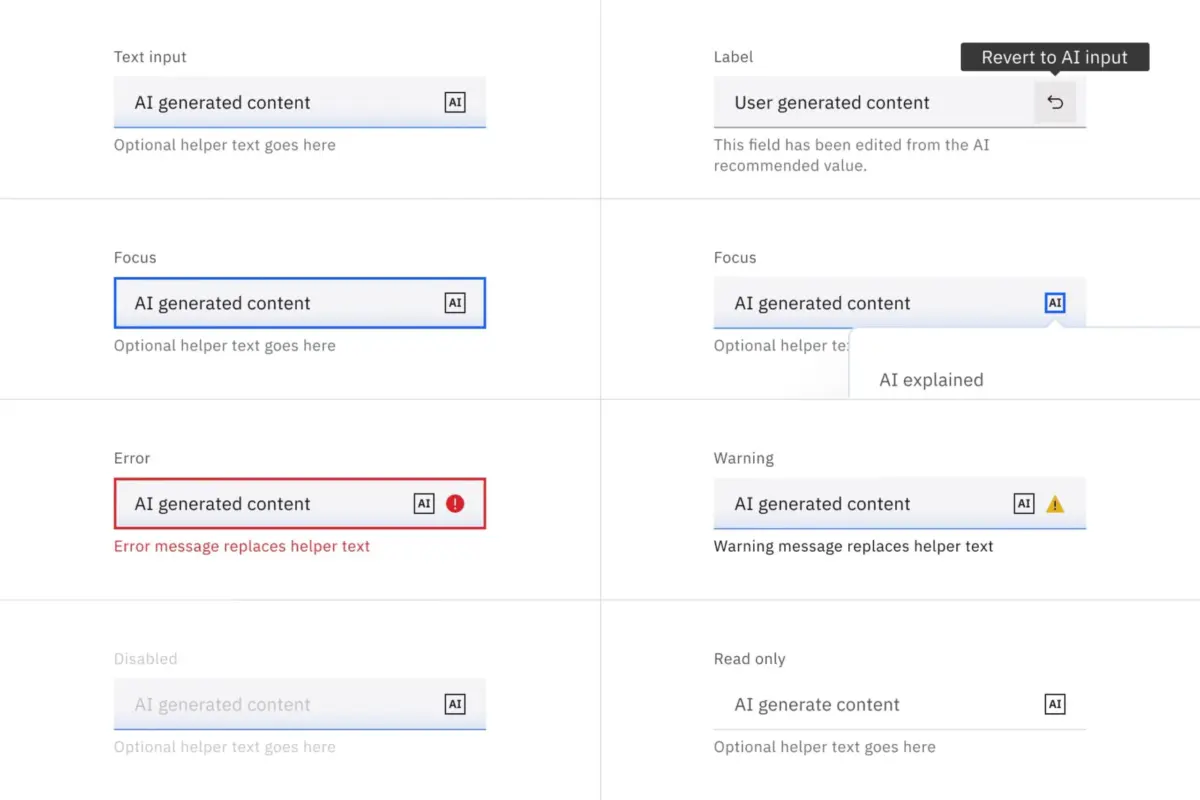
UX design systems—such as IBM’s Carbon Design System, which has pioneered dedicated AI label components—demonstrate the gold standard: pairing an unmistakable AI icon with plain-text descriptors like "AI-generated" alongside expandable explainability panels.

A Global Regulatory Pattern
While European businesses are currently adapting to the August 2026 enforcement date, it would be a mistake to view these rules as an isolated European phenomenon. Across the globe, parallel regulatory frameworks are rapidly converging on the exact same pattern:
- United States: State-level laws are tightening rapidly, with specific statutes targeting synthetic human performers (digital voice and likeness rights), mandatory disclosures for political advertising, and rigorous guardrails for generative tools in education and finance.
- China: The Cyberspace Administration of China enforces strict provisions requiring deep synthesis service providers to explicitly tag AI-generated images, videos, and audio with machine-readable metadata and visible user alerts.
- Canada and the UK: Emerging guidelines from competition and data protection watchdogs strongly advise transparency in automated communications to prevent consumer deception.
What we are witnessing is not a fragmented coincidence, but a unified global regulatory consensus: Deception by omission is no longer acceptable.
Future Outlook: Moving Toward Trustworthy UX
The implementation of the EU AI transparency rules marks the end of the "Wild West" era of generative AI deployment. Far from stifling creativity, these regulations offer a unique opportunity to build genuine consumer trust.

When users can easily distinguish between authentic human storytelling and algorithmic generation, the fear of "AI slop" diminishes. Product designers and engineers who embrace transparent interface patterns early will find themselves ahead of the curve, protecting their enterprises from costly regulatory penalties while fostering healthier digital experiences.
Meet “Design Patterns For AI Interfaces”
As product teams navigate these complex regulatory and UX challenges, having the right practical resources is essential. Design Patterns For AI Interfaces is a comprehensive video course created by interface expert Vitaly Friedman. Featuring real-life product teardowns, UX best practices, and actionable design patterns, it helps designers build compliant, intuitive, and user-friendly AI features.
Useful Resources & Official Documentation
- European Commission Official Statement on AI Transparency
- Article 50(4) of the EU AI Act FAQ
- EU Code of Practice for AI-Generated Content
- Official EU AI Icon Set & Labelling Guidelines
- Carbon Design System AI Component Guidelines
- Nielsen Norman Group Research on the AI Sparkle Icon Problem