There is no modern-day Field of Dreams for independent local publishers. The romanticized mantra of “if you build it, they will come”—where the “it” is rigorous, investigative journalism and the “they” are community members eagerly paying for subscriptions to support the lifeblood of a healthy democracy—rarely holds true in the harsh light of the contemporary media market.
For years, media analysts, academic institutions, and industry insiders have recognized this sobering truth. Yet, despite systemic financial headwinds, a glaring lack of commercial infrastructure, and the relentless demands of operating as a one-person or small-team show, local news entrepreneurs continue to find ways to defy the odds. They are stepping into the widening news deserts left behind by the contraction, corporate gutting, and outright collapse of legacy community newspapers.
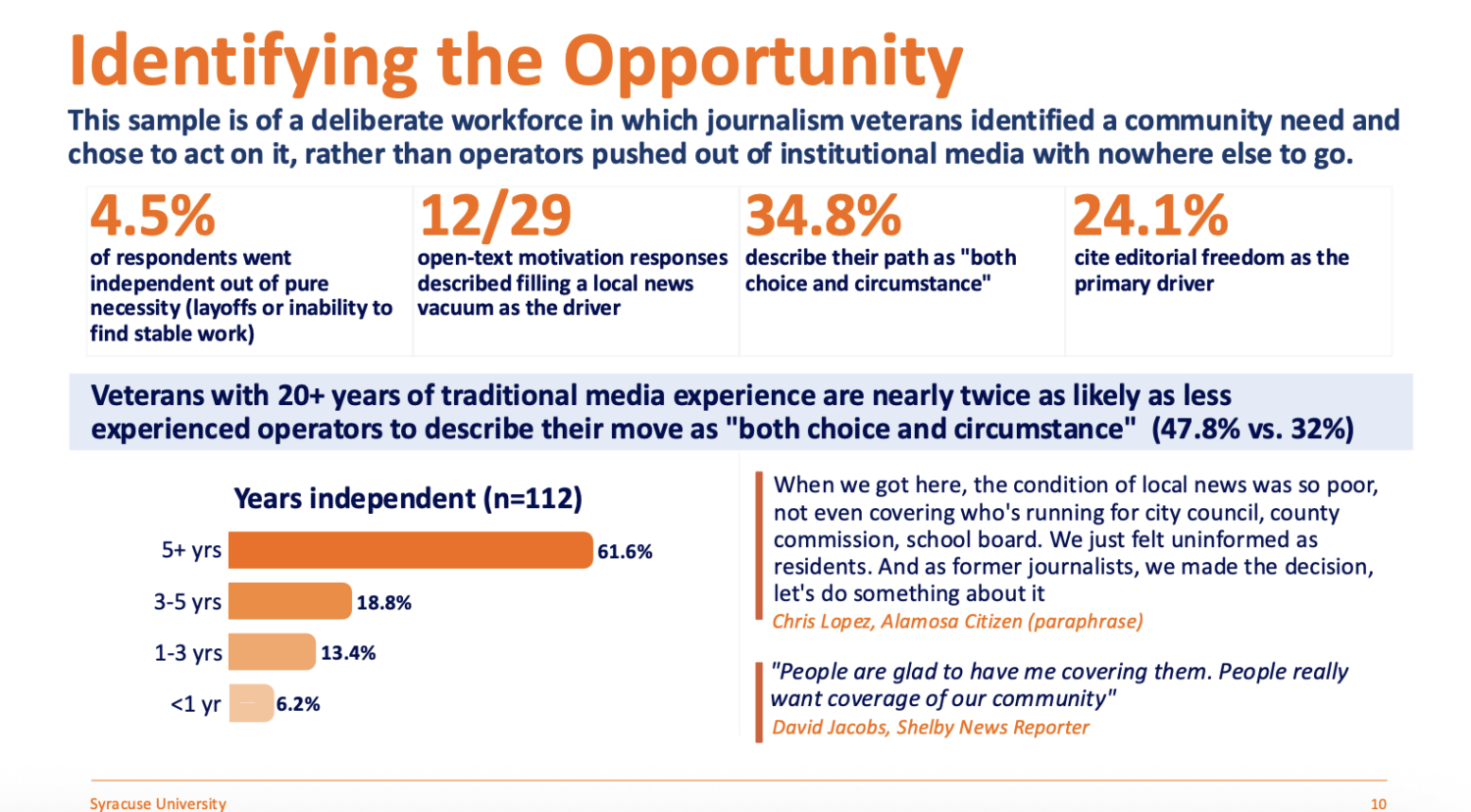
A comprehensive new study by Syracuse University’s Institute for Democracy, Journalism and Citizenship (IDJC) pulls back the curtain on the arduous daily realities facing these independent publishers. Titled “A Hard Reality: Independent Local Journalism in the United States,” the research—conducted by Merrill Brown and Jacob Spudich—examines survey data from 112 independent publishers operating across 37 states and Washington, D.C.
The findings present a nuanced portrait of an emerging sector defined equally by its radical ingenuity and its precarious fragility. While the newsrooms surveyed occupy wildly divergent phases of maturity—ranging from scrappy garage startups to relatively stable digital outlets—Spudich notes that for many, simply keeping the lights on and publishing vital local news constitutes a profound, mission-accomplished milestone.
However, the report carries an urgent warning: producing exceptional journalism is no longer enough to guarantee survival. From day one, founders must grapple with complex revenue engineering, product development, audience retention, and relentless community engagement. Worse yet, the study reveals a striking paradox: success breeds burnout. As local news sites grow and secure more paying subscribers, the operational burden escalates to levels that frequently push founders to the brink of exhaustion.
Detailed Chronology: The Evolution of the Independent News Movement
To understand where independent local journalism stands today, it is necessary to trace the trajectory of how the modern news ecosystem arrived at this inflection point. The crisis of local news is not a sudden catastrophe; it is a decades-long erosion that has fundamentally reshaped civic life in America.
Phase One: The Collapse of the Legacy Model (Late 2000s – 2010s)
For generations, local newspapers functioned as civic anchors, sustained by a lucrative monopoly on local advertising—classifieds, automotive, real estate, and retail display ads. When the digital revolution fractured that advertising model, tech platforms like Craigslist and social media giants siphoned off critical revenue streams.
As corporate conglomerates and private equity firms swept up regional newspaper chains, they implemented aggressive cost-cutting measures. Newsrooms were hollowed out through rolling layoffs, buyouts, and centralized printing operations. Communities that once relied on dedicated beat reporters covering city hall, local school boards, and county courts suddenly found themselves sliding into "news deserts"—geographic areas stripped of reliable, accountability-driven reporting.
Phase Two: The Rise of the Accidental Entrepreneur (2010s – 2020)
Out of the ashes of traditional newsrooms emerged a new breed of publisher: the laid-off journalist. Armed with little more than a laptop, a content management system, and deep institutional knowledge of their communities, former reporters began launching independent digital news sites.
Initially viewed as niche anomalies, these hyper-local outlets proved that audiences still craved community-level reporting. However, these founders typically launched their ventures driven by a journalistic imperative rather than a business plan. They learned revenue development, audience acquisition, and platform management through trial and error, often subsidizing their early operations with freelance work or personal savings.
Phase Three: Institutional Reckoning and the Creator Economy (Present Day)
Today, independent digital news has graduated from a decentralized experiment into a distinct segment of the modern "creator economy." Over the past two decades, approximately 1,500 local digital news organizations have launched across the United States.
Infrastructure organizations—such as LION Publishers (Local Independent Online News), the Institute for Nonprofit News (INN), the American Journalism Project (AJP), and the Center for Cooperative Media at Montclair State University—have begun stepping in to provide operational networks, capital investments, and scaling resources. Yet, as the Syracuse IDJC study highlights, the infrastructure supporting these entrepreneurs remains dangerously thin relative to the scale of the crisis.
Supporting Context & Metrics: Hard Numbers Behind the Headlines
The IDJC study, “A Hard Reality,” provides empirical weight to what many industry observers have long suspected anecdotally. By surveying 112 publishers across 37 states and Washington, D.C., Brown and Spudich mapped out the financial, operational, and psychological contours of contemporary independent journalism.
The Revenue Paradox and Financial Precarity
One of the most alarming revelations of the Syracuse study concerns the personal financial stability of the entrepreneurs themselves. Independent local journalism is often championed as a viable economic alternative to corporate media layoffs, but the data tells a sobering story:
Income Disparity: Only 4 in 10 publishers surveyed derive 100% of their personal income from their local news sites.
The Subsidy Gap: For 1 in 5 respondents, the news organization accounts for less than a quarter of their total personal income, indicating that founders are relying on side hustles, pensions, or spouses to make ends meet.
Monetization Reliance: Despite shifts toward reader-revenue models across the media industry, 8 out of 10 surveyed publishers remain heavily or almost solely dependent on advertising-driven business models.
This reliance on advertising presents a structural vulnerability. Small, independent digital outlets often struggle to compete with programmatic ad networks or capture national ad dollars, leaving them dependent on local businesses that may also lack marketing budgets.
The Burnout Epidemic
Perhaps the study’s most striking psychological finding centers on the cost of growth. In traditional industries, business growth alleviates stress by generating revenue to hire staff and delegate tasks. In independent local news, however, growth often accelerates burnout.
The research reveals that more than half of the respondents experiencing peak burnout risk are actually performing well with paying subscribers. When a local news site gains traction, the volume of tips, community demands, administrative overhead, and content production scales exponentially. For a solo founder or a two-person shop, this success translates directly into longer hours, unmanageable workloads, and emotional exhaustion.
The Ultimate Vote of No Confidence
For years, mainstream media pundits questioned whether startup founders would eventually return to legacy newsrooms once market conditions stabilized. The Syracuse study definitively answers that question.
When asked if they would ever return to a traditional newsroom, fewer than 2% of surveyed publishers said yes.
This statistic serves as an indictment of corporate media management. Independent publishers view legacy newsrooms—particularly those controlled by remote private equity firms—as fundamentally broken operations that prioritize shareholder extraction over public service. For these entrepreneurs, the punishing realities of running a micro-newsroom are vastly preferable to the indignities and instability of corporate journalism.
Official Statements & Expert Insights: A Q&A with Merrill Brown
To unpack the deeper implications of the IDJC report, researcher Merrill Brown spoke extensively about the intersection of business acumen, community integration, and the macro-trends defining the local news revolution.
On the Realities of the Movement
"We set out to look at how local news entrepreneurs are faring," Brown explained. "There are thousands of them around the country dealing with the reality of covering and engaging with their communities with small teams, if they have any support at all. They are often working out of their homes and on their own. But it’s not a brand-new phenomenon… and there’s enough history here that it seems it merits taking a hard look at who they are and how they’re doing."
On the Dual Demands of Journalism and Business
Brown emphasized that success in the independent sector requires an immediate recalibration of skill sets. Founders cannot afford to view themselves strictly as journalists; they must function as chief executive officers, product managers, and community organizers.
"Success isn’t just about producing great journalism. From day one, entrepreneurs have to be thinking about revenue, the product itself, and community engagement," Brown said. "Community engagement doesn’t fall neatly into an editorial bucket… The people who feel like they’re making it are really involved in their communities."
This community integration goes beyond attending city council meetings. It requires embedding oneself within the commercial and social fabric of the town—knowing local merchants, understanding regional economic drivers, and listening to the daily concerns of residents.
On Closing the Business Skills Gap
When questioned about why so many journalists remain ill-equipped for the commercial realities of running a media enterprise, Brown pointed to systemic gaps in higher education and industry support systems.
"There is enormous room for the expansion of business skills academic programs," Brown noted. "People going into this facet of the ‘creator economy’ have to understand how they’re going to build businesses. At the same time, organizations like LION and INN are doing tremendous work, but they have funding challenges and many priorities. I’m not sure today’s funders recognize how much attention and, of course, funding all these news entrepreneurs require. There aren’t enough boot camps, aren’t enough places for people considering starting news sites to get advice, and too few playbooks."
On the Blind Spot of the National Media Narrative
Brown expressed deep frustration regarding how national media outlets frame the state of journalism. While urban newspapers and national networks dominate headlines with stories of layoffs and financial distress, the quiet, decentralized renaissance unfolding across small-town and suburban America is routinely overlooked.
"It is enormously frustrating that there isn’t a wider understanding even in the media community that local journalism is in the midst of a promising revolution," Brown observed. "Somebody in Washington seeing the troubles of The Washington Post or someone in a news desert seeing the collapse of local news coverage… probably doesn’t recognize that all this is part of a larger set of circumstances that’s a national problem, a problem for our democracy and for our civic lives."
Future Outlook: Charting a Path Forward for Independent News
As the independent local news movement matures, its long-term viability will depend on systemic structural changes across philanthropy, education, and industry collaboration. The heroic efforts of individual founders working 80-hour weeks out of their home offices cannot indefinitely substitute for a sustainable economic ecosystem.
1. Re-Engineering Journalistic Education
J-schools and graduate programs must undergo a pedagogical overhaul. Equipping students solely with reporting, writing, and ethics training is no longer responsible preparation for the modern media marketplace. Curriculums must integrate mandatory coursework in digital product management, monetization strategies, audience analytics, and small business operations. Aspiring founders must graduate fluent in P&L statements, ad sales, reader-revenue conversion funnels, and donor stewardship.
2. Scaling Philanthropic and Institutional Support
While philanthropic heavyweights like the American Journalism Project, the Lenfest Institute, and Knight Foundation have injected critical capital into the ecosystem, the sheer volume of independent startups demands a massive expansion of funding. Support cannot be restricted to a handful of high-profile nonprofit outlets in major metropolitan areas; micro-publishers in rural counties and smaller municipalities require targeted grants, operational mentorship, and legal assistance.
3. Expanding Cooperative and Shared-Service Models
To combat isolation and operational burnout, independent publishers must lean into cooperative networks. Models pioneered by organizations like the Center for Cooperative Media—where independent outlets pool resources, share back-office administrative tasks, syndicate reporting, and combine ad sales efforts—offer a blueprint for operational relief. By reducing the administrative burden on individual founders, these networks can help mitigate the relentless burnout identified by the Syracuse study.
4. Broadening Public Awareness
Ultimately, saving local journalism requires shifting public consciousness. Citizens must be educated to view local news not as a passive commodity consumed for free on social media, but as essential civic infrastructure—on par with clean water, public libraries, and local schools. Until communities fully recognize that quality independent journalism requires direct financial investment, the publishers working to keep their towns informed will remain locked in a grueling battle against burnout and financial precarity.
The independent local news revolution is real, vital, and happening across America. Whether it survives to anchor the future of our democracy will depend on whether the rest of the media ecosystem, philanthropy, and the public are willing to give these entrepreneurs the structural support they so urgently deserve.