In the fast-paced ecosystem of search engine optimization (search marketing), the sheer volume of available software platforms can paralyze even seasoned digital strategists. A quick query for the "best keyword research tools" returns thousands of bloated listicles—spanning 10, 20, or even 100 options—leaving marketers overwhelmed, confused, and no closer to an actionable execution plan.
To cut through the digital noise and establish an authoritative industry benchmark, a comprehensive survey was conducted involving 139 leading search marketing experts. These industry veterans, enterprise SEO directors, agency founders, and growth content marketers were posed a deceptively simple question:
"If you could only use 3 tools for keyword research, which 3 would you choose?"
The findings provide a clear, data-backed consensus. Far from requiring a fragmented dozen-tool tech stack, the elite cohort converges heavily around a proven, battle-tested triumvirate. Leading the leaderboard by a wide margin are Semrush (claiming 87 votes), followed by Google Keyword Planner (57 votes), and Ahrefs Keywords Explorer (55 votes).
This report analyzes the collective insights of these 139 experts, dissects the core tools dominating the leaderboard, explores alternative utility players, and provides an authoritative framework for building a profitable online marketing campaign.
Detailed Breakdown: The Top 3 Leaderboard Titans
An analysis of the votes reveals that the market is largely anchored by all-in-one SEO suites that blend massive multi-national keyword databases with deep competitor intelligence. Let’s examine the standout features of the top three platforms driving success for modern agencies and brands.
1. Semrush (87 Votes)
Semrush captured the top spot on the expert leaderboard, cementing its status as an industry-leading, all-in-one SEO and PPC suite. Boasting a massive database of over 23 billion keywords spanning 142 international databases, Semrush provides the depth required for advanced topical and competitor research.
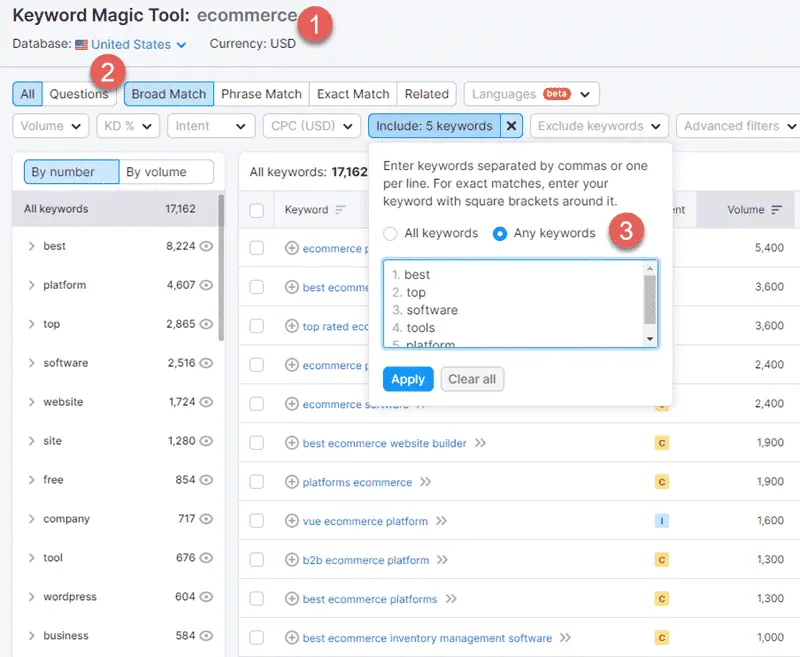
Keyword Magic Tool: Highly praised for its capacity to group keywords by topic, search intent, question type, and SERP features. Users can effortlessly funnel keyword lists directly into position trackers or PPC campaigns.
Keyword Gap Tool: Allows digital marketers to execute side-by-side comparisons of up to five competitors simultaneously, revealing missed organic opportunities and competitive vulnerabilities.
2. Google Keyword Planner (57 Votes)
As the native platform sitting directly on top of Google’s data infrastructure, Google Keyword Planner (GKP) remains a foundational pillar for traffic volume estimation. While modern updates restrict granular search volume data to active Google Ads accounts—offering free users only broad ranges—it remains a trusted baseline for relative traffic data and regional targeting.
PPC & SEO Synergy: Experts note that while GKP is fundamentally a paid advertising tool, its historical data and keyword clustering capabilities provide valuable directional insights when cross-referenced with organic platforms.
3. Ahrefs Keywords Explorer (55 Votes)
Ahrefs secures its position as a powerhouse alternative and primary hub for many enterprise SEOs. Its Keywords Explorer report delivers exhaustive topical opportunities across multiple search engines, including Google, Bing, Yahoo, YouTube, and Amazon.
Keyword Ideas Report & SERP Overview: Beyond basic volume metrics, Ahrefs provides robust clickstream data, return rates, and comprehensive SERP history snapshots, helping marketers evaluate the true traffic potential of a given phrase.
Supporting Context & Metrics: What the Experts Are Saying
While the Big Three dominate the top of the leaderboard, the 139 surveyed experts highlighted a diverse range of auxiliary tools, free Chrome extensions, and qualitative methodologies required to build a holistic keyword research ecosystem.
The Rise of Search Intent and Content Clustering
A recurring theme among top-tier strategists is that traditional keyword research—obsessed solely with exact-match phrases and raw search volume—is largely outdated. Modern SEO requires a granular focus on search intent and topic modeling.
Brendan Hufford (Growth Content Marketer, ActiveCampaign) emphasizes: "If I only had 3 keyword research tools, I’d use tools that focus more on topical research and search intent instead of ‘keywords.’ Simply doing the research and putting the keywords in the right places won’t help you rank if you don’t match the search intent."
Suganthan Mohanadasan (Co-Founder, Snippet Digital) advocates for tools like Keyword Insights, noting that advanced natural language processing (NLP) and machine learning are now essential for clustering keywords and determining whether a query demands a single blog post, an FAQ section, or a transactional product page.
Leveraging Competitor Gaps and Reverse-Engineering
Many contributors highlighted the efficiency of spying on competitors to uncover low-hanging fruit rather than brainstorming from scratch.
Gael Breton and Luke Monaghan (International SEO Manager, Lululemon) rely heavily on competitive intelligence platforms like Semrush and SISTRIX. By analyzing the exact terms driving organic traffic to rival domains, brands can systematically capture established market share.
Chris Dreyer (CEO, Rankings.io) points out the immense value of Ahrefs’ SERP position history, which provides a historical snapshot of how competitors perform over time, allowing agencies to map out defensive and offensive positioning strategies.
Unearthing the "Human Element"
A fascinating sub-narrative among the expert responses is the pushback against relying exclusively on software. Several veterans advocate for direct human interaction and unconventional tools.
Kurt Frankenberg (Founder, Shoestring101) shares an unconventional yet highly effective approach: "My first, second, and third SEO tool is actual human interaction, plus a yellow pad to jot down responses… Asking paying customers how they found us on the internet yields actual customer-generated keywords that are better than any software tool."
Paul Shapiro (Technical SEO Lead, Shopify) champions tools like Seed Keywords to run micro-surveys, discovering how real consumers naturally phrase queries before filtering them through technical databases.
Official Insights & Notable Tool Mentions
Beyond the primary leaderboard, the expert panel frequently cited several specialized auxiliary resources:
AnswerThePublic & Keywords Everywhere: Widely praised for instantly mapping out question-based queries (who, what, where, why) and injecting search volume data directly into the browser during manual Google searches.
KWFinder (Mangools): Noted for its exceptionally user-friendly interface, robust long-tail discovery, and precise keyword difficulty scores.
Google Search Console (GSC): Frequently cited as an underutilized goldmine. Experts like Charlie Williams (Screaming Frog) and Emily Yost (Superscript Marketing) remind marketers to mine GSC for queries already driving impressions but suffering from low click-through rates (CTR), representing immediate optimization wins.
BuzzSumo: Though not a traditional keyword tool, it remains an indispensable asset for content ideation, identifying trending social topics, and understanding what formats (listicles, infographics) resonate within a specific niche.
Future Outlook: The Evolution of Keyword Research
As we look toward the future of search marketing, the definition of keyword research continues to evolve. The convergence of machine learning, semantic search, and multi-platform discovery (YouTube, Amazon, TikTok, and generative AI search experiences) means that keyword research is no longer a static, one-time spreadsheet exercise.
The collective wisdom of these 139 experts points toward a unified conclusion: Success belongs to the marketer who combines robust enterprise data suites (like Semrush and Ahrefs) with granular search intent analysis and qualitative customer insights.
By narrowing your toolkit to a focused, synergistic stack—rather than hoarding dozens of disjointed software subscriptions—you can streamline your workflow, uncover hidden topical gaps, and build resilient, high-converting organic marketing campaigns that withstand algorithmic shifts.


![139 Experts Reveal Best Keyword Research Tools [Leaderboard]](https://www.robbierichards.com/wp-content/uploads/2021/01/Best-Keyword-Research-Tools-for-SEO.jpg)
![139 Experts Reveal Best Keyword Research Tools [Leaderboard]](https://www.robbierichards.com/wp-content/uploads/2021/10/Semrush-home-page-screenshot.jpg)
![139 Experts Reveal Best Keyword Research Tools [Leaderboard]](https://www.robbierichards.com/wp-content/uploads/2022/05/image12.png)
![139 Experts Reveal Best Keyword Research Tools [Leaderboard]](https://www.robbierichards.com/wp-content/uploads/2022/06/Keyword-Gap-Tool.jpg)
![139 Experts Reveal Best Keyword Research Tools [Leaderboard]](https://www.robbierichards.com/wp-content/uploads/2018/08/rj-employee_Robbie-color-new.png)
![139 Experts Reveal Best Keyword Research Tools [Leaderboard]](https://www.robbierichards.com/wp-content/uploads/2022/06/Google-Keyword-Planner.jpg)
![139 Experts Reveal Best Keyword Research Tools [Leaderboard]](https://www.robbierichards.com/wp-content/uploads/2022/06/Ahrefs-home-page.jpg)
![139 Experts Reveal Best Keyword Research Tools [Leaderboard]](https://www.robbierichards.com/wp-content/uploads/2021/08/Luke-Monaghan-headshot.jpg)
![139 Experts Reveal Best Keyword Research Tools [Leaderboard]](https://www.robbierichards.com/wp-content/uploads/2021/08/Gael-Breton-headshot.jpg)
![139 Experts Reveal Best Keyword Research Tools [Leaderboard]](https://www.robbierichards.com/wp-content/uploads/2015/04/KW-Expert-Roundup.jpg)
![139 Experts Reveal Best Keyword Research Tools [Leaderboard]](https://www.robbierichards.com/wp-content/uploads/2019/05/John-Doherty-150x150.jpg)
![139 Experts Reveal Best Keyword Research Tools [Leaderboard]](https://www.robbierichards.com/wp-content/uploads/2015/04/ana_hoffman.jpg)
![139 Experts Reveal Best Keyword Research Tools [Leaderboard]](https://www.robbierichards.com/wp-content/uploads/2021/08/Paul-Shapiro-headshot.jpg)
![139 Experts Reveal Best Keyword Research Tools [Leaderboard]](https://www.robbierichards.com/wp-content/uploads/2021/08/Chris-Castillo.jpg)
![139 Experts Reveal Best Keyword Research Tools [Leaderboard]](https://www.robbierichards.com/wp-content/uploads/2021/08/Matthew-Barby-headshot.jpg)
![139 Experts Reveal Best Keyword Research Tools [Leaderboard]](https://www.robbierichards.com/wp-content/uploads/2017/08/Chris-Dreyer-Rankings.io_-150x150.jpg)