

Executive Overview
For over seven decades, John Steinbeck’s 1952 American masterwork, East of Eden, has cast a long, moral shadow over the literary landscape. At its pulsing, fractured core stands Cathy Ames—later known as Kate Albey—an angel-faced succubus universally condemned by generations of readers as a literal monster. Devoid of empathy and immune to conventional remorse, Cathy commits matricide, patronizes suicide, shoots her husband, abandons her infant twin boys, and carves out a merciless financial empire as a brothel madam. Steinbeck himself famously struggled with her characterization, oscillating between writing her as a biological aberration incapable of human affection and admitting in private correspondence how deeply tethered he felt to her creation.
Enter filmmaker and writer Zoe Kazan. In her daring, seven-part Netflix limited series adaptation of East of Eden, Kazan—alongside Florence Pugh’s transfixing, chillingly complex portrayal of Cathy—re-evaluates the literary tradition that conditioned audiences to write Cathy off as a simple demon. By peeling back the layers of predetermination, Kazan’s adaptation poses a deeply unsettling question: How much of what we label as "evil" in women is actually a rational, albeit monstrous, reaction to a world where a woman’s only path to autonomy is through the subjugation of others?
This critical re-examination does not exist in a cultural vacuum. Released during an era saturated with true-crime obsession, high-profile media trials, and complex fictional explorations of female rage—ranging from Hulu’s Furious to the polarizing cultural fixation on modern criminal cases like that of Lindsay Clancy—Kazan’s series arrives at a cultural inflection point. It forces contemporary audiences to grapple with the uncomfortable space where understandable survival mechanisms and unforgivable moral transgressions bleed into one another.
Detailed Chronology: From Steinbeck’s Page to Kazan’s Screen
To understand the magnitude of Zoe Kazan’s intervention, one must trace the evolution of Cathy Ames across literature, film, and television, noting how her narrative has been systematically compressed, whitewashed, or demonized over the decades.
1. The Literary Blueprint (1952)
When John Steinbeck published East of Eden, he structured the novel around the biblical parable of Cain and Abel, mapped across generations of the Trask family. Yet, it was Cathy Ames who anchored the novel’s philosophical meditations on free will, encapsulated by the Hebrew word timshel ("thou mayest"). Steinbeck famously introduced Cathy’s backstory with a chilling diagnostic certainty: "I believe there are monsters born in the world to human parents."
Without offering a definitive psychological etiology for her behavior, Steinbeck frames her childhood through dark, predatory undertones. Yet, embedded within the text are clues to her worldview: Cathy learns early that the world is a hostile, transactional landscape where one can either be the predator or the prey.
2. The Elia Kazan Adaptation (1955)
Three years after publication, Zoe Kazan’s grandfather, legendary director Elia Kazan, brought East of Eden to the silver screen, working from a screenplay by Paul Osborn. This cinematic adaptation drastically pruned Steinbeck’s sprawling 600-page epic. Focusing almost entirely on the final third of the novel, the film elevated James Dean’s brooding Cal Trask to center stage while largely scrubbing the narrative of Lee (the philosophical servant who raises the twins) and reducing Cathy/Kate to secondhand whispers.
In the 1955 film, Cathy operates as an almost mythical shadow. When a lawman confirms to Cal that his mother—now a local madam—shot his father, Cal asks if his father must have done something to hurt her. The lawman replies that his father gave her everything she could ask for. The film leaves little room for nuance: Cathy is a straightforward pariah.
3. The Netflix Reimagining (2026)
Zoe Kazan’s seven-part limited series dramatically recalibrates this cinematic lineage. By placing Florence Pugh’s Cathy at the intellectual and emotional epicenter of the narrative, the series rejects the luxury of simple categorization.
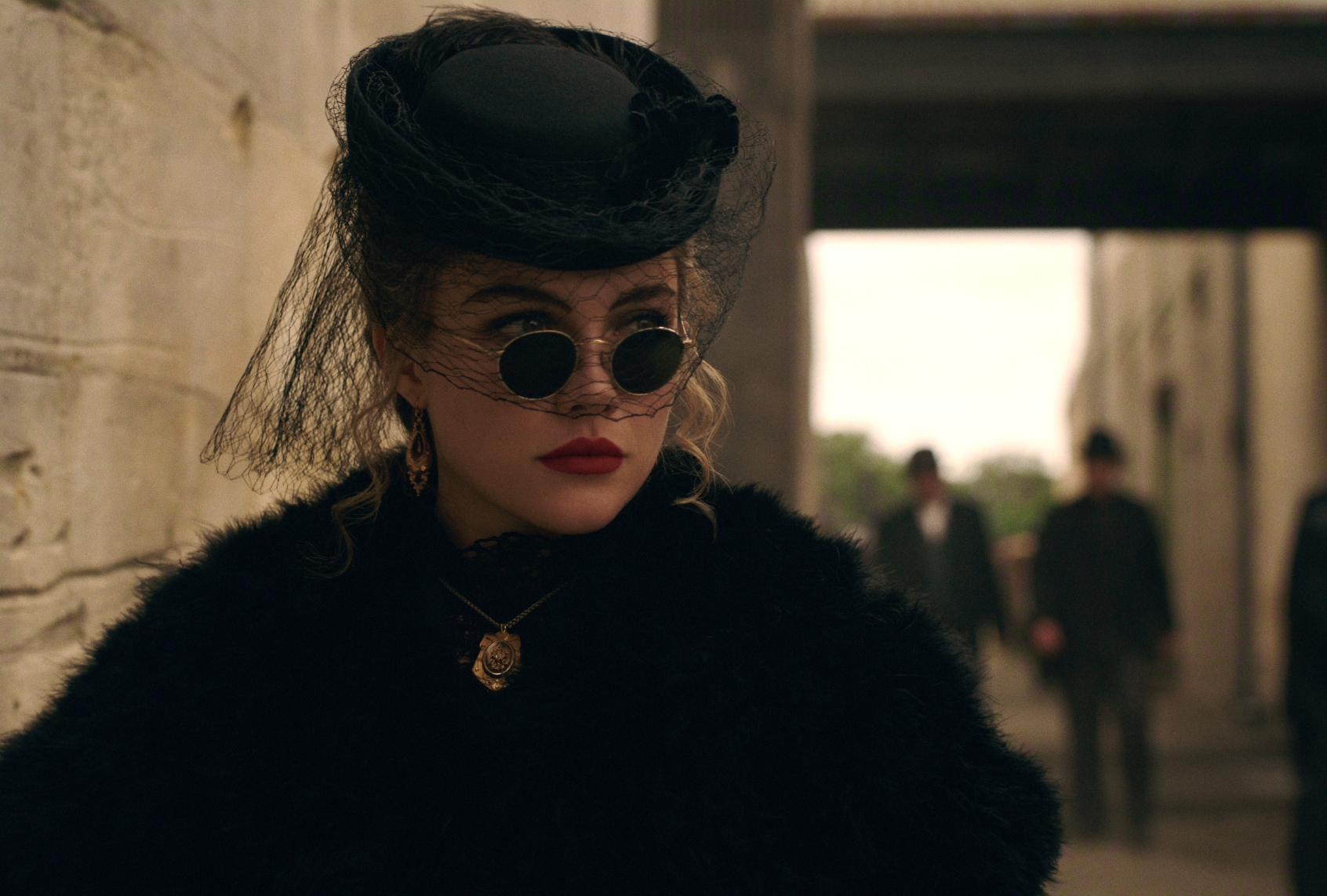
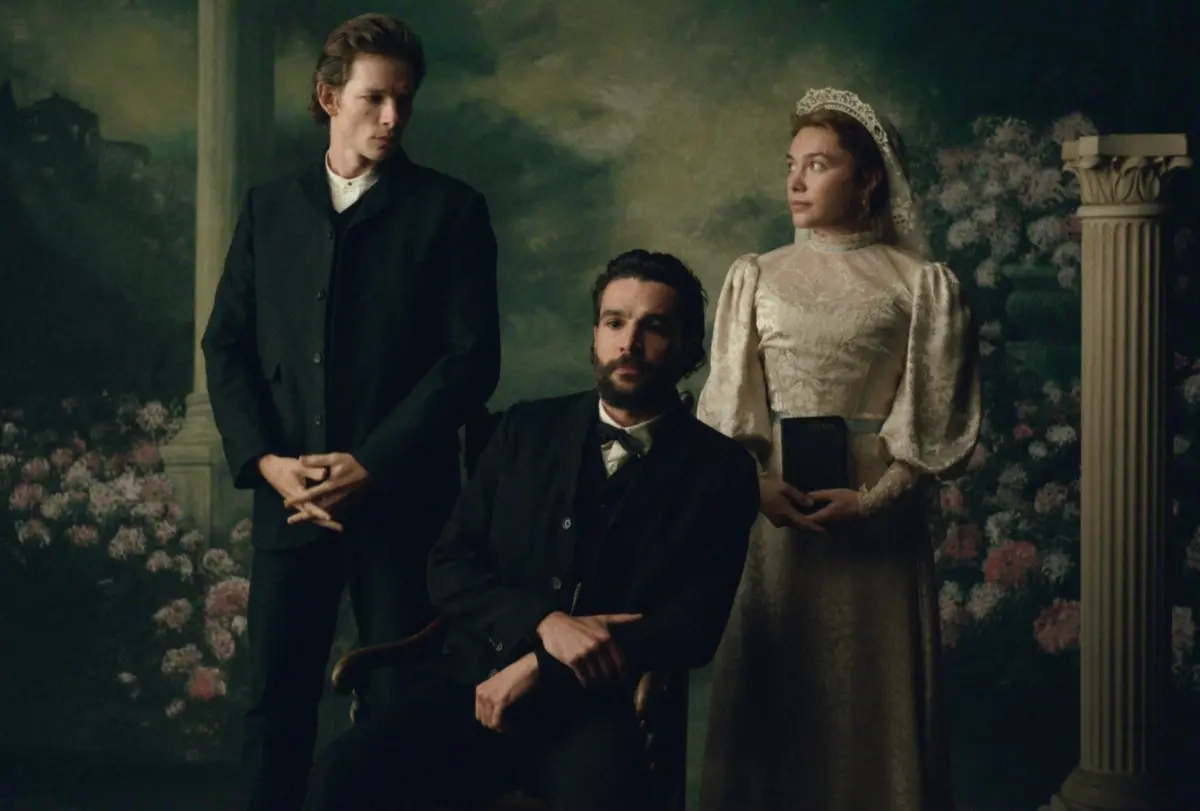
In the opening scenes of the adaptation, Pugh’s Cathy is seen clawing her bloodied, broken body across a desolate dirt field toward the home of Charles Trask (Mike Faist) and Adam Trask (Christopher Abbott). Through a targeted voiceover, Cathy outlines her foundational worldview: "Everyone is normal to himself."
Rather than treating Cathy as a biological glitch, Kazan uses spare, evocative imagery—such as a man luring a young girl in a blue dress into a dark hole—to suggest early, systemic violation. Paired with Lewis Carroll’s Alice in Wonderland as a thematic manual for navigating an upside-down world, Kazan’s Cathy arrives at a pragmatic, if terrifying, conclusion: in a society where a woman’s sole route to agency is economic survival, one must weaponize power or be consumed by it.
Supporting Context & Metrics: Cultural Parallels and Modern Paranoia
The timing of Netflix’s East of Eden cannot be decoupled from contemporary socio-cultural anxieties surrounding female violence, maternal expectation, and media sensationalism.
The True-Crime Paradox and Female Rage
Modern prestige television has experienced a massive influx of "trauma plots" designed to explain, contextualize, or rationalize female rage. While some entries—such as Hulu’s Furious—meticulously navigate the systemic pressures breaking women down, others lean heavily into sensationalized tropes, trading psychological depth for shock value (as seen in projects like Monster: The Lizzie Borden Story).
Critics and cultural commentators note that audiences have been trained to seek out "origin stories" for violent actors, often attempting to retroactively justify horrific acts through the lens of survival. However, this cultural reflex creates a paradoxical viewing experience: viewers find themselves oddly rooting for the protagonist of a murder trial or trauma narrative, inadvertently minimizing the gravity of the actual violence committed.
The Lindsay Clancy Case as a Real-World Mirror
This tension spilled directly into the American consciousness via the high-profile legal proceedings of Lindsay Clancy, a Massachusetts labor and delivery nurse who killed her three young children before attempting suicide in January 2023. Clancy’s case ignited a fierce national debate regarding the limits of criminal responsibility, the catastrophic failures of psychiatric care, and the devastating realities of postpartum psychosis.
During her televised trial—which ultimately ended in a mistrial due to a hung jury—the defense argued that psychosis entirely severed Clancy from reality. The prosecution, drawing on a harsher, almost Steinbeckian rhetoric, argued the actions were premeditated acts of calculated escape from an unwanted domestic life.
The parallels, while bounded by the vast gulf between fiction and human tragedy, highlight society’s deep discomfort with mothers who reject their roles. Whether examining a fictional sociopath like Cathy Ames or debating the psychological state of a real-world mother on trial, the public remains hopelessly divided between two impulses: diagnostic empathy and moral condemnation.
Official Statements & Critical Discourse
The cultural conversation surrounding Kazan’s adaptation has sparked rigorous discourse among literary critics, feminist theorists, and television historians.
In her analysis for The Atlantic, cultural critic Elizabeth Bruenig addressed the dangerous friction inherent in modern audience sympathy toward violent perpetrators, writing:
"And some elements of it seem inarguably true, such as the idea that Clancy’s psychiatric care was woefully uncoordinated… But this theory also has the odd effect of making Clancy the star of her own murder trial, for whom the viewer at home may be encouraged to root, which risks eliding the gravity of what she did."
This sentiment directly mirrors the artistic tightrope Zoe Kazan walks with East of Eden. By refusing to sanitize Cathy Ames, yet refusing to keep her at a flat, cartoonish distance, Kazan forces the audience to hold two contradictory truths simultaneously: Cathy’s motivations—rooted in a ruthless calculation for economic and personal survival in an oppressive patriarchal society—are entirely understandable, yet her actions remain utterly unforgivable.
Florence Pugh addressed the psychological density of playing Cathy in early press rounds, emphasizing the character’s profound disillusionment with societal scripts:
"Cathy isn’t looking for redemption because she doesn’t believe the system holding her captive is worthy of her repentance. She looks at the domestic cage offered to women of her time and makes a cold, terrifying calculation: she would rather rule the underworld as a monster than live as a compliant, powerless ghost in someone else’s home."
Future Outlook: The Legacy of Kazan’s Vision
As Netflix streams Zoe Kazan’s East of Eden, its cultural footprint extends far beyond the traditional boundaries of a book-to-screen adaptation. The series serves as a diagnostic tool for how 21st-century audiences process moral complexity.
By dismantling the trope of the "born monster," Kazan and Pugh invite viewers to interrogate the environmental architectures that foster desperation, coercion, and cruelty. The series challenges us to look past the comforting binary of hero and villain, suggesting that humanity’s capacity for evil is rarely born in a vacuum; it is often cultivated in the harsh soil of a world that denies its most vulnerable inhabitants the fundamental grace of timshel—the freedom to choose a better path.
Ultimately, East of Eden will likely redefine how future adaptations approach Steinbeck’s corpus, proving that classic texts can be radically updated without losing their philosophical core. More importantly, it leaves audiences with a lingering, uncomfortable challenge: can we bear to look at the monsters we fear most, recognize the systemic failures that shaped them, and still have the moral courage to hold them accountable?